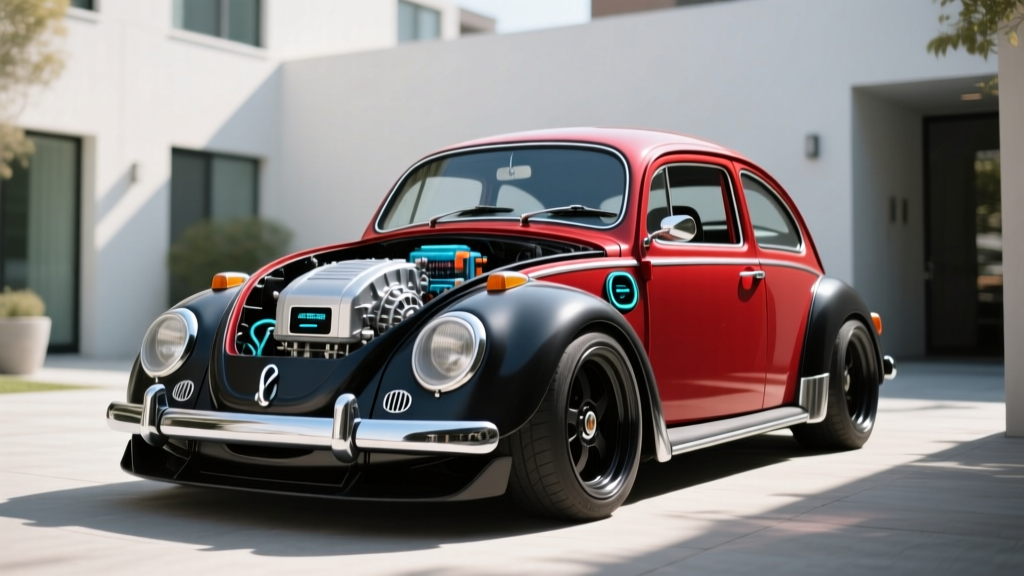
Converting a classic Volkswagen Beetle to electric power is one of the most popular EV-swap projects in the enthusiast world — and for good reason. The Beetle's lightweight chassis (roughly 1,800–2,200 lbs depending on year), simple mechanical layout, and massive aftermarket support make it an ideal conversion candidate. But before you pull the trigger on a Volkswagen Beetle electric conversion kit, you need hard numbers on cost, range, charging logistics, and how the finished car stacks up against a modern production EV.
The Quick Answer
A turnkey Volkswagen Beetle electric conversion kit (motor, controller, battery pack, charger, and hardware) typically costs $12,000 to $35,000 for parts alone, depending on battery capacity and motor power. Professional installation adds $5,000–$15,000. Expect a real-world range of 60–150 miles depending on pack size (15–40 kWh usable), and a top speed of 70–90 mph for most street-oriented builds. Total project cost usually lands between $20,000 and $55,000 when you include the donor car, fabrication, and ancillary upgrades.
What's Actually in a Beetle EV Conversion Kit?
Most kits marketed for the classic Beetle (1961–1979 air-cooled models, and some Super Beetle variants) fall into three tiers. Understanding what you're buying — and what you still need to source — is the single biggest factor in budget accuracy.
| Component | Budget Kit | Mid-Range Kit | Premium Kit |
|---|---|---|---|
| Motor | Series DC (9"–11") ~60–80 HP | AC induction or PMAC ~100–140 HP | AC PMAC (e.g., NetGain Hyper9, Cascadia Motion) ~140–200+ HP |
| Controller | Curtis 1238 or similar | Curtis 1238/1239 or Sevcon Gen4 | Sevcon Gen4 / Cascadia Rinehart |
| Battery Pack (usable kWh) | 15–20 kWh (LiFePO4/LFP prismatic) | 25–35 kWh (LFP or NMC modules) | 35–45 kWh (Tesla-grade NMC or LFP modules) |
| Onboard Charger | 1.5–3.3 kW (Level 1/low Level 2) | 3.3–6.6 kW (Level 2) | 6.6–7.2 kW + DC fast-charge capable (CCS/NACS add-on) |
| Adapter Plate & Coupler | Included (basic) | Included (CNC-machined) | Included (custom-balanced, flywheel option) |
| BMS (Battery Management System) | Basic cell-level monitoring | Active balancing BMS | Full active BMS w/ thermal management integration |
| Estimated Kit Price | $12,000–$18,000 | $18,000–$27,000 | $27,000–$35,000+ |
Critical note on kW vs kWh: The battery capacity is measured in kilowatt-hours (kWh) — that's your energy tank, analogous to gallons of gas. The motor and charger power are measured in kilowatts (kW) — that's the rate of energy delivery or intake. A 30 kWh battery paired with a 6.6 kW onboard charger will take roughly 4.5 hours to charge from empty (30 ÷ 6.6 ≈ 4.5 hrs), not counting charging losses and taper at the top of the curve.
Real-World Range: What to Actually Expect
Kit manufacturers often quote optimistic range figures based on flat-terrain, 30-mph testing. Here's what you'll see in real-world driving conditions, based on community build data and typical Beetle aerodynamics (a drag coefficient around 0.48 — far worse than any modern EV):
| Battery Size (usable) | City (stop-and-go, regen helps) | Highway (60–65 mph) | Cold Weather (below 35°F) |
|---|---|---|---|
| 15–20 kWh | 55–70 miles | 40–55 miles | 35–50 miles |
| 25–30 kWh | 85–110 miles | 65–85 miles | 55–75 miles |
| 35–40 kWh | 120–150 miles | 95–120 miles | 80–105 miles |
Several factors compress range in a converted Beetle versus a purpose-built EV:
- Aerodynamics: The Beetle's upright, rounded shape creates substantial drag above 55 mph. Efficiency drops sharply on the highway — expect 300–400 Wh/mile at 65 mph, compared to 240–280 Wh/mile for a modern Tesla Model 3 or Hyundai Ioniq 6.
- Weight distribution: Battery placement (often in the front trunk and rear engine bay) can upset the Beetle's already rear-biased weight balance, affecting tire wear and rolling resistance.
- No thermal management: Most conversion kits use passively cooled battery packs. Without active heating or cooling, you'll see 20–35% range loss in cold weather and potentially reduced charge speeds in heat.
- Regenerative braking limitations: Budget DC motor setups offer minimal or no regen. AC motor kits with proper controllers can recover meaningful energy in city driving, adding 5–15% effective range.
Charging a Converted Beetle: Home and Public Options
Your charging experience depends entirely on the onboard charger spec in your kit. Most Beetle conversions rely exclusively on Level 2 AC charging, since adding DC fast-charge capability (CCS or NACS) requires additional hardware, communication protocol integration, and cost.
| Charging Level | Power (kW) | Miles Added per Hour | Full Charge Time (30 kWh pack) |
|---|---|---|---|
| Level 1 (120V household) | 1.2–1.5 kW | 3–5 miles/hr | 20–25 hours |
| Level 2 (240V, basic kit charger) | 3.3 kW | 9–12 miles/hr | 9–10 hours |
| Level 2 (240V, upgraded charger) | 6.6–7.2 kW | 18–24 miles/hr | 4.5–5 hours |
Home charging reality: If you have a garage or dedicated parking spot with access to a 240V outlet (NEMA 14-50 or hardwired Level 2 station), overnight charging is practical and cheap. At the US average residential electricity rate of roughly $0.16/kWh (per EIA data), fully charging a 30 kWh Beetle pack costs about $4.80 — yielding roughly 85–110 city miles. That's approximately $0.04–$0.06 per mile in energy cost.
Public charging: Without DC fast-charge capability, public Level 2 stations (ChargePoint, EVgo L2, Blink) are your only away-from-home option. These typically cost $0.12–$0.25/kWh or $1.00–$2.00/hour. A full public charge might run $5–$10. This makes road-tripping impractical — a converted Beetle is fundamentally a local-use vehicle.
Total Project Cost vs. Buying a New EV
The most common question from prospective converters: "Am I saving money versus just buying a new EV?" The honest answer is almost always no — if your goal is purely economical transportation. Here's the full cost breakdown:
| Cost Factor | Beetle EV Conversion (Mid-Range Build) | 2026 Chevrolet Equinox EV (2LT, base comparison) |
|---|---|---|
| Vehicle / Kit Purchase | $8,000 (donor car) + $22,000 (kit) + $10,000 (install) = $40,000 | ~$34,900 MSRP (before incentives) |
| Federal Tax Credit (§30D) | $0 (conversions do not qualify) | Up to $7,500 (subject to IRS §30D eligibility rules: income caps, MSRP limits, battery sourcing) |
| Effective Purchase Price | $40,000 | ~$27,400 (after max credit) |
| Annual Electricity / Fuel | ~$600/yr (8,000 mi @ $0.075/mi avg) | ~$700/yr (8,000 mi @ $0.088/mi avg, slightly heavier vehicle) |
| Annual Maintenance | $300–$600/yr (older chassis components, suspension, brakes) | $150–$300/yr (EV drivetrain is nearly maintenance-free; cabin filter, tires, wipers) |
| Insurance (annual avg) | $1,200–$2,200/yr (specialty/classic car + EV modification; varies heavily by insurer) | $1,400–$1,800/yr (standard EV insurance) |
| 5-Year Total Operating Cost | ~$10,500–$17,000 | ~$10,000–$13,500 |
| 5-Year Total Cost of Ownership | $50,500–$57,000 | $37,400–$40,900 |
The math is stark: a mid-range Beetle conversion typically costs $10,000–$20,000 more over five years than buying a competitively priced new EV with a full warranty, 250+ miles of EPA range, DC fast charging, and modern safety systems. The conversion only makes financial sense if you already own the donor Beetle, do the labor yourself, and value the project as a hobby rather than pure transportation.
Common Misconceptions About Beetle EV Conversions
| Myth | Fact |
|---|---|
| "It'll save me money versus buying an EV." | Almost never true for transportation purposes. A new 2026 Chevy Equinox EV or Nissan Leaf starts around $28,000–$33,000 after the federal credit, with 200–300+ miles of range and a full warranty. |
| "I can use any battery pack." | Battery chemistry matters enormously. LFP (lithium iron phosphate) cells are heavier but safer, longer-lasting (3,000+ cycles), and tolerate 100% state of charge. NMC cells are lighter and more energy-dense but degrade faster at high SoC and carry higher thermal runaway risk. Always match your BMS to your cell chemistry. |
| "It'll charge at any public station." | Most conversions have J1772 Level 2 inlets only. You cannot use DC fast chargers (CCS, NACS, CHAdeMO) without dedicated hardware and protocol integration — a $3,000–$6,000 add-on that many kits don't support. |
| "Conversions qualify for the $7,500 tax credit." | They do not. The IRS §30D credit applies only to new qualified plug-in electric vehicles meeting specific MSRP, income, battery sourcing, and final-assembly requirements. Aftermarket conversions are ineligible. |
| "The Beetle's light weight makes it super efficient." | Light weight helps, but the Beetle's terrible aerodynamics (Cd ~0.48) and narrow, high-resistance tires offset much of that advantage at highway speeds. Real-world efficiency of 280–400 Wh/mile is typical — worse than most modern EVs. |
| "I don't need to upgrade brakes or suspension." | A 30–40 kWh battery pack adds 500–900 lbs to the car. Upgraded shocks, springs, and front disc brake conversions (many classic Beetles have front drum brakes) are strongly recommended for safety. |
Who Should (and Shouldn't) Convert a Beetle to Electric?
Decision Framework: Is a Beetle EV Conversion Right for You?
Choose the conversion if:
- You already own a Beetle with sentimental or collector value and want to drive it more often without maintaining an aging air-cooled engine.
- You have fabrication skills or access to a shop, and you view this as a hobby project — not a cost-saving measure.
- Your daily driving is under 50 miles round-trip, mostly local roads under 55 mph.
- You have reliable home Level 2 charging access (garage or driveway with 240V).
- You live in a mild climate (minimal cold-weather range loss) or accept reduced winter range.
- You already have a primary vehicle for longer trips and highway driving.
Buy a production EV instead if:
- Your primary goal is saving money on fuel and maintenance — a new EV with the §30D credit will cost less upfront and over 5 years.
- You need 200+ miles of range, DC fast charging for road trips, or all-weather reliability.
- You don't have access to home charging and would rely on public infrastructure.
- You want modern safety features (airbags, ABS, electronic stability control, backup camera) — a classic Beetle chassis has none of these.
- You want a warranty. Conversion kits typically carry 1–3 year limited warranties on electronic components, with no coverage for integration issues or battery degradation beyond basic cell replacement.
First-Time EV Buyer Considerations for Conversion Projects
If you've never owned an EV and are considering a Beetle conversion as your entry point, understand these ownership realities:
Registration and legality: Most US states allow EV conversions to be registered, but the process varies widely. Some states (California, Oregon, Washington) have relatively straightforward procedures through the DMV or BAR (Bureau of Automotive Repair). Others require special inspections, revised weight certificates, or emissions-exemption paperwork. Budget $200–$800 and several weeks for registration. Check your state's specific EV conversion registration requirements before starting the build.
Insurance challenges: Not all insurers will cover a home-built EV conversion. Specialty insurers like Hagerty or American Modern may offer classic-car policies with modification riders. Expect to provide detailed documentation of the conversion components, battery safety measures, and professional installation receipts (if applicable). Some insurers will only cover the car at its pre-conversion classic-car value, not the conversion investment.
Resale value uncertainty: A well-executed conversion by a known shop (e.g., EV West, Zelectric, Cadilac EV) can retain value or even appreciate in the collector market. A DIY conversion with undocumented components and no professional wiring will be very difficult to sell. Keep meticulous records of every component, wire gauge, fuse rating, and battery cell batch number.
Battery longevity: LFP battery packs in conversion applications typically retain 80%+ capacity after 2,000–3,000 charge cycles — roughly 10–15 years of typical use. NMC packs may degrade to 80% capacity in 1,000–2,000 cycles depending on depth of discharge and thermal management. Plan for eventual battery replacement at $4,000–$10,000 depending on pack size.
Frequently Asked Questions
Can I keep the original manual transmission in a Beetle EV conversion?
Yes, and most kits are designed to mate with the Beetle's stock 4-speed transaxle. The electric motor bolts to an adapter plate that replaces the engine, and the clutch is either retained (for gear shifting) or replaced with a fixed coupler (single-speed operation, using only 2nd or 3rd gear). Keeping the transmission adds weight and complexity but allows you to select a gear for hills or highway merging. Single-speed setups are simpler and more efficient but limit top-speed flexibility.
How long does a Beetle EV conversion take?
A professional shop typically completes a turnkey conversion in 4–12 weeks. A competent DIY builder working evenings and weekends should budget 3–6 months, depending on fabrication complexity, wiring experience, and parts availability. First-time builders without electrical or fabrication experience often take 6–12 months.
What's the top speed of a converted electric Beetle?
Most street-oriented builds top out between 70–90 mph, governed by motor RPM limits, gear ratios, and the Beetle's aerodynamic instability above 70 mph. The chassis was designed in the 1930s for a 60-mph top speed — high-speed stability is poor regardless of powertrain. Higher-power AC motor builds (150+ HP) can reach 100+ mph, but this is not recommended given the suspension, brake, and steering limitations of the original chassis.
Is a converted Beetle safe to drive daily?
Honestly, a classic Beetle chassis lacks every modern safety system: no airbags, no crumple zones, no ABS, no stability control, no side-impact protection. Adding the weight of batteries (500–900 lbs) increases stopping distances and stresses 50-year-old suspension components. If you upgrade brakes (front disc conversion), suspension, and tires, the car becomes more capable — but it will never match the crash safety of any modern vehicle. Treat it as a fair-weather, local-use car, not a daily commuter in mixed traffic.
Do I need a special electrician to install a Level 2 charger at home?
Yes. A licensed electrician should install a dedicated 240V circuit (typically 40A or 50A for a NEMA 14-50 outlet, or hardwired for a wall-mounted station). Installation costs range from $500–$2,500 depending on panel capacity, run distance, and local permitting. If your home has a 100A electrical panel, you may need a panel upgrade ($1,500–$3,000) to safely support a Level 2 charger alongside existing loads. Always get a permit and inspection — unpermitted electrical work can void your homeowner's insurance.