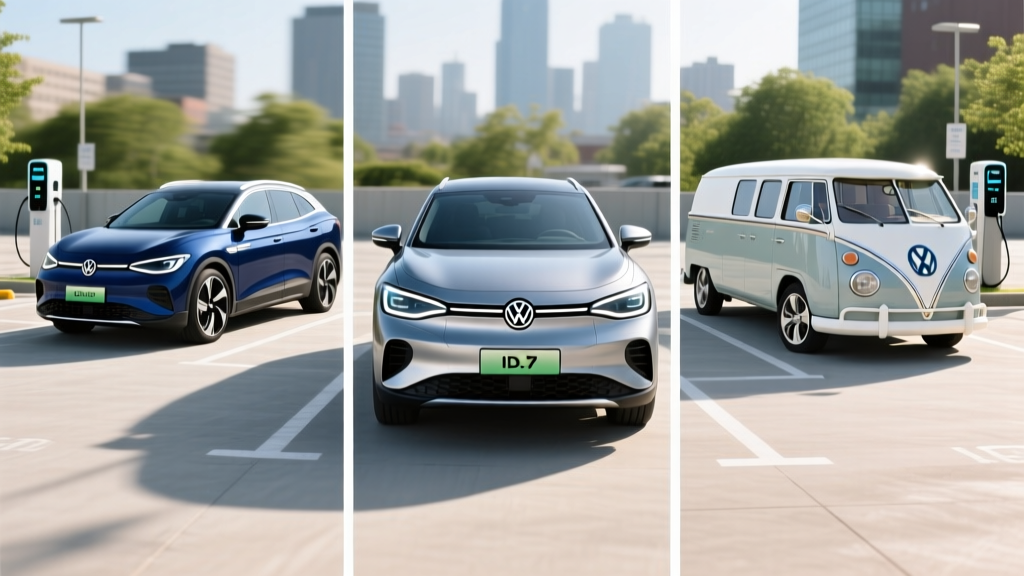
Quick Answer: Volkswagen's all-electric lineup for 2026 includes three models: the ID.4 compact SUV (starting ~$39,735, EPA range up to 291 miles), the ID.7 sedan (starting ~$49,995, EPA range up to 340 miles), and the ID.Buzz three-row minivan (starting ~$59,995, EPA range up to 234 miles). All three use VW's MEB platform with NMC battery chemistry and CCS1 charging (NACS adapter available for Tesla Supercharger access). The ID.4 remains the volume seller and best value; the ID.7 targets highway commuters wanting maximum range; the ID.Buzz fills a niche no other EV minivan occupies.
Volkswagen's 2026 All-Electric Lineup at a Glance
Volkswagen has committed heavily to electrification, and by 2026, the brand's US all-electric portfolio spans three distinct vehicle categories. Each model rides on the modular MEB (Modular Electric Drive Matrix) platform, sharing underlying architecture but tuned for very different buyers. Here's how they stack up on paper before we get into real-world ownership reality.
| Spec | 2026 ID.4 (Pro S AWD) | 2026 ID.7 Pro S | 2026 ID.Buzz 1st Edition |
|---|---|---|---|
| Base MSRP | $43,735 | $49,995 | $59,995 |
| EPA Range | 263 mi (AWD) / 291 mi (RWD) | 340 mi | 234 mi (RWD) / 231 mi (AWD) |
| Battery (usable) | 82 kWh (NMC) | 86 kWh (NMC) | 91 kWh (NMC) |
| Peak DC Fast Charge | 175 kW | 200 kW | 175 kW |
| 10–80% DCFC Time | ~28 min | ~26 min | ~30 min |
| Level 2 Rate | 11 kW (AC) | 11 kW (AC) | 11 kW (AC) |
| Horsepower | 295 hp (AWD) | 282 hp (RWD) | 282 hp (RWD) / 330 hp (AWD) |
| 0–60 mph | 5.4 sec | 6.5 sec | 7.3 sec (RWD) |
| MPGe (combined) | 104 MPGe | 115 MPGe (est.) | 87 MPGe |
| Cargo Volume | 30.3 cu ft (rear up) | 18.8 cu ft (trunk) | 75.5 cu ft (behind 2nd row) |
| Battery Warranty | 8 yr / 100,000 mi | 8 yr / 100,000 mi | 8 yr / 100,000 mi |
Sources: EPA fueleconomy.gov, Volkswagen USA.
Real-World Range Reality: EPA estimates assume mixed driving at moderate temperatures. Expect the ID.4 AWD to deliver roughly 220–240 miles on sustained highway driving at 70+ mph, and as low as 180–200 miles in sub-freezing winter conditions without preconditioning. The ID.7's superior aerodynamics help it hold range better at highway speeds — expect ~280–300 real-world highway miles. The ID.Buzz, with its brick-like profile, loses the most at speed — plan for ~190–200 highway miles in practice.
How Volkswagen All-Electric Models Compare to Gas and Hybrid Alternatives
The decision between a Volkswagen all-electric vehicle and a gas or hybrid alternative usually comes down to daily mileage, home charging access, and how long you plan to keep the vehicle. Let's put hard numbers to the comparison.
| Metric | ID.4 Pro S AWD (EV) | Tiguan SE (Gas) | Toyota RAV4 Hybrid (HEV) |
|---|---|---|---|
| MSRP (base) | $43,735 | $33,490 | $33,425 |
| Fuel/Energy Cost per Mile | $0.044 (home, $0.14/kWh) | $0.125 (28 MPG, $3.50/gal) | $0.089 (40 MPG, $3.50/gal) |
| Annual Fuel (15k mi) | $660 | $1,875 | $1,313 |
| 5-Year Fuel Total | $3,300 | $9,375 | $6,565 |
| Estimated Maintenance (5 yr) | $1,800 | $3,500 | $3,200 |
| Federal Tax Credit (potential) | Up to $7,500* | $0 | $0 |
| 5-Year Total Energy + Maint. | ~$5,100 | ~$12,875 | ~$9,765 |
*Federal §30D tax credit eligibility depends on MSRP caps (SUVs: $80,000), buyer AGI limits ($150K single / $300K joint), and battery critical-mineral and component sourcing requirements that tighten annually. Verify current-year eligibility at IRS.gov and with your tax professional. Point-of-sale transfer is available at participating dealers, reducing your out-of-pocket at purchase.
The math is clear: the ID.4 costs roughly $10,000 more upfront than a Tiguan but recoups $7,775 in energy and maintenance savings over five years before factoring in any tax credit. If you qualify for the full $7,500 credit, the ID.4 actually costs less to own over five years despite the higher sticker price. Without home charging, however, DC fast charging at $0.35–$0.50/kWh pushes per-mile costs to $0.11–$0.16, erasing much of the energy advantage.
Charging the Volkswagen All-Electric Fleet: What You Actually Need
VW's MEB vehicles charge via CCS1 connectors for DC fast charging and J1772 for Level 2 AC. Volkswagen provides a NACS adapter (or has integrated NACS on newer builds) for access to Tesla's Supercharger network — a significant real-world advantage given Tesla's ~17,000+ Superchargers nationwide.
| Level | Power | Miles Added per Hour | Use Case |
|---|---|---|---|
| Level 1 (120V outlet) | 1.2–1.9 kW | 3–5 mi/hr | Overnight trickle; emergency only |
| Level 2 (240V home) | 7.7–11 kW | 22–35 mi/hr | Daily home charging; full overnight refill |
| DC Fast (public) | 50–175+ kW | 150–400+ mi/hr (peak) | Road trips; quick top-ups |
Charging curve reality: The ID.4's 175 kW peak rate only holds between roughly 10–30% State of Charge (SoC). It tapers to ~120 kW by 50% and drops below 60 kW past 80%. That 10–80% time of ~28 minutes assumes battery preconditioning is active (the car navigates to a charger via the infotainment system). Arrive at a charger cold, and add 5–10 minutes.
Home Charging Installation Costs
Most Volkswagen all-electric owners will want a Level 2 home charger. Budget for the following:
| Item | Low Estimate | High Estimate |
|---|---|---|
| Level 2 EVSE (ChargePoint, Emporia, Wallbox) | $300 | $700 |
| Electrician labor (240V/50A circuit run) | $500 | $2,000 |
| Panel upgrade (if 200A panel is full or undersized) | $1,500 | $3,500 |
| Permit and inspection | $50 | $300 |
| Total (no panel upgrade) | $850 | $3,000 |
| Total (with panel upgrade) | $2,350 | $6,500 |
Always get a quote from a licensed electrician before purchasing. If your panel has spare capacity and the run from panel to garage is short, you'll be at the low end. Older homes with 100A service will almost certainly need an upgrade.
Federal Tax Credit and Incentives: What You Can Actually Claim
The IRS §30D Clean Vehicle Credit offers up to $7,500 for qualifying new EVs, but eligibility is a three-part test that trips up many buyers:
- MSRP Cap: SUVs and vans (ID.4, ID.Buzz) must be under $80,000; sedans (ID.7) under $55,000. All three VW models currently clear these thresholds at base and most mid-trims.
- Buyer Income Cap: Adjusted gross income must not exceed $150,000 (single), $225,000 (head of household), or $300,000 (joint filers).
- Battery Sourcing: The credit splits into two halves — $3,750 for critical-mineral sourcing and $3,750 for battery-component manufacturing. Requirements tighten each year. As of 2026, a growing percentage of VW's battery supply chain qualifies, but confirm the specific VIN's eligibility at fueleconomy.gov before signing.
The credit can be transferred to the dealer at point of sale, giving you an instant price reduction rather than waiting until tax filing. Many states also offer additional rebates — check your state energy office or the AFDC state incentive database.
Common Misconceptions About Volkswagen EVs — Corrected
| Myth | Fact |
|---|---|
| "VW's EV software is still broken." | VW's ID.Software 4.0 (rolled out through 2025–2026 OTA updates) resolved most early ID.4 infotainment complaints — faster response, better route planning, and more reliable phone connectivity. It's not Tesla-smooth, but it's functional. |
| "The battery will need replacing in 5 years." | VW warranties the battery for 8 years/100,000 miles against degradation below 70% capacity. Industry data from Recurrent Auto shows MEB batteries losing roughly 5–8% capacity over the first 100,000 miles — well within warranty thresholds. |
| "You can't road-trip an ID.4." | With DC fast charging at 175 kW and access to Electrify America, EVgo, and (via adapter) Tesla Superchargers, road-tripping requires ~25-minute stops every 200 miles. That's realistic for most drivers. |
| "EVs cost more to insure." | Sometimes true. ID.4 insurance premiums run 10–20% higher than a comparable Tiguan due to higher repair costs and parts pricing. Get quotes before buying — the difference varies wildly by insurer and zip code. |
| "Public charging is unreliable everywhere." | Network reliability varies. Electrify America averages ~90% uptime; Tesla Superchargers (now accessible to VW via adapter) exceed 95%. Plan routes using PlugShare or A Better Routeplanner and have a backup charger identified. |
Ownership Decision Framework: Which Volkswagen All-Electric Model Fits You?
Choose the ID.4 if: You need a practical daily-driver SUV, want the lowest entry price in VW's EV lineup, have home charging, and your typical commute is under 80 miles round-trip. The RWD Pro trim at ~$39,735 (before credits) delivers 291 miles EPA — more than enough for most buyers.
Choose the ID.7 if: You commute long distances on highways, prefer a sedan's driving dynamics and efficiency, and value maximum range. The 340-mile EPA rating means fewer charging stops on road trips and less range anxiety in winter. Best for drivers covering 20,000+ miles per year.
Choose the ID.Buzz if: You need three rows and family-hauler cargo space that no other EV currently offers. Accept the range compromise (231–234 miles EPA, ~190 real-world highway) as the trade-off for a vehicle with no direct electric rival. Best as a second car or for urban/suburban families with reliable home charging.
Choose a PHEV or hybrid instead if: You lack home charging access, regularly drive 300+ miles between charging opportunities, live in an area with sparse public charging infrastructure, or your budget can't absorb the EV price premium even after incentives.
Five-Year Total Cost of Ownership: ID.4 vs. the Competition
| Cost Category | VW ID.4 Pro S AWD | Toyota RAV4 Hybrid XLE | Honda CR-V EX-L (Gas) |
|---|---|---|---|
| Purchase Price (after est. credit) | $36,235* | $35,925 | $36,400 |
| Energy/Fuel (5 yr, 15k mi/yr) | $3,300 | $6,565 | $9,375 |
| Maintenance (5 yr) | $1,800 | $3,200 | $3,500 |
| Insurance (5 yr est.) | $9,500 | $7,800 | $7,500 |
| Depreciation (5 yr est.) | $18,000 | $14,500 | $16,000 |
| 5-Year Total | $68,835 | $67,990 | $72,775 |
*Assumes $7,500 federal credit. Without the credit, the ID.4 total rises to $76,335. Depreciation figures are estimates based on current EV resale trends — EV depreciation has been steeper than ICE/hybrid vehicles in 2024–2025 due to price wars and incentive fluctuations.
The takeaway: with the full tax credit, the ID.4's five-year cost is competitive with the RAV4 Hybrid despite higher insurance and depreciation. Without the credit, the hybrid wins on pure economics unless your annual mileage is very high (where the per-mile energy savings compound faster).
Frequently Asked Questions
Does the Volkswagen ID.4 qualify for the $7,500 federal tax credit?
The ID.4 qualifies on MSRP (under the $80,000 SUV cap) and most buyers will clear the income threshold. However, the battery-sourcing and critical-mineral requirements determine whether you receive the full $7,500, a partial $3,750, or nothing. Check the specific VIN at fueleconomy.gov before purchasing, as sourcing compliance can vary by production batch and model year.
Can I charge a Volkswagen EV at Tesla Superchargers?
Yes. Volkswagen has adopted NACS access for its EVs. Depending on your model year and build date, your vehicle either has a native NACS port or includes a CCS-to-NACS adapter. This opens access to Tesla's Supercharger network, which currently offers the most reliable DC fast-charging experience in the US.
How does cold weather affect Volkswagen EV range?
Expect 20–30% range reduction in sustained sub-freezing temperatures. The ID.4's 291-mile EPA rating (RWD) drops to roughly 200–230 miles in winter highway driving. VW's heat pump (standard on most trims) helps, but battery chemistry inherently loses efficiency in cold. Precondition the battery while plugged in to mitigate this.
What happens if the battery degrades past the warranty period?
Out-of-warranty battery replacement for MEB-platform vehicles currently costs between $15,000 and $22,000 depending on the pack size. However, real-world degradation data suggests most MEB batteries will retain 80–85% capacity at 150,000 miles — still providing usable daily range. Full pack replacement is rare; individual module replacement is possible at lower cost.
Is the VW ID.Buzz practical as a daily driver?
For suburban families with home charging and daily drives under 100 miles, absolutely. Its 234-mile EPA range covers most daily needs with margin. For road trips or rural driving without reliable charging, the limited range and 175 kW charge rate (slower than rivals) make it less practical as a sole vehicle. Consider it as a family's second car or commit to route planning.
How reliable are Volkswagen's all-electric models?
Early ID.4 model years (2021–2023) had software-related complaints and some 12V battery issues. The 2024–2026 models with updated software and hardware revisions have shown improved reliability. Check NHTSA.gov for any open recalls on your target VIN, and review IIHS ratings — the ID.4 earned IIHS Top Safety Pick+ in recent testing.