Quick Verdict: The Entry-Level EV Benchmark
The 2023 Tesla Model 3 RWD (Rear-Wheel Drive) remains one of the most efficient, tech-forward electric sedans on the used and remaining-new market heading into 2026. Built on Tesla's pre-Highland platform, this base trim delivers 272 miles of EPA-estimated range from a ~60 kWh LFP (lithium iron phosphate) battery, making it one of the most durable and cost-effective battery chemistries available in any consumer EV. For buyers who prioritize low running costs, access to the Supercharger network, and minimalist tech over luxury materials, the 2023 Model 3 RWD continues to punch well above its price class — even as the refreshed Highland Model 3 has taken over new production.
| Spec | Value |
|---|---|
| EPA Range | 272 miles |
| Battery (usable) | ~57.5 kWh (60 kWh gross) |
| Battery Chemistry | LFP (Lithium Iron Phosphate) |
| Drivetrain | Rear-Wheel Drive (single motor) |
| Horsepower | 283 hp |
| 0–60 mph | 5.8 seconds |
| Max DC Fast Charge | 170 kW |
| 10–80% DC Charge Time | ~30 minutes |
| Level 2 Charge Rate | 11.5 kW (44 mi/hr) |
| MPGe (combined) | 132 MPGe |
| Efficiency | 25 kWh/100 mi |
| Cargo Volume | 23 cu ft (trunk + frunk) |
| Battery Warranty | 8 years / 100,000 miles |
| Original Base MSRP | $40,240 (2023) |
Range and Efficiency: EPA Sticker vs. Real World
Real-World Expectation: 230–255 miles highway (70–80 mph); 260–275 miles mixed city/suburban; 190–220 miles in freezing weather (below 32°F) with cabin heating.
The 2023 Model 3 RWD's 272-mile EPA figure is among the most honest stickers in the EV segment. Tesla's thermal management system — which includes a heat pump standard on all 2023 Model 3 trims — helps preserve range in moderate cold better than many competitors. However, LFP batteries are more sensitive to extreme cold than NMC chemistries. Expect roughly 20–30% range loss in sustained sub-freezing temperatures, particularly on short trips where the battery doesn't have time to warm up.
On highway road trips at 75 mph in 65–80°F conditions, owners consistently report 235–250 miles before needing to stop. The car's 25 kWh/100 mi combined efficiency rating, per EPA data on fueleconomy.gov, is exceptional for a 3,800-lb sedan and directly translates to lower charging costs per mile.
One key LFP advantage: Tesla recommends charging the Model 3 RWD to 100% at least once per week. Unlike NMC batteries that degrade faster at full charge, LFP chemistry tolerates daily 100% sessions, effectively giving you the full 272-mile envelope every day rather than capping at 80% for longevity.
Charging: DC Fast, Level 2, and the Supercharger Advantage
The 2023 Model 3 RWD uses a CCS1 charge port (on non-Tesla-standard units built for the North American market in 2023) and supports up to 170 kW peak DC fast charging. That peak rate is only sustained briefly — typically between 10–30% State of Charge — before tapering. The full 10–80% session takes approximately 30 minutes at a V3 Supercharger or equivalent 150+ kW CCS station.
| Charging Level | Power | Rate / Time |
|---|---|---|
| Level 1 (120V household) | ~1.4 kW | ~5 mi/hr |
| Level 2 (240V home, 48A) | 11.5 kW | ~44 mi/hr (full charge ~6 hrs) |
| DC Fast (peak) | 170 kW | 10–80% in ~30 min |
| DC Fast (sustained avg) | ~95 kW | Average over 10–80% session |
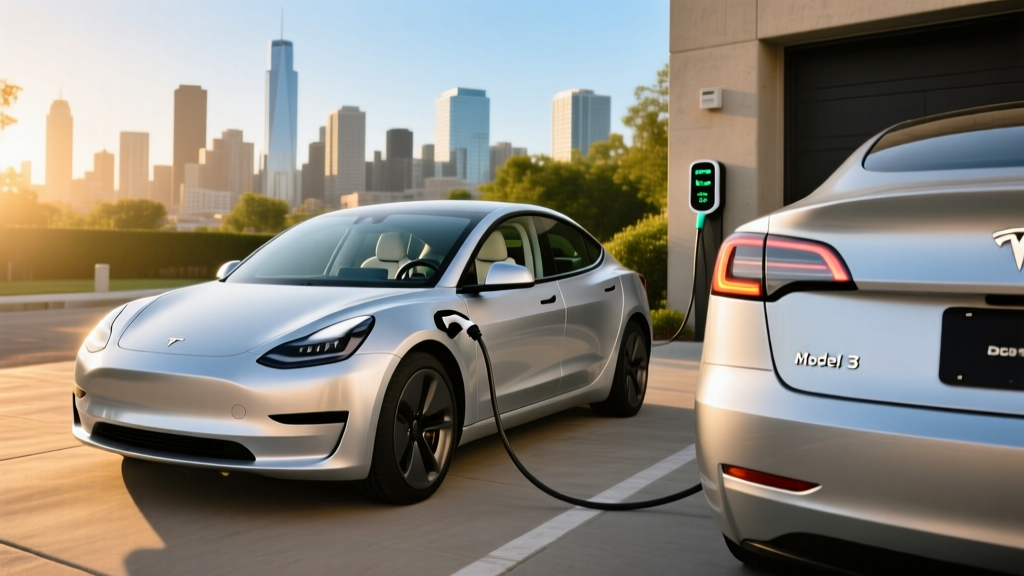
At home on a Level 2 wall connector (Tesla recommends the Gen 3 Wall Connector on a 60A circuit), the 11.5 kW onboard charger replenishes roughly 44 miles of range per hour. A full 0–100% charge takes about 6 hours — easily accomplished overnight. Installation costs for a 240V/60A circuit typically range from $800–$2,000 depending on panel proximity and local permit fees. A 200-amp electrical panel is generally sufficient; older homes with 100-amp service may need a panel upgrade ($1,500–$3,000 additional).
The Supercharger network remains Tesla's strongest ownership advantage. As of early 2026, there are over 6,500 Supercharger stations in North America. Non-Tesla EVs now access many of these via NACS adapters, but Model 3 owners enjoy seamless plug-and-charge integration with no adapter needed. For road-trippers, this reliability differential is significant.
Performance and Driving Dynamics
The single rear-mounted motor produces 283 horsepower and launches the Model 3 RWD to 60 mph in 5.8 seconds. That's quick enough for confident highway merging and passing, though it trails the Long Range AWD (4.2 seconds) and Performance (3.1 seconds) variants noticeably.
Ride quality on the pre-Highland Model 3 is firm. The suspension tuning prioritizes handling over comfort, and 18-inch Aero wheels (standard) transmit more road imperfections than rivals like the Hyundai Ioniq 6 or BMW i4. The steering is precise and well-weighted, and the low center of gravity (battery pack under the floor) gives the car a planted, sporty feel through corners.
Regenerative braking is strong and essentially enables one-pedal driving in most conditions. The 2023 model does not offer adjustable regen levels — it's a fixed, aggressive setting that most owners adapt to within a week.
Interior, Tech, and Daily Livability
The 2023 Model 3 interior is defined by its radical minimalism. A single 15-inch touchscreen handles all infotainment, climate controls, navigation, and vehicle settings. There is no instrument cluster — speed and drive status appear in the upper-left corner of the center screen. This approach polarizes buyers: some find it clean and distraction-free, others miss physical buttons and a dedicated speedometer.
Passenger space: Front legroom is generous at 42.7 inches. Rear legroom measures 35.2 inches — adequate for adults on shorter trips but tight for tall passengers on long drives. The rear seat is best suited for two adults; the middle position is compromised by a high floor (due to the battery pack) and limited shoulder room.
Cargo: The trunk offers 19.8 cu ft, plus a 3.1 cu ft front trunk (frunk), totaling approximately 23 cu ft. That's competitive with compact luxury sedans but trails the Model Y significantly (76 cu ft with seats folded).
Standout tech:
- Autopilot (standard): SAE Level 2 driver-assist with adaptive cruise control and lane-centering. Requires hands on the wheel and continuous driver supervision.
- Full Self-Driving (Supervised): Optional $8,000 upgrade (or $199/mo subscription as of 2026) adding traffic light/stop sign recognition, autosteer on city streets, and auto lane change. Still SAE Level 2 — not autonomous.
- Over-the-air updates: Tesla regularly pushes software improvements to navigation, UI, and even efficiency tuning.
- Sentry Mode: 360-degree camera recording when parked, with mobile alerts.
- Dashcam: Built-in, no accessory needed.
Pricing, Tax Credits, and Ownership Costs
The 2023 Model 3 RWD originally started at $40,240 (including destination). With the introduction of the Highland refresh in late 2023/early 2024, remaining new 2023 stock was discounted, and most 2023 Model 3 RWD units on the market in 2026 are pre-owned, typically priced between $24,000–$31,000 depending on mileage and condition.
| Item | Amount |
|---|---|
| Original 2023 Base MSRP | $40,240 |
| Typical 2026 Used Price | $24,000–$31,000 |
| Federal Used EV Credit (§25E) | Up to $4,000 (30% of sale price, max $4,000) |
| Federal New EV Credit (§30D) | Up to $7,500 if purchased new (subject to eligibility) |
| Estimated Insurance (annual) | $1,800–$2,600 |
Federal tax credit eligibility depends on several factors governed by IRS §30D rules:
- MSRP cap: Sedans must be under $55,000 MSRP (the 2023 Model 3 RWD qualifies).
- Buyer income cap: AGI must not exceed $150,000 (single), $225,000 (head of household), or $300,000 (joint).
- Battery sourcing: Critical minerals and battery component requirements phase in annually. The 2023 Model 3 RWD's LFP battery (sourced from CATL in China) faced increasing sourcing restrictions through 2023–2024 that reduced the credit from $7,500 to $3,750 for many buyers during its production run.
- Point-of-sale transfer: Beginning in 2024, eligible buyers can transfer the credit to the dealer for an immediate price reduction rather than claiming it on their tax return.
For used 2023 Model 3 RWD buyers in 2026, the §25E used clean vehicle credit offers up to $4,000 (30% of the sale price, capped at $4,000). Income caps for used credits are lower: $75,000 (single), $112,500 (head of household), $150,000 (joint). The vehicle must be purchased from a licensed dealer, and the credit can also be transferred at point of sale.
Pros and Cons
- Best-in-class efficiency at 25 kWh/100 mi
- LFP battery tolerates daily 100% charging and has longer cycle life
- Access to the Supercharger network — most reliable public charging in North America
- Strong OTA software update cadence
- Low center of gravity, responsive handling
- Heat pump standard (better cold-weather efficiency)
- Competitive used pricing in 2026 ($24k–$31k)
- Firm ride quality, especially on rough pavement
- Rear seat is tight for tall adults on long trips
- All controls routed through touchscreen — no physical buttons or instrument cluster
- LFP battery loses more range in extreme cold vs. NMC
- 170 kW peak charge rate trails competitors at 250–350 kW
- No adjustable regen braking
- Insurance costs above segment average
Who Should Buy the 2023 Model 3 RWD?
Choose the 2023 Model 3 RWD if:
- You're a daily commuter driving 40–100 miles round-trip and want minimal charging costs
- You have access to home Level 2 charging (or can install it)
- You value Supercharger access for occasional road trips
- You want an LFP battery for its longevity and 100% daily charging tolerance
- You're buying used in 2026 and want a proven EV under $30,000 with the §25E credit
Look elsewhere if:
- You regularly carry rear-seat adults on long trips (consider the Model Y or Ioniq 5)
- You live in a region with sustained sub-zero winters and need maximum cold-weather range
- You prefer physical buttons, a heads-up display, or a traditional instrument cluster
- You need AWD for snow/ice (step up to the Model 3 Long Range AWD)
Warranty and Long-Term Battery Outlook
Tesla covers the 2023 Model 3 RWD battery and drive unit for 8 years or 100,000 miles, whichever comes first, with a guaranteed minimum 70% capacity retention over that period. The vehicle limited warranty is 4 years / 50,000 miles.
LFP batteries have demonstrated strong longevity in Tesla's fleet. Data from Tesla's 2023 Impact Report indicates that Model 3 LFP packs retain approximately 90% capacity after 100,000 miles. The chemistry's inherent stability — no cobalt or nickel — also means lower fire risk and more predictable degradation curves compared to NMC. For a used 2023 Model 3 RWD buyer in 2026, this is a meaningful reassurance: a three-year-old LFP pack with 30,000–40,000 miles likely still holds 92–95% of original capacity.
Out-of-warranty battery replacement for the Model 3 RWD currently ranges from $12,000–$16,000 at Tesla service centers, though this is rarely needed within the first 150,000 miles based on fleet data.
Frequently Asked Questions
What is the real-world range of the 2023 Tesla Model 3 RWD?
The EPA rates it at 272 miles. In real-world highway driving at 75 mph in mild weather, expect 235–250 miles. In freezing conditions with cabin heat, range can drop to 190–220 miles. City and suburban driving with regenerative braking often matches or slightly exceeds the EPA estimate.
How fast does the 2023 Model 3 RWD charge at home and on the road?
At home on a Level 2 (240V, 48A) charger, it adds about 44 miles per hour and fully charges in roughly 6 hours. On a DC fast charger, it peaks at 170 kW and charges from 10–80% in approximately 30 minutes. Average sustained DC rate is closer to 95 kW due to charge-curve tapering above 50% SoC.
Does the 2023 Model 3 RWD qualify for the federal EV tax credit?
If purchased new, it was eligible for up to $7,500 under §30D, though battery sourcing rules reduced the credit to $3,750 for many 2023 buyers due to the LFP cell's Chinese origin (CATL). If purchased used in 2026 from a dealer, it qualifies for up to $4,000 under §25E, subject to buyer income caps ($75k single / $150k joint) and the vehicle being priced at or below $25,000 for the maximum credit. Always verify current rules at irs.gov.
Is the 2023 Model 3 RWD worth buying vs. competitors in 2026?
Against the Hyundai Ioniq 6 SE (361 mi EPA, $42k new), the Model 3 RWD sacrifices range but wins on charging infrastructure (Superchargers), software integration, and used-market pricing. Against the BMW i4 eDrive35 ($52k new), the Tesla is far more affordable but less refined in ride and materials. For budget-conscious buyers wanting a proven EV with excellent efficiency and Supercharger access, the used 2023 Model 3 RWD at $25,000–$30,000 is one of the best values in the 2026 market.
Can I charge the 2023 Model 3 RWD at non-Tesla charging stations?
Yes. The 2023 Model 3 RWD came with a CCS1 charge port (or Tesla's proprietary connector, depending on build date). Tesla now provides a CCS adapter for older vehicles, and the Supercharger network is increasingly open to non-Tesla EVs. You can also use Electrify America, EVgo, and ChargePoint stations with the appropriate connector.
Is Tesla Autopilot self-driving?
No. Autopilot and the optional FSD (Supervised) are SAE Level 2 driver-assistance systems. You must keep your hands on the steering wheel, eyes on the road, and remain prepared to take over at any time. These systems assist with steering, acceleration, and braking but do not replace the driver.