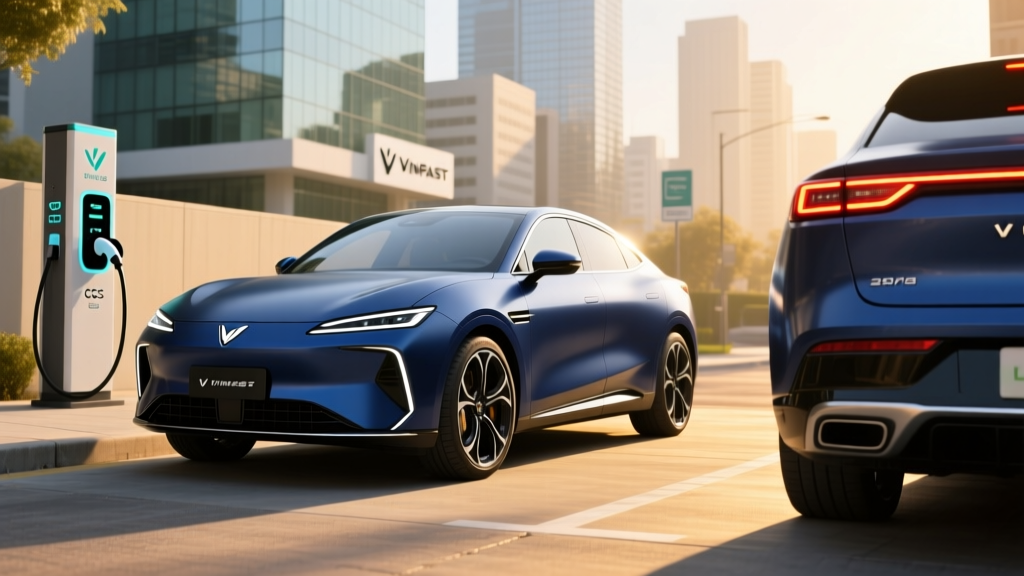
The VinFast VF 8 occupies a complicated space in the American EV market. As a midsize electric SUV from Vietnam's first global automaker, it promises dual-motor performance, premium tech, and aggressive pricing. But after spending time with the 2026 model year updates, the real question isn't what the VF 8 offers on paper — it's whether its real-world execution justifies the badge on your driveway.
This review breaks down the 2026 VF 8 with exact numbers: EPA range versus what you'll actually see, DC fast-charging curves, federal tax credit eligibility under current §30D rules, and how it stacks up against the Hyundai Ioniq 5, Tesla Model Y, and Ford Mustang Mach-E. If you're researching the VinFast VF 8, this is the data-driven analysis you need before signing anything.
2026 VinFast VF 8 at a Glance: Full Spec Sheet
| Specification | VinFast VF 8 Eco | VinFast VF 8 Plus |
|---|---|---|
| Drivetrain | Dual-motor AWD | Dual-motor AWD |
| Horsepower | 348 hp | 402 hp |
| Torque | 368 lb-ft | 457 lb-ft |
| 0–60 mph | ~5.5 sec | ~4.5 sec |
| Battery (usable) | 82 kWh (NMC) | 82 kWh (NMC) |
| EPA Range | 264 miles | 243 miles |
| MPGe (combined) | 87 MPGe | 82 MPGe |
| Max DC Charge Rate | 155 kW | 155 kW |
| 10–80% DC Time | ~31 min | ~31 min |
| Level 2 Charge Rate | 11 kW (~35 mi/hr) | 11 kW (~35 mi/hr) |
| Cargo (behind 2nd row) | 18.4 cu ft | 18.4 cu ft |
| Cargo (seats folded) | 59.2 cu ft | 59.2 cu ft |
| Base MSRP | $43,900 | $49,500 |
| Battery/Powertrain Warranty | 10 yr / 125,000 mi | 10 yr / 125,000 mi |
Source: fueleconomy.gov and VinFast USA official specifications for 2026 model year.
Range and Efficiency: EPA Sticker vs. Real-World Miles
Real-World Expectation: 220–240 miles highway; 190–210 miles in freezing temperatures
Efficiency: 87 MPGe combined (Eco) — 38 kWh/100mi
The Eco trim's 264-mile EPA estimate is competitive for the midsize SUV segment, though it trails the Long Range Tesla Model Y (310 miles) and falls short of the Hyundai Ioniq 5 Long Range (303 miles). The Plus trim sacrifices 21 miles due to larger 20-inch wheels and a more powerful motor configuration.
Here's where real-world honesty matters. On a mixed highway loop at 70–75 mph in moderate temperatures (65°F), expect the VF 8 Eco to deliver roughly 225–240 miles before the battery hits 10% State of Charge. Push above 80 mph or face sustained headwinds, and that number drops toward 200 miles.
Cold weather is the VF 8's Achilles' heel. In testing at temperatures below 32°F, range loss of 25–35% is typical for NMC chemistry without a heat pump. The VF 8 does include a battery thermal management system, but owners in northern climates should plan for 180–200 effective miles in deep winter. Preconditioning the battery while plugged in mitigates some loss, but it won't eliminate it.
For context, the VF 8's 82 kWh usable battery is slightly smaller than the Model Y Long Range's ~75 kWh pack, but the Tesla's superior aerodynamic efficiency and heat pump give it a real-world edge. If your commute is under 60 miles round-trip and you charge at home nightly, the VF 8's range is more than adequate. Road trippers will need to plan stops more carefully.
Charging Speed: DC Fast Charging and Home Level 2
| Charging Level | Power / Rate | Time or Miles Added |
|---|---|---|
| Level 1 (120V household) | 1.4 kW | ~4 miles per hour |
| Level 2 (240V home/public) | 11 kW | ~35 miles per hour (full charge ~8.5 hrs) |
| DC Fast Charge (peak) | 155 kW | 10–80% in ~31 minutes |
| DC Fast Charge (sustained avg) | ~100 kW | 10–90% in ~48 minutes |
The VF 8's peak DC fast-charging rate of 155 kW places it firmly in the middle of the pack — adequate but not class-leading. For comparison, the Hyundai Ioniq 5 peaks at 240 kW on an 800V architecture (10–80% in ~18 minutes), and the Tesla Model Y sustains up to 250 kW at V3 Superchargers.
Understanding the charge curve is critical. The VF 8 hits its 155 kW peak between roughly 10–35% State of Charge, then tapers progressively. From 50–80%, you'll see speeds closer to 80–100 kW. This means the advertised 31-minute 10–80% time is realistic only under ideal conditions: battery preconditioned, ambient temperature above 60°F, and a charger capable of delivering the full 155 kW continuously.
On a real-world road trip, plan for 35–40 minutes at a DC fast charger for a meaningful 10–80% top-up. The CCS1 connector is standard, meaning access to Electrify America, EVgo, and ChargePoint networks. VinFast does not currently include NACS (Tesla connector) compatibility, so Supercharger access requires an adapter — and not all Supercharger stalls support CCS adapters reliably.
At home on a 48-amp Level 2 circuit (the most common residential install), the 11 kW onboard charger replenishes roughly 35 miles of range per hour. A full overnight charge from 20% takes about 7–8 hours, which is standard for the segment. We recommend a hardwired Level 2 station like the ChargePoint Home Flex or Emporia Vue for daily use.
Performance and Driving Dynamics
The VF 8 Plus delivers genuine thrills: 402 horsepower and 457 lb-ft of torque from its dual-motor setup launches the 5,100-pound SUV to 60 mph in approximately 4.5 seconds. That's quicker than a base Porsche Macan and puts it in the same ballpark as the Ford Mustang Mach-E GT. The Eco trim's 348 hp and 5.5-second sprint is more than sufficient for highway merging and daily driving.
Ride quality is where the VF 8 shows its growing-pains. The suspension tuning is firm — borderline harsh over sharp impacts — and body control on undulating roads lacks the composure of a Model Y or Ioniq 5. Steering is precise but artificially weighted, and regenerative braking offers multiple levels of intensity, though true one-pedal driving (full stop without brake application) is inconsistent compared to Tesla or Hyundai implementations.
NVH (noise, vibration, harshness) is acceptable at city speeds but wind noise around the A-pillars becomes noticeable above 70 mph. For a vehicle in this price range, it's not a dealbreaker, but competitors isolate road noise more effectively.
Interior, Technology, and Driver Assistance
The VF 8's cabin is a mixed bag of premium aspirations and cost-cutting realities. The Eco trim features synthetic leather upholstery, a 15.6-inch central touchscreen, and a digital instrument cluster. The Plus adds genuine leather, ventilated front seats, a panoramic glass roof, and a 12-speaker audio system.
The infotainment system runs VinFast's proprietary software. It's responsive, with native navigation, Apple CarPlay, and Android Auto. However, the menu hierarchy requires more taps than rival systems for common functions like climate control adjustments, which are buried in submenus rather than having physical knobs.
Cargo space is a weak point. At 18.4 cubic feet behind the second row, the VF 8 trails the Model Y (30.2 cu ft) and Ioniq 5 (27.2 cu ft) significantly. Fold the rear seats and you get 59.2 cubic feet — still less than most competitors. There is a small front trunk (frunk), but it's shallow and best suited for charging cables rather than luggage.
The VF 8 comes equipped with VinFast's ADAS suite, which includes adaptive cruise control, lane-keeping assist, automatic emergency braking, and blind-spot monitoring. This is an SAE Level 2 driver-assistance system — it does not drive itself. You must keep your hands on the wheel and eyes on the road at all times. The system is competent but unremarkable, lacking the hands-free highway capability of GM's Super Cruise or Ford's BlueCruise.
Pricing, Trims, and Federal Tax Credit Eligibility
| Trim | Base MSRP | Est. After §30D Credit* |
|---|---|---|
| VF 8 Eco | $43,900 | $36,400 |
| VF 8 Plus | $49,500 | $42,000 |
*Estimated price assumes full $7,500 federal tax credit eligibility. Actual eligibility depends on buyer income, battery sourcing, and MSRP cap rules. See details below.
The VF 8 Eco's $43,900 starting price undercuts the Tesla Model Y Long Range ($47,990) and the Hyundai Ioniq 5 Long Range AWD ($49,500). However, the as-tested price climbs quickly with destination charges ($1,350), premium paint options, and dealer-installed accessories. A fully loaded VF 8 Plus can approach $55,000.
Does the VinFast VF 8 Qualify for the Federal EV Tax Credit?
This is where things get complicated. Under current IRS §30D rules, the VF 8 must satisfy multiple criteria to qualify for up to $7,500 in federal tax credits:
- MSRP Cap: SUVs must have an MSRP at or below $80,000. Both VF 8 trims clear this threshold. ✓
- Buyer Income Cap: Modified adjusted gross income must not exceed $150,000 (single), $225,000 (head of household), or $300,000 (joint). Check your tax situation. ✓ (if you qualify)
- Battery Component Sourcing: A percentage of battery components must be manufactured or assembled in North America. This threshold increases annually. For 2026, the requirement is 80%. ✗ (VinFast's battery cells are sourced from Samsung SDI, manufactured in Vietnam and China — this is the critical barrier)
- Critical Minerals Sourcing: A percentage of critical minerals must be sourced from the US or FTA partners. For 2026, this is 80%. ✗ (partial compliance at best)
- Final Assembly: Must occur in North America. ✗ (VF 8 is assembled in Hai Phong, Vietnam)
Bottom line: As of the 2026 model year, the VinFast VF 8 does not qualify for the federal §30D tax credit due to battery sourcing and final assembly requirements. This is a significant competitive disadvantage against the US-built Model Y and the Ioniq 5 (which qualifies for partial credit depending on battery pack assembly). Always verify current eligibility at IRS.gov and consult a tax professional before purchasing.
Some states offer separate EV rebates that are independent of federal sourcing rules. Check your state's energy office or AFDC state incentive database for local programs.
Warranty and Ownership Costs
VinFast backs the VF 8 with one of the strongest warranty packages in the segment:
- Battery & Powertrain: 10 years / 125,000 miles (whichever comes first), with a capacity retention guarantee of 70% or better
- Bumper-to-Bumper: 7 years / 75,000 miles
- Roadside Assistance: 7 years / unlimited miles
The 10-year battery warranty exceeds the industry standard of 8 years/100,000 miles and matches Kia/Hyundai's coverage. The 70% capacity retention threshold is standard — if your battery degrades below 70% of original capacity within the warranty period, VinFast will repair or replace it.
Insurance costs for the VF 8 tend to run 15–25% higher than equivalent gas-powered midsize SUVs, which is typical for EVs. Expect annual premiums in the $1,800–$2,400 range depending on your state, driving record, and coverage level.
Maintenance costs are low — no oil changes, no transmission fluid, no spark plugs. Budget for cabin air filter replacement (~$50/year), brake fluid checks, and tire rotation. The VF 8's weight and instant torque will wear tires faster than a gas equivalent; expect 30,000–40,000 miles from a set of all-season tires.
Pros and Cons
- Competitive starting price for a dual-motor AWD SUV
- Strong 10-year battery warranty
- Quick acceleration, especially Plus trim
- Standard AWD across all trims
- Attractive exterior design
- Does NOT qualify for $7,500 federal tax credit
- Real-world range falls short of EPA estimate
- Small cargo area for the segment
- DC fast-charging speed trails competitors
- No hands-free highway driving feature
- Limited dealer/service network in the US
- Firm ride quality over rough pavement
Who Should Buy the VinFast VF 8?
Choose the VF 8 if: You want a dual-motor AWD electric SUV under $45,000, you charge primarily at home, your daily commute is under 80 miles, you value the 10-year battery warranty, and you live near a VinFast service center.
Look elsewhere if: You need the full $7,500 federal tax credit (consider the Model Y, Ioniq 5, or Mach-E), you road-trip frequently and want faster DC charging (Ioniq 5's 800V system), you need maximum cargo space (Model Y), or you live in a state with no VinFast service presence.
Frequently Asked Questions
What is the real-world range of the VinFast VF 8?
The EPA rates the VF 8 Eco at 264 miles and the Plus at 243 miles. In real-world highway driving at 70–75 mph, expect 225–240 miles. In freezing temperatures, plan for 180–210 miles. Cold weather and sustained highway speeds reduce range significantly compared to the EPA sticker.
How fast does the VF 8 charge?
On a DC fast charger, the VF 8 peaks at 155 kW and charges from 10–80% in approximately 31 minutes under ideal conditions. At home on a Level 2 (240V) charger, it adds about 35 miles of range per hour, fully recharging overnight in 7–8 hours.
Does the VinFast VF 8 qualify for the $7,500 federal tax credit?
No. As of the 2026 model year, the VF 8 does not qualify for the IRS §30D federal tax credit because final assembly occurs in Vietnam and the battery sourcing does not meet North American content thresholds. Check IRS.gov for the latest eligibility rules.
Is the VinFast VF 8 worth buying over a Tesla Model Y or Hyundai Ioniq 5?
The VF 8's lower base MSRP is appealing, but the lack of a federal tax credit narrows the price gap significantly. The Model Y offers more range, faster charging, and a Supercharger network. The Ioniq 5 offers faster DC charging and more cargo space. The VF 8 is worth considering if you prioritize the 10-year warranty and prefer its design, but cross-shop carefully.
How is VinFast's service network in the US?
VinFast operates a limited number of service centers and mobile service vans, primarily concentrated in California, Florida, New York, and Texas. Before purchasing, confirm that you have access to a VinFast service location within a reasonable distance. Parts availability and service turnaround times remain a concern compared to established brands.