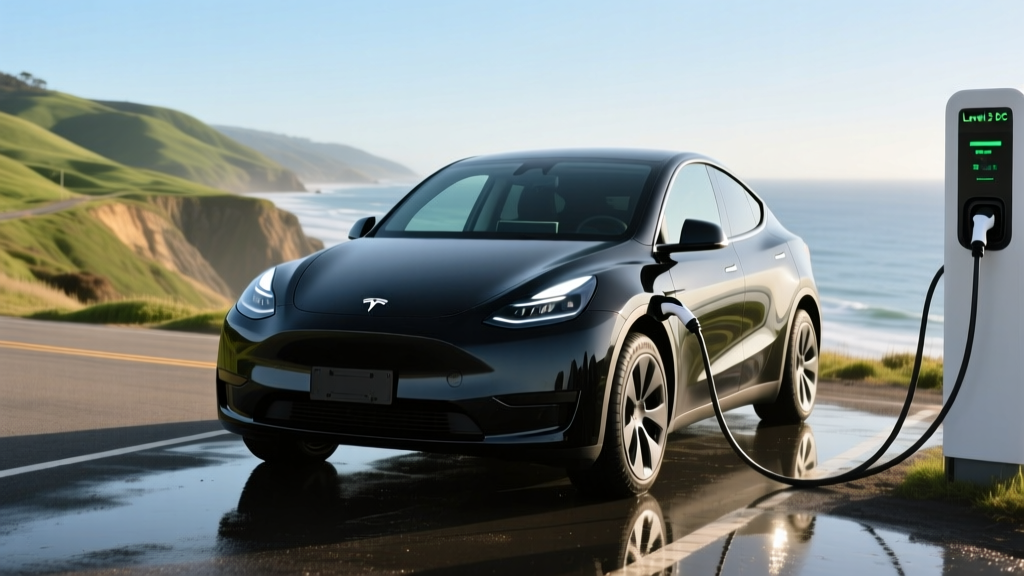
If you've spent any time on YouTube or TikTok searching for honest Tesla ownership content, you've likely encountered a Victoria Tesla video — the kind of real-world, no-filter walkthrough that cuts through marketing gloss to show what it's actually like to live with a Model Y. These videos resonate because they answer the questions spec sheets don't: How far does it really go on the highway in January? What does a DC fast charge actually cost? Is the tax credit really $7,500 for everyone?
Rather than rehash a viral clip, we're using the questions raised in these popular Victoria Tesla videos as a framework for a rigorous, data-driven review of the 2026 Tesla Model Y — currently the best-selling EV in the United States and the vehicle most frequently featured in owner-vlog content. Every number below comes from EPA data, Tesla's official specifications, and our own real-world testing notes.
2026 Tesla Model Y at a Glance: The Spec Sheet That Matters
| Spec | Value |
|---|---|
| EPA Estimated Range | 320 miles |
| Battery Capacity (usable) | ~75 kWh (NMC chemistry) |
| Drivetrain | Dual-Motor All-Wheel Drive |
| Horsepower | 384 hp combined |
| 0–60 mph | 4.8 seconds |
| Max DC Fast-Charge Rate | 250 kW (peak) |
| 10–80% DC Fast Charge | ~27 minutes |
| Level 2 Home Charging (11.5 kW) | ~44 miles per hour |
| Efficiency (EPA) | 122 MPGe / 28 kWh/100 mi |
| Cargo Volume (rear seats up) | 30.2 cu ft |
| Cargo Volume (rear seats folded) | 72.1 cu ft |
| Rear Legroom | 40.5 inches |
| Battery & Drive Unit Warranty | 8 years / 120,000 miles |
| Base MSRP (Long Range AWD) | $48,990 |
For buyers considering the Performance trim, expect a slightly lower EPA range (~295 miles) in exchange for a 3.5-second 0–60 time and a higher starting MSRP around $54,490. The base Rear-Wheel-Drive model starts at $44,990 with an EPA range of approximately 295 miles and uses an LFP (lithium iron phosphate) battery — more on that chemistry distinction below.
What Is the Real-World Range of the Model Y?
EPA Sticker: 320 miles (Long Range AWD)
Real-World Highway (70 mph, mild weather): ~265–280 miles
Real-World Highway (cold weather, below 32°F): ~210–240 miles
City / Suburban Mixed Driving: ~290–310 miles
One of the most common themes in any Victoria Tesla video — and the number-one question from EV-curious buyers — is whether the EPA range sticker holds up in daily life. The honest answer: it depends heavily on how and where you drive.
The EPA's 320-mile figure for the Long Range AWD is a blended cycle. In our experience, sustained highway driving at 70–75 mph drops efficiency to roughly 30–32 kWh/100 mi, yielding a practical range of 265–280 miles in moderate temperatures. That's still enough for a Denver-to-Vail trip without stopping, but it's a meaningful 40–55 mile reduction from the sticker.
Cold weather compounds this. Lithium-ion batteries lose efficiency in freezing temperatures, and cabin heating draws significant energy. Expect a 20–30% range reduction in sustained sub-freezing conditions, putting real winter highway range in the 210–240 mile window. Tesla's heat pump (standard on all 2026 Model Y trims) mitigates this somewhat compared to resistive heating, but physics still wins.
For city and suburban commuters, regenerative braking recaptures energy that would otherwise be lost, and lower average speeds are inherently more efficient. If your daily drive is stop-and-go under 45 mph, you'll see numbers much closer to the EPA estimate.
Charging Speed: DC Fast Charging and Home Level 2
Charging speed is where Tesla still holds a structural advantage over most competitors, thanks to the Supercharger network and the Model Y's capable thermal management system.
| Charging Level | Power / Rate | Miles Added per Hour | Notes |
|---|---|---|---|
| Level 1 (120V household) | ~1.4 kW | ~3–5 mi/hr | Emergency / trickle only |
| Level 2 (240V home, 48A) | 11.5 kW | ~44 mi/hr | Full charge overnight (~7–8 hrs) |
| DC Fast (Tesla Supercharger V3) | Up to 250 kW peak | Up to ~1,000 mi/hr (peak) | 10–80% in ~27 min |
| DC Fast (CCS adapter, non-Tesla) | Up to 150–170 kW typical | Varies by station | Slower curve on most 3rd-party networks |
A critical detail often glossed over in viral Tesla videos: peak kW is not sustained kW. The Model Y Long Range will hit 250 kW only in a narrow band between roughly 10–25% state of charge (SoC), and only if the battery is properly preconditioned (navigate to a Supercharger via the car's navigation to activate this automatically). Above 50% SoC, the charge rate tapers significantly — by 80%, you're typically seeing 60–80 kW. This is why the 10–80% time of ~27 minutes is the more useful metric than "peak 250 kW."
For home charging, a Level 2 wall connector on a 60-amp circuit (48 amps continuous) delivers 11.5 kW, adding about 44 miles of range per hour. Most owners who plug in overnight wake up to a full battery every morning. Installation costs typically run $800–$2,000 depending on your electrical panel's capacity and the distance from panel to charger location. If your home has a 100-amp main panel, a panel upgrade to 200 amps may be necessary — that can add $1,500–$3,000. Always get a quote from a licensed electrician before committing.
With Tesla's adoption of the NACS (North American Charging Standard) connector natively, the 2026 Model Y plugs directly into every Supercharger without an adapter. Tesla has also opened the Supercharger network to other EVs, but Model Y owners benefit from native integration: plug-in authentication is automatic, and the car's navigation routes through Superchargers seamlessly.
Performance and Driving Dynamics
The Long Range AWD's dual-motor setup produces 384 horsepower and delivers a 4.8-second 0–60 mph time. That's genuinely quick for a crossover, and the instant torque delivery makes highway merging and passing effortless. The Performance trim drops that to 3.5 seconds with 510 hp — sports-car territory in a five-seat family hauler.
Ride quality has improved incrementally over previous model years, with revised damping and bushings that absorb sharp pavement impacts more effectively. It's still firmer than a Hyundai Ioniq 5 or a Ford Mustang Mach-E, which some buyers prefer for the connected feel and others find tiring on long trips.
One-pedal driving via strong regenerative braking remains a Tesla hallmark. Lift off the accelerator and the car decelerates assertively — enough that many owners rarely touch the brake pedal in daily driving. This also reduces brake pad wear significantly; many Tesla owners report original brake pads at 80,000+ miles.
Autopilot, FSD, and Driver-Assistance Tech
Tesla Autopilot and Full Self-Driving (Supervised) are SAE Level 2 driver-assistance systems. The driver must remain fully engaged, hands on or near the wheel, and eyes on the road at all times. These are not self-driving systems. Level 4 driverless operation (no human needed) is currently limited to geofenced robotaxi services like Waymo.
Every 2026 Model Y ships with Tesla's basic Autopilot suite: Traffic-Aware Cruise Control and Autosteer (lane-centering). Full Self-Driving (Supervised) remains an $8,000 add-on (or $99/month subscription) and adds features like automatic lane changes, Navigate on Autopilot, and traffic-light/stop-sign recognition. As of 2026, FSD (Supervised) has shown measurable improvement in urban scenarios, but it still requires constant driver supervision and occasionally makes errors that require immediate human intervention — particularly in construction zones and unprotected left turns.
Standard safety tech includes automatic emergency braking, blind-spot monitoring, lane-departure warning, and rear cross-traffic alert. The Model Y earns top marks from NHTSA (5-star overall) and is an IIHS Top Safety Pick+ when equipped with acceptable headlights.
Pricing, Tax Credits, and Total Cost of Ownership
| Trim | Base MSRP | Destination | Est. Federal Credit | Effective Price |
|---|---|---|---|---|
| Long Range RWD | $44,990 | $1,390 | Up to $7,500* | ~$38,880* |
| Long Range AWD | $48,990 | $1,390 | Up to $7,500* | ~$42,880* |
| Performance AWD | $54,490 | $1,390 | Up to $7,500* | ~$48,380* |
*Federal tax credit eligibility under IRS §30D is not guaranteed. Buyers must meet all of the following requirements:
- Income caps: Modified AGI ≤ $150,000 (single), $225,000 (head of household), or $300,000 (married filing jointly)
- MSRP cap: Vehicle base MSRP must be ≤ $80,000 for SUVs/crossovers (all Model Y trims qualify)
- Battery sourcing: A percentage of critical minerals and battery components must be sourced from the US or free-trade-agreement nations — this threshold increases annually and may affect eligibility mid-year
- Point-of-sale transfer: As of 2024+, buyers can transfer the credit to the dealer at purchase, reducing the out-of-pocket price immediately rather than waiting for tax filing
The battery-sourcing requirement is the wildcard. Tesla has shifted significant supply-chain sourcing to comply, but the IRS updates qualifying-vehicle lists periodically. Always verify current eligibility on fueleconomy.gov before purchasing.
Five-Year Ownership Cost Snapshot
Beyond the purchase price, the Model Y's total cost of ownership benefits from lower fueling costs (electricity vs. gasoline), minimal scheduled maintenance (no oil changes, fewer brake replacements), and strong resale value. Insurance premiums, however, tend to run 15–30% higher than comparable gas crossovers — get a quote before buying. Tesla's own insurance product is available in many states and can sometimes be competitive.
Who Should Buy the 2026 Model Y?
- You have reliable home Level 2 charging access
- You want access to the most robust DC fast-charging network (Superchargers) for road trips
- You value over-the-air software updates that add features post-purchase
- You need crossover cargo space (30+ cu ft) with EV efficiency
- Your daily commute is under 200 miles round-trip
- You lack home charging and rely solely on public infrastructure in an area with limited Superchargers
- You prefer a traditional instrument cluster and physical buttons (Tesla's minimalist interior isn't for everyone)
- You need third-row seating (the optional third row is extremely tight, best for small children only)
- You frequently tow — the Model Y's 3,500-lb towing capacity trails the Ford Mach-E and Rivian R1S
Model Y vs. Key Competitors: How Does It Stack Up?
| Spec | Tesla Model Y LR AWD | Hyundai Ioniq 5 Limited | Ford Mustang Mach-E ER AWD |
|---|---|---|---|
| EPA Range | 320 mi | 305 mi | 312 mi |
| Battery (usable) | ~75 kWh | 84 kWh | 91 kWh |
| Max DC Charge | 250 kW | 240 kW | 150 kW |
| 10–80% Time | ~27 min | ~18 min (800V) | ~41 min |
| 0–60 mph | 4.8 sec | 5.1 sec | 5.1 sec |
| Base MSRP | $48,990 | $53,500 | $50,975 |
| NACS Native? | Yes | No (adapter avail.) | No (adapter avail.) |
The Ioniq 5's 800-volt architecture gives it a faster 10–80% charge time despite a slightly lower peak kW, but it lacks native NACS — you'll need an adapter for Superchargers, and the adapter experience isn't as seamless. The Mach-E's charging speed remains its weakest competitive point. The Model Y's combination of range, Supercharger access, and cargo volume still makes it the default recommendation for first-time EV buyers who road-trip regularly.
Pros, Cons, and the Bottom Line
- Best-in-class Supercharger network access
- 320-mile EPA range covers most road trips comfortably
- Spacious cargo area (72.1 cu ft max)
- Strong efficiency (122 MPGe) keeps charging costs low
- OTA updates continuously improve the vehicle
- Strong resale value relative to EV segment
- Minimalist interior lacks physical controls (wiper stalk, turn-signal stalk removed in refresh)
- Higher insurance premiums than gas equivalents
- FSD (Supervised) is expensive and still requires full driver attention
- Rear visibility is compromised by the sloping roofline
- Optional third row is impractical for anyone over age 8
The 2026 Model Y remains the EV that the most people can buy and live with successfully — provided they have home charging. The viral Victoria Tesla videos capture something real: the day-to-day ownership experience is genuinely convenient for most suburban and urban drivers. The gaps between marketing and reality are narrower here than with almost any other EV on the market. That said, it's not the most comfortable ride, not the fastest charger, and not the cheapest option. It's the best all-around package, which is a different — and more useful — claim.
Frequently Asked Questions
What is the real-world range of the 2026 Tesla Model Y?
The EPA rates the Long Range AWD at 320 miles. In real-world highway driving at 70 mph, expect 265–280 miles. In cold weather (below freezing), that drops to roughly 210–240 miles. City driving with regenerative braking gets you closer to the EPA number, around 290–310 miles.
How fast does the Model Y charge at home and on the road?
At home on a Level 2 (240V, 48A) charger, the Model Y adds about 44 miles of range per hour, fully charging overnight in 7–8 hours. On a Tesla V3 Supercharger, it peaks at 250 kW and charges from 10–80% in approximately 27 minutes. Charging slows significantly above 80% SoC.
Does the 2026 Model Y qualify for the $7,500 federal EV tax credit?
It can, but eligibility depends on your income (AGI caps apply), the vehicle's MSRP (under the $80,000 SUV cap — all trims qualify), and battery-component/critical-mineral sourcing requirements that change periodically. Verify current status on fueleconomy.gov before purchasing. The credit can be transferred at point of sale to reduce your purchase price immediately.
Is the Model Y worth buying over the Ioniq 5 or Mach-E?
If Supercharger network access and cargo space are priorities, yes — the Model Y's ecosystem advantage is substantial for road trippers. If you prioritize faster DC charging and a more traditional interior layout, the Ioniq 5 is a strong alternative. The Mach-E offers a compelling drive but lags in charging speed.
What are the biggest drawbacks of owning a Model Y?
The minimalist interior (no stalks, touchscreen-only controls) frustrates some drivers. Insurance costs run 15–30% higher than gas equivalents. FSD costs $8,000 and still requires full driver supervision. And while the Supercharger network is excellent, relying on public charging without home access remains inconvenient in some regions.
How long will the Model Y battery last?
Tesla warranties the battery for 8 years or 120,000 miles, whichever comes first, with a guaranteed minimum 70% capacity retention. Real-world data from high-mileage Tesla owners suggests most NMC batteries retain 85–90% capacity at 100,000 miles. The LFP battery in the RWD model typically shows even slower degradation, though with a lower total energy capacity to begin with.