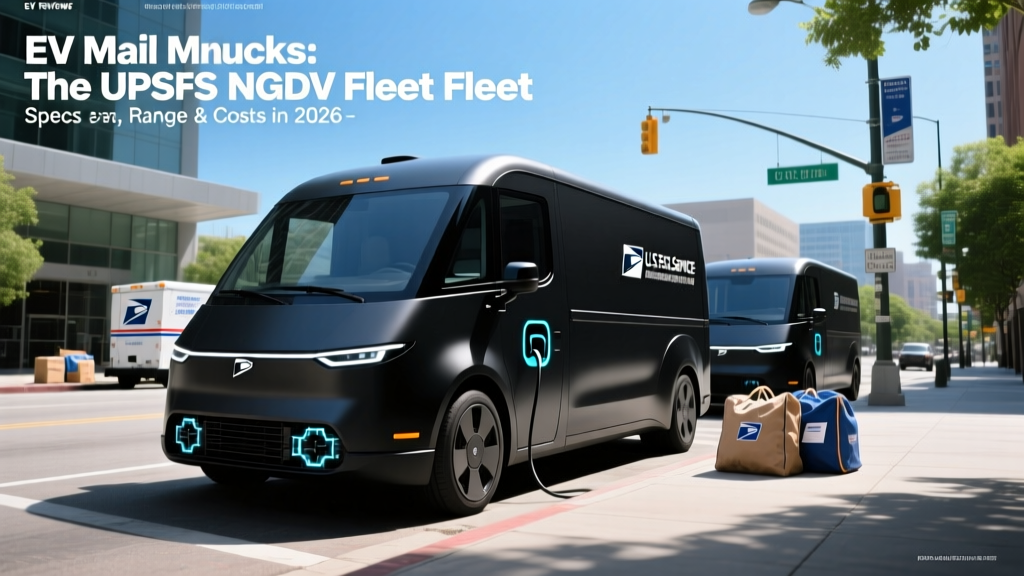
If you've seen a boxy, modern mail truck rolling through your neighborhood, you're witnessing one of the largest commercial fleet electrification efforts in U.S. history. The EV mail trucks replacing the aging Grumman Long Life Vehicles (LLVs) are called the Next Generation Delivery Vehicle (NGDV), built by Oshkosh Defense. By 2026, the USPS has committed to at least 45,000 battery-electric NGDVs out of a total order of up to 60,000 vehicles, with deliveries accelerating from facilities in Spartanburg, South Carolina.
Quick Answer: What Are the USPS EV Mail Trucks?
The USPS EV mail trucks are the Oshkosh-built NGDV (Next Generation Delivery Vehicle). They carry a ~125 kWh NMC battery pack, target an EPA-estimated range of approximately 70–90 miles depending on route conditions, and charge via Level 2 AC (up to 19.2 kW) at depot facilities overnight. They are not available for private purchase — they are purpose-built fleet vehicles for USPS letter carriers.
The NGDV Electric Platform: Specs That Matter
The NGDV isn't a consumer EV with a mail slot bolted on. It's a ground-up commercial delivery platform designed around the specific stop-and-go, low-speed, right-hand-drive demands of postal routes. Oshkosh Defense won the contract in 2021, and after a contentious expansion from an initial 10% EV commitment to at least 75% battery-electric units (following pressure from the EPA and the Biden administration), the fleet is now predominantly electric.
| Specification | NGDV (Battery-Electric) | Legacy Grumman LLV |
|---|---|---|
| Battery Capacity | ~125 kWh (NMC chemistry) | N/A — 2.5L ICE |
| EPA-Est. Range | ~70–90 miles | ~170 miles (8 gal tank, ~21 MPG) |
| Motor Power | ~150 kW (~201 hp) | ~105 hp |
| Level 2 Charging | Up to 19.2 kW AC | N/A |
| 10–80% Charge Time (L2) | ~4.5–5 hours | N/A |
| DC Fast Charging | Not equipped (depot L2 only) | N/A |
| Cargo Volume | ~140 cu ft | ~120 cu ft |
| Payload Capacity | ~1,800 lbs | ~1,000 lbs |
| Climate Control | Full HVAC with heat pump | No AC (most units) |
| Safety Features | 360° cameras, collision warning, AEB | None |
| Right-Hand Drive | Yes | Yes |
A few things jump out from this spec sheet. The ~125 kWh battery is large by consumer standards (for context, the Ford F-150 Lightning Extended Range uses a 131 kWh pack), but mail routes are short, stop-heavy, and energy-intensive due to constant acceleration, idling at mailboxes, and HVAC use. The 70–90 mile real-world range is adequate because the average USPS city delivery route is roughly 18–25 miles, according to USPS operational data. Rural routes can stretch longer, which is why the USPS also ordered a subset of NGDVs with a low-emission ICE powertrain for routes where range or depot charging infrastructure is insufficient.
EV Mail Trucks vs. the Old Grumman LLV: Real Cost Comparison
The Grumman LLV has been the backbone of USPS delivery since 1987. It's a 2.5-liter, rear-wheel-drive workhorse with no air conditioning, no modern safety features, and increasingly catastrophic maintenance costs. The USPS estimated that LLV maintenance alone was consuming a growing share of its operating budget — some vehicles are approaching 40 years old.
| Cost Factor | NGDV (Electric) | Grumman LLV (Gas) |
|---|---|---|
| Unit Acquisition Cost | ~$50,000–$60,000 per vehicle | ~$18,000 (original, 1987–1994) |
| Fuel / Energy Cost per Mile | ~$0.08–$0.12/mi (commercial electricity rates) | ~$0.18–$0.25/mi (at 8 MPG stop-and-go, $3.50/gal) |
| Annual Fuel/Energy (est. 10,000 mi/yr) | ~$800–$1,200 | ~$1,800–$2,500 |
| Maintenance (Annual Est.) | ~$600–$900 (no oil, filters, exhaust, fewer moving parts) | ~$3,000–$5,000+ (aging fleet, frequent breakdowns) |
| Estimated Annual Operating Cost | ~$1,400–$2,100 | ~$4,800–$7,500 |
| Expected Service Life | 20+ years / 200,000+ miles (target) | Originally 24 years; many exceeded |
The math favors electric heavily on the operating side. At roughly $3,000–$5,000 in annual savings per vehicle, the higher upfront cost of the NGDV pays for itself within 3–5 years on a per-unit basis, assuming commercial electricity rates remain stable and depot charging infrastructure is in place. For a fleet of 45,000 electric units, that's potentially $135–225 million in annual operating savings.
Source: USPS NGDV contract details and fleet modernization reports are documented at about.usps.com. EPA oversight and environmental review of the fleet transition is available via epa.gov.
Depot Charging Infrastructure: The Real Bottleneck
The NGDV was designed around a specific operational pattern: the truck leaves the depot in the morning, completes a route of 20–80 miles, returns to the depot, and charges overnight. This is Level 2 AC depot charging, not public fast charging. Each NGDV needs a dedicated or shared Level 2 station at its home post office.
At 19.2 kW (the maximum Level 2 rate the NGDV accepts), charging from 10% to 80% takes approximately 4.5 to 5 hours. A full 10–100% charge takes roughly 6–7 hours. This works perfectly for overnight depot charging — most vehicles are parked for 12–16 hours between shifts.
The infrastructure challenge is real, though. The USPS operates roughly 31,000 post offices and delivery facilities nationwide. Equipping these with enough Level 2 chargers, electrical panel upgrades, and in some cases, utility service upgrades, is a multi-billion-dollar parallel investment. The USPS has been working with the General Services Administration and utility providers to phase this in, but not every facility had chargers ready when the first NGDVs arrived. This has caused localized deployment delays — trucks sitting at facilities without adequate charging capacity.
What This Means for Fleet Buyers Watching the NGDV
If you manage a commercial delivery fleet and are watching the NGDV rollout, the key lesson is that charging infrastructure lead time often exceeds vehicle delivery time. Plan for 6–12 months of electrical permitting, utility coordination, and charger installation before your EVs arrive.
Cold Weather, Route Length, and the Range Reality
Real-World Range vs. Sticker
EPA-Estimated Range: ~70–90 miles (depending on route profile and testing cycle)
Real-World Urban Route (moderate climate): ~65–85 miles — well within most city routes
Cold-Weather Range (below 30°F): Expect ~25–35% reduction, yielding ~45–65 miles
Highway/Long Rural Route: Higher speeds and HVAC draw reduce efficiency significantly
Cold weather is the single biggest operational variable for EV mail trucks. Mail carriers in Minnesota, Maine, or Montana may see usable range drop to 45–65 miles on the coldest days. The NGDV includes a heat pump for cabin climate, which is significantly more efficient than resistive heating and helps mitigate range loss, but physics is physics — battery chemistry slows down in cold, and HVAC energy demand rises.
This is precisely why the USPS retained a portion of the NGDV order as low-emission internal combustion engine (ICE) vehicles. Rural routes in the Dakotas or Alaska, where routes can exceed 80 miles and depot charging may not be available, are assigned the ICE variant. This is a pragmatic fleet decision, not an ideological one.
Safety, Tech, and the Carrier Experience
The old Grumman LLV had no airbags, no ABS (on early models), no backup camera, and notoriously caught fire at an alarming rate — the USPS Office of Inspector General documented hundreds of LLV fires over the vehicle's lifespan. The NGDV addresses this comprehensively:
- 360-degree camera system — critical for a vehicle with large blind spots operating in residential areas
- Automatic Emergency Braking (AEB) and forward collision warning
- Electronic Stability Control — the LLV was notoriously top-heavy and prone to rollover risk
- Full HVAC — including air conditioning, a first for most USPS carriers
- Ergonomic cab design — lower step-in height, improved seat, better visibility
- Right-hand drive — retained for curbside mailbox access
These are SAE Level 0–1 driver-assistance features, not autonomous driving. The carrier is fully in control at all times. There is no Autopilot or self-driving capability — these are work trucks with modern safety nets.
Who's Building Them and What's the Timeline?
Oshkosh Defense, a subsidiary of Oshkosh Corporation (NYSE: OSK), is the prime contractor. Vehicles are assembled at a dedicated facility in Spartanburg, South Carolina. The battery-electric powertrain components are sourced from multiple suppliers, and the NGDV uses a skateboard-style chassis with the battery pack mounted low for stability.
Key timeline milestones:
- February 2021: USPS awards Oshkosh the NGDV contract (initially up to 10 years, up to $6 billion)
- 2022: USPS increases EV commitment from 10% to at least 75% of the order (at least 45,000 BEVs out of 60,000 total)
- 2023–2024: Pilot vehicles tested at select facilities; production ramps
- 2025–2026: Full-rate production and nationwide deployment; thousands of units delivered
- 2027–2028: Target for full fleet replacement completion
What Private Fleet Buyers Can Learn from the NGDV
You can't buy a USPS NGDV — they aren't sold to the public and likely won't appear on the used market for 15–20 years. But the NGDV program offers several transferable lessons for anyone evaluating electric commercial vehicles:
| Common Misconception | What the Data Shows |
|---|---|
| "EVs don't have enough range for delivery routes" | Average city mail routes are 18–25 miles. Even with cold-weather loss, 70+ miles of range covers most urban routes with margin. |
| "Electric commercial vehicles cost too much upfront" | Higher acquisition cost ($50K–$60K vs. ~$18K legacy) is offset by $3K–$5K/year in fuel and maintenance savings. Payback in 3–5 years. |
| "Charging infrastructure is too expensive to build" | Depot L2 charging at $3,000–$7,000 per station (installed) is a fraction of vehicle cost. Shared charging and phased rollout manage capital expenditure. |
| "EV batteries won't last in fleet service" | Modern NMC packs with active thermal management are warrantied for 8–10 years / 100,000+ miles. Stop-and-go use with nightly L2 charging is actually gentler on batteries than highway cycling. |
| "Cold weather makes EV fleets impractical" | Heat pumps and route-specific vehicle assignment (ICE for extreme cold/long routes) solve this. Mixed fleets are the pragmatic answer. |
Decision Framework: Is an Electric Delivery Fleet Right for You?
If You're Evaluating Electric Commercial Vehicles for Your Fleet:
Choose electric delivery vehicles if:
- Your average daily route is under 80 miles (covers most urban/suburban last-mile delivery)
- Your vehicles return to a central depot nightly (enabling L2 overnight charging)
- Your facility has or can accommodate electrical service upgrades for Level 2 chargers
- Your fleet operates in moderate climates, or you can assign ICE vehicles to extreme-cold routes
- You want to reduce per-mile operating costs by 40–60% after the payback period
Stick with ICE or hybrid for now if:
- Your routes regularly exceed 120 miles per day without a mid-day charging opportunity
- Your vehicles operate in regions with sustained sub-zero temperatures and no depot charging
- Your facilities lack electrical capacity and utility upgrades are cost-prohibitive or delayed
- You need DC fast charging capability and your vehicles can't accommodate 30+ minute charging stops mid-route
Frequently Asked Questions
Can I buy a USPS EV mail truck for personal use?
No. The Oshkosh NGDV is a purpose-built federal fleet vehicle and is not available for private purchase. When the old Grumman LLVs are eventually decommissioned and sold at auction, the NGDVs will likely follow the same path — but not for 15–20+ years.
How much does a USPS EV mail truck cost?
The estimated per-unit cost of the battery-electric NGDV is $50,000–$60,000, though exact pricing varies based on contract terms, volume, and configuration. This is significantly more than the original LLV cost (~$18,000 in 1987 dollars) but includes modern safety, climate, and technology systems.
What happens if an NGDV runs out of charge on a route?
The NGDV's battery capacity and route planning are designed with significant margin. The average city route is 18–25 miles against a 70–90 mile range. For edge cases, USPS facilities maintain backup vehicles and recovery protocols, similar to how they handle an LLV running out of gas or breaking down.
Are the EV mail trucks made in America?
Yes. The NGDV is assembled at Oshkosh Defense's facility in Spartanburg, South Carolina, with a largely domestic supply chain as required by federal procurement rules.
How long do the NGDV batteries last?
While USPS hasn't published a specific battery warranty figure publicly, commercial-grade NMC packs in depot-charged, stop-and-go service typically warrant 8–10 years or 100,000–150,000 miles before reaching 70–80% state of health. The NGDV's nightly Level 2 charging pattern (slow, controlled, no DC fast charging) is one of the gentlest charging profiles for battery longevity.
Will the USPS EV mail trucks use Tesla Superchargers or public charging networks?
No. The NGDV charges exclusively at USPS depot facilities via Level 2 AC connections. It is not equipped with a CCS, NACS, or CHAdeMO connector for public DC fast charging. This is by design — the operational model is depot-return-overnight-charge, not en-route charging.
How does the NGDV compare to Amazon's Rivian EDV?
Amazon's Rivian EDV (Electric Delivery Van) is the closest comparable vehicle. The Rivian EDV uses a ~135 kWh battery, achieves approximately 120–150 miles of range, and is slightly larger. Both are purpose-built for delivery, but the Rivian EDV was designed for Amazon's specific logistics model (longer routes, package delivery vs. letter delivery). The NGDV is right-hand drive for mailbox access; the Rivian EDV is left-hand drive with a curbside delivery focus.