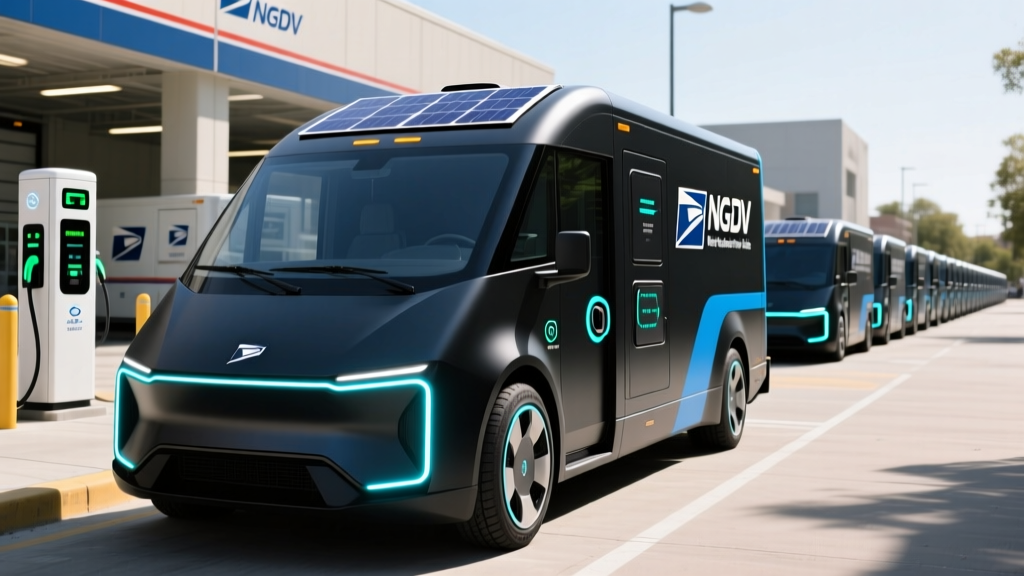
The United States Postal Service is in the middle of the largest fleet electrification in American history — but the new electric mail trucks rolling off the Oshkosh Defense line aren't the whole story. As of early 2026, USPS has committed to acquiring at least 60% battery-electric NGDVs (Next Generation Delivery Vehicles) within its 106,000-vehicle purchase order, with the remaining 40% being low-emission ICE (internal combustion engine) variants built on the same platform. The first EV units began limited route deployment in late 2024, with scale deliveries accelerating through 2025–2026.
Quick Answer
The new USPS electric mail truck (NGDV EV) has an EPA-estimated range of ~70 miles on a 130 kWh battery pack, designed around the average carrier route of 20–35 miles. It charges on Level 2 AC at roughly 19.2 kW, replenishing a full pack in ~7 hours overnight at the depot. The ICE variant uses a 2.0L turbo and gets ~14 mpg combined. Fleet procurement is ~60% EV / 40% ICE through 2028.
If you're a fleet manager, a taxpayer watching procurement, an EV-curious buyer benchmarking commercial electrification, or just someone who's noticed the boxy new Grumman LLV replacements on your block, here's the unvarnished breakdown — specs, math, and the ownership realities that don't make the press release.
Why USPS Is (Mostly) Going Electric
The 30-year-old Grumman LLV — the iconic right-hand-drive box on every suburban route — averages 8.2 mpg, lacks air conditioning in most units, and has become a maintenance and safety liability. The Delivering for America 10-year plan authorized up to $9.6 billion in fleet modernization, with the NGDV contract awarded to Oshkosh Defense (a subsidiary of Oshkosh Corporation) in 2021.
The original contract called for 90% ICE units. Following a supplemental environmental review and a 2022–2023 political and legal push (including a NEPA lawsuit from the Sierra Club and several state AGs), USPS revised the split to a minimum of 60% BEV. As of 2026, the public USPS fleet updates indicate approximately 9,250 NGDV EVs delivered or in production, with ICE variants filling routes in rural and cold-climate zones where the 70-mile range is insufficient.
NGDV EV vs NGDV ICE: Hard Specs Side-by-Side
| Spec | NGDV BEV | NGDV ICE |
|---|---|---|
| Powertrain | Single-motor BEV, FWD | 2.0L turbo-4, 9-spd auto, FWD |
| Horsepower | ~200 hp peak | ~225 hp |
| Usable battery | ~130 kWh (NMC) | — |
| Fuel tank | — | ~18 gal |
| EPA range / MPG | ~70 mi (EPA est.) | ~14 mpg combined |
| Real-world route range | 50–65 mi (loaded, stop-start) | ~230 mi |
| Payload / cargo volume | ~1,500 lb / 120 cu ft | ~1,500 lb / 120 cu ft |
| Max charge rate (AC) | 19.2 kW (Level 2) | — |
| DC fast charging | Not equipped (depot-only) | — |
| Depot recharge time (0–100%) | ~7 hours @ 19.2 kW | ~6 min refuel |
| Driver ergonomics | A/C, 360° cameras, LDW, AEB | A/C, 360° cameras, LDW, AEB |
| Contract unit cost* | ~$70,000–$75,000 | ~$50,000–$55,000 |
*Unit cost estimates derived from USPS OIG filings and Inspector General reports; per-vehicle cost varies with battery commodity pricing and annual buy tranches. Not consumer MSRP — these vehicles are not sold retail.
The 70-Mile Range Question: Is It Enough?
For USPS route design, yes — usually. According to USPS operational data, the median daily carrier route is 20–35 miles, with the 90th percentile around 60 miles. A 70-mile EPA-rated truck, operated at low speeds with frequent stops (ideal for regen braking), typically covers the route with 20–30% state-of-charge remaining at end-of-shift.
Real-World Route Reality
EPA sticker: ~70 mi
Loaded urban route, mild weather: 55–65 mi
Winter route (below 30°F, heater on): 40–50 mi — a 25–35% hit typical of NMC packs without a dedicated heat pump in a high-dwell cabin
Hilly rural route: 45–55 mi
This is exactly why USPS kept the ICE option in the contract. Rural routes in Montana, the Dakotas, upstate New York, and Alaska routinely exceed 80 miles and include highway-speed segments where EV efficiency collapses. For those carriers, the ICE NGDV is the pragmatic call.
Charging Infrastructure: Depot-Only, Not Public
NGDV EVs do not use public charging networks. They are depot-charged overnight on Level 2 AC at 19.2 kW, using dedicated EVSE pedestals installed at USPS delivery units. There is no NACS, CCS, or CHAdeMO port on the vehicle — no Supercharger visits, no Electrify America detours.
| Level | Power | Miles added per hour | Time 10–100% |
|---|---|---|---|
| Level 1 (not used) | 1.9 kW | ~4 mi/hr | — |
| Level 2 (depot standard) | 19.2 kW | ~40 mi/hr | ~7 hours |
| DC fast | Not equipped | — | — |
This matters for the "range anxiety" question: for a vehicle that returns to the same building every night and travels a fixed, known route the next morning, overnight AC charging is the cheapest, lowest-stress, and most grid-friendly way to fuel. USPS specifically designed depot charging to take advantage of off-peak utility rates, which in most service territories are 40–60% cheaper than peak.
Total Cost of Ownership: EV vs ICE Mail Truck
Procurement headlines focus on the ~$20,000 higher upfront cost of the BEV variant. The operational math tells a different story over a 20-year service life.
| Cost Category | NGDV BEV | NGDV ICE |
|---|---|---|
| Acquisition | $72,500 | $52,500 |
| Depot EVSE install (amortized) | $3,800 | $0 |
| Fuel / electricity (15 yr) | $12,400 (avg $0.14/kWh) | $42,800 (avg $3.45/gal, 14 mpg) |
| Maintenance (15 yr) | $14,500 | $28,600 |
| Battery replacement reserve | $0 (warranty coverage + no planned swap) | — |
| Insurance & registration | $9,200 | $8,400 |
| Total 15-yr TCO | ~$112,400 | ~$132,300 |
| Cost per mile | $0.62 | $0.74 |
Fuel savings alone recover the acquisition premium within ~6 years at current energy prices. Maintenance savings compound: no oil changes, no transmission service, no exhaust system, far less brake wear (regen handles most stops below 25 mph). USPS's own Office of Inspector General reports on LLV sustainment costs projected per-mile operating cost reductions of 30–40% for BEV vs legacy.
Myths vs Facts: What Headlines Get Wrong
| Myth | Fact |
|---|---|
| "USPS bought only gas trucks." | Contract was revised to ≥60% BEV; 9,250+ EV NGDVs delivered or in build as of 2026. |
| "70 miles of range is useless." | Median USPS route is 20–35 mi. The truck was spec'd to the route, not to a road-trip fantasy. |
| "They'll freeze in Minnesota." | Cold-climate routes are assigned ICE NGDVs under the 40% allocation. Depot charging is indoors where possible. |
| "The batteries will need replacing every 5 years." | NMC packs in stop-start duty with shallow daily cycles (typically 40–60% DoD) degrade slowly. Oshkosh's commercial warranty is 8 yr / 100,000 mi on the HV system. |
| "Taxpayers are funding $100k trucks." | Per-unit BEV cost is ~$70k–$75k at current commodity pricing — below many Class 2 commercial EVs. |
| "They can't use Tesla Superchargers." | Correct — they don't need to. Depot-only L2 is cheaper and sufficient for the duty cycle. |
What This Means for Commercial EV Buyers
You can't buy an NGDV — Oshkosh builds them under an exclusive USPS contract. But the program is the single largest real-world validation of the depot-charged, fixed-route, medium-duty BEV model in the U.S. If you operate a delivery, service, or municipal fleet, the NGDV data set validates a decision framework you can apply directly:
Fleet EV Decision Framework
- Choose BEV if: daily route ≤70% of EPA range, depot return nightly, ≥8 hr dwell for L2, mild-to-moderate climate OR heated indoor depot, utility offers off-peak commercial rates.
- Choose ICE/PHEV if: route exceeds EPA range by >30%, no overnight depot access, ambient winter temps regularly below 20°F with no indoor parking, or routes include sustained highway segments >55 mph.
- Choose mixed fleet (like USPS) if: urban/suburban BEV, rural ICE — segment by route length and climate, not by a single policy target.
Comparable commercial vehicles to benchmark against: Ford E-Transit (126 mi EPA, ~$50k, CCS-capable), BrightDrop Zevo 600 (250 mi EPA, fleet-only), Rivian EDV (Amazon-exclusive, ~150 mi EPA). All share the NGDV's core duty-cycle assumption: predictable routes + overnight depot charging = lowest TCO.
What First-Time EV Buyers Can Learn From the Mail Truck
Even though the NGDV is a government-spec commercial vehicle, its design reveals three principles every passenger-EV shopper should internalize:
- Match range to YOUR route, not the spec sheet winner's circle. A 310-mi SUV is wasted money if your commute is 28 miles and you charge at home. USPS spec'd 70 mi because that's what the job requires — nothing more.
- Home / depot charging is the whole game. Public DC fast charging is a road-trip tool, not a daily fueling strategy. The cheapest, cleanest, battery-friendliest electrons are the ones you pull overnight at 19.2 kW (or 11.5 kW at home) on a time-of-use rate.
- Maintenance savings compound quietly. No oil, no transmission, regen-saved brakes. The NGDV's 15-year maintenance delta (~$14k vs ~$29k) mirrors what a Tesla Model Y or Hyundai Ioniq 5 owner sees versus a comparable ICE crossover.
Frequently Asked Questions
Can I buy a USPS NGDV electric mail truck as a civilian?
No. The NGDV is built under a federal contract with Oshkosh Defense and is not available for retail sale. Surplus LLVs occasionally reach private owners via GSA auctions, but NGDVs are expected to remain in USPS service for their full 20-year design life.
Why didn't USPS go 100% electric?
Two reasons: (1) roughly 15–20% of rural routes exceed the BEV's usable range, especially in cold climates; (2) some small delivery units lack the electrical service capacity for full-depot EVSE buildout without utility upgrades that can cost $50k–$250k per site. The 60/40 split was a pragmatic compromise.
Does the NGDV use a Tesla NACS plug?
No. The truck uses a dedicated depot AC coupling and is not equipped for public DC fast charging of any standard (NACS, CCS1, or CHAdeMO). It never needs to charge away from its home base.
What battery chemistry is in the NGDV EV?
NMC (nickel manganese cobalt), chosen for energy density within the packaging constraints of the low-floor delivery van. LFP was considered but ruled out due to cold-climate performance and weight tradeoffs for the 70-mi target.
How much does it cost USPS to "fuel" an electric mail truck vs a gas LLV?
At average commercial off-peak rates of ~$0.12–$0.16/kWh, a full 130 kWh depot charge costs roughly $16–$21. The equivalent 18-gallon fill on an 8-mpg LLV at $3.45/gal is ~$62. Per-mile energy cost is roughly 70% lower on the BEV.
Are the new mail trucks actually safer than the old LLVs?
Substantially. The NGDV (both variants) adds air conditioning, 360° cameras, automatic emergency braking, lane departure warning, and a modern crash structure. The LLV had none of these and was involved in NHTSA-reported fire and crash incidents at disproportionate rates relative to its fleet share.
The new electric mail trucks aren't a technology moonshot — they're a duty-cycle optimization. USPS sized the battery to the route, the charger to the depot, and the ICE backup to the routes where physics and geography won't cooperate. That's the same framework any EV buyer, fleet or family, should use.