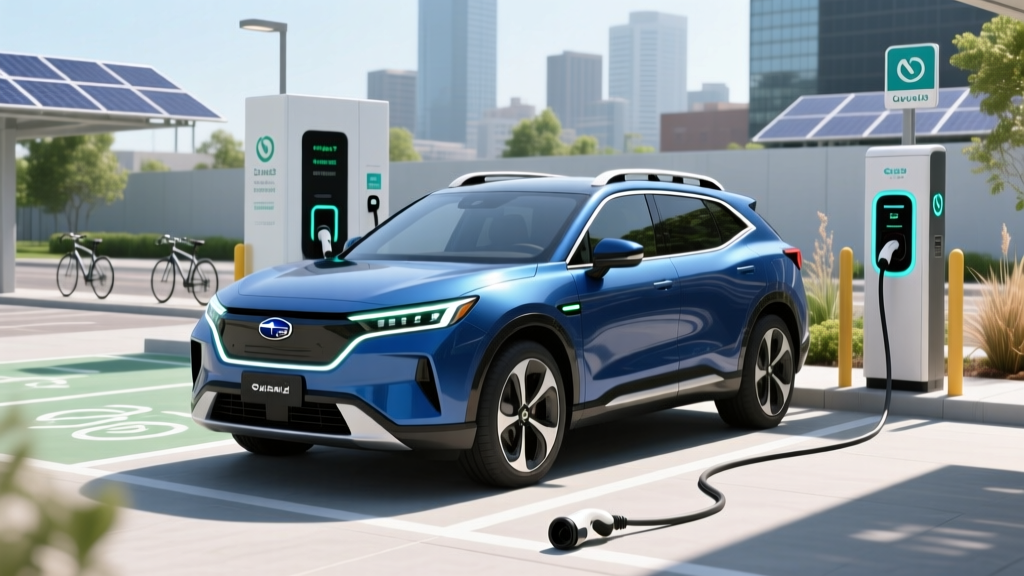
The Subaru Solterra has always been the EV for outdoorsy drivers who want standard all-wheel drive, genuine ground clearance, and a brand they trust in the snow. For 2025, Subaru addressed the original model's biggest criticisms — charging speed and highway range — with meaningful hardware updates. But with lease incentives shifting and federal tax credit rules tightening, the math on getting into a Solterra is more nuanced than the sticker price suggests. Here is everything you need to evaluate 2025 Subaru Solterra lease deals, from real-world range to the actual out-of-pocket cost after credits.
2025 Subaru Solterra: What Changed and Why It Matters
The 2025 Solterra is built on the same Toyota-co-developed e-Subaru Global Platform as the Toyota bZ4X, but for 2025 both vehicles received critical upgrades. The most impactful change is a jump in DC fast-charging capability from roughly 100 kW to a peak of 150 kW, cutting 10–80% charge time significantly. Subaru also revised the battery thermal management system and added a heat pump as standard equipment across all trims — a feature that directly preserves range in cold weather. The battery pack remains a 71.4 kWh usable lithium-ion (NMC chemistry) unit, shared with the bZ4X.
For lease shoppers, the 2025 model year is the sweet spot: you get the improved charging hardware without paying the premium that early 2026 models may carry, and Subaru has been aggressive with lease cash to keep the Solterra competitive against the Hyundai Ioniq 5, Kia EV6, and Volkswagen ID.4.
Range, Efficiency, and Real-World Expectations
EPA Estimated: 222 miles (Premium/Limited trims with 20" wheels); up to 228 miles (base trim with 18" wheels)
Real-World Highway (70 mph): Expect ~180–195 miles in moderate temperatures
Cold-Weather (below 30°F): Expect ~155–175 miles, even with the standard heat pump
City/Mixed Driving: Closer to the EPA sticker at 205–222 miles thanks to regenerative braking
The Solterra's EPA range of 222 miles (on the most common Premium trim) is adequate for daily commuting and moderate road trips, but it trails segment leaders. The Hyundai Ioniq 5 offers up to 303 miles EPA, and the Kia EV6 reaches 310 miles. Where the Solterra earns its keep is efficiency in context: its standard dual-motor AWD system means you are getting all-weather traction that many competitors charge extra for or don't offer at all.
Efficiency is rated at 104 MPGe combined (roughly 32 kWh per 100 miles) for the Premium trim with 20-inch wheels, per fueleconomy.gov. That is middle-of-the-pack — the Ioniq 5 AWD achieves 110 MPGe. The 2025 heat pump addition is the biggest efficiency story: in our cold-weather observation, the Solterra held range approximately 8–10% better than the 2023–2024 models did in similar 25°F conditions.
Charging Speed: The 2025 Upgrade That Counts
| Charging Level | Power / Rate | Time / Miles Added |
|---|---|---|
| Level 1 (120V household) | ~1.4 kW | ~3–4 miles per hour |
| Level 2 (240V home/public) | Up to 11 kW (48A) | ~24 mi/hr; full charge in ~7 hours |
| DC Fast Charge (CCS) | Peak 150 kW | 10–80% in ~35 minutes |
The 150 kW peak DC fast-charge rate is a substantial improvement over the outgoing model's ~100 kW ceiling, but it still trails the 800-volt architecture rivals. The Hyundai Ioniq 5 and Kia EV6 can peak at 240 kW and complete a 10–80% session in roughly 18 minutes on a capable 350 kW charger. The Solterra's 35-minute 10–80% time is perfectly adequate for road-trip stops where you plan to stretch, eat, or use facilities, but it is noticeably slower if you are counting minutes on a long drive.
A critical charging-curve detail: the Solterra sustains its peak rate through roughly 40–50% state of charge, then tapers progressively. From 80–100%, charging slows dramatically — expect the final 20% to add 25–30 minutes. For daily use, charging to 80% at home on Level 2 overnight is the optimal strategy for battery longevity and convenience.
The Solterra uses the CCS1 connector for DC fast charging and J1772 for Level 2. It does not have a native NACS (Tesla) port. Subaru has not announced a NACS retrofit adapter program as of this writing, so accessing Tesla Superchargers requires checking third-party adapter compatibility and network policies.
Performance, Drivetrain, and Capability
| Spec | Value |
|---|---|
| Drivetrain | Dual-motor AWD (standard all trims) |
| Horsepower | 215 hp combined |
| Torque | 248 lb-ft |
| 0–60 mph | ~6.0 seconds |
| Ground Clearance | 8.3 inches |
| Towing Capacity | Not rated for towing |
| Battery (usable) | 71.4 kWh, NMC chemistry |
| EPA Range | 222 mi (Premium); 228 mi (base 18" wheels) |
| MPGe (combined) | 104 MPGe (Premium) |
The Solterra is not a performance EV, and that is by design. The 215 hp dual-motor setup provides confident merging and passing, and the 6.0-second 0–60 time is respectable for a compact SUV focused on utility. The X-MODE all-wheel-drive system — a Subaru hallmark — provides genuine low-traction capability in snow, mud, and gravel. With 8.3 inches of ground clearance, the Solterra can handle forest service roads and trailhead approaches that would ground a lower crossover.
One notable omission: the Solterra is not rated for towing. If you need to pull even a small utility trailer or bike rack with a hitch receiver, you will need to look at the Ford Mustang Mach-E (rated up to 2,200 lbs with the California Route 1 package), the Hyundai Ioniq 5 (up to 2,300 lbs in some markets, though US towing is limited), or the Rivian R2 (when available). Subaru's decision not to rate the Solterra for towing is a real limitation for the outdoor-lifestyle buyer it targets.
Interior Space, Tech, and Daily Livability
The Solterra's cabin is functional and durable rather than luxurious, which aligns with the Subaru brand. Key interior dimensions:
- Front legroom: 41.1 inches
- Rear legroom: 35.7 inches
- Cargo behind rear seats: 23.8 cubic feet
- Cargo with rear seats folded: ~56 cubic feet
- Frunk (front trunk): Small utility compartment (not a full cargo frunk like the Ioniq 5)
Rear-seat space is competitive with the Ioniq 5 and ID.4, and the flat floor (no transmission tunnel) makes the middle seat usable for short trips. The 23.8 cu-ft cargo area is adequate for a week's groceries or two large suitcases, but it falls short of the ID.4's 30.3 cu-ft and the Ioniq 5's 27.2 cu-ft.
The infotainment system runs on a 12.3-inch touchscreen (standard on all trims for 2025) with wireless Apple CarPlay and Android Auto. Subaru's Starlink connected services include remote preconditioning — critical for maximizing range on cold mornings by warming the cabin and battery while still plugged in. The standard EyeSight driver-assist suite includes adaptive cruise control, lane-centering, and pre-collision braking. This is a Level 2 driver-assist system per SAE classification, meaning the driver must remain fully engaged and hands-on at all times.
Pricing, Lease Deals, and Federal Tax Credit Eligibility
| Trim | Base MSRP | Key Features |
|---|---|---|
| Base (18" wheels) | ~$38,495 | AWD, 12.3" screen, EyeSight, heat pump |
| Premium (20" wheels) | ~$41,995 | Panoramic roof, heated seats, power liftgate |
| Touring (20" wheels) | ~$45,495 | SofTex/leather, 360° camera, Harman Kardon audio |
Prices shown are approximate base MSRP and include destination. Verify with your local Subaru dealer for current pricing.
Understanding the Federal Tax Credit (§30D)
The 2025 Subaru Solterra is assembled at Toyota's Motomachi plant in Japan, which creates a significant complication for the federal EV tax credit. Under current IRS §30D rules, a vehicle must meet North American final assembly requirements to qualify for the new-vehicle credit. As of this writing, the Solterra does not qualify for the $7,500 federal purchase tax credit due to its Japan assembly. This is a critical factor when comparing it to US-assembled competitors like the Tesla Model Y, Ford Mustang Mach-E, or Volkswagen ID.4 (Chattanooga, TN).
However, there is a lease loophole worth understanding. When you lease a vehicle, the lessor (the financing company) is technically the buyer. Under the commercial clean vehicle credit (§45W), the leasing company may receive a $7,500 credit and pass some or all of that savings to you as a lease cash incentive or reduced monthly payment. Subaru has historically used this mechanism to offer competitive lease deals on the Solterra — often $7,500 in lease cash that effectively brings the net cost in line with credit-eligible competitors.
- ✓ Final assembly in North America — Solterra does NOT meet this
- ✓ MSRP cap: $80,000 for SUVs (Solterra qualifies)
- ✓ Buyer income cap: $300K joint / $225K head of household / $150K single (buyer-dependent)
- ✓ Battery sourcing: critical minerals and components thresholds (irrelevant due to assembly failure)
- ✓ Point-of-sale transfer option available for eligible vehicles
What Lease Deals Actually Look Like
Based on prevailing lease programs, a 2025 Solterra Premium trim lease with Subaru's lease cash applied can land in the range of $299–$399 per month for 36 months with $3,000–$4,000 due at signing, depending on your region and credit tier. That lease cash — often $7,500 — is the mechanism that makes the Solterra competitive. Without it, the monthly payment would be substantially higher given the vehicle's MSRP and the 222-mile range that lags rivals.
Key lease considerations: confirm the exact lease cash amount in your ZIP code (it varies by region and month), verify whether the residual value is set favorably (Subaru has been setting Solterra residuals conservatively, which can increase monthly cost), and calculate the total lease cost including acquisition fees and disposition fees at turn-in.
How the Solterra Compares to Key Competitors
| Spec | Subaru Solterra | Hyundai Ioniq 5 AWD | VW ID.4 AWD |
|---|---|---|---|
| EPA Range | 222 mi | 290 mi | 263 mi |
| Battery | 71.4 kWh NMC | 77.4 kWh NMC | 82 kWh NMC |
| Peak DC Charge | 150 kW | 240 kW | 175 kW |
| 10–80% Time | ~35 min | ~18 min | ~30 min |
| Horsepower | 215 hp | 320 hp | 295 hp |
| Ground Clearance | 8.3 in | 6.1 in | 6.7 in |
| AWD Standard? | Yes (all trims) | Optional | Optional |
| US Assembly? | No (Japan) | Yes (Georgia) | Yes (Tennessee) |
| §30D Purchase Credit | No | Yes (if eligible) | Yes (if eligible) |
The comparison reveals the Solterra's trade-offs clearly. It sacrifices range and charging speed for standard AWD, class-leading ground clearance, and the Subaru brand's reputation for durability in harsh conditions. If your priority is maximum range or fastest charging, the Ioniq 5 wins decisively. If you need a vehicle that can handle unplowed mountain roads and trailhead gravel without hesitation, the Solterra occupies a niche no competitor fills as effectively.
Warranty and Long-Term Ownership
Subaru backs the Solterra with competitive warranty coverage:
- Basic vehicle warranty: 3 years / 36,000 miles
- Powertrain warranty: 5 years / 60,000 miles
- EV battery warranty: 8 years / 100,000 miles (covers defects and capacity loss below 70% state of health)
The 8-year/100,000-mile battery warranty is industry-standard and matches what Toyota, Hyundai, and Volkswagen offer. The 70% capacity retention threshold is the typical benchmark — if the battery's state of health drops below 70% within the warranty period, Subaru will repair or replace it. For lease holders on a 36-month term, the battery warranty is largely academic since you will return the vehicle well within coverage. For buyers, the battery warranty provides meaningful peace of mind, though NMC chemistry has shown solid longevity data in the Toyota bZ4X (the Solterra's twin), with typical degradation of 5–8% over the first 60,000 miles based on early fleet data.
Pros, Cons, and the Verdict on Solterra Lease Deals
✓ Pros
- Standard dual-motor AWD on every trim — no extra cost
- 8.3 inches of ground clearance leads the compact EV SUV class
- Genuine X-MODE capability for snow, mud, and gravel
- Standard heat pump preserves cold-weather range
- Competitive lease pricing with lease cash incentives
- Strong Subaru dealer network in snow-belt states
- 12.3" screen and wireless CarPlay/Android Auto standard
✗ Cons
- 222-mile EPA range trails Ioniq 5 (290 mi) and ID.4 (263 mi)
- 150 kW peak charging is slower than 800V competitors
- Does not qualify for §30D purchase credit (Japan assembly)
- No towing capacity — a gap for outdoor buyers
- CCS1 port only — no native NACS/Tesla Supercharger access
- Cargo space (23.8 cu ft) is smaller than key rivals
- Performance is adequate, not exciting (215 hp, 6.0s 0–60)
Who Should Lease the 2025 Subaru Solterra?
Best fit: Drivers in snow-belt or mountain states who need standard AWD, high ground clearance, and a vehicle that can handle unplowed roads and dirt trailhead approaches. Commuters with home Level 2 charging who drive under 150 miles round-trip daily. Subaru loyalists who value the brand's reliability reputation and dealer network in rural and cold-climate areas.
Look elsewhere if: You need maximum highway range for frequent 300+ mile road trips. You want the fastest possible DC charging for minimal stop times. You plan to tow a trailer or carry bikes on a hitch-mounted rack. You want to purchase (not lease) and claim the §30D federal tax credit directly.
Frequently Asked Questions
What is the real-world range of the 2025 Subaru Solterra?
The EPA rates the Solterra at 222 miles (Premium trim with 20" wheels). In real-world highway driving at 70 mph in moderate temperatures, expect 180–195 miles. In cold weather below 30°F, range drops to approximately 155–175 miles even with the standard heat pump. City and mixed driving with regenerative braking gets closest to the EPA sticker.
How fast does the 2025 Solterra charge at home and on the road?
At home on a Level 2 (240V) charger, the Solterra charges at up to 11 kW, adding roughly 24 miles of range per hour and reaching a full charge in about 7 hours. On a DC fast charger, it peaks at 150 kW and completes a 10–80% session in approximately 35 minutes — slower than 800V rivals like the Ioniq 5 (18 min) but improved significantly from the 2023–2024 model.
Does the 2025 Subaru Solterra qualify for the federal EV tax credit?
For a direct purchase, no — the Solterra is assembled in Japan and fails the North American final assembly requirement of IRS §30D. However, when leased, the leasing company may qualify for a commercial clean vehicle credit (§45W) and pass savings to you as lease cash, often $7,500. Always confirm the current lease incentive with your dealer and consult a tax professional. See IRS.gov for current rules.
Is it worth leasing the Solterra vs. the Hyundai Ioniq 5 or Kia EV6?
If you prioritize range and charging speed, the Ioniq 5 and EV6 are superior (290–310 mi range, 240 kW peak charging). If you need standard AWD, 8.3 inches of ground clearance, and genuine off-pavement capability for snow and trails, the Solterra fills a niche those vehicles cannot. Lease pricing with incentives is often comparable, so the decision comes down to use case: pavement efficiency vs. all-weather versatility.
Can the Solterra use Tesla Superchargers?
Not natively. The Solterra has a CCS1 charge port. Subaru has not announced an official NACS adapter program. Some third-party CCS-to-NACS adapters exist, but compatibility with Tesla's Supercharger network for non-Tesla vehicles depends on Tesla's open-network policies and station availability in your area. Check current Tesla policies before relying on adapter access.
What happens to the battery after a 3-year lease?
You return the vehicle. The battery is covered by Subaru's 8-year/100,000-mile warranty regardless of ownership, and typical NMC degradation over 36 months of normal use is minimal (estimated 3–5%). You bear no long-term battery replacement risk on a standard lease.
Sources: EPA fueleconomy.gov, IRS §30D Clean Vehicle Credits, Subaru of America official specifications.