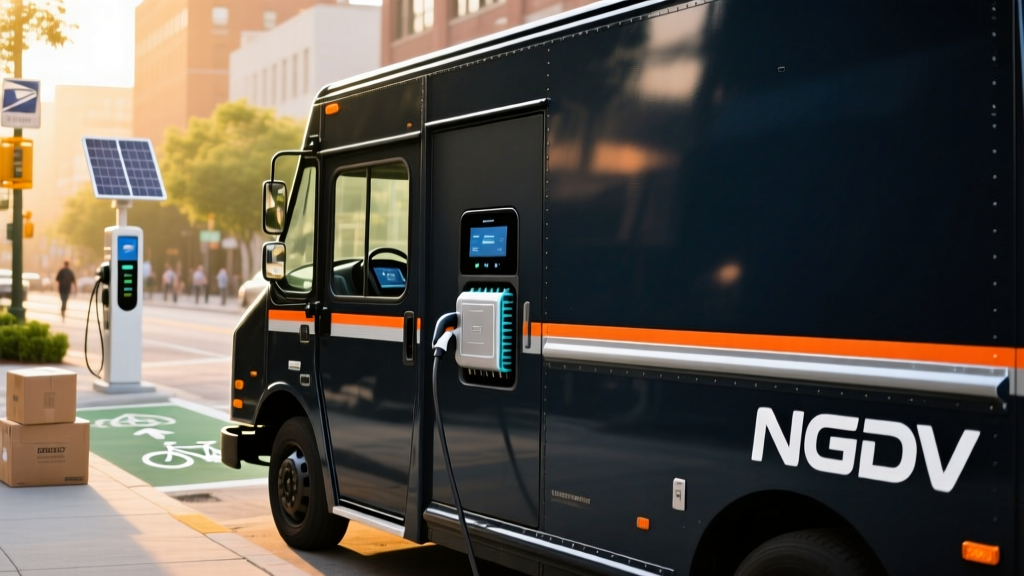
The short answer: The USPS is deploying up to 66,000 electric Next Generation Delivery Vehicles (NGDVs) built by Oshkosh Defense as part of a $10+ billion fleet modernization. The electric NGDV has an estimated 70–90 mile real-world range, a ~130 kWh battery pack, and Level 2 AC charging. It replaces the 30-year-old Grumman LLV, which averages roughly 8–10 MPG on gasoline. For fleet managers and EV-curious buyers, the USPS program is the largest single electric commercial-vehicle rollout in U.S. history — and a proving ground for the medium-duty EV platforms that will eventually reach consumer driveways.
Why the USPS Is Going Electric — and Why It Matters to You
If you have seen a boxy, right-hand-drive electric vehicle creeping through your neighborhood with the USPS eagle on its flank, you are looking at the Oshkosh NGDV. The United States Postal Service committed to acquiring at least 66,000 battery-electric delivery vehicles through 2028, after initially planning a mostly gas-powered fleet. Congressional pressure, EPA analysis, and the Inflation Reduction Act's fleet-electrification funding pushed the ratio to roughly 75% electric and 25% low-emission gas.
For everyday EV shoppers, the USPS program matters for three reasons:
- Charging infrastructure buildout. Depot-level charging installations at USPS facilities are adding commercial-grade Level 2 and DC fast-charging capacity to neighborhoods that previously had none.
- Real-world fleet data. With thousands of NGDVs running daily routes, we are getting hard numbers on electric commercial-vehicle degradation, uptime, and cold-weather performance — data that directly translates to consumer EV ownership.
- Platform trickle-down. The battery packs, thermal management systems, and electric drivetrains validated in the NGDV program inform the next generation of commercial EVs from Oshkosh and its competitors.
USPS Electric Mail Truck Specs: The Oshkosh NGDV EV
Oshkosh Defense has been deliberately vague about full technical specifications — these are government-contract vehicles, not consumer models you can cross-shop on a dealer lot. But through USPS environmental impact statements, contract disclosures, and fleet-testing reports, we can piece together the core numbers.
| Specification | NGDV Electric | Legacy Grumman LLV (Gas) |
|---|---|---|
| Battery Capacity | ~130 kWh (NMC lithium-ion) | N/A (12-gal gas tank) |
| EPA-Estimated Range | ~70–90 miles (route-dependent) | ~80–120 miles (8–10 MPG) |
| Charging (Level 2 AC) | ~19.2 kW; full charge in 7–8 hours | N/A |
| DC Fast Charging | Not equipped (depot L2 only) | N/A |
| Cargo Volume | ~125 cu ft | ~120 cu ft |
| Powertrain | Single electric motor, FWD | 2.5L Iron Duke I4, 82 HP |
| 0–30 mph | Est. 4–5 seconds | Est. 8–10 seconds |
| HVAC System | Electric heat pump + AC | Engine-driven |
| Safety Tech | AEB, 360° cameras, collision warnings | None |
| Estimated Unit Cost | ~$70,000–$85,000 per vehicle | ~$20,000 (1987–1994 purchase) |
Real-World Range Reality: The NGDV's ~130 kWh battery is large by consumer standards (a Tesla Model Y Long Range has ~75 kWh usable). But delivery routes are brutal on efficiency: constant stop-and-go, frequent door openings, HVAC running all day, and heavy curb-weight from 125 cu ft of cargo. Expect 70–90 miles in moderate weather, dropping to 50–65 miles in sub-freezing conditions where battery heating and cabin HVAC draw heavily. The average USPS city route covers 20–35 miles, so range is adequate — but rural routes pushing 60+ miles require careful planning.
Electric NGDV vs. Gas LLV: The Cost Comparison
The legacy Grumman Long Life Vehicle (LLV) has been the backbone of USPS delivery since 1987. These right-hand-drive box trucks are legendary for durability but infamous for inefficiency, catching fire (literally — the LLV has a well-documented fire problem), and costing the Postal Service roughly $5,000–$8,000 per year in fuel and maintenance per vehicle.
| Cost Category | NGDV Electric | Grumman LLV (Gas) |
|---|---|---|
| Fuel / Electricity | ~$800–$1,200/yr (at $0.12/kWh) | ~$3,500–$5,000/yr (at $3.50/gal, 9 MPG) |
| Maintenance | ~$500–$1,000/yr (no oil, fewer moving parts) | ~$3,000–$5,000/yr (aging fleet, frequent repairs) |
| Estimated Annual Total | ~$1,300–$2,200 | ~$6,500–$10,000 |
| 5-Year Operating Cost | ~$6,500–$11,000 | ~$32,500–$50,000 |
The math is clear: even with a significantly higher upfront purchase price (~$70,000–$85,000 for the electric NGDV vs. a theoretical $35,000–$45,000 for a gas NGDV variant), the electric version pays for its premium within 4–6 years through fuel and maintenance savings alone. Over a 15-year vehicle lifespan, the USPS projects savings of $40,000–$60,000+ per vehicle.
This mirrors the consumer EV ownership equation almost exactly: higher sticker price, dramatically lower running costs, and a break-even point that depends on your annual mileage and local electricity rates.
Charging Infrastructure: The Hidden Story
The NGDV charges exclusively via Level 2 AC at USPS depot facilities — no DC fast charging. This is intentional: mail trucks return to the same facility every evening, park for 10–14 hours, and depart the next morning. A 19.2 kW Level 2 charger replenishes the ~130 kWh battery in roughly 7–8 hours, which fits the operational cycle perfectly.
For fleet operators considering electric commercial vehicles, this highlights a critical principle: match the charging strategy to the duty cycle. Vehicles with predictable, depot-return routes do not need expensive DC fast-charging infrastructure. Level 2 is cheaper to install ($3,000–$7,000 per port for commercial installations), gentler on battery longevity, and compatible with off-peak utility rates.
The USPS is installing tens of thousands of Level 2 ports across its network, and the electrical infrastructure upgrades required — panel expansions, transformer upgrades, utility coordination — are creating a template that commercial fleets nationwide are following.
What Consumer EV Buyers Can Learn from the USPS Program
You cannot buy an NGDV. But the lessons from the USPS electrification program apply directly to your next EV purchase:
| Myth | What USPS NGDV Data Shows |
|---|---|
| "EV batteries won't last." | NMC packs with proper thermal management and daily shallow cycling (20–80% SoC) are projected for 15+ year lifespans with <20% degradation. |
| "EVs can't handle cold weather." | Range drops 25–35% in sub-freezing temps — real, but manageable with heat pumps and route planning. The NGDV's electric heat pump outperforms the LLV's engine-driven heater in warmup time. |
| "EVs are always more expensive." | Higher upfront cost, but 5-year TCO is lower in almost every high-utilization scenario. Same math applies to consumer EVs driven 12,000+ miles/year. |
| "Charging takes too long." | Depot charging overnight is invisible to operations. Consumer parallel: home Level 2 charging means you start every day "full" — no gas station stops. |
First-Time EV Buyer Takeaways
- Daily range needs are lower than you think. The average USPS route is 20–35 miles. The average American drives 37 miles/day (FHWA data). A 250-mile EPA-range EV covers 95%+ of daily driving with room to spare.
- Home charging changes everything. Like the NGDV returning to its depot, an EV plugged into a home Level 2 charger starts every morning at your target SoC. No fuel stops, no cold-starts.
- Maintenance savings are real. No oil changes, no transmission fluid, no spark plugs, regenerative braking extends pad life 2–3x. The USPS expects 50–70% lower maintenance costs per mile.
- Cold weather is manageable, not catastrophic. Expect 20–35% range loss below freezing. Preconditioning (warming the battery while plugged in) mitigates this significantly — a feature available on most modern consumer EVs.
Decision Framework: Is an EV Right for Your Driving Pattern?
Use this framework to decide between a BEV, PHEV, or sticking with gas:
- Choose a BEV (full electric) if: You drive under 250 miles/day, have access to home or workplace Level 2 charging, and want the lowest long-term operating cost. Like the USPS, predictable daily routes with overnight charging are the ideal EV use case.
- Choose a PHEV (plug-in hybrid) if: You drive 30–50 miles daily (covering most commutes on electric-only mode) but regularly take 200+ mile road trips where charging access is uncertain. PHEVs like the Toyota RAV4 Prime (42 miles electric-only, 38 MPG combined after depletion) offer the best of both worlds.
- Stick with gas or HEV (hybrid) if: You lack reliable charging access (apartment, street parking), regularly drive 300+ miles in rural areas, or your annual mileage is under 6,000 miles (where fuel savings won't offset higher EV purchase price within a reasonable timeframe).
Common Misconceptions About USPS Electric Mail Trucks
"The NGDV has terrible range." With 70–90 miles, the NGDV has more than enough range for most city delivery routes. The USPS's own data shows 95%+ of routes fall within the electric NGDV's capability. Range is only a concern for long rural routes, which is why the USPS retained some gas-powered NGDVs for those assignments.
"Electric mail trucks will break down in winter." Cold-weather range loss is real (~25–35%), but the NGDV was tested in extreme conditions from Alaska to Arizona. The electric heat pump and battery thermal management system are specifically engineered for four-season operation. Consumer EVs from Hyundai, Tesla, and BMW use similar heat-pump architectures.
"This is just a government boondoggle." The per-vehicle cost is high, but the USPS Office of Inspector General and independent analyses project net savings over the fleet's lifespan through reduced fuel, maintenance, and fire-loss costs. The LLV fleet was costing the USPS over $500 million annually in maintenance alone.
Frequently Asked Questions
Can I buy a USPS electric mail truck?
No. The Oshkosh NGDV is a government-contract vehicle not available to consumers. However, the commercial EV platforms being validated in this program will influence future fleet and consumer vehicles. If you need a right-hand-drive electric vehicle for a delivery business, look at the Workhorse E-Gen or the BrightDrop Zevo 600.
How much does a USPS electric mail truck cost?
Estimated at $70,000–$85,000 per vehicle, compared to roughly $35,000–$45,000 for the gas-powered NGDV variant. The higher upfront cost is offset by $4,000–$7,000 in annual operating savings per vehicle.
What battery chemistry does the NGDV use?
The NGDV uses NMC (nickel manganese cobalt) lithium-ion cells, chosen for energy density in a vehicle that needs to maximize range within a fixed chassis footprint. NMC is the same chemistry used in most long-range consumer EVs (Tesla, Ford, Hyundai), while LFP (lithium iron phosphate) is gaining ground in standard-range models for its longer cycle life and lower cost.
Do USPS electric trucks charge at public charging stations?
No. The NGDV charges exclusively at USPS depot facilities via dedicated Level 2 AC chargers. They do not use public DC fast-charging networks like Electrify America or Tesla Superchargers.
How does the NGDV compare to Amazon's Rivian EDV?
Amazon's Rivian EDV (Electric Delivery Van) has a ~150-mile estimated range and a ~110 kWh battery. Both vehicles target last-mile delivery, but Rivian's consumer-vehicle DNA gives the EDV a more refined driving experience, while the NGDV prioritizes government-procurement durability and cost targets. Amazon has deployed over 10,000 Rivian EDVs as of early 2026.