The Used Electric Vehicle Tax Credit: Your Complete 2026 Eligibility Guide
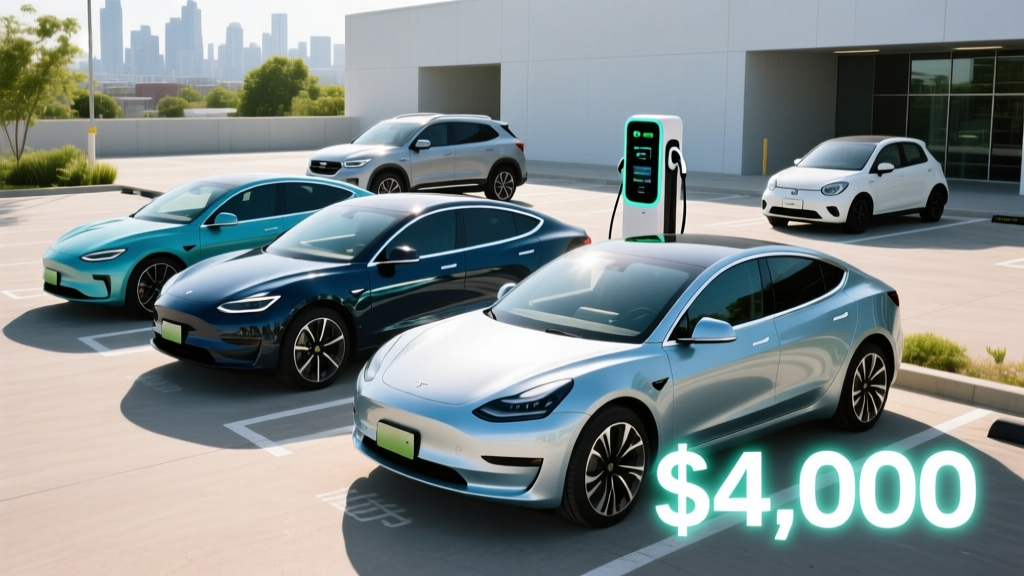
Buying a pre-owned EV is one of the smartest ways to enter electrified ownership — lower upfront cost, reduced depreciation risk, and a federal incentive that most buyers overlook. The used electric vehicle tax credit, officially known as the IRS §25E Previously-Owned Clean Vehicle Credit, offers up to $4,000 (or 30% of the sale price, whichever is lower) for qualifying used EVs and PHEVs. Unlike the new-vehicle §30D credit, this one targets budget-conscious buyers and has its own distinct rules around income, vehicle price, and model-year eligibility.
But the tax credit is only one piece of the ownership-cost equation. Insurance premiums, charging expenses, maintenance savings, and depreciation all shape your real five-year cost. This guide breaks down every dollar — savings and expenses alike — so you can determine whether a used EV actually saves you money or simply shifts where you spend it.
Do You Qualify? IRS §25E Tax Credit Eligibility Checklist
The used electric vehicle tax credit is narrower than the new-vehicle credit. Both the buyer and the vehicle must meet specific requirements. Here's the full eligibility framework as of the 2026 tax year:
- Credit amount: 30% of the sale price, up to a maximum of $4,000
- Vehicle price cap: The sale price must not exceed $25,000
- Model-year requirement: The vehicle must be at least two model years older than the calendar year of purchase (for a 2026 purchase, the vehicle must be a 2024 model year or older)
- Buyer income caps (modified AGI): $75,000 single / $112,500 head of household / $150,000 married filing jointly
- Vehicle type: Must be a qualified plug-in EV or fuel-cell vehicle with a battery capacity of at least 7 kWh
- Purchase channel: Must be purchased from a licensed dealer (private-party sales do not qualify)
- First-time transfer: The vehicle must not have been resold by the same buyer claiming the credit in a prior year — it must be the first qualifying resale since the vehicle was new
- Point-of-sale transfer: Yes — you can transfer the credit to the dealer at purchase, reducing your out-of-pocket cost immediately rather than waiting for tax filing
The $25,000 price cap is the biggest constraint. It excludes most luxury used EVs but makes models like a 2022 Nissan Leaf, 2021 Chevrolet Bolt EV, 2023 Hyundai Kona Electric, or a 2022 Volkswagen ID.4 squarely eligible. Always verify the specific VIN against the DOE's qualified vehicle list at fueleconomy.gov before committing to a purchase.
5-Year Total Cost of Ownership: Used EV vs. Comparable Gas Car
The tax credit lowers your entry price, but ownership costs accumulate over years. Below is a realistic 5-year TCO comparison between a used 2022 Chevrolet Bolt EV (purchased at $22,000, after the $4,000 credit nets $18,000) and a comparable used 2022 gasoline compact (purchased at $19,000). Both driven 12,000 miles/year.
| Cost Category | Used 2022 Bolt EV | Used 2022 Gas Compact (30 MPG) |
|---|---|---|
| Purchase price (after credit) | $18,000 | $19,000 |
| Fuel / charging (5 yrs) | $3,240 | $7,000 |
| Maintenance (5 yrs) | $1,200 | $3,500 |
| Insurance (5 yrs) | $9,600 | $7,500 |
| Depreciation (5 yrs) | $7,200 | $7,600 |
| Total 5-Year Cost | $39,240 | $44,600 |
| Net 5-Year Savings (EV) | +$5,360 | |
The Bolt EV wins by roughly $5,360 over five years, but the savings are unevenly distributed: fuel and maintenance heavily favor the EV, while insurance pulls the other direction. Your personal numbers depend on local electricity rates, driving patterns, and insurance profile.
Charging vs. Gasoline: The Real Cost Per Mile
Electricity pricing varies dramatically by region and charging method. Here's the math at three common scenarios, compared against a gas car averaging 30 MPG at $3.50/gallon:
| Charging Scenario | Rate | EV Cost/Mile (3.5 mi/kWh) | Gas Cost/Mile (30 MPG) |
|---|---|---|---|
| Home Level 2 (national avg) | $0.16/kWh | $0.046 | $0.117 |
| Public Level 2 (network avg) | $0.30/kWh | $0.086 | $0.117 |
| DC fast charging (avg) | $0.48/kWh | $0.137 | $0.117 |
Home charging is the economic sweet spot — at $0.046/mile, you're paying less than half the fuel cost of a 30 MPG gas car. However, if you rely exclusively on DC fast charging at public stations ($0.48/kWh), the EV actually costs more per mile than gasoline. This is why home charging access is the single most important variable in EV ownership economics. Most owners charge 80-90% of their miles at home, making the blended cost land around $0.06-0.07/mile — a clear win.
For a Bolt EV with its 65 kWh battery (usable) and EPA-rated 259 miles of range, expect roughly 230-240 real-world miles in mixed driving, dropping to 190-210 miles in sustained highway or cold-weather conditions. At fueleconomy.gov, the Bolt EV achieves 120 MPGe combined.
Maintenance Savings: Where EVs Genuinely Cost Less
EV powertrains have far fewer wear components than internal combustion engines. No oil changes, no spark plugs, no timing belts, no exhaust system repairs, and significantly reduced brake wear thanks to regenerative braking. Here's a category-by-category comparison over 60,000 miles:
| Maintenance Item | Used EV | Used Gas Car |
|---|---|---|
| Oil changes (6 over 5 yrs) | $0 | $420 |
| Brake pads (2 axle sets) | $0-$200 (regen extends life) | $600-$900 |
| Coolant / transmission fluid | $0-$100 | $200-$400 |
| Air filters / cabin filters | $100-$150 | $150-$250 |
| Tires (EVs wear tires faster due to weight/torque) | $1,000-$1,400 | $800-$1,200 |
| Battery / powertrain warranty repairs | $0 (covered under 8yr/100k mi) | N/A |
| Total Estimated | $1,100-$1,850 | $2,170-$3,170 |
The net maintenance savings range from $1,000 to $1,800 over five years. One important caveat: EV tires tend to wear 15-25% faster due to higher vehicle weight and instant torque delivery. Budget for premium EV-rated tires (like Michelin e.Primacy or Hankook iON) at your second rotation.
Insurance Reality: The Cost Category Where EVs Lose
EV insurance premiums run 15-30% higher than comparable gas vehicles, and this is the most underreported cost in EV ownership discussions. The reasons are structural, not temporary:
- Higher repair costs: EV battery packs and power electronics are expensive to replace after collision damage. Even minor undercarriage impacts can trigger total-loss declarations if battery integrity is questioned.
- Specialized labor: Fewer body shops have high-voltage certification, concentrating repair work at higher-cost facilities.
- Parts availability: EV-specific body panels and structural components have longer lead times and fewer aftermarket alternatives.
- Vehicle value: Even used EVs carry higher book values than comparable gas cars, raising comprehensive and collision premiums.
For a used Bolt EV, expect annual premiums of $1,800-$2,100 depending on your profile, versus $1,400-$1,650 for a comparable gas compact. That's an extra $1,600-$2,250 over five years. Shop multiple insurers — companies like Geico, Progressive, and Tesla Insurance (where available) have begun offering more competitive EV-specific rates as their actuarial data matures.
Depreciation and Resale Value Trends
EV depreciation has been volatile. Early EVs (2018-2021) experienced steep drops due to rapid technology advancement, battery health uncertainty, and Tesla's aggressive new-vehicle price cuts that dragged down used values across the market. By 2025-2026, the picture has stabilized somewhat:
- 5-year depreciation (used EV purchased at 2-3 years old): Expect 35-45% loss over the next 5 years, depending on brand and battery health
- 5-year depreciation (used gas compact, same age): Expect 35-45% — the gap has largely closed
- Key depreciation drivers for EVs: Battery state of health (SoH), range relative to current models, charging standard (NACS-equipped vehicles hold value better post-2024), and brand support (discontinued models like the Bolt EV face higher depreciation risk than continuing nameplates)
A used 2022 Bolt EV purchased at $22,000 in 2026 might reasonably sell for $11,000-$14,000 in 2031, depending on mileage and battery condition. Request a battery health report (available through the dealer or OBD-II tools like LeafSpy for Nissan models) before purchasing any used EV — a battery at 90%+ state of health commands a meaningful resale premium.
State, Local, and Utility Incentives Beyond Federal
Federal credits are only the starting point. Many states, municipalities, and electric utilities stack additional incentives on top of the §25E credit. These vary significantly by jurisdiction and change frequently — always verify current availability with official sources.
- State rebates: States like California (CVRP), Colorado, Massachusetts, New York, and Oregon offer additional rebates for used EV purchases, typically $1,000-$4,000, often with their own income caps
- Utility rebates: Many electric utilities offer $250-$1,500 rebates for home Level 2 charger installation, and some offer reduced EV-specific electricity rates (time-of-use plans) that further lower charging costs
- HOV lane access: Several states extend carpool lane stickers to used EV purchases, a non-monetary but highly valuable perk in congested metro areas
- Registration fee offsets: Some states charge higher annual registration fees for EVs (to replace lost gas-tax revenue) — factor this in, typically $50-$225/year depending on the state
Check the Alternative Fuels Data Center for a state-by-state incentive database, and contact your local utility directly for charger rebates.
Decision Framework: Is a Used EV the Right Financial Move?
Buy a used EV with the §25E credit if:
- You have reliable home charging access (garage, driveway, or workplace Level 2)
- Your annual mileage exceeds 10,000 miles (fuel savings scale with distance)
- You find a qualifying vehicle under $25,000 from a dealer with verified battery health
- Your modified AGI falls within the income caps
- You plan to keep the vehicle 3+ years to capture the full TCO advantage
Stick with a gas or hybrid vehicle if:
- You rely exclusively on street parking with no charging access
- You drive fewer than 6,000 miles/year (fuel savings won't offset higher insurance)
- Your region has extreme cold (below 0°F regularly) and limited charging infrastructure
- You need a vehicle for frequent 400+ mile road trips and don't want to plan around DC fast charging
Frequently Asked Questions
How much does it really cost to own a used EV over 5 years?
Based on a used 2022 Bolt EV purchased at $22,000 with the $4,000 §25E credit applied, expect approximately $39,000-$42,000 in total 5-year costs including purchase, charging, insurance, maintenance, and depreciation. This is roughly $4,000-$6,000 less than a comparable gas compact over the same period, primarily driven by fuel and maintenance savings.
Can I claim both the used EV tax credit and a state rebate?
Yes. The federal §25E credit stacks with most state and utility incentives. For example, a California buyer might combine the $4,000 federal credit with a $1,000-$2,000 CVRP rebate and a $500 utility charger rebate — potentially reducing a $22,000 used EV purchase to under $16,000 out of pocket.
Does the used EV tax credit apply to PHEVs?
Yes, provided the PHEV has a battery capacity of at least 7 kWh. Models like the 2022 Toyota RAV4 Prime (18.1 kWh battery) and 2023 Hyundai Tucson PHEV (13.8 kWh) can qualify, but only if the dealer sale price is $25,000 or less — which is challenging for many PHEVs given their higher original MSRPs.
What happens if my battery degrades significantly after purchase?
Federal law mandates that EV batteries carry a minimum warranty of 8 years/100,000 miles for capacity retention (typically guaranteed above 60-70% of original capacity). A 2022 model purchased in 2026 would retain factory battery warranty coverage through at least 2030 or 100,000 miles from the vehicle's original in-service date. Check the specific manufacturer's warranty terms and whether they transfer to subsequent owners (most do).
Is the point-of-sale transfer option worth using?
Generally, yes. Transferring the credit to the dealer reduces your purchase price immediately rather than waiting until you file your federal tax return. This lowers your financed amount (saving interest) or your upfront cash requirement. The dealer must be registered with the IRS Energy Credits Online portal — confirm this before finalizing the sale.