The 'Trump Bans Tesla Production' Rumor: What's Actually Happening in 2026
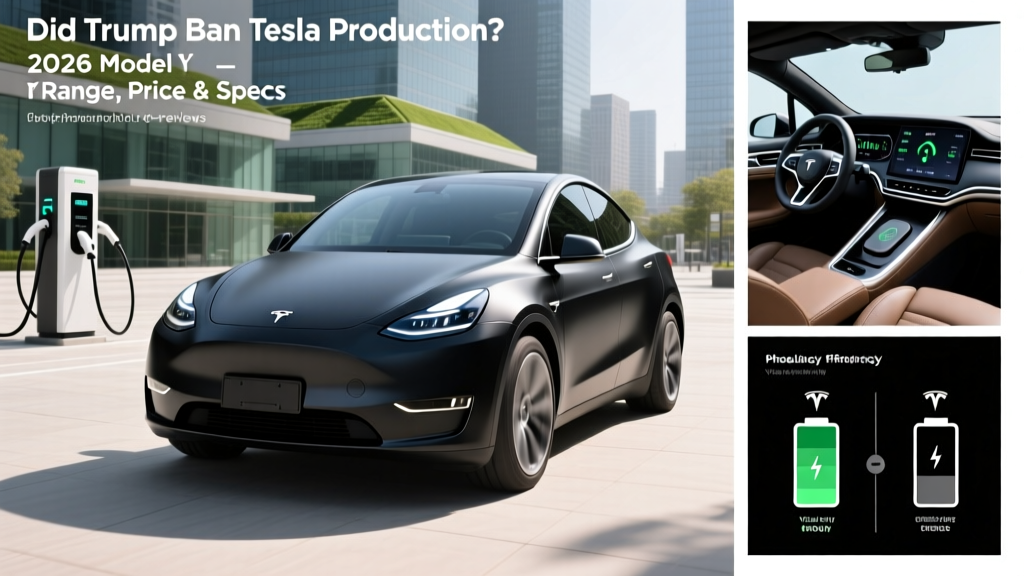
If you've seen headlines or social media posts claiming that Donald Trump has banned Tesla production, you can stop worrying: no such ban exists. As of early 2026, Tesla's U.S. manufacturing operations in Austin, Fremont, and elsewhere continue without federal interruption. The rumor appears to stem from a mix of political commentary, tariff disputes, and Elon Musk's public disagreements with the administration — none of which have translated into any executive action restricting Tesla's ability to build or sell cars in the United States.
What has changed in 2026 is the policy landscape around EVs: tariff adjustments on imported battery minerals, evolving IRS §30D tax credit sourcing requirements, and shifting federal incentives. These affect Tesla's pricing and credit eligibility, but they are not a production ban. Tesla's Giga Texas facility continues to produce the Model Y, Model 3, Cybertruck, and Semi at scale.
With the misinformation addressed, let's get to what actually matters for buyers: a data-driven review of the 2026 Tesla Model Y — the best-selling EV in America — covering real-world range, charging speed, pricing after tax credits, and whether it still holds up against a growing field of competitors.
2026 Tesla Model Y: Spec Table at a Glance
| Specification | Long Range RWD | Long Range AWD | Performance |
|---|---|---|---|
| EPA Range | 320 mi | 308 mi | 285 mi |
| Battery (usable) | ~75 kWh, NMC | ~75 kWh, NMC | ~75 kWh, NMC |
| MPGe (combined) | 122 MPGe | 116 MPGe | 111 MPGe |
| Efficiency | 27 kWh/100 mi | 29 kWh/100 mi | 30 kWh/100 mi |
| 0-60 mph | 5.8 sec | 4.8 sec | 3.5 sec |
| Horsepower | 346 hp | 384 hp | 510 hp |
| Drivetrain | RWD (single motor) | AWD (dual motor) | AWD (dual motor) |
| Max DC Fast Charge | 250 kW | 250 kW | 250 kW |
| 10-80% DC Time | ~25 min | ~25 min | ~25 min |
| Level 2 Home Charge | 11.5 kW (~44 mi/hr) | 11.5 kW (~44 mi/hr) | 11.5 kW (~44 mi/hr) |
| Cargo (rear seats up) | 30.2 cu ft | ||
| Cargo (seats folded) | 72.1 cu ft | ||
| Rear Legroom | 41.6 in | ||
| Base MSRP | $44,990 | $47,990 | $52,490 |
| Battery Warranty | 8 yr / 120,000 mi | ||
Source: EPA / fueleconomy.gov, Tesla.com specifications. Prices exclude destination fee. Specs reflect 2026 model year.
Real-World Range: Beyond the EPA Sticker
EPA Estimate: 320 miles (Long Range RWD)
Real-World Highway (70 mph, 75°F): ~265-280 miles
Real-World Highway (70 mph, 25°F): ~210-230 miles
Mixed City/Suburban Commute: ~290-310 miles
The EPA's 320-mile figure for the Long Range RWD is achievable in ideal conditions — moderate temperatures, city-suburban driving with regenerative braking doing heavy lifting. But as with every EV, your actual range depends heavily on speed, temperature, and terrain.
At sustained highway speeds of 70-75 mph, expect to lose roughly 12-18% versus the EPA sticker. That puts real-world highway range in the 265-280 mile window in fair weather. In freezing conditions (below 32°F), range drops further due to cabin heating demands and reduced battery efficiency — plan for 210-230 miles of highway range in deep winter. The Model Y's standard heat pump helps mitigate cold-weather losses compared to older EVs without one, but physics still applies.
For daily commuters doing 30-60 miles round trip with access to home charging, range is a non-issue. For road trippers, the 265-mile real-world highway number means charging stops every 3.5-4 hours — which aligns well with typical rest-stop cadence.
Charging Speed: DC Fast Charging and Home Setup
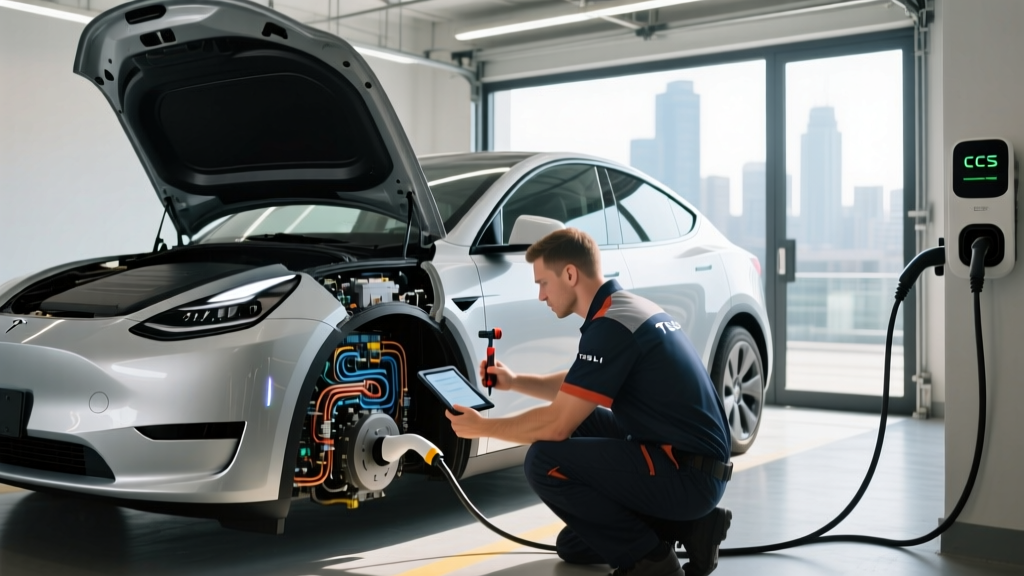
The 2026 Model Y supports a peak DC fast-charge rate of 250 kW on Tesla's V3 and V4 Superchargers, as well as on compatible CCS-equipped public stations (the Model Y now ships with the NACS connector natively, and CCS adapters are available for non-Tesla networks).
| Charging Level | Power (kW) | Speed (miles of range per hour) | Typical Use Case |
|---|---|---|---|
| Level 1 (120V household) | ~1.4 kW | ~5 mi/hr | Emergency / overnight trickle |
| Level 2 (240V home, 48A) | 11.5 kW | ~44 mi/hr | Daily home charging |
| DC Fast (Supercharger V3) | Up to 250 kW peak | ~1,000 mi/hr at peak | Road trips, rapid top-ups |
The charging curve matters. The Model Y peaks at 250 kW only at low state-of-charge (roughly 10-30% SoC). As the battery fills, the rate tapers: expect ~150 kW around 50% SoC, dropping to ~60 kW by 75%, and slowing further above 80%. A 10-80% session takes approximately 25 minutes under optimal thermal conditions. Tesla's navigation system automatically preconditions the battery when you route to a Supercharger — warming it to the ideal temperature for maximum charge acceptance. If you arrive at a fast charger without preconditioning (e.g., navigating manually), expect slower initial speeds, especially in cold weather.
For home charging, a Wall Connector on a 60A circuit delivers the full 11.5 kW / 44 miles of range per hour. An overnight charge (8-10 hours) easily replenishes a full battery. Installation costs for a Level 2 home setup typically range from $500 (simple outlet near the panel) to $2,500+ if a panel upgrade or long conduit run is required — consult a licensed electrician for your specific situation.
Pricing, Trims, and Federal Tax Credit Eligibility
| Trim | Base MSRP | Est. Federal Credit | Effective Price (if eligible) |
|---|---|---|---|
| Long Range RWD | $44,990 | Up to $7,500 | ~$37,490 |
| Long Range AWD | $47,990 | Up to $7,500 | ~$40,490 |
| Performance | $52,490 | Up to $7,500 | ~$44,990 |
Prices exclude $1,390 destination fee and potential state/local incentives.
Federal tax credit (§30D) eligibility for the Model Y in 2026 depends on several factors, and the rules have tightened under updated IRS critical-mineral and battery-component sourcing requirements. Here's what determines whether you qualify:
- MSRP cap: SUVs must be priced at or below $80,000. All Model Y trims clear this easily.
- Buyer income cap: Adjusted gross income must not exceed $150,000 (single), $225,000 (head of household), or $300,000 (joint filers).
- Battery sourcing: A percentage of critical minerals must be sourced from the U.S. or FTA partners, and battery components must be manufactured or assembled in North America. Tesla has significantly localized its supply chain, but the exact credit amount ($3,750 or $7,500) depends on whether the vehicle meets both the mineral and component thresholds for the given model year. Check the latest IRS qualified vehicle list before purchasing.
- Point-of-sale transfer: As of 2024, buyers can transfer the credit to the dealer at purchase, reducing the upfront cost rather than waiting for a tax refund. This remains available in 2026.
Important: Tax credit rules are subject to change, and your personal eligibility depends on your income, filing status, and tax liability. Consult a tax professional or reference irs.gov for definitive guidance.
Performance and Driving Dynamics
The 2026 Model Y continues to offer brisk acceleration across the lineup. The Long Range AWD hits 0-60 mph in 4.8 seconds with 384 hp from its dual-motor setup — more than sufficient for confident highway merging and passing. The Performance trim drops that to 3.5 seconds with 510 hp, which is sports-sedan quick in a crossover body.
Ride quality in the refreshed Model Y (post-2025 update) is noticeably improved over earlier models, with revised damper tuning and acoustic glass reducing road noise. The steering remains precise and weighted, though some drivers note it feels artificially heavy in Sport mode. Regenerative braking is strong and enables genuine one-pedal driving in most scenarios, though Tesla no longer allows drivers to fully disable regen — a point of contention for some buyers transitioning from ICE vehicles.
The Model Y's low center of gravity (battery pack under the floor) keeps body roll well-controlled through corners, though at 4,400+ lbs, it's no sports car in the twisties. For an electric crossover focused on efficiency and practicality, the handling is a genuine strength.
Interior, Tech, and Notable Drawbacks
The Model Y's interior follows Tesla's minimalist philosophy: a single 15.4-inch center touchscreen handles navigation, climate, media, and vehicle settings. There is no instrument cluster — speed and range info appear in the upper-left corner of the main display. Build quality has improved significantly at Giga Texas, with tighter panel gaps and higher-grade materials than early Fremont-built examples.
Standout tech features:
- Over-the-air (OTA) software updates that add features post-purchase
- Tesla Supercharger network — still the most reliable and widespread DC fast-charging network in the U.S. (~7,000+ stalls nationally)
- Sentry Mode dashcam recording and remote climate control via app
- Autopilot standard (adaptive cruise + lane centering); FSD (Supervised) available as a $8,000 option or $99/month subscription
Notable drawbacks:
- No physical buttons for climate, wipers, or glovebox — everything routes through the touchscreen, which can be distracting
- Rear visibility is compromised by the sloping roofline and thick C-pillars; the backup camera is essential
- FSD (Supervised) remains an SAE Level 2 system — it requires continuous driver attention and is not autonomous driving
- Insurance premiums tend to run 15-25% higher than comparable ICE crossovers due to repair costs
- No Apple CarPlay or Android Auto — Tesla's native infotainment is the only option
Warranty Coverage
Tesla's warranty for the 2026 Model Y:
- Basic vehicle: 4 years / 50,000 miles
- Battery and drive unit: 8 years / 120,000 miles (Long Range & Performance), with a guaranteed minimum 70% capacity retention over the warranty period
The 8-year/120,000-mile battery warranty is competitive with Hyundai/Kia's 10-year/100,000-mile coverage when you factor in the higher mileage allowance. Real-world degradation data from Tesla's fleet shows most Model Y packs retain 88-92% capacity at 100,000 miles — well above the 70% warranty threshold. The NMC chemistry used in Long Range and Performance trims offers higher energy density than LFP (used in the standard-range Model 3), at a slight trade-off in cycle life. For most owners, the battery will outlast the vehicle's useful life.
Who Should Buy the 2026 Tesla Model Y?
- You want access to the Supercharger network for hassle-free road trips
- You need 300+ miles of real-world range for commuting and weekend travel
- You value OTA updates that keep the vehicle current years after purchase
- You want strong cargo space (72.1 cu ft with seats folded) in a midsize crossover
- You qualify for the §30D tax credit, bringing the effective price into the low $40Ks
- You prefer physical buttons and traditional infotainment (consider Hyundai Ioniq 5 or Kia EV6)
- You need three rows of seating (consider the Kia EV9 or Tesla Model X)
- You want the absolute lowest price point (the Chevy Equinox EV starts ~$10K less)
- You're uncomfortable with Tesla's all-touchscreen interface or Autopilot's Level 2 limitations
Frequently Asked Questions
Did Trump actually ban Tesla production?
No. There is no executive order, legislation, or regulatory action banning Tesla from manufacturing vehicles in the United States as of 2026. Tesla's U.S. factories (Giga Texas, Fremont, Giga Nevada) continue normal operations. The rumor conflates political commentary and tariff policy debates with actual production restrictions, which do not exist.
What is the real-world range of the 2026 Tesla Model Y?
The EPA rates the Long Range RWD at 320 miles. In real-world highway driving at 70 mph and moderate temperatures, expect approximately 265-280 miles. In freezing winter conditions, plan for 210-230 miles of highway range. City and suburban driving with regenerative braking can approach or match the EPA figure.
How fast does the Model Y charge at home and on road trips?
On a DC fast charger (Tesla Supercharger V3), the Model Y peaks at 250 kW and charges from 10-80% in approximately 25 minutes. At home on a Level 2 Wall Connector (11.5 kW / 48A), it adds about 44 miles of range per hour, fully recharging overnight in 7-8 hours.
Does the 2026 Tesla Model Y qualify for the $7,500 federal EV tax credit?
It can, but eligibility depends on your income (capped at $150K single / $300K joint), the vehicle's MSRP (under $80K — all trims qualify), and current battery-sourcing compliance. The credit amount ($3,750 or $7,500) depends on whether both critical-mineral and battery-component thresholds are met. Verify on the IRS qualified vehicles list and consult a tax professional.
Is the Model Y still worth buying vs. the Hyundai Ioniq 5 or Ford Mustang Mach-E?
The Model Y remains the benchmark for range efficiency, Supercharger network access, and cargo versatility. The Ioniq 5 offers faster 800V charging (10-80% in ~18 min on a 350 kW charger) and a more conventional interior with physical buttons. The Mach-E provides a more engaging driving feel and CarPlay support. If Supercharger access and cargo space are priorities, the Model Y still leads. If charging speed or interior ergonomics matter more, test-drive the Ioniq 5.
Is Tesla's FSD (Full Self-Driving) actually self-driving?
No. FSD (Supervised) is an SAE Level 2 driver-assistance system. It can handle highway lane changes, navigate on-ramps, and manage some city streets, but it requires the driver to remain fully attentive with hands ready to take over at any moment. It is not autonomous driving. Only Level 4 services like Waymo operate without a human driver — and those are limited to specific geofenced areas.