Quick Answer: Toyota's Upcoming Three-Row EV SUV
Toyota is teasing a new large three-row electric SUV expected to debut as a production model in late 2026 or early 2027. Based on teaser imagery and industry reporting, the vehicle will likely ride on an evolved version of Toyota's dedicated EV architecture, target an EPA range of roughly 300–330 miles, offer seating for up to seven, and carry a starting MSRP in the $50,000–$55,000 range before incentives. Until Toyota releases final specifications, all numbers below are preliminary estimates based on Toyota's prior EV announcements, current bZ-series engineering, and competitive benchmarks in the segment.
What Toyota Has Revealed So Far
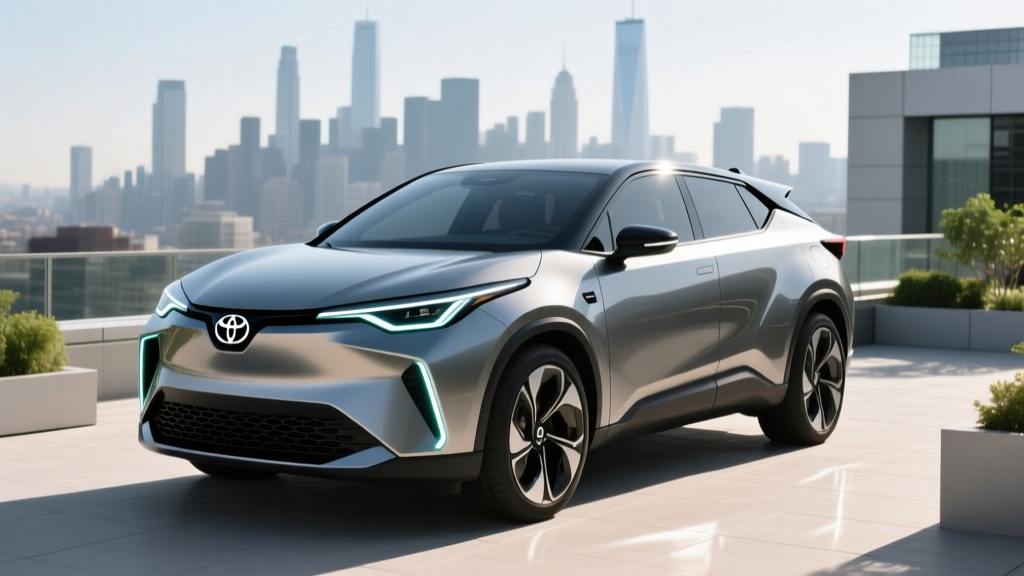
Toyota's teaser campaign points to a battery-electric, three-row crossover positioned above the bZ4X in both size and price. The automaker has confirmed the vehicle will use a dedicated EV platform — not a converted gas-car chassis — which typically allows for a flat floor, better interior packaging, and optimized battery placement. Toyota's recent EV concepts have hinted at a design language featuring a closed-off grille, slim LED lighting, and a stretched wheelbase to accommodate third-row seating.
What we can reasonably project based on Toyota's engineering trajectory and the competitive landscape:
| Specification | Estimated | Competitive Benchmark |
|---|---|---|
| Battery capacity (usable) | ~95–105 kWh | Hyundai Ioniq 9: ~110 kWh |
| Battery chemistry | NMC (nickel manganese cobalt) likely | Kia EV9: NMC |
| EPA-estimated range | ~300–330 mi | Kia EV9: 270–304 mi |
| Peak DC fast-charge rate | ~200–250 kW | Hyundai Ioniq 9: ~240 kW |
| 10–80% DC charge time | ~25–30 min (est.) | Kia EV9: ~24 min at 350 kW |
| Level 2 AC charging | 11–19 kW onboard | Industry standard: 11.5 kW |
| Drivetrain | RWD standard, AWD available | Kia EV9: RWD/AWD |
| Horsepower (AWD est.) | ~350–400 hp | Kia EV9 AWD: 379 hp |
| 0–60 mph (AWD est.) | ~5.5–6.5 sec | Kia EV9 GT-Line AWD: 5.0 sec |
| Seating | 6 or 7 passengers | Segment standard |
| Towing capacity (est.) | ~3,500–5,000 lbs | Rivian R1S: 7,700 lbs |
| Starting MSRP (est.) | $50,000–$55,000 | Kia EV9: $54,900 |
All figures are preliminary estimates. Final specifications will be confirmed by Toyota at the vehicle's official reveal. Source benchmarks: fueleconomy.gov, manufacturer press sites.
How Does a Toyota Three-Row EV Compare to Gas and Hybrid Alternatives?
Toyota dominates the three-row family SUV segment with the gas-powered Highlander and the hybrid Grand Highlander. Buyers cross-shopping the upcoming EV against these established models need a clear cost and capability comparison.
| Metric | Toyota 3-Row EV (Est.) | Grand Highlander Hybrid | Highlander (Gas V6) |
|---|---|---|---|
| Starting MSRP | ~$52,000 | $46,605 | $39,070 |
| EPA fuel economy / efficiency | ~85–95 MPGe | 36 MPG combined | 24 MPG combined |
| Energy cost per mile (national avg.) | ~$0.04–$0.05 | ~$0.10 | ~$0.15 |
| Annual fuel/energy (15,000 mi) | ~$600–$750 | ~$1,500 | ~$2,250 |
| Estimated 5-yr fuel savings vs. gas | $7,500–$8,250 | $3,750 | Baseline |
| Scheduled maintenance (5 yr est.) | ~$1,200 | ~$2,800 | ~$3,200 |
| Federal tax credit eligibility (§30D) | Up to $7,500* | None (hybrid) | None |
| Cargo (behind 3rd row, cu ft) | ~18–22 (est.) | 20.6 | 16.1 |
*Federal tax credit eligibility under IRS §30D depends on MSRP caps (vans/SUVs: up to $80,000), buyer income limits ($300K MFJ / $150K single), and battery critical-mineral and component sourcing requirements. Rules are subject to change — verify current eligibility at irs.gov and consult a tax professional.
Real-World Range: What the EPA Sticker Won't Tell You
If Toyota delivers an EPA-estimated 320 miles, that number represents a controlled laboratory test cycle. Real-world range for a large, three-row electric SUV depends heavily on conditions:
- Highway driving at 75+ mph: Expect roughly 10–15% range reduction. A 320-mile EPA rating translates to approximately 270–290 miles on a sustained interstate trip.
- Cold weather (below 32°F): Battery chemistry and cabin heating can reduce range by 20–30%. In sub-freezing conditions, plan for 220–260 miles of usable range.
- Towing or heavy cargo loads: Towing even a small trailer can cut range by 30–50%, dropping effective range to 160–220 miles.
- DC fast-charging curve taper: Peak charging rates (e.g., 250 kW) are only sustained at low states of charge. Expect the charge rate to taper significantly above 80% SoC — that last 20% can take as long as the first 80%.
For a family road-tripper, this means planning charging stops every 200–250 miles in mixed conditions is a sensible strategy, even with a 320-mile sticker. Preconditioning the battery (warming it before arriving at a fast charger) will be essential for achieving advertised charge speeds, especially in cooler weather.
Cost Breakdown: Purchase, Charging, and Ongoing Ownership
Here's a realistic five-year cost projection for the Toyota three-row EV compared to the Grand Highlander Hybrid, assuming 15,000 miles driven annually and national average energy prices.
| Cost Category | Toyota 3-Row EV (Est.) | Grand Highlander Hybrid |
|---|---|---|
| Purchase price (base MSRP) | $52,000 | $46,605 |
| Federal tax credit (§30D est.) | –$7,500* | $0 |
| Net purchase after credit | $44,500 | $46,605 |
| Home Level 2 charger install | $1,200–$2,500 | N/A |
| Energy/fuel (5 years) | $3,250–$3,750 | $7,500 |
| Maintenance (5 years) | $1,200 | $2,800 |
| Insurance (5 years, est. avg.) | $9,500–$11,000 | $7,500–$9,000 |
| Estimated 5-year total | $59,650–$62,950 | $64,405–$65,905 |
Key takeaways: The EV's higher sticker price is partially offset by the federal tax credit (if eligible) and substantially lower energy and maintenance costs. Insurance premiums for EVs tend to run 10–20% higher than equivalent gas vehicles due to higher repair costs and specialized parts. Over five years, the EV can break even or come out slightly ahead on total cost — and the savings gap widens in years six through ten as fuel savings compound.
Home charging installation is a one-time cost. A Level 2 charger (240V, 40–48 amps) typically costs $500–$800 for the unit and $700–$1,700 for professional electrical installation, depending on whether your panel needs upgrading. If your home has a 200-amp panel with spare capacity, expect the lower end. A panel upgrade to 200A or higher can add $1,500–$3,000. Consult a licensed electrician for a site-specific quote.
Common Misconceptions About Large Electric SUVs
| Myth | Fact |
|---|---|
| "The battery will need replacing in a few years." | Modern NMC and LFP batteries are designed for 200,000+ miles with less than 20% degradation. Toyota's EV battery warranty is expected to cover 8 years/100,000 miles with a capacity retention threshold (typically 70% of original capacity). |
| "You can't take a large EV on road trips." | With 300+ miles of range and 25-minute fast-charge stops (10–80%), a 600-mile road trip requires one charging stop of roughly 25–30 minutes. Planning apps like A Better Routeplanner make this straightforward. |
| "EVs are worse in cold weather." | Range does decrease 20–30% in freezing temps, but EVs start reliably in any cold (no engine cranking), can precondition the cabin while plugged in, and use heat pumps for efficient heating. The range loss is manageable with planning. |
| "I need a special electrical system to charge at home." | Most homes with a 200-amp panel can support a Level 2 charger on a 50-amp circuit. A qualified electrician can confirm your panel's capacity. Level 1 charging (standard 120V outlet) adds 3–5 miles per hour overnight — sufficient for some daily commutes. |
| "The $7,500 tax credit applies to everyone." | IRS §30D has income caps ($300K married filing jointly, $150K single), MSRP caps ($80K for SUVs/vans), and battery sourcing requirements. Not all buyers or all trims will qualify. Verify at irs.gov. |
Charging Infrastructure: What You Need Before You Buy
A large three-row EV SUV demands a practical charging strategy. Here's what matters:
Home charging (essential for most owners): A Level 2 home charger at 11.5 kW (48 amps on a 240V/60A circuit) can fully replenish a ~100 kWh battery overnight in roughly 9–10 hours. This is the backbone of daily EV ownership — you start each morning with a full battery.
Public DC fast charging: For road trips, the vehicle's peak DC charge rate (estimated 200–250 kW) determines how quickly you can add range. At a 350 kW Electrify America or Tesla Supercharger station, expect to add roughly 150–200 miles in a 20-minute session (10–80% SoC). However, actual speeds depend on battery temperature, state of charge, and station congestion.
Connector standard: By 2026, the NACS (North American Charging Standard) connector — originally developed by Tesla — has been widely adopted across the industry. Toyota has confirmed NACS compatibility on its newer EVs. This means access to the Tesla Supercharger network (over 25,000 stalls in North America) in addition to CCS-based networks like Electrify America and EVgo. Verify the specific connector on the production model when announced.
If you don't have home charging: Public-only charging is possible but less convenient and more expensive. DC fast-charging costs average $0.30–$0.50 per kWh nationally, pushing your per-mile energy cost closer to $0.10–$0.14 — narrowing the savings gap versus a hybrid. Before purchasing any EV, honestly assess your daily charging access.
Decision Framework: Should You Wait for Toyota's EV or Buy Now?
Choose the Toyota Three-Row EV (when available) if:
- You want a dedicated EV platform with optimized packaging and a flat floor
- You have reliable home charging (Level 2 or at minimum Level 1)
- Your daily driving is under 200 miles and you road-trip 2–4 times per year
- You value lower ongoing energy and maintenance costs over a lower purchase price
- You qualify for the federal §30D tax credit (check income and sourcing rules)
- You prefer Toyota's dealer network and resale value track record
Choose the Grand Highlander Hybrid instead if:
- You lack home charging access and rely on street parking or apartments
- You frequently tow more than 3,500 lbs or drive in extreme cold regularly
- You need a vehicle immediately and cannot wait for the EV's production timeline
- Your budget is tighter and the ~$5,000–$8,000 price premium of the EV is prohibitive even after incentives
- You drive in rural areas with limited DC fast-charging infrastructure
Consider the Kia EV9 or Hyundai Ioniq 9 if:
- You want a three-row EV now — both are already on sale with confirmed EPA specs
- You want to compare real-world range and charging data from existing owners
- You prefer to test-drive and purchase immediately rather than wait for an unreleased model
Frequently Asked Questions
When will Toyota's three-row electric SUV be available to buy?
Toyota has teased the vehicle but has not confirmed an exact on-sale date. Based on the teaser timeline and typical production ramps, expect the vehicle to go on sale in late 2026 or as a 2027 model year. Final pricing and specs will be announced closer to launch.
Will it qualify for the $7,500 federal EV tax credit?
It's too early to confirm. Eligibility under IRS §30D depends on battery sourcing (critical minerals and component manufacturing), buyer income limits, and the vehicle's MSRP staying under the $80,000 SUV cap. Toyota's prior bZ4X did qualify at launch, but rules have tightened. Check irs.gov for the current eligible vehicle list when the model is released.
How does it compare to the Kia EV9?
The Kia EV9 currently offers 270–304 miles of EPA range (depending on trim and drivetrain), DC fast charging up to 350 kW (10–80% in ~24 minutes), and starts at $54,900. Toyota's EV will likely target similar or slightly better range, potentially at a competitive price point, but exact specs won't be confirmed until the reveal. The EV9 has the advantage of being available now with real-world ownership data.
Will it have a frunk (front trunk)?
Dedicated EV platforms typically include a frunk, but Toyota has not confirmed cargo details. Competitors like the EV9 offer a modest front trunk (roughly 1.8 cu ft for storage). Expect Toyota to include one, but size and features (drain plug, power open/close) are TBD.
What battery chemistry will Toyota use?
Toyota has used both NMC (nickel manganese cobalt) and LFP (lithium iron phosphate) chemistries across its global lineup. For a large, range-focused SUV, NMC is more likely due to its higher energy density — meaning more range in a given battery volume. LFP offers longer cycle life and lower cost but is heavier per kWh, which matters less in smaller vehicles. Toyota's final chemistry choice will affect both range and long-term degradation characteristics.
Is this a self-driving vehicle?
No. Expect Toyota to equip the vehicle with its Toyota Safety Sense suite — a Level 2 driver-assistance system per SAE automation standards. This includes adaptive cruise control, lane-centering, and automated emergency braking. The driver must remain engaged and supervising at all times. Level 2 is not self-driving; it is an assistance feature.