The landscape of Tesla new incentives shifted significantly entering 2026, with federal tax credit rules tightening around battery sourcing and critical mineral requirements. For buyers eyeing a Model Y or Model 3, understanding exactly which trims qualify for the full $7,500 §30D credit—and which fall short due to MSRP caps or income limits—can mean the difference between a $31,490 Model 3 and one that costs $38,990 out of pocket. This guide breaks down current Tesla pricing, real-world range expectations, charging performance, and the precise incentive eligibility for each model.
2026 Tesla Lineup: Quick Verdict
Tesla's core lineup for 2026 centers on the refreshed Model 3 (Highland) and the Juniper-updated Model Y, both benefiting from improved efficiency, quieter cabins, and updated interior materials. The Model S and Model X continue as premium offerings but face stiff competition from the Lucid Air and Rivian R1S respectively. For most buyers, the Model Y Long Range AWD remains the sweet spot: 320 miles EPA, access to the Supercharger network, and strong likelihood of full federal credit eligibility when configured under the MSRP cap.
Tesla Model 3: Specs, Range & Pricing
| Spec | Model 3 RWD | Model 3 Long Range AWD | Model 3 Performance |
|---|---|---|---|
| EPA Range | 272 mi | 346 mi | 315 mi |
| Battery (usable) | 60 kWh (LFP) | 79 kWh (NMC) | 79 kWh (NMC) |
| Drivetrain | RWD | Dual-Motor AWD | Dual-Motor AWD |
| Horsepower | 271 hp | 346 hp | 510 hp |
| 0–60 mph | 5.8 sec | 4.2 sec | 2.9 sec |
| Efficiency | 25 kWh/100mi (134 MPGe) | 24 kWh/100mi (140 MPGe) | 26 kWh/100mi (129 MPGe) |
| Max DC Charge | 170 kW | 250 kW | 250 kW |
| 10–80% DC Time | ~25 min | ~20 min | ~20 min |
| Level 2 Rate | 11.5 kW (~44 mi/hr) | 11.5 kW (~44 mi/hr) | 11.5 kW (~44 mi/hr) |
| Base MSRP | $38,990 | $45,990 | $52,990 |
| Cargo Volume | 23 cu ft (trunk + frunk) | 23 cu ft | 23 cu ft |
| Rear Legroom | 35.2 in | 35.2 in | 35.2 in |
The base Model 3 RWD uses a lithium iron phosphate (LFP) battery, which trades energy density for longevity—Tesla recommends charging LFP to 100% regularly, and degradation is typically under 5% over 100,000 miles. The Long Range and Performance trims use nickel-manganese-cobalt (NMC) chemistry for higher energy density; daily charging to 80% is recommended, with 100% reserved for road trips.
Tesla Model Y: Specs, Range & Pricing
| Spec | Model Y RWD | Model Y Long Range AWD | Model Y Performance |
|---|---|---|---|
| EPA Range | 260 mi | 320 mi | 293 mi |
| Battery (usable) | 60 kWh (LFP) | 79 kWh (NMC) | 79 kWh (NMC) |
| Drivetrain | RWD | Dual-Motor AWD | Dual-Motor AWD |
| Horsepower | 295 hp | 384 hp | 455 hp |
| 0–60 mph | 6.6 sec | 4.8 sec | 3.5 sec |
| Efficiency | 26 kWh/100mi (129 MPGe) | 25 kWh/100mi (134 MPGe) | 27 kWh/100mi (125 MPGe) |
| Max DC Charge | 170 kW | 250 kW | 250 kW |
| 10–80% DC Time | ~25 min | ~20 min | ~20 min |
| Level 2 Rate | 11.5 kW (~44 mi/hr) | 11.5 kW (~44 mi/hr) | 11.5 kW (~44 mi/hr) |
| Base MSRP | $44,990 | $49,990 | $53,990 |
| Cargo Volume | 72 cu ft (max) | 72 cu ft (max) | 72 cu ft (max) |
| Rear Legroom | 38.4 in | 38.4 in | 38.4 in |
| Towing Capacity | — | 3,500 lbs | 3,500 lbs |
The Juniper refresh brought a redesigned front fascia, ventilated front seats, ambient lighting, and a rear touchscreen for passengers. Efficiency improved roughly 5% over the prior generation, translating to about 15 additional miles of EPA range on the Long Range AWD. The Model Y's hatchback design and 72 cu ft of cargo space with rear seats folded make it the practical choice for families and those who need to haul gear.
Charging Performance: Home & DC Fast Charging
| Charging Level | Power / Rate | Miles Added per Hour | Best Use Case |
|---|---|---|---|
| Level 1 (120V) | ~1.4 kW | ~4–5 mi/hr | Overnight trickle, low-mileage commuters |
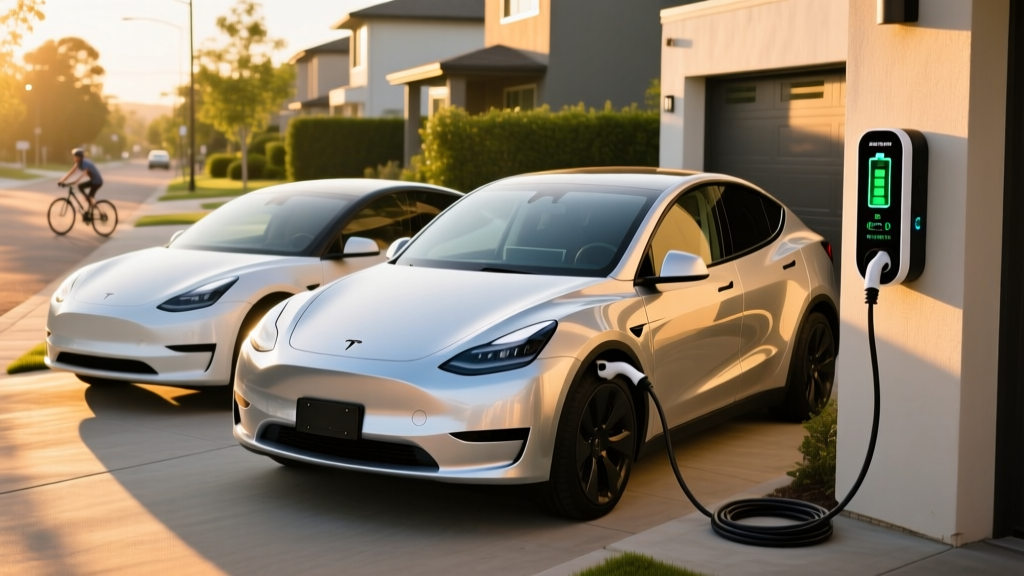
| Level 2 (240V, 48A) | 11.5 kW | ~44 mi/hr | Daily home charging, full overnight replenish |
| DC Fast (250 kW peak) | Up to 250 kW | ~1,000 mi/hr (peak) | Road trips; 10–80% in ~20 min (LR/Perf) |
Tesla's charge curve is aggressive in the mid-range but tapers significantly above 80% state of charge. On a V3 Supercharger (250 kW), the Model Y Long Range pulls peak power between roughly 15% and 45% SoC, then steps down to ~150 kW by 60% and ~75 kW by 80%. This means a 10–80% session takes about 20 minutes, but pushing from 80–100% adds another 20–25 minutes. For road-trip efficiency, Tesla's navigation routes you through Superchargers and preconditions the battery automatically—arrive at a charger with the battery cold and you'll see peak rates closer to 100 kW until it warms.
For home Level 2 installation, budget $1,200–$2,500 for a Tesla Wall Connector plus electrician labor on a 60A circuit (48A continuous). Homes with older 100A electrical panels may need a $2,000–$4,000 panel upgrade to 200A, which is a common surprise cost for first-time EV buyers.
Federal Tax Credit & Tesla New Incentives Breakdown
The IRS §30D federal tax credit offers up to $7,500 for qualifying new EVs, but eligibility for Tesla models depends on three intersecting rules: buyer income, vehicle MSRP, and battery component/mineral sourcing. As of 2026, the credit can be applied at the point of sale as a direct discount rather than waiting for a tax refund.
| Model / Trim | Base MSRP | SUV MSRP Cap | Est. Credit | Effective Price |
|---|---|---|---|---|
| Model 3 RWD | $38,990 | $55,000 (sedan) | Up to $7,500* | ~$31,490 |
| Model 3 Long Range AWD | $45,990 | $55,000 (sedan) | Up to $7,500* | ~$38,490 |
| Model 3 Performance | $52,990 | $55,000 (sedan) | Up to $7,500* | ~$45,490 |
| Model Y RWD | $44,990 | $80,000 (SUV) | Up to $7,500* | ~$37,490 |
| Model Y Long Range AWD | $49,990 | $80,000 (SUV) | Up to $7,500* | ~$42,490 |
| Model Y Performance | $53,990 | $80,000 (SUV) | Up to $7,500* | ~$46,490 |
*Credit amount depends on battery sourcing compliance. The $7,500 credit splits into two halves: $3,750 for battery components manufactured in North America, and $3,750 for critical minerals sourced from the U.S. or free-trade-agreement countries. Tesla's Fremont and Austin battery cell production has steadily increased domestic sourcing, but verify current compliance on fueleconomy.gov before purchase. Buyer income caps: $150,000 single / $225,000 head of household / $300,000 joint (modified AGI). See IRS §30D guidelines for full details.
- Buyer MAGI under $150K (single) / $300K (joint filing)
- Vehicle MSRP under $55,000 for sedans (Model 3) or $80,000 for SUVs (Model Y)
- Battery components ≥ North American manufactured threshold
- Critical minerals ≥ sourced from U.S./FTA partner threshold
- Vehicle assembled in North America (all U.S.-built Teslas qualify)
- Point-of-sale transfer available at Tesla delivery
Tech, Driver Assistance & Ownership Experience
Every 2026 Tesla ships with Basic Autopilot, which provides lane centering and traffic-aware cruise control. This is an SAE Level 2 driver-assistance system—you must keep your hands on the wheel and eyes on the road at all times. Full Self-Driving (Supervised) adds automatic lane changes, traffic light/stop sign recognition, and Navigate on Autopilot for $8,000 (or $99/month), but remains Level 2 despite the name. No production Tesla is self-driving.
The infotainment system runs on a 15.4-inch center touchscreen with no physical buttons for climate or mirrors—everything routes through the screen or voice commands. Netflix, YouTube, and gaming are available while parked. Over-the-air updates continue to add features post-purchase, though some have been paywalled (acceleration boost, rear-seat heating in earlier models).
Tesla's warranty covers the battery and drive unit for 8 years / 100,000 miles on RWD models and 8 years / 120,000 miles on Long Range and Performance trims, with a minimum 70% capacity retention threshold. The basic vehicle warranty is 4 years / 50,000 miles. Battery replacement costs outside warranty range from $12,000–$16,000 depending on pack size, though real-world data from IIHS-monitored fleets shows most Tesla packs retain 88–92% capacity at 100,000 miles.
- Access to 6,000+ Supercharger stalls—most reliable DC network in the U.S.
- Industry-leading efficiency (24–27 kWh/100mi) means lower charging cost per mile
- OTA updates add features without dealer visits
- Strong resale value relative to most EV competitors
- Point-of-sale tax credit reduces effective purchase price immediately
- No Apple CarPlay or Android Auto—Tesla's ecosystem only
- Minimalist interior lacks physical controls; learning curve for climate/mirror adjustments
- FSD (Supervised) is expensive and still requires full driver attention
- Insurance premiums run 15–30% higher than comparable non-Tesla EVs
- Panel gaps and build consistency still draw complaints, though improved since 2023
Tesla vs. Key Competitors: Is It Worth Buying?
The Model Y Long Range AWD ($49,990, 320 mi) competes directly with the Hyundai Ioniq 5 ($52,600, 305 mi), Ford Mustang Mach-E Extended Range ($51,995, 312 mi), and Kia EV6 ($51,900, 310 mi). Tesla's advantages: lower base price, higher EPA range, and Supercharger access. Competitors counter with more conventional interiors (physical buttons, CarPlay), faster peak charging in some cases (Ioniq 5 at 350 kW on capable chargers), and available dealer service networks.
The Model 3 Long Range AWD ($45,990, 346 mi) is the efficiency benchmark in its class. The Hyundai Ioniq 6 ($47,500, 361 mi) beats it on range but sacrifices cargo space. The BMW i4 eDrive40 ($57,900, 307 mi) offers a more traditional luxury experience at a premium. For pure value-per-mile-of-range, the Model 3 remains difficult to beat.
Who Should Buy a Tesla in 2026?
- You road-trip regularly and want the most reliable DC fast-charging network
- You want maximum range per dollar and can charge at home
- You prefer OTA updates and a tech-forward ownership model
- Your household income qualifies for the §30D credit
- You need Apple CarPlay/Android Auto or prefer physical controls
- You want dealer-based service and traditional sales negotiation
- Your commute is short and a less expensive PHEV or shorter-range EV suffices
- You exceed the income cap for the federal tax credit
Frequently Asked Questions
What is the real-world range of a Tesla Model Y?
The Model Y Long Range AWD is EPA-rated at 320 miles. In real-world highway driving at 70 mph, expect 275–290 miles. In cold weather (below 32°F), plan for 240–260 miles. Preconditioning the battery via the Tesla app before departure mitigates some cold-weather loss.
How fast does a Tesla charge at home and on the road?
At home on a Level 2 Tesla Wall Connector (11.5 kW), you gain roughly 44 miles of range per hour—a full overnight charge. On a V3 Supercharger (250 kW peak), the Model Y Long Range charges from 10–80% in about 20 minutes, though the rate tapers significantly above 80% SoC.
Does Tesla qualify for the $7,500 federal tax credit?
All current Model 3 and Model Y trims fall under the MSRP cap and are assembled in the U.S. However, the full $7,500 depends on battery component and critical mineral sourcing thresholds that change annually. Verify your specific configuration on fueleconomy.gov before ordering. Buyer income must be under $150K single / $300K joint.
Is the Tesla Model Y worth buying over the Hyundai Ioniq 5 or Ford Mach-E?
The Model Y wins on price (starting ~$3,000–$5,000 less), range (320 vs. 305–312 mi), and Supercharger network access. The Ioniq 5 and Mach-E offer more conventional interiors with physical controls, Apple CarPlay, and in some cases faster peak charging on 350 kW-capable infrastructure. If charging network reliability is your top priority, Tesla still leads.
What are the biggest drawbacks of owning a Tesla?
No Apple CarPlay or Android Auto, insurance costs 15–30% above average, all controls are screen-based with a learning curve, and FSD (Supervised) costs $8,000 extra while still requiring full driver attention. Service center wait times can be long in some metro areas.
How long will a Tesla battery last?
Tesla warrants the battery for 8 years / 100,000–120,000 miles (depending on trim) with a minimum 70% capacity retention. Real-world fleet data shows most packs retain 88–92% at 100,000 miles. LFP batteries (Model 3 RWD, Model Y RWD) tend to degrade more slowly than NMC, often retaining 93–95% at the same mileage.