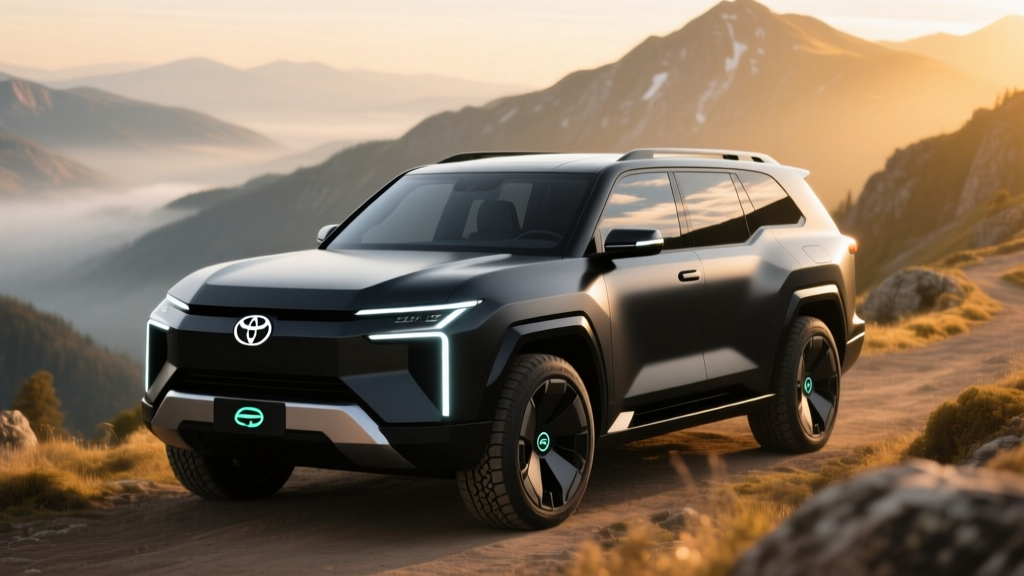
If you're searching for a Land Cruiser electric model in 2026, the direct answer is: Toyota does not currently sell a fully electric Land Cruiser in the United States. The current-generation 2024–2026 Land Cruiser is a hybrid only, pairing a 2.4-liter turbocharged four-cylinder engine with an electric motor in Toyota's i-FORCE MAX powertrain. While Toyota has announced a next-generation all-electric Land Cruiser concept globally, it remains unreleased for the U.S. market with no confirmed on-sale date.
Quick Answer
Current option: 2026 Toyota Land Cruiser Hybrid (i-FORCE MAX) — 27 MPG combined, ~$57,000 base MSRP.
Fully electric Land Cruiser: Not yet available in the U.S. Toyota has previewed an EV concept but confirmed no production timeline for North America.
Closest EV alternative: Rivian R1S, Tesla Model X, or upcoming electric body-on-frame SUVs from GM and Stellantis.
What Toyota Actually Sells: The 2026 Land Cruiser Hybrid
The reintroduced Land Cruiser for the U.S. market rides on Toyota's TNGA-F body-on-frame platform, shared with the Tacoma, 4Runner, and Sequoia. It's exclusively available with the i-FORCE MAX hybrid powertrain — there is no gas-only or fully electric variant.
| Spec | 2026 Land Cruiser (i-FORCE MAX) |
|---|---|
| Powertrain | 2.4L turbo I-4 hybrid |
| Horsepower | 326 hp combined |
| Torque | 465 lb-ft |
| EPA Fuel Economy | 23 city / 27 hwy / 25 combined MPG |
| 0–60 mph | ~6.4 seconds |
| Towing Capacity | 6,000 lbs |
| Base MSRP | ~$57,345 (1958 trim) |
| Warranty | 3 yr / 36,000 mi basic; 5 yr / 60,000 mi powertrain |
The hybrid system uses a small 1.87 kWh nickel-metal hydride battery — far too small to qualify as a plug-in hybrid (PHEV). You cannot charge it externally, and there is no electric-only driving range. The electric motor serves as a torque-fill assist, boosting low-end response and improving efficiency by roughly 15–20% over a conventional gas setup.
How the Land Cruiser Hybrid Compares to an Electric SUV
If you want a three-row, body-on-frame, off-road-capable SUV with zero tailpipe emissions, no current production EV matches the Land Cruiser's exact formula. Here's how the hybrid stacks up against the closest electric alternatives:
| Attribute | 2026 Land Cruiser Hybrid | 2026 Rivian R1S (Dual-Motor) | 2026 Tesla Model X (Long Range) |
|---|---|---|---|
| Powertrain | Turbo hybrid | BEV (dual motor) | BEV (dual motor) |
| EPA Range / MPG | 25 MPG (~525 mi on 21-gal tank) | ~352 mi (EPA) | ~348 mi (EPA) |
| 0–60 mph | 6.4 sec | 4.5 sec | 3.8 sec |
| Towing | 6,000 lbs | 7,700 lbs | 5,000 lbs |
| Off-Road Capability | Excellent (locking diffs, crawl control) | Very good (air suspension, tank turns) | Limited |
| Base MSRP | ~$57,345 | ~$79,900 | ~$81,630 |
| Federal Tax Credit (§30D) | Not eligible (hybrid) | Up to $7,500 (verify sourcing) | Not eligible (MSRP cap exceeded) |
The Land Cruiser hybrid wins on price, proven off-road durability, and refueling flexibility — you can fill up anywhere in five minutes. The Rivian R1S wins on performance, zero emissions, and lower per-mile energy cost if you have home charging access. The Model X is the fastest but the least off-road oriented and exceeds the IRS §30D MSRP cap of $80,000 for SUVs, disqualifying it from the federal credit.
Real Costs: Hybrid vs Electric SUV Ownership
Beyond the sticker price, ownership costs diverge significantly between hybrid and electric SUVs. Here's a five-year cost breakdown assuming 15,000 miles per year, national average fuel and electricity prices:
| Cost Category (5 years) | Land Cruiser Hybrid | Rivian R1S (Dual-Motor) |
|---|---|---|
| Purchase Price (base) | $57,345 | $79,900 |
| Federal Tax Credit | $0 | Up to -$7,500 (if eligible) |
| Fuel / Electricity | ~$12,600 (gas @ $3.50/gal, 25 MPG) | ~$5,400 (electric @ $0.15/kWh, 2.5 mi/kWh) |
| Maintenance | ~$3,500 (oil, filters, brakes) | ~$1,500 (no oil changes, regen saves brakes) |
| Insurance (avg) | ~$9,000 | ~$12,000 (higher repair costs) |
| 5-Year Total (est.) | ~$82,445 | ~$91,300 (after credit) |
The hybrid is roughly $9,000 cheaper over five years at the base trim, primarily because of its lower purchase price. However, the Rivian's per-mile energy cost is about 60% lower — $0.072/mi versus $0.168/mi for gas. If you drive significantly more than 15,000 miles per year, the energy-cost advantage of an EV widens. Conversely, if you drive less or lack home charging access, the hybrid's lower upfront cost and zero range anxiety may outweigh EV savings.
Will Toyota Make an All-Electric Land Cruiser?
Toyota has signaled intent to electrify its full lineup, including its iconic off-roaders. The company unveiled the bZ4X as its first global battery-electric SUV and has committed to a broader EV rollout. Internationally, Toyota has shown concepts hinting at an electric Land Cruiser successor, potentially on a dedicated EV platform.
However, Toyota's U.S. EV strategy has been cautious. The bZ4X (rebadged for 2025+ as a more competitive offering) remains Toyota's only BEV on American roads. A body-on-frame electric Land Cruiser would require a large battery pack — likely 100+ kWh — to match the current model's ~525-mile effective range and towing capability, adding significant weight and cost. Toyota has historically prioritized hybrids and hydrogen fuel cells for its larger vehicles.
Bottom line: Don't wait for a Land Cruiser electric if you need a vehicle in the next 1–2 years. It is not in Toyota's confirmed U.S. product pipeline for 2026–2027.
Decision Framework: Should You Buy the Hybrid or Look Elsewhere?
Choose the Land Cruiser Hybrid If:
- You need serious off-road capability with locking differentials and crawl control
- You tow regularly (up to 6,000 lbs) and can't risk EV range loss under load
- You live in a rural area or charging desert with limited DC fast-charging infrastructure
- You want a proven platform with Toyota's reliability track record and dealer network
- Your budget is under $65,000
Choose an Electric SUV (Rivian R1S, etc.) If:
- You have reliable Level 2 home charging and want to "fuel" in your garage overnight
- Your daily driving is under 250 miles round-trip with occasional longer road trips
- You want instant torque, quieter operation, and zero tailpipe emissions
- You qualify for the §30D federal tax credit (income caps: $150K single / $300K joint; vehicle MSRP under $80K for SUVs)
- You value lower per-mile operating costs and less routine maintenance
Common Misconceptions About a Land Cruiser Electric
| Myth | Fact |
|---|---|
| "The Land Cruiser hybrid can plug in and drive on electric only." | False. The i-FORCE MAX is a conventional hybrid (HEV), not a plug-in. The 1.87 kWh battery charges only through regenerative braking and the engine. There is no EV mode or plug. |
| "Toyota has an electric Land Cruiser on sale in other countries." | Not as of 2026. Toyota has shown concepts, but no production electric Land Cruiser is available in any market. The Land Cruiser 300 Series sold globally is also hybrid/gas only. |
| "An electric SUV can't tow or go off-road." | Partially outdated. The Rivian R1S tows 7,700 lbs and has completed off-road trails like the Rubicon. However, towing with any EV cuts range by 30–50%, which is a real limitation. |
| "I should wait — Toyota will release an electric Land Cruiser soon." | Unlikely before 2028 at the earliest for the U.S. market. Toyota's body-on-frame EV platform is still in development. |
What First-Time EV Buyers Should Know
If the absence of a Land Cruiser electric pushes you toward another EV SUV, keep these practical considerations in mind:
- Home charging is essential. Level 2 home charging (240V, typically 7.6–11.5 kW) adds 25–40 miles of range per hour. Expect $800–$2,500 for a quality Level 2 charger installation, depending on whether your electrical panel needs an upgrade to 200A service.
- Real-world range is less than EPA. Highway driving at 70+ mph typically reduces range by 10–15%. Cold weather (below 30°F) can cut range by 20–30% due to battery chemistry limitations and cabin heating demands. An EV rated at 350 miles EPA may deliver 250–280 miles on a winter highway trip.
- DC fast charging slows above 80%. A vehicle that peaks at 200 kW from 10–50% SoC may taper to 40 kW by 85%. Plan road-trip stops to charge from 10–80%, not to 100%, for the fastest overall travel time.
- Tax credit eligibility is complex. The §30D credit of up to $7,500 requires meeting battery critical-mineral sourcing and component manufacturing thresholds, plus buyer income caps and vehicle MSRP limits. Rules shift annually — always verify on irs.gov before purchasing.
- Insurance is typically higher for EVs. Expect premiums 15–30% above comparable gas vehicles due to higher repair costs and battery replacement risk. Get quotes before committing.
Frequently Asked Questions
Is the Toyota Land Cruiser a plug-in hybrid?
No. The 2026 Land Cruiser uses Toyota's i-FORCE MAX conventional hybrid system. It cannot be plugged in and has no electric-only driving range. The small battery assists the gasoline engine for improved torque and efficiency.
Will Toyota release a fully electric Land Cruiser?
Toyota has not confirmed a production all-electric Land Cruiser for the U.S. market. Concepts have been shown internationally, but no timeline has been announced. Expect 2028 or later at the earliest.
What's the closest electric alternative to the Land Cruiser?
The Rivian R1S is the closest match: body-on-frame-equivalent capability, three rows, off-road ready, and 7,700-lb towing. The Tesla Model X is faster and more efficient but not off-road oriented. The upcoming electric Chevrolet Tahoe/GMC Yukon (expected late 2026–2027) may also compete in this space.
How much does it cost to fuel a Land Cruiser hybrid vs an electric SUV?
At national averages, the Land Cruiser hybrid costs roughly $0.168 per mile on gas. A comparable electric SUV like the Rivian R1S costs about $0.072 per mile on home electricity — a 57% savings. Over 15,000 annual miles, that's approximately $1,440 per year in fuel savings with an EV.
Does the Land Cruiser hybrid qualify for any tax credits?
No. The §30D federal tax credit applies only to plug-in electric vehicles (BEVs and PHEVs). Conventional hybrids like the Land Cruiser do not qualify. Some states may offer small hybrid incentives, but these vary by jurisdiction — check your state's energy office for details.