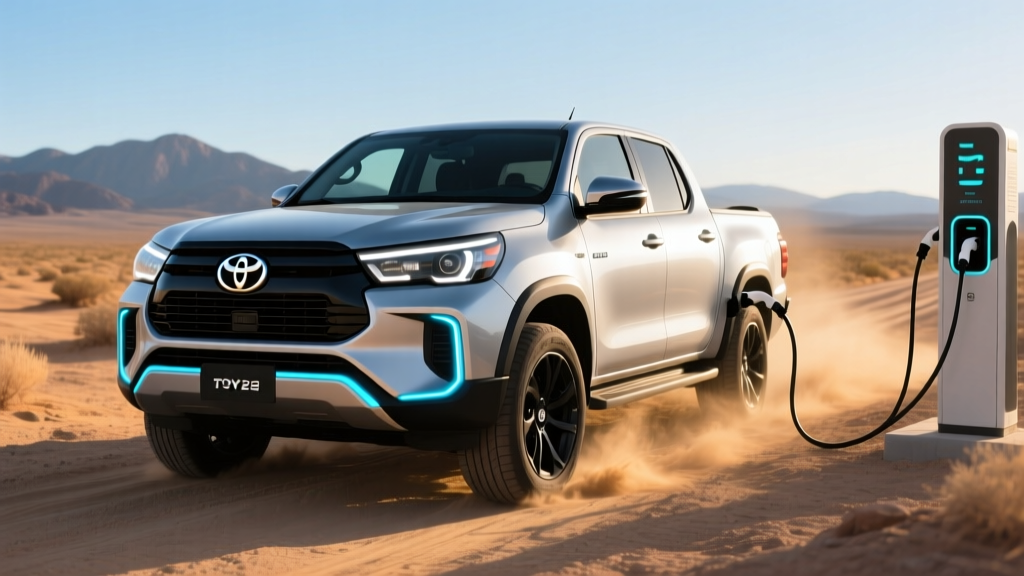
The Toyota Hilux has been the world's best-selling midsize pickup for decades, dominating markets from Southeast Asia to South Africa. Now, Toyota is bringing that nameplate into the electric era with the Toyota Hilux BEV — a battery-electric pickup that aims to preserve the Hilux's legendary durability while adding zero-tailpipe-emission operation. But for US-based EV shoppers, the bigger question is whether this truck will ever cross the Pacific, and if so, whether its specs can compete with the Ford Maverick, Hyundai Santa Cruz, and the looming Tesla Cybertruck refresh.
As of early 2026, Toyota has officially unveiled the Hilux BEV concept and shared preliminary specifications, but production timing and US-market availability remain unconfirmed. Below, we break down every confirmed and projected spec, benchmark it against real-world expectations, and explain what American buyers need to know.
Range, Battery & Efficiency: What the Numbers Say
Toyota has confirmed the Hilux BEV will use a lithium-ion battery pack positioned in a skateboard-style chassis beneath the bed. While Toyota has not published a final usable capacity figure, industry reports and the company's EV platform presentations suggest a pack in the 75–85 kWh usable range, likely using NMC (nickel-manganese-cobalt) chemistry to balance energy density with the thermal demands of a truck that may see heavy loads and towing duty.
| Spec | Projected / Confirmed |
|---|---|
| Battery Usable Capacity | ~75–85 kWh (NMC chemistry projected) |
| EPA Estimated Range | Not yet rated (US model unconfirmed) |
| WLTP Range (Global Target) | ~300–350 km (186–217 miles) |
| Projected US EPA Range | ~170–210 miles (est.) |
| Efficiency (Projected) | ~2.0–2.4 kWh/mi (~42–50 MPGe) |
| Drivetrain | Dual-motor AWD (confirmed) |
| 0–60 mph (Projected) | ~7.5–8.5 seconds |
| Horsepower | ~250–300 hp (est.) |
Toyota has not confirmed whether an LFP (lithium iron phosphate) variant is planned. LFP would sacrifice some range for lower cost, longer cycle life, and the ability to charge routinely to 100% without degradation concerns — a compelling trade-off for fleet buyers who drive predictable routes. If Toyota offers an LFP trim, expect ~10–15% less range but potentially a lower entry price.
Charging Speed: DC Fast Charge & Home Level 2
Charging speed is where midsize electric pickups have struggled. The Ford F-150 Lightning peaks at 150 kW, while the Rivian R1T can sustain up to 200+ kW on newer battery packs. Here's what we know and project for the Hilux BEV:
| Charging Level | Power (kW) | Estimated Speed |
|---|---|---|
| Level 1 (120V household) | ~1.4 kW | ~4–5 miles of range per hour |
| Level 2 (240V home/public) | ~7.2–11 kW | ~22–35 miles of range per hour |
| DC Fast Charge (peak) | ~150 kW (projected) | |
| DC Fast Charge 10–80% | ~30–40 minutes (projected) |
Toyota's bZ4X, which shares the e-TNGA platform lineage, peaks at roughly 150 kW on DC fast charging and takes approximately 30 minutes from 10–80%. The Hilux BEV, with a larger battery, will likely follow a similar charge curve — peaking near 150 kW at low states of charge before tapering significantly above 80% to protect battery longevity.
Charging curve reality: Peak kW is not sustained kW. A 150 kW peak does not mean the truck charges at 150 kW for the entire session. Most EVs sustain peak rates only between 10–40% state of charge, then step down. Expect the Hilux BEV to average roughly 100–120 kW over a 10–80% session if battery preconditioning is engaged. Without preconditioning — especially in cold weather — peak rates may be 30–50% lower.
Performance, Drivetrain & Capability
The Hilux BEV is confirmed as a dual-motor all-wheel-drive configuration, which aligns with Toyota's approach for its electric trucks globally. This gives it inherent traction advantages for off-road and worksite use. Projected output of 250–300 hp and an estimated 7.5–8.5 second 0–60 mph time puts it squarely in the midsize truck performance bracket — quicker than a base diesel Hilux but not in the performance-truck territory of a Rivian R1T Quad-Motor.
Toyota has emphasized that the Hilux BEV is being engineered to the same durability standards as its internal-combustion sibling. The company has shown prototype testing in extreme heat, cold, and rough-terrain conditions — a signal that this is not a compliance vehicle but a genuine attempt at a work-capable electric pickup.
Towing and payload: Toyota has not published official towing or payload figures. Given the battery weight penalty (expect 1,000–1,500 lbs more than an equivalent ICE Hilux), payload capacity may be modestly reduced. Towing will have a dramatic impact on range — plan for a 40–50% range reduction when towing near max capacity at highway speeds, consistent with every other EV truck we've tested.
Pricing, Trims & Federal Tax Credit Eligibility
Because the Toyota Hilux BEV is not confirmed for the US market, no official MSRP exists in dollars. However, based on global pricing signals and Toyota's EV positioning:
| Trim (Projected) | Est. Global Price (USD equiv.) | US MSRP (If Offered) | Federal Tax Credit |
|---|---|---|---|
| Base Work Truck | ~$38,000–$42,000 | ~$40,000–$45,000 | Up to $7,500* |
| Mid-Level | ~$45,000–$50,000 | ~$48,000–$53,000 | Up to $7,500* |
| Top Trim / Adventure | ~$52,000–$58,000 | ~$55,000–$62,000 | Up to $7,500* |
*Federal tax credit eligibility under IRS §30D is subject to multiple requirements for 2026:
- MSRP cap: Trucks/vans/SUVs must have an MSRP of $80,000 or less; sedans $55,000 or less. All projected Hilux BEV trims should clear this threshold.
- Buyer income cap: Modified AGI must not exceed $150,000 (single), $225,000 (head of household), or $300,000 (joint).
- Battery sourcing: Critical minerals and battery component sourcing requirements phase in annually. For 2026, a significant percentage of battery components must be manufactured or assembled in North America, and critical minerals must be sourced from the US or FTA partners. If the Hilux BEV is built in Thailand or Japan with Asian battery supply chains, it may qualify for only a partial credit ($3,750) or none at all.
- Point-of-sale transfer: Eligible buyers can transfer the credit to the dealer at purchase, reducing the out-of-pocket price immediately rather than waiting for tax filing.
Key takeaway: Do not assume the full $7,500 credit. Battery sourcing rules are the wildcard. Always verify current-year eligibility on the fueleconomy.gov credit lookup tool before purchasing.
Interior, Cargo & Technology
Toyota has shown the Hilux BEV concept with a modernized interior featuring a large central touchscreen (likely 12.3 inches on higher trims), a digital instrument cluster, and Toyota Safety Sense 3.0 driver-assistance features. The cabin appears to follow the same layout as the latest-generation Hilux Revo, meaning it should offer:
- Front legroom: ~42 inches (projected, based on current Hilux double-cab)
- Rear legroom: ~34–36 inches (double-cab configuration)
- Bed length: ~5.0–5.5 feet (standard for midsize double-cab)
- Bed volume: ~40–50 cu ft (estimated)
- Frunk (front trunk): Likely present but size unconfirmed; expect 5–10 cu ft given the dual-motor packaging
Tech highlights:
- Toyota Safety Sense 3.0: pre-collision system, lane tracing assist, full-speed adaptive cruise control, road sign assist
- Wireless Apple CarPlay / Android Auto
- Over-the-air software updates
- Vehicle-to-load (V2L) capability projected — allowing the truck to power tools or devices on a worksite
- 360-degree camera system for off-road and parking
Notable drawbacks:
- The Hilux platform is narrower than the Tacoma, meaning interior width and shoulder room may feel tight compared to US-market midsize trucks
- Rear-seat comfort in the current Hilux generation is below competitors like the Honda Ridgeline and Ford Ranger
- Infotainment software in Toyota's global models has historically lagged behind US-market vehicles in responsiveness and UI design
Warranty & Battery Longevity
Toyota has historically offered strong warranty coverage on its electrified vehicles. For the US market (if the Hilux BEV arrives), expect:
| Coverage | Projected Terms |
|---|---|
| Basic Vehicle Warranty | 3 years / 36,000 miles |
| Powertrain Warranty | 5 years / 60,000 miles |
| EV Battery Warranty | 8 years / 100,000 miles (minimum 70% capacity retention) |
The 8-year/100,000-mile battery warranty is mandated by California Air Resources Board (CARB) standards, which Toyota follows across all 50 states for its EVs. The 70% capacity retention threshold means Toyota guarantees the battery will hold at least 70% of its original kWh capacity over that period. In practice, NMC batteries in modern thermal-managed packs typically degrade 10–15% over 8 years under normal use, meaning most owners will see 85–90% state of health at the warranty boundary.
Toyota's hybrid battery track record is excellent — the Prius battery routinely exceeds 200,000 miles. If that engineering discipline carries over to the Hilux BEV's traction battery, long-term durability should be a strength.
Who Should Buy the Toyota Hilux BEV?
Choose the Hilux BEV if:
- You operate a fleet in a market where the Hilux is sold and need a zero-emission work truck for urban/suburban routes under 150 miles
- You value Toyota's reliability reputation and want an EV from a manufacturer with decades of hybrid battery experience
- You need V2L capability to power tools or equipment on-site without a generator
- Your daily driving is predictable and within the truck's real-world range envelope
Look elsewhere if:
- You need 300+ miles of range for highway road trips (consider the Rivian R1T or wait for next-gen platforms)
- You require full-size truck towing capacity (the F-150 Lightning or Silverado EV are better suited)
- You're a US buyer and the Hilux BEV isn't confirmed for your market — the Tacoma EV or Ford Maverick EV may arrive first
- You need fast DC charging for frequent long-distance driving — 150 kW peak is adequate but not class-leading
Pros & Cons at a Glance
- Toyota's legendary reliability and global service network
- Dual-motor AWD for genuine off-road and worksite capability
- Projected V2L for powering tools and equipment
- Strong battery warranty (8yr/100k mi)
- Compact midsize footprint ideal for urban worksites
- Range (~170–210 mi EPA est.) is modest for a pickup
- US availability unconfirmed as of 2026
- DC fast charging likely capped at ~150 kW
- Narrower cabin than US-market midsize trucks
- Towing will significantly reduce range (40–50% loss)
- Battery sourcing may limit federal tax credit eligibility
Frequently Asked Questions
What is the real-world range of the Toyota Hilux BEV?
Based on projected WLTP figures and typical EPA conversion, expect roughly 170–210 miles on the EPA cycle. Real-world highway driving at sustained speeds will yield approximately 140–175 miles, and cold-weather operation could reduce that further to 120–150 miles. Urban stop-and-go driving with regenerative braking will be closer to the EPA sticker.
How fast does the Toyota Hilux BEV charge?
Projected DC fast charging peaks at approximately 150 kW, with a 10–80% session taking roughly 30–40 minutes. Home Level 2 charging at 240V should deliver 22–35 miles of range per hour depending on the onboard charger capacity (7.2–11 kW).
How much does the Toyota Hilux BEV cost after tax credits?
US pricing is unconfirmed since the vehicle is not yet available in America. If offered, base pricing is projected around $40,000–$45,000, potentially dropping to $32,500–$37,500 with the full $7,500 federal tax credit — though battery sourcing rules may limit credit eligibility.
Is the Toyota Hilux BEV available in the United States?
As of early 2026, Toyota has not confirmed the Hilux BEV for the US market. The US gets the Tacoma as its midsize truck, and Toyota may develop a Tacoma EV instead. American buyers should watch for announcements at major auto shows and Toyota's US press site.
Does the Toyota Hilux BEV qualify for the federal EV tax credit?
If sold in the US, eligibility under IRS §30D will depend on battery sourcing and critical-mineral requirements. The MSRP and buyer income caps are likely to be met, but if the battery cells and modules are manufactured outside North America or FTA-partner nations, the credit may be reduced to $3,750 or eliminated entirely. Always check fueleconomy.gov for the latest eligibility data.
Is the Hilux BEV worth buying vs. competitors?
In global markets where it competes against the Ford Ranger EV, BYD Shark, and Isuzu D-Max EV, the Hilux BEV's value proposition rests on Toyota's service network, reliability, and resale value. Range and charging speed are middling. For US buyers, the competitive set is different — the Rivian R1T, Ford F-150 Lightning, and upcoming Tacoma EV will be the relevant comparisons.