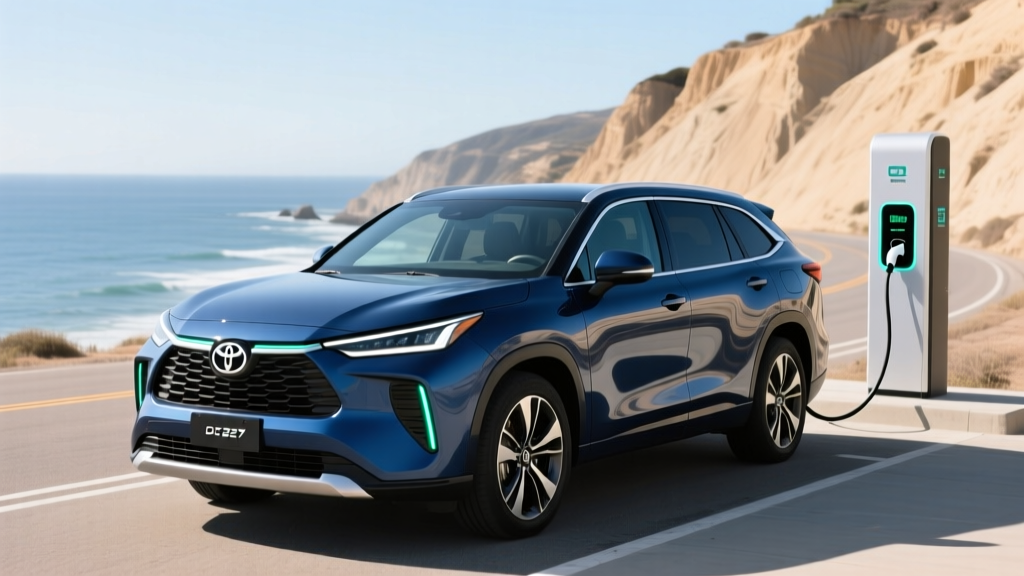
Quick Answer: Is the Toyota Highlander EV 2027 Available Now?
No. As of early 2026, the Toyota Highlander EV 2027 has been announced by Toyota but is not yet available for purchase or reservation. Toyota confirmed a next-generation, battery-electric three-row SUV is in development, likely riding on an evolved version of the e-TNGA platform shared with the bZ4X. Based on Toyota's product roadmap and industry reporting, a late-2026 reveal with 2027 model-year sales is the most plausible timeline. All specifications discussed below are preliminary estimates based on platform analysis, Toyota's existing EV engineering, and competitive positioning — not confirmed manufacturer data.
Projected Specs: What a Highlander EV Could Deliver
Toyota has not published official specifications for the Highlander EV. However, by analyzing the bZ4X's architecture, Toyota's battery supply agreements with Panasonic and Prime Planet Energy & Solutions (PPES), and the competitive landscape, we can build an educated estimate of what the 2027 model may offer.
| Specification | Estimated (Preliminary) | Source / Basis |
|---|---|---|
| Battery Capacity (usable) | ~90–100 kWh | Larger platform than bZ4X's 71.4 kWh pack |
| Battery Chemistry | NMC (nickel manganese cobalt) | Toyota's current BEV strategy; LFP possible for base trim |
| EPA Range (est.) | 280–320 miles | Based on ~3.0–3.2 mi/kWh efficiency for a ~5,000 lb SUV |
| Drivetrain | Dual-motor AWD (likely standard) | Highlander buyer expectations; Toyota's AWD expertise |
| Horsepower (est.) | 300–380 hp | Dual-motor bZ4X makes 214 hp; larger SUV = more power |
| 0–60 mph (est.) | 5.5–6.5 seconds | Competitive with Kia EV9 (5.0s AWD) and gas Highlander (7.0s) |
| Max DC Fast Charge Rate | ~150–180 kW (peak) | bZ4X peaks ~150 kW; Toyota may improve with new thermal mgmt |
| 10–80% DC Charge Time (est.) | ~28–35 minutes | Based on estimated charge curve and battery size |
| Level 2 AC Charging | ~11 kW onboard charger | Industry standard for this class |
| Seating | 7 passengers (3 rows) | Core Highlander identity |
| Towing Capacity (est.) | 3,500–5,000 lbs | Gas Highlander tows 5,000 lbs; EV torque helps but weight hurts |
| Battery Warranty | 8 years / 100,000 miles | Federal minimum; Toyota currently offers 10yr/150k on bZ4X |
Real-World Range Reality Check
If Toyota achieves a 300-mile EPA estimate, expect real-world results to vary significantly:
- Mild weather, mixed driving: ~270–290 miles
- Sustained highway (75 mph): ~240–260 miles (aerodynamic drag dominates at speed)
- Cold weather (below 30°F): ~200–240 miles (battery resistance + cabin heating draw)
- Towing near max capacity: ~150–180 miles (expect 40–50% range reduction under load)
These estimates align with observed real-world performance of similarly sized EVs like the Kia EV9 and Rivian R1S. Toyota's heat pump system, if included on all trims, would help mitigate cold-weather losses.
Highlander EV vs. Gas vs. Hybrid Highlander: The Numbers
The current Highlander family includes a turbocharged gas model and the Highlander Hybrid. Here's how an EV variant would compare on the metrics that matter to family SUV buyers.
| Metric | Highlander EV (est. 2027) | Highlander Hybrid (2026) | Highlander Gas (2026) |
|---|---|---|---|
| Powertrain | Dual-motor BEV | 2.5L 4-cyl + 2 electric motors | 2.4L Turbo 4-cyl |
| Horsepower | ~300–380 hp | 243 hp combined | 265 hp |
| EPA Range / Tank | ~280–320 mi | ~600+ mi (17.9 gal × 35 mpg) | ~475 mi (17.9 gal × 24 mpg combined) |
| Efficiency | ~85–95 MPGe (est.) | 36 mpg combined | 24 mpg combined |
| Fuel/Energy Cost per Mile | ~$0.04–0.06 (home charging) | ~$0.10 (at $3.50/gal) | ~$0.15 (at $3.50/gal) |
| Annual Fuel/Energy (15k mi) | ~$600–900 | ~$1,500 | ~$2,200 |
| Estimated Base MSRP | ~$48,000–55,000 | ~$41,000 | ~$39,000 |
| Federal Tax Credit (§30D) | Up to $7,500 (if eligible) | None (not a PHEV/BEV) | None |
| Effective Starting Price | ~$40,500–55,000 | ~$41,000 | ~$39,000 |
| CO₂ Tailpipe Emissions | Zero | Low (hybrid) | Standard ICE |
Key takeaway: The Highlander EV's operating cost advantage is substantial — roughly $1,300–1,600/year in fuel savings versus the gas model when charging primarily at home. However, the upfront price premium of $9,000–16,000 means breakeven on fuel alone takes 6–10 years without the tax credit, or 4–7 years with the full $7,500 credit. The Highlander Hybrid occupies a compelling middle ground: lower upfront cost, excellent fuel economy, no charging infrastructure needed, and proven reliability.
Charging the Highlander EV: Home, Public, and Road Trips
Charging access is the single biggest variable in EV ownership satisfaction. Here's what a Highlander EV owner would likely face.
| Charging Level | Power | Estimated Miles Added per Hour | Best Use Case |
|---|---|---|---|
| Level 1 (120V outlet) | ~1.4 kW | ~4–5 miles/hr | Overnight top-ups; emergency only for a large battery |
| Level 2 (240V home) | ~11 kW | ~33–35 miles/hr | Daily charging; full overnight recharge from 20% to 100% |
| DC Fast Charging | ~150–180 kW (peak) | ~180–220 miles/hr (at peak) | Road trips; 10–80% in ~30 min |
Home Charging Installation: What to Budget
A Level 2 home charger is strongly recommended for any 90+ kWh battery. Here's a realistic cost breakdown for a 240V/48A hardwired installation:
| Component | Low Estimate | High Estimate |
|---|---|---|
| Level 2 Charger (e.g., ChargePoint Home Flex, Emporia) | $350 | $700 |
| Electrician labor (run 240V/60A circuit) | $500 | $2,000 |
| Permit and inspection | $50 | $300 |
| Electrical panel upgrade (if needed: 100A → 200A) | $1,500 | $3,500 |
| Total (no panel upgrade) | $900 | $3,000 |
| Total (with panel upgrade) | $2,400 | $6,500 |
Most homes built after 2000 with a 200A panel can accommodate a Level 2 charger without an upgrade. Older homes or those with heavy existing loads (electric range, dryer, HVAC) may need the panel work. Always get a quote from a licensed electrician before purchasing equipment — they can assess your panel capacity and recommend the right circuit size.
Public Charging and Road Trips
Toyota's bZ4X currently includes one year of complimentary charging on the Electrify America network. If Toyota extends this to the Highlander EV, it would provide meaningful road-trip value. However, public DC fast-charging reliability remains inconsistent outside major corridors. According to J.D. Power's 2025 EV Experience Index, public charging satisfaction continues to lag behind home charging by a wide margin.
For road trips, a Highlander EV with ~300 miles of range and ~30-minute 10–80% charging means planning a stop every 2.5–3 hours of driving. This is workable but requires route planning with apps like A Better Routeplanner to verify charger availability and operational status along your route.
Tax Credits, Incentives, and True Purchase Cost
The IRS §30D federal tax credit offers up to $7,500 for qualifying new EVs, but eligibility depends on several factors that change frequently. As of 2026, the key requirements include:
- MSRP cap: SUVs/vans/pickups must have an MSRP at or below $80,000
- Buyer income cap: Modified AGI ≤ $150,000 (single), $225,000 (head of household), $300,000 (joint)
- Battery sourcing: Critical minerals and battery components must meet phased-in domestic/free-trade sourcing thresholds (increasing annually)
- Final assembly: Vehicle must be assembled in North America
- Point-of-sale transfer: Eligible buyers can transfer the credit to the dealer at purchase for an immediate price reduction
Will the Highlander EV qualify? This is uncertain until Toyota confirms battery sourcing and assembly location. If Toyota assembles it at a North American plant (Georgetown, KY, or Princeton, IN are plausible candidates) and sources enough qualifying battery materials, the $7,500 credit is achievable. However, Toyota's bZ4X — assembled in Japan — did not qualify for §30D, which significantly hurt its US competitiveness. Toyota is acutely aware of this and is likely engineering the Highlander EV with domestic assembly and sourcing in mind.
Always verify eligibility at the time of purchase using the fueleconomy.gov tax credit tool and consult a tax professional regarding your personal eligibility.
Five-Year Cost of Ownership: Highlander EV vs. Gas vs. Hybrid
Here's a modeled 5-year/75,000-mile ownership comparison. Assumptions: $3.50/gallon gas, $0.13/kWh home electricity (national average), 85% home charging / 15% public DC charging for the EV, standard maintenance schedules.
| Cost Category | Highlander EV (est.) | Highlander Hybrid | Highlander Gas |
|---|---|---|---|
| Purchase Price (base, before credit) | $52,000 | $41,000 | $39,000 |
| Federal Tax Credit | –$7,500 (if eligible) | $0 | $0 |
| Effective Purchase Price | $44,500 | $41,000 | $39,000 |
| Fuel/Energy (5 yr, 75k mi) | $3,500 | $7,500 | $11,000 |
| Maintenance (5 yr) | $1,200 | $3,000 | $3,500 |
| Insurance (5 yr, est.) | $9,500 | $7,500 | $7,200 |
| Estimated Depreciation (5 yr) | $22,000 | $18,000 | $17,500 |
| Total 5-Year Cost | $80,700 | $77,000 | $78,200 |
Analysis: Even with the $7,500 tax credit, the Highlander EV's higher purchase price and insurance premiums (EVs typically cost 15–25% more to insure due to repair complexity and parts cost) keep its 5-year total cost slightly above the Hybrid. The EV's fuel and maintenance savings are real — $7,500 less in fuel and $2,300 less in maintenance versus the gas model — but they don't fully close the upfront gap in five years. The breakeven window is typically year 6–8 for most buyers.
The Highlander Hybrid remains the most cost-effective choice for buyers who lack home charging access, drive in extreme cold regularly, or plan to keep the vehicle fewer than five years.
Common Misconceptions About the Highlander EV
| Myth | Fact |
|---|---|
| "The battery will need replacing in 5–8 years and cost $20,000." | Modern NMC batteries are engineered for 200,000+ miles with <10% degradation. Toyota's battery warranty covers 8 years/100,000 miles minimum (10yr/150,000 mi on bZ4X). Real-world data from long-term EVs shows most packs retain 85–90% capacity at 100k miles. |
| "It's a three-row SUV — EVs can't handle family road trips." | A ~300-mile range with ~30-minute fast charging is workable for road trips with basic planning. Families already do this in the Kia EV9, Rivian R1S, and Tesla Model X. It requires 1–2 stops on a 500-mile trip. |
| "I'll save $10,000/year going electric." | Realistic annual fuel savings vs. gas are $1,300–1,600 for 15,000 miles of driving. Meaningful, but not transformative year-over-year. The total-cost advantage takes 6+ years to materialize. |
| "Any Toyota EV will get the $7,500 tax credit." | The bZ4X did not qualify because it was assembled in Japan. Credit eligibility depends on assembly location, battery sourcing, buyer income, and MSRP — all of which must be confirmed for the Highlander EV at launch. |
| "I don't need home charging — public chargers are everywhere now." | Public DC charger reliability remains inconsistent. J.D. Power data shows roughly 1 in 5 public charging sessions encounter a problem. Home charging is dramatically cheaper ($0.04–0.06/mi vs. $0.12–0.18/mi at public DC) and far more reliable. If you cannot install a Level 2 charger at home, a PHEV or hybrid is likely a better fit. |
Decision Framework: Is the Highlander EV Right for You?
Choose the Highlander EV (when available) if:
- You have (or can install) a Level 2 home charger on a 240V circuit
- Your daily driving is under 80 miles round-trip (most US commutes)
- You take 2–4 road trips per year and can plan charging stops
- You want the lowest per-mile operating cost and plan to keep the SUV 7+ years
- You qualify for the §30D tax credit (income and sourcing dependent)
- You value instant torque, quiet operation, and zero tailpipe emissions
Choose the Highlander Hybrid instead if:
- You live in an apartment or cannot install home charging
- You regularly drive in sub-20°F winters where EV range drops 25–35%
- You frequently tow trailers over long distances (EV towing range is severely reduced)
- You want to minimize upfront cost and keep the vehicle under 5 years
- You live in a region with limited public DC fast-charging infrastructure
- You want Toyota's longest-proven reliability track record in this segment
Wait for more information if:
- The Highlander EV's battery sourcing and §30D eligibility are unconfirmed at your purchase time
- Competing three-row EVs (Kia EV9, Hyundai Ioniq 9, VW ID. Buzz, Tesla Model Y 7-seat) meet your needs today
- You want confirmed real-world range and charging data before committing
What First-Time EV Buyers Should Know Before Committing
If the Highlander EV would be your first battery-electric vehicle, these practical realities matter more than spec sheets:
- kW vs. kWh: kW (kilowatts) measures power — how fast you charge. kWh (kilowatt-hours) measures energy — how big the battery is. A 100 kWh battery charged at 150 kW will not charge in 40 minutes because the charge rate tapers above ~80% state of charge to protect battery health.
- Preconditioning matters: Navigating to a DC fast charger (or using a preconditioning feature) warms the battery for faster charging. Without it, cold-soaked batteries charge significantly slower — sometimes 50% below peak rate.
- The 80% rule: For daily driving, charge to 80% to prolong battery life. Reserve 100% charges for road trips. This is especially important for NMC chemistry; LFP batteries can be charged to 100% regularly without significant degradation.
- Insurance is higher: Get a quote before purchasing. EV insurance premiums run 15–25% higher than equivalent gas vehicles in most states due to specialized repair requirements and higher parts costs.
- Your electrical panel is the gatekeeper: Before anything else, have an electrician assess whether your home's panel can support a 240V/48A circuit. A panel upgrade can add $1,500–3,500 to your setup cost.
Competitive Landscape: What Else Exists in 2026
The Highlander EV won't launch into a vacuum. Several three-row electric SUVs are already on sale and worth considering if you need a vehicle today:
- Kia EV9: EPA range up to 304 mi, starting ~$55,000, 200 kW DC charging, NACS port (Supercharger access). The current benchmark for the segment.
- Hyundai Ioniq 9: Launched for 2026, shares EV9 platform, similar range and charging. Competitive pricing expected.
- Tesla Model Y (7-seat option): EPA range ~310 mi, Supercharger network access, but tight third row best suited for children.
- Rivian R1S: Premium pricing (~$75,000+), excellent capability, but significantly more expensive than a Highlander EV is likely to be.
- VW ID. Buzz: 3-row electric minivan, ~230 mi EPA range, retro styling. More van than SUV.
The Highlander EV's competitive advantage will likely be Toyota's brand trust, dealer network (over 1,200 US locations), and the expectation of strong long-term reliability — if the specs and pricing are right.
When will the Toyota Highlander EV 2027 be available to buy?
Toyota has announced a battery-electric three-row SUV is in development, but no firm on-sale date has been confirmed. Industry analysis suggests a late-2026 reveal with deliveries beginning in the first half of 2027 as a 2027 model-year vehicle. Reservations have not yet opened.
Will the Highlander EV qualify for the $7,500 federal tax credit?
Unknown until Toyota confirms assembly location and battery component/critical mineral sourcing. If assembled in North America with sufficient domestic sourcing, it should qualify — but the bZ4X (Japan-assembled) did not. Check fueleconomy.gov at launch for the definitive answer. Income and MSRP caps also apply per IRS §30D rules.
How does the Highlander EV compare to the Highlander Hybrid for a family?
The Hybrid offers ~600+ miles of total range, lower upfront cost, no charging infrastructure requirement, and proven reliability. The EV offers lower per-mile energy cost, zero tailpipe emissions, stronger acceleration, and a quieter ride — but requires home charging access and road-trip planning. For families without reliable home charging, the Hybrid is the more pragmatic choice today.
What will charging a Highlander EV cost compared to gas?
At $0.13/kWh (national average residential rate) and an estimated 3.0 mi/kWh efficiency, home charging costs roughly $0.04–0.05 per mile — about $650/year for 15,000 miles. The gas Highlander at 24 mpg combined and $3.50/gallon costs ~$0.15 per mile, or ~$2,200/year. That's a roughly $1,550 annual savings on energy when charging at home. Public DC fast charging ($0.30–0.45/kWh) reduces but doesn't eliminate this advantage.
Is Toyota's EV technology reliable enough for a family SUV?
Toyota's bZ4X has shown acceptable battery performance in early long-term testing, though its charging speeds lag behind Hyundai/Kia's 800V architecture. Toyota has decades of hybrid battery experience (over 25 million hybrid vehicles sold globally) that informs their EV battery management. The larger question is whether Toyota's software, charging integration, and ADAS features match competitor offerings at launch. First-year model risk is real — waiting for the 2028 model year may be prudent for risk-averse buyers.