The Short Answer on Toyota Electric Trucks
As of early 2026, Toyota does not sell a fully electric pickup truck in the United States. The Toyota Tacoma EV remains in development and has not been officially announced with a firm launch date or production timeline. For buyers wanting an electrified Toyota truck today, the 2026 Toyota Tundra i-FORCE MAX hybrid is the only option — a traditional hybrid (HEV), not a plug-in, delivering an EPA-estimated 20–22 MPG combined depending on configuration. If you need a battery-electric truck now, competitors like the Ford F-150 Lightning, Rivian R1T, and Chevrolet Silverado EV are currently on sale. This guide breaks down what's known about a future Toyota EV truck, how the Tundra hybrid compares to gas and electric rivals, and a decision framework to help you choose.
Where Toyota Stands on Electric Trucks in 2026
Toyota's electrification strategy has been notably cautious compared to rivals. While Ford launched the F-150 Lightning in 2022 and GM rolled out the Silverado EV on its Ultium platform, Toyota has prioritized hybrids across its lineup and invested heavily in hydrogen fuel-cell research alongside battery EVs. The company has signaled it will offer a battery-electric pickup eventually, likely built on a dedicated EV platform, but as of this writing, no official specs, pricing, or release date have been published for a Tacoma EV or Tundra EV.
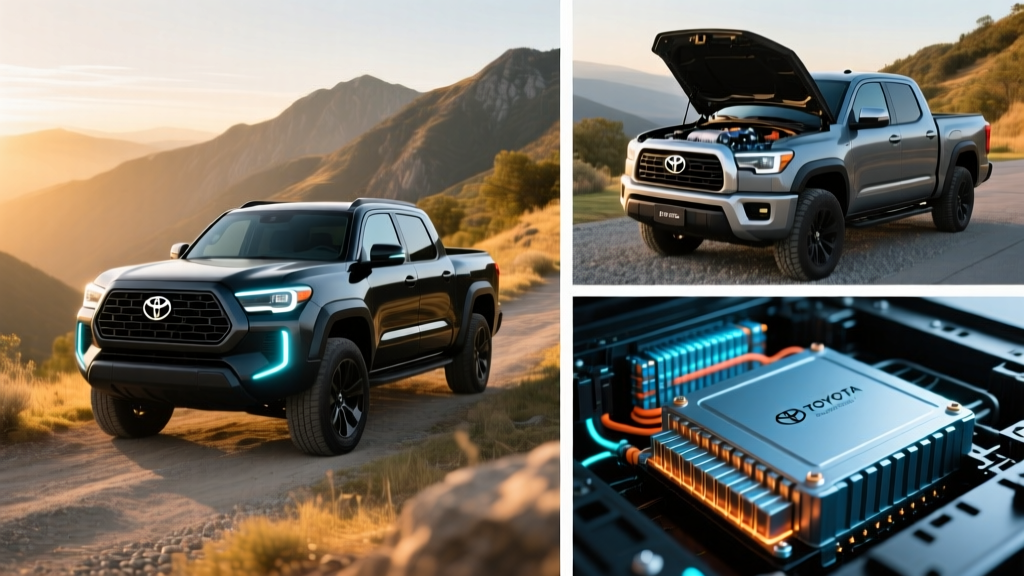
What Toyota does sell today is the Tundra i-FORCE MAX, a twin-turbo V6 hybrid powertrain that pairs a 3.4-liter engine with a 49-hp electric motor integrated into the bell housing. It's a self-charging hybrid — no plug, no electric-only range — designed for torque and towing rather than efficiency maximization. The Tacoma lineup, refreshed for 2024, currently offers only a turbocharged 2.4-liter four-cylinder engine with an available i-FORCE MAX hybrid variant (also a traditional HEV) on select trims.
2026 Tundra i-FORCE MAX: The Electrified Toyota Truck You Can Buy Today
The Tundra i-FORCE MAX is Toyota's current electrified truck offering. Here's what the numbers look like:
| Spec | 2026 Tundra i-FORCE MAX (4x4 CrewMax) |
|---|---|
| Powertrain | 3.4L Twin-Turbo V6 + 49-hp electric motor (HEV) |
| Horsepower / Torque | 437 hp / 583 lb-ft |
| 0–60 mph | ~5.7 seconds |
| EPA MPG (city / hwy / combined) | 20 / 24 / 22 (varies by config) |
| Max Towing Capacity | Up to 12,000 lbs |
| Max Payload | Up to 1,945 lbs |
| Starting MSRP | ~$57,000 (TRD Off-Road); trims up to ~$82,000 |
| Federal Tax Credit | None — HEVs do not qualify for §30D clean vehicle credit |
| Powertrain Warranty | 5 years / 60,000 miles; hybrid components 10 yrs / 150,000 miles |
The i-FORCE MAX hybrid system recovers energy during braking and deceleration, using the electric motor to assist acceleration and reduce turbo lag. You won't plug it in, and you won't drive on electric power alone. The real benefit is low-end torque — 583 lb-ft at just 2,400 RPM — and a modest fuel economy improvement over the non-hybrid twin-turbo V6, which returns around 19 MPG combined.
For comparison, the non-hybrid 2026 Tundra SR5 4x4 starts around $45,000 and gets approximately 19 MPG combined. The i-FORCE MAX premium ranges from $3,000–$5,000 depending on trim, and the fuel savings over the non-hybrid are modest — roughly $150–$250 per year for a driver covering 15,000 miles, assuming $3.50/gallon fuel (based on fueleconomy.gov data).
Tacoma Hybrid: Toyota's Midsize Electrified Truck
The current-generation Tacoma (redesigned for 2024) offers the i-FORCE MAX hybrid on TRD Off-Road, TRD Pro, and Trailhunter trims. Like the Tundra system, this is a traditional HEV — no plug required.
| Spec | 2026 Tacoma i-FORCE MAX (4x4) | 2026 Tacoma Turbo (non-hybrid 4x4) |
|---|---|---|
| Engine | 2.4L Turbo 4-cyl + electric motor | 2.4L Turbo 4-cyl |
| Horsepower / Torque | 326 hp / 465 lb-ft | 278 hp / 317 lb-ft |
| EPA MPG Combined | ~23–24 MPG | ~21–22 MPG |
| Starting MSRP (hybrid trim) | ~$46,000 (TRD Off-Road) | ~$37,000 (SR5) |
| Federal §30D Credit | Not eligible (HEV) | Not eligible |
The Tacoma hybrid's advantage is torque delivery for off-road crawling and towing (6,500-lb max tow rating), not fuel savings. Real-world highway MPG in testing tends to land closer to 20–21 MPG at sustained 70+ mph speeds — the electric motor provides the most benefit in stop-and-go and low-speed terrain.
How Toyota Trucks Compare to Battery-Electric Rivals
If you're cross-shopping a Toyota truck against a full battery-electric vehicle (BEV), here's how the ownership math and capability stack up against the leading electric trucks on sale in 2026:
| Factor | Tundra i-FORCE MAX HEV | Ford F-150 Lightning (Ext. Range) | Rivian R1T (Dual-Motor Max) |
|---|---|---|---|
| Powertrain Type | Hybrid (no plug) | BEV | BEV |
| EPA Range / MPG | 22 MPG combined | ~320 miles | ~410 miles |
| Energy Cost per 1,000 mi | ~$175 (gas @ $3.85/gal) | ~$45–$65 (home charging) | ~$45–$65 (home charging) |
| Starting MSRP | ~$57,000 | ~$72,000 | ~$82,000 |
| Federal §30D Tax Credit | $0 | Up to $7,500 (eligibility varies) | Up to $7,500 (eligibility varies) |
| Max Towing | 12,000 lbs | 10,000 lbs | 11,000 lbs |
| Charging Required | None — gas stations only | Home L2 or public DC fast | Home L2 or public DC fast |
| Cold-Weather Impact | Minimal MPG loss | 15–30% range loss | 15–30% range loss |
The fuel-cost advantage of a BEV is substantial if you charge at home. At the national average residential electricity rate of ~$0.17/kWh and an efficiency of ~2.0 kWh/mile (typical for full-size electric trucks), home charging costs roughly $0.05–$0.06 per mile versus $0.18–$0.20 per mile for the Tundra hybrid burning gas. Over 15,000 annual miles, that's a savings of approximately $1,800–$2,100 per year with a BEV charged primarily at home.
However, the Tundra hybrid has zero charging infrastructure requirements. If you live in an apartment, lack a garage, or frequently tow heavy loads over long distances, the hybrid eliminates the range reduction and charging-time penalties that BEVs face when towing. Towing with the F-150 Lightning can cut range by 40–50%, turning a 320-mile truck into a 160–190-mile truck on a trailer run.
Real-World Ownership Costs: Toyota Hybrid vs. Electric Truck
Let's run a 5-year ownership comparison for a buyer driving 15,000 miles per year, financing at 6.5%, with home charging available for the BEV scenario:
| Cost Category | Tundra i-FORCE MAX ($57K MSRP) | F-150 Lightning Ext. Range ($72K MSRP, -$7,500 credit) |
|---|---|---|
| Purchase Price (after credit) | $57,000 | $64,500 |
| Fuel / Energy (5 yrs) | $13,125 (gas) | $2,750 (home electricity) |
| Maintenance (5 yrs) | ~$3,500 (oil, filters, brakes) | ~$1,500 (no oil changes, regen saves brakes) |
| Insurance (5 yrs est.) | ~$9,500 | ~$11,500 |
| Estimated 5-Year Total | ~$83,125 | ~$80,250 |
The BEV pulls ahead on operating costs, but the gap narrows when you factor in potentially higher insurance premiums (EVs typically cost 15–25% more to insure), faster depreciation uncertainty for newer EV platforms, and the upfront cost of a home Level 2 charger installation ($500–$2,000 for equipment and electrician work). The Tundra hybrid wins on simplicity: no charger install, no range planning, no cold-weather surprises.
Key caveat on the §30D federal tax credit: Eligibility for the up-to-$7,500 credit depends on MSRP caps ($80,000 for trucks/vans/SUVs), buyer income limits ($300K joint / $150K single modified AGI), and battery critical-mineral and component sourcing requirements that tighten annually. The F-150 Lightning's credit eligibility has shifted across model years. Always verify current eligibility at IRS.gov before relying on the credit in your purchase math. The credit can now be transferred to the dealer at point of sale as a price reduction.
What About a Future Toyota Tacoma EV or Tundra EV?
Toyota has confirmed it is developing battery-electric trucks, but details remain scarce. Industry reporting suggests a dedicated EV platform is in development, potentially arriving in the late 2020s. Until Toyota publishes official specs, treat any leaked range, pricing, or battery figures as preliminary and unconfirmed.
What we can reasonably expect based on Toyota's announced EV roadmap and competitive pressure:
- Target range: Likely 300–350+ miles EPA to remain competitive with F-150 Lightning and Silverado EV
- Charging: Toyota's newer bZ-series EVs support DC fast charging at up to 150 kW; a truck platform may push higher
- Towing: Expect 8,000–10,000+ lbs to be competitive, though BEV towing always penalizes range significantly
- Pricing: Likely starting in the $55,000–$65,000 range for a midsize EV truck, potentially qualifying for §30D credit if battery sourcing requirements are met
Toyota's historical approach suggests they'll wait until battery costs drop further and charging infrastructure matures before committing to a full-size electric pickup. If you're considering holding off on a truck purchase to wait for a Toyota EV, understand that a confirmed launch is likely still 2–4 years away at minimum.
Common Misconceptions About Toyota Electric Trucks
| Myth | Fact |
|---|---|
| "The Tundra hybrid is a plug-in EV" | The i-FORCE MAX is a traditional HEV. It charges its small battery via regenerative braking — there's no plug and no electric-only driving range. |
| "Toyota has an electric truck I can buy now" | As of 2026, Toyota sells no fully electric (BEV) pickup in the US. The bZ4X is a crossover SUV, not a truck. |
| "I'll save a ton on gas with the Tundra hybrid" | The i-FORCE MAX gains only 2–3 MPG over the non-hybrid V6. Annual fuel savings are roughly $150–$250 — this powertrain is about torque, not efficiency. |
| "Electric trucks can't tow" | They can tow — the F-150 Lightning tows up to 10,000 lbs. The limitation is range: towing cuts BEV range by 40–50%, requiring more frequent charging stops. |
| "The Tacoma EV is coming next year" | Toyota has not announced a production date, specs, or pricing for any battery-electric truck. Any timeline is speculative. |
Decision Framework: Which Toyota Truck (or Rival) Is Right for You?
Choose the Tundra i-FORCE MAX hybrid if:
- You need a full-size truck today and want Toyota reliability
- You tow frequently (10,000+ lbs) and can't tolerate BEV range loss under load
- You lack home charging access (apartment, street parking, no garage outlet)
- You drive in extreme cold regularly where BEV range drops 15–30%
- You want zero lifestyle change — gas stations work everywhere, no charging apps needed
Choose the Tacoma i-FORCE MAX hybrid if:
- You need a midsize truck for off-road use, light towing, or daily driving
- You want Toyota's hybrid reliability with strong low-end torque for trails
- Fuel savings are a secondary concern to capability and durability
Choose a battery-electric truck (F-150 Lightning, Rivian R1T, Silverado EV) if:
- You have reliable home Level 2 charging (or can install it)
- Your daily driving is under 200 miles and you rarely tow over long distances
- You want the lowest per-mile energy cost (~$0.05/mi vs ~$0.18/mi for gas)
- You qualify for the §30D federal tax credit (check income and sourcing rules at IRS.gov)
- You value instant torque, a frunk, and near-silent operation
Wait for a Toyota EV truck if:
- You're committed to the Toyota brand but want a BEV
- Your current truck still meets your needs and you can delay purchasing 2–4+ years
- You're comfortable with no confirmed timeline, specs, or pricing
Frequently Asked Questions
Does Toyota make a fully electric truck in 2026?
No. Toyota currently sells the Tundra and Tacoma with i-FORCE MAX hybrid powertrains (traditional HEVs, no plug). A battery-electric Toyota truck has not been officially announced with a release date or specifications.
Is the Toyota Tundra hybrid worth the extra cost over the gas model?
It depends on your priority. The i-FORCE MAX adds roughly $3,000–$5,000 to the price and delivers 583 lb-ft of torque with only a 2–3 MPG improvement. If towing performance and throttle response matter most, yes. If you're buying purely for fuel savings, the payback period exceeds 10 years at current gas prices.
Can I get a federal tax credit on a Toyota Tundra or Tacoma hybrid?
No. The §30D clean vehicle credit applies only to plug-in electric vehicles (BEVs and PHEVs) that meet battery sourcing, MSRP, and buyer income requirements. Traditional hybrids like the i-FORCE MAX do not qualify. Some states may offer separate incentives for hybrids — check your local programs.
How much would a future Toyota electric truck likely cost?
No official pricing exists. Based on competitive positioning and Toyota's bZ-series pricing strategy, industry analysts estimate a starting MSRP in the $55,000–$65,000 range for a midsize electric truck, potentially reaching $70,000+ for a full-size model. These figures are speculative until Toyota confirms details.
What's the most fuel-efficient truck Toyota sells?
The 2026 Tacoma i-FORCE MAX hybrid 4x2 returns the best EPA numbers in Toyota's truck lineup at approximately 24–25 MPG combined. For a full-size truck, the Tundra i-FORCE MAX achieves about 22 MPG combined. Neither matches the per-mile energy cost of a battery-electric truck charged at home.
Should I wait for the Toyota Tacoma EV?
Only if your timeline is flexible. Toyota has not confirmed a Tacoma EV production date, and a launch before 2028–2029 appears unlikely based on available information. If you need a truck within the next 12–18 months, consider the Tacoma hybrid, a rival BEV truck, or a PHEV SUV if your payload needs allow.