The Short Answer on Toyota's 2026 Electric Cycle
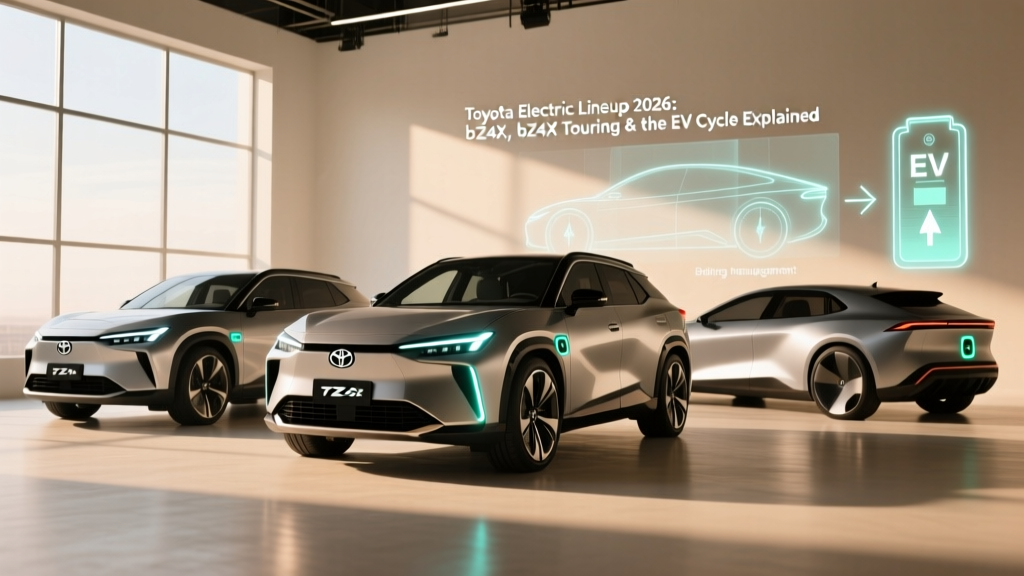
Toyota's 2026 electric vehicle lineup in the U.S. centers on the bZ4X crossover SUV (EPA-estimated up to 252 miles of range, starting around $38,465) and the newly introduced bZ4X Touring variant with extended range. Toyota has historically approached full battery-electric vehicles cautiously, favoring its dominant hybrid lineup. If you're researching the "Toyota electric cycle 2026," you're likely weighing whether Toyota's EV offerings are mature enough to buy — or whether a Toyota hybrid (like the RAV4 Hybrid or Prius) remains the smarter move. The honest answer: Toyota's EVs are competent but lag competitors in charging speed and range. They make sense for Toyota-loyal buyers with reliable home charging who want the brand's reliability reputation in an electric package. Everyone else should cross-shop the Hyundai Ioniq 5, Tesla Model Y, and Chevrolet Equinox EV.
Toyota's 2026 EV Lineup: What's Actually Available
Toyota's battery-electric strategy has evolved significantly since the original bZ4X launched for the 2023 model year. For 2026, Toyota offers the following fully electric vehicles in the U.S. market:
| Spec | bZ4X XLE (FWD) | bZ4X Limited (AWD) | bZ4X Touring (AWD) |
|---|---|---|---|
| EPA Range | 252 mi | 228 mi | ~290 mi (est.) |
| Battery (usable) | 64 kWh (NMC) | 64 kWh (NMC) | 74.4 kWh (NMC) |
| Horsepower | 201 hp | 214 hp | 338 hp |
| 0–60 mph | 7.1 sec | 5.8 sec | ~5.0 sec (est.) |
| Peak DC Fast Charge | 150 kW | 150 kW | ~150 kW |
| 10–80% DC Charge | ~30 min | ~30 min | ~33 min |
| Level 2 (240V) Rate | 7.2 kW | 7.2 kW | 7.2 kW |
| MPGe (combined) | 119 MPGe | 104 MPGe | ~112 MPGe (est.) |
| Base MSRP | $38,465 | $43,165 | ~$47,000 (est.) |
| Battery Warranty | 8 yr / 100,000 mi | 8 yr / 100,000 mi | 8 yr / 100,000 mi |
Note: Touring trim specs are based on Toyota's announced preliminary figures for the 2026 model year. Final EPA certification may vary. Source: Toyota Motor Corporation and fueleconomy.gov.
Real-World Range vs. EPA Sticker
The bZ4X XLE FWD carries a 252-mile EPA estimate, but plan for ~210–225 miles on sustained highway driving at 70+ mph. In freezing temperatures (below 32°F), expect a further 20–30% reduction, dropping effective range to ~160–180 miles. The bZ4X does not come standard with a heat pump on all trims (it's included on some packages), which significantly affects cold-weather efficiency. The larger-battery Touring variant should improve this picture, but its higher weight partially offsets the capacity gain.
Toyota EV vs. Toyota Hybrid: The Numbers That Matter
Many buyers researching Toyota's electric cycle are really asking: Should I buy a bZ4X or a RAV4 Hybrid? Here's a direct comparison using real data:
| Metric | bZ4X XLE (EV) | RAV4 Hybrid XLE |
|---|---|---|
| MSRP | $38,465 | $35,075 |
| Federal Tax Credit (§30D) | Up to $7,500* | $0 |
| Effective Price After Credit | ~$30,965* | $35,075 |
| EPA Efficiency | 119 MPGe | 39 MPG combined |
| Annual Fuel/Energy Cost (15k mi) | ~$570 (at $0.14/kWh) | ~$1,346 (at $3.50/gal) |
| Annual Maintenance | ~$300 | ~$600 |
| Range / Tank | 252 mi | 580 mi |
| "Refuel" Time | 30 min (10–80% DC) / 8+ hr (L2) | 5 min |
| Cargo Volume | 27.7 cu ft | 37.6 cu ft |
*Federal §30D tax credit eligibility depends on MSRP caps, buyer income limits, battery component sourcing, and point-of-sale transfer rules. Always verify current eligibility at IRS.gov before purchasing.
The takeaway: The bZ4X can actually undercut the RAV4 Hybrid on effective purchase price once the federal credit is applied. But the hybrid wins decisively on range, cargo space, and refueling convenience. If you take regular road trips exceeding 200 miles, lack home charging, or live in extreme cold, the RAV4 Hybrid remains the pragmatic choice. If you commute under 80 miles daily, charge at home, and want lower running costs, the bZ4X's economics work.
Real Cost of Ownership: 5-Year Breakdown
| Cost Category | bZ4X XLE (EV) | RAV4 Hybrid XLE | RAV4 Gas LE (AWD) |
|---|---|---|---|
| Purchase Price (after credit) | $30,965 | $35,075 | $32,525 |
| Fuel / Energy | $2,850 | $6,730 | $8,654 |
| Maintenance | $1,500 | $3,000 | $3,750 |
| Insurance (avg) | $8,400 | $7,200 | $7,000 |
| Estimated Depreciation | $14,500 | $12,000 | $13,500 |
| Total 5-Year Cost | $58,215 | $64,005 | $65,429 |
Key assumptions: electricity at $0.14/kWh national average, gas at $3.50/gal, home charging for the EV. Insurance premiums for EVs run 10–20% higher on average due to higher repair costs and parts pricing. Depreciation for the bZ4X reflects Toyota's improving EV resale values but acknowledges that early Toyota EVs haven't yet matched the brand's legendary hybrid residual values.
Home Charging: The Make-or-Break Factor
Every ownership-cost advantage of the bZ4X depends on home charging access. At the bZ4X's 7.2 kW Level 2 rate, a full charge from 10% to 100% takes roughly 8.5 hours on a 240V home charger — fine for overnight charging. If you're limited to a standard 120V outlet (Level 1), you'll add only about 3–4 miles per hour, meaning a full charge takes over 20 hours. That's impractical as a primary strategy.
Home charger installation costs: A Level 2 charger (such as the ChargePoint Home Flex or Emporia Vue) runs $300–$700 for the unit. Professional installation by a licensed electrician typically costs $500–$2,000 depending on your panel capacity, wiring distance, and local permit fees. If your home needs a panel upgrade (from 100A to 200A), add $1,500–$3,000. Budget $1,000–$2,500 total for most straightforward installations.
Charging Speed: Toyota's Persistent Weakness
The bZ4X's 150 kW peak DC fast-charging rate is the most significant competitive gap in Toyota's electric cycle. For context:
- Hyundai Ioniq 5: 240 kW peak, 10–80% in ~18 minutes
- Tesla Model Y: 250 kW peak, 10–80% in ~15 minutes
- Chevrolet Equinox EV: 150 kW peak, 10–80% in ~24 minutes (larger battery)
- Toyota bZ4X: 150 kW peak, 10–80% in ~30 minutes
The bZ4X doesn't just peak at 150 kW — its charge curve tapers aggressively. In real-world DC fast charging, the bZ4X typically sustains closer to 80–100 kW for much of the session, particularly as the battery passes 50% state of charge. On a road trip, that means longer stops and more patience required. Toyota has stated that the larger-battery Touring variant uses an updated thermal management system, but peak charge rates remain similar. If you road-trip frequently, this matters.
On the positive side, Toyota includes one year of complimentary charging on the Electrify America network (with session limits), which helps offset early ownership charging costs.
Federal Tax Credit and Incentive Reality
The bZ4X's §30D federal tax credit eligibility is not guaranteed for every buyer. Under current IRS rules, qualification requires:
- MSRP cap: SUVs must be priced at or below $80,000 (bZ4X clears this easily)
- Buyer income limits: Modified AGI ≤ $150,000 (single), $225,000 (head of household), $300,000 (joint)
- Battery sourcing: Critical minerals and battery components must meet phased-in percentage thresholds from U.S. or FTA-partner countries — this changes annually and can disqualify otherwise eligible vehicles mid-year
- Point-of-sale transfer: As of 2024, buyers can transfer the credit to the dealer for an upfront price reduction rather than waiting to claim it at tax filing
Always confirm current eligibility with your dealer and cross-reference IRS.gov before signing. Battery sourcing rules have caused several vehicles to lose eligibility mid-year in previous cycles. Some states offer additional rebates (California's CVRP, Colorado's state credit, etc.), but these vary by jurisdiction — check your state's energy office for current programs.
Common Misconceptions About Toyota's EVs
| Myth | Fact |
|---|---|
| "Toyota doesn't make real EVs" | The bZ4X is a production BEV sold since 2023, with the Touring variant expanding the lineup for 2026. Toyota's EV commitment is smaller than Hyundai's or Tesla's, but it exists. |
| "The bZ4X battery will degrade quickly" | Toyota warranties the traction battery for 8 years/100,000 miles against failure and excessive capacity loss (below 70%). Toyota also engineered a conservative battery buffer (~10% top and bottom) to slow degradation. Early data from 2023–2024 models shows typical degradation of 3–5% over the first two years. |
| "Toyota EVs are as efficient as Toyota hybrids" | Not in all conditions. The bZ4X achieves 119 MPGe combined, which translates to roughly 28–30 kWh/100 mi. That's competitive among EVs but doesn't match the RAV4 Hybrid's 39 MPG — especially on long highway trips where the EV's efficiency drops and the hybrid's doesn't. |
| "I can charge it anywhere" | The bZ4X uses the CCS1 connector for DC fast charging. Tesla Superchargers with the Magic Dock adapter are accessible, and NACS adoption is planned for future models. But current bZ4X owners rely on Electrify America, EVgo, ChargePoint, and other CCS networks — which have variable reliability in rural areas. |
| "The tax credit makes it basically free" | The maximum §30D credit is $7,500, and it requires meeting income, MSRP, and sourcing requirements. Many buyers qualify for less or nothing. Always verify before committing. |
Decision Framework: Is Toyota's 2026 Electric Cycle Right for You?
Choose the Toyota bZ4X if:
- You have reliable Level 2 home charging (garage or driveway with 240V access)
- Your daily commute is under 80 miles round-trip
- You value Toyota's dealer network, reliability reputation, and resale support
- You qualify for the full §30D tax credit, making the effective price competitive
- You rarely take road trips over 200 miles one-way
Choose the Toyota bZ4X Touring if:
- You want the bZ4X platform with more range and significantly more power (338 hp)
- You're willing to pay a ~$8,000–$10,000 premium over the base XLE
- You still have home charging and moderate road-trip needs
Choose a Toyota Hybrid Instead if:
- You lack home charging access (apartment, street parking)
- You regularly drive 300+ miles between stops
- You live in extreme cold (sustained sub-20°F winters)
- Cargo space is a priority (RAV4 Hybrid offers 37.6 cu ft vs. 27.7)
- You want maximum range per fill-up without planning charging stops
Consider a Competitor EV if:
- Fast charging speed is critical (Hyundai Ioniq 5 or Tesla Model Y charge significantly faster)
- You need 300+ miles of EPA range (Tesla Model Y Long Range: 320 mi; Chevy Equinox EV: 319 mi)
- You want NACS native compatibility today (Tesla, Ford, GM vehicles)
What First-Time EV Buyers Should Know About Toyota
If the bZ4X is your first EV, here are practical ownership realities that brochures don't emphasize:
Preconditioning matters. The bZ4X supports battery preconditioning when you navigate to a DC fast charger via the built-in navigation. This warms the battery to optimize charge speed. If you skip this step (e.g., using a phone app to find a charger but not setting it as a nav destination), your charge session will be noticeably slower, especially in cold weather.
The charge curve is real. Don't plan road trips around the "150 kW" peak figure. After 50% state of charge, charging speed drops substantially. The most time-efficient strategy on road trips is to charge from 10–60% (roughly 20 minutes) and then drive again, rather than waiting to reach 80% or higher.
Regenerative braking is modest. Unlike some EVs offering strong one-pedal driving, the bZ4X's regen is relatively mild even at its maximum setting. You'll still use the brake pedal regularly. This isn't a flaw — it's a design choice that makes the transition from gas cars easier — but don't expect the one-pedal experience of a Tesla or Nissan Leaf.
Tire wear is higher. EVs are heavier and deliver instant torque, which accelerates tire wear. Budget for tire replacement every 30,000–40,000 miles rather than the 50,000+ miles typical of a gas-powered RAV4. OEM replacement tires for the bZ4X run $200–$280 each.
Frequently Asked Questions
Does Toyota make any fully electric vehicles in 2026?
Yes. The 2026 Toyota bZ4X is available in XLE, Limited, and the new Touring trim. All are fully battery-electric (BEV), not plug-in hybrids. Toyota also sells several plug-in hybrids (RAV4 Prime, Prius Prime) and conventional hybrids, which are different vehicle categories.
What is the real-world range of the 2026 Toyota bZ4X?
The FWD XLE trim carries a 252-mile EPA estimate. In real-world mixed driving, expect 220–240 miles. On sustained highway driving at 70+ mph, expect 210–225 miles. In freezing weather, that can drop to 160–180 miles. The Touring variant's larger battery should deliver approximately 250–270 real-world miles in moderate conditions.
How long does it take to charge the bZ4X at home?
On a 240V Level 2 home charger at 7.2 kW, a full charge (10–100%) takes approximately 8.5 hours. On a standard 120V outlet (Level 1), expect over 20 hours for a full charge. Most owners charge overnight on Level 2 and rarely need a full 0–100% charge for daily driving.
Is the Toyota bZ4X eligible for the $7,500 federal tax credit?
The bZ4X has qualified for the §30D credit, but eligibility depends on your income (AGI limits apply), the vehicle's battery sourcing compliance for the current year, and MSRP caps. Credit availability can change mid-year due to sourcing rule updates. Verify at IRS.gov and with your dealer before purchasing.
Should I buy the bZ4X or wait for Toyota's next-gen EVs?
Toyota has announced plans for next-generation EVs with improved batteries and 500+ mile range potential, but these are not expected in the U.S. before 2027–2028. If you need an EV now and the bZ4X fits your driving pattern, it's a capable vehicle. If you can wait and want class-leading range and charging, holding for the next platform is reasonable.
How does Toyota's EV warranty compare?
Toyota covers the bZ4X traction battery for 8 years or 100,000 miles, with a capacity retention threshold of 70%. The basic vehicle warranty is 3 years/36,000 miles, and the powertrain warranty is 5 years/60,000 miles. These are industry-standard figures — Hyundai offers a 10-year/100,000-mile battery warranty, which is longer.