If you've been searching for the Toyota Cybertruck, you're not alone. The term has become a popular shorthand among EV shoppers hoping Toyota will release a futuristic, angular electric pickup to rival the Tesla Cybertruck. But here's the honest truth that every buyer needs to hear: there is no vehicle officially named the "Toyota Cybertruck," and as of early 2026, Toyota has not announced a production electric pickup truck for the U.S. market under that name or any other.
What Toyota has done is tease the idea, file patents, and showcase concepts that suggest an electric truck is in development. Meanwhile, the electric pickup segment is already crowded with vehicles you can actually order and drive home today. This guide separates confirmed facts from speculation, explains what Toyota is likely building, and helps you decide whether to wait or buy an available electric truck now.
The "Toyota Cybertruck" Name: Where the Confusion Comes From
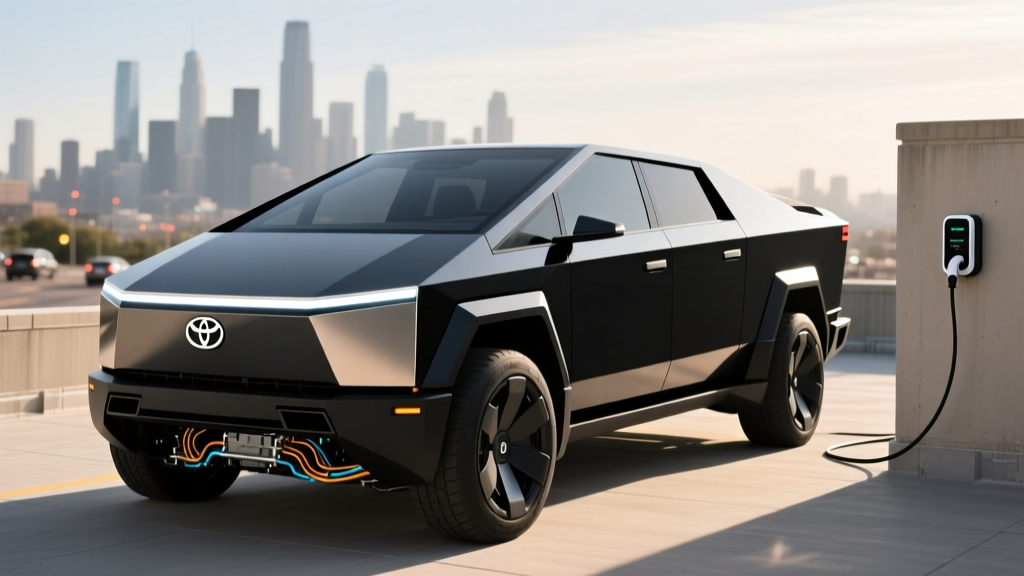
The search term "Toyota Cybertruck" appears to be a grassroots mashup of two things: Toyota's well-documented truck heritage (Tacoma, Tundra) and Tesla's polarizing Cybertruck, which began deliveries in late 2023. Internet forums, YouTube thumbnails, and AI-generated concept renders have fueled speculation that Toyota is building a direct Cybertruck competitor with a similarly angular, stainless-steel design.
That's not what Toyota has shown. The closest official preview is the Toyota bZ Pickup Concept, revealed at the company's December 2021 "mega supply" event alongside 14 other battery-electric concepts. Toyota also showed a mid-size electric truck concept at the 2023 Tokyo Mobility Show that appeared closer to production intent. Neither vehicle carries the "Cybertruck" name, and neither has a confirmed U.S. on-sale date as of 2026.
Key fact: Toyota has not announced a U.S.-market electric pickup truck with a confirmed model name, price, or release date. Any article or video presenting a "Toyota Cybertruck" as currently available is misleading.
What Toyota Has Actually Revealed About an Electric Truck
Toyota's electric truck ambitions are real, even if the production timeline remains opaque. Here's what we know from official sources:
- bZ Pickup Concept (2021): A unibody, mid-size electric truck concept with a short bed, integrated light bar, and aggressive stance. It appeared closest to a Tacoma-sized EV rather than a full-size Tundra replacement.
- Tokyo concept (2023): A more production-realistic electric truck with a conventional pickup silhouette, suggesting Toyota is testing market appetite for a battery-electric truck in its core segments.
- Patent filings: Toyota has filed multiple patents related to electric truck bed structures, structural battery pack integration for body-on-frame vehicles, and modular truck platforms.
- Hybrid bridge strategy: Toyota has prioritized the Tundra i-FORCE MAX hybrid and Tacoma hybrid as interim steps, betting that truck buyers will transition through hybrids before full electrification.
Toyota's public messaging has consistently emphasized a "multi-pathway" approach — offering hybrids, plug-in hybrids, hydrogen fuel cell vehicles, and battery EVs simultaneously. This means an electric truck is likely in the pipeline, but Toyota is unlikely to rush one to market until battery costs decline further and U.S. charging infrastructure matures.
Estimated Specs: What a Toyota Electric Truck Could Offer
While no official specs exist, we can make educated projections based on the bZ concept, Toyota's current battery partnerships (primarily with Panasonic and CATL), and the competitive landscape. All figures below are speculative estimates — not confirmed by Toyota.
| Specification | Estimated / Projected | Notes |
|---|---|---|
| EPA Range | ~280–340 miles | Depends on battery size; mid-size truck segment target |
| Battery Capacity | ~100–125 kWh (usable) | Likely NMC chemistry for energy density in a truck application |
| Battery Chemistry | NMC (Nickel Manganese Cobalt) | LFP unlikely for a truck needing high energy density & towing capacity |
| DC Fast Charge (Peak) | ~150–250 kW | Toyota's bZ4X peaks at 150 kW; next-gen platform expected faster |
| 10–80% DC Charge Time | ~25–35 minutes (est.) | Depends on pack thermal management & charge curve |
| Level 2 Home Charging | ~11.5 kW (~25–30 mi/hr) | Standard for trucks in this class |
| Drivetrain | Dual-motor AWD | Expected for truck buyers; possible tri-motor for performance trim |
| Horsepower | ~400–550 hp (est.) | Competitive with Rivian R1T and Silverado EV |
| 0–60 mph | ~4.5–5.5 seconds (est.) | Typical for dual-motor electric trucks |
| Towing Capacity | ~7,500–10,000 lbs (est.) | Mid-size target; full-size would aim higher |
| Starting MSRP | $55,000–$65,000 (est.) | Mid-size positioning between R1T and Silverado EV |
These projections assume Toyota targets the mid-size electric truck segment (Tacoma-class), which is currently underserved. The Rivian R1T and the discontinued Chevrolet Silverado EV have leaned larger and more expensive, leaving room for a more affordable, Tacoma-sized electric pickup.
If a future Toyota electric truck achieves an EPA-estimated 310 miles, expect real-world highway range of approximately 250–270 miles at 70 mph, and potentially 200–220 miles in freezing temperatures (below 30°F). Trucks suffer more cold-weather range loss than sedans due to their larger frontal area, higher rolling resistance, and less efficient aerodynamics. Always budget 20–30% below the EPA sticker for road-trip planning in a truck.
Electric Trucks You Can Actually Buy in 2026
Rather than wait for an unconfirmed Toyota electric truck, here are the production electric pickups available to U.S. buyers right now, with verified EPA data and pricing:
| Model | EPA Range | Battery (kWh) | Peak DC kW | 10–80% Time | 0–60 mph | Starting MSRP |
|---|---|---|---|---|---|---|
| Rivian R1T (Dual-Motor, Standard) | 270 mi | 95 (usable) | 200 kW | ~21 min | 4.5 sec | $69,900 |
| Rivian R1T (Max Pack) | 410 mi | 141 (usable) | 200 kW | ~38 min | 4.5 sec | $87,900 |
| Tesla Cybertruck (AWD) | 340 mi | ~123 (usable) | 250 kW | ~18 min | 4.1 sec | $79,990 |
| Tesla Cybertruck (Cyberbeast) | 320 mi | ~123 (usable) | 250 kW | ~18 min | 2.6 sec | $99,990 |
| Ford F-150 Lightning (Std Range) | 240 mi | 98 (usable) | 150 kW | ~29 min | 4.0 sec | $54,995 |
| Ford F-150 Lightning (Ext Range) | 320 mi | 131 (usable) | 150 kW | ~41 min | 4.0 sec | $69,995 |
| GMC Sierra EV (Denali Edition 1) | 440 mi | ~200 (est.) | 350 kW | ~12 min | ~4.5 sec | $99,495 |
Sources: fueleconomy.gov, manufacturer press sites. Pricing reflects base MSRP before any incentives and is subject to change.
Federal Tax Credit: What to Expect for a Future Toyota Electric Truck
When (and if) Toyota brings an electric truck to market, its eligibility for the federal §30D EV tax credit will depend on several factors that change frequently. Here's the current framework for 2026:
- Maximum credit: Up to $7,500, split between $3,750 for critical minerals sourcing and $3,750 for battery component sourcing (per IRS §30D guidelines).
- MSRP caps: Vans, SUVs, and pickup trucks must have an MSRP of $80,000 or less to qualify. Sedans are capped at $55,000.
- Buyer income limits: Modified adjusted gross income must not exceed $300,000 (joint), $225,000 (head of household), or $150,000 (individual).
- Battery sourcing requirements: Increasingly strict critical-mineral and battery-component sourcing rules apply, with foreign entity of concern (FEOC) restrictions that have disqualified several models.
- Point-of-sale transfer: Eligible buyers can transfer the credit to the dealer at purchase, reducing the upfront price rather than waiting for a tax refund.
Eligibility changes frequently based on battery sourcing rules and IRS guidance. A Toyota electric truck assembled in the U.S. (likely at a Kentucky or Texas plant) with a compliant battery supply chain could qualify — but only if Toyota meets the critical-mineral and component thresholds. Always verify current eligibility at fueleconomy.gov before purchasing, and consult a tax professional for your specific situation.
For comparison, as of early 2026: the Ford F-150 Lightning qualifies for the full $7,500 credit (subject to income limits). The Rivian R1T qualifies for a partial credit depending on trim and delivery date. The Tesla Cybertruck's eligibility has fluctuated based on battery sourcing changes.
Should You Wait for Toyota's Electric Truck or Buy Now?
This is the decision every prospective electric truck buyer faces. Here's a practical framework:
Buy Now If...
- You need a truck within the next 6–12 months
- You want to lock in current federal tax credits before rules tighten further
- Your daily driving is under 200 miles round-trip (most electric trucks handle this easily)
- You have home Level 2 charging access (or can install it)
- You value proven reliability data and established service networks
Wait for Toyota If...
- You're a loyal Toyota truck owner and want to stay in the brand ecosystem
- You prioritize Toyota's reputation for long-term reliability and resale value
- You want a mid-size electric truck (Tacoma-class) — a segment currently underserved
- You can comfortably wait until 2027–2028 or later for a potential release
- You want a more conservative, proven design rather than a radical one
What Toyota Truck Buyers Should Do Today
If you're a current Tacoma or Tundra owner exploring electric options, here's a practical path forward:
- Test-drive the Ford F-150 Lightning and Rivian R1T. These are the most mature electric trucks on the market and will give you a baseline for what electric truck ownership feels like — including regenerative braking, one-pedal driving, instant torque for towing, and the reality of road-trip charging.
- Assess your home charging situation. Electric trucks have large batteries (95–200 kWh). A Level 2 home charger (240V, 48A) is essentially mandatory for convenient ownership. Budget $800–$2,500 for a quality Level 2 unit plus professional installation, and confirm your electrical panel has capacity (a 200A panel is typically required).
- Calculate your real total cost of ownership. Electric trucks have higher upfront costs but lower fueling and maintenance expenses. At $0.13/kWh (national average electricity rate) and 2.0 mi/kWh efficiency, you're paying roughly $0.065/mile for energy — compared to $0.15–$0.20/mile for gasoline in a comparable truck.
- Monitor Toyota's official announcements. Follow Toyota's U.S. newsroom for any production truck reveal. Be skeptical of unofficial renders and rumor sites.
Frequently Asked Questions
Does the Toyota Cybertruck exist?
No. "Toyota Cybertruck" is an unofficial term used by enthusiasts and content creators. Toyota has not announced any vehicle by this name. The closest official previews are the bZ Pickup Concept (2021) and a mid-size electric truck concept shown in Tokyo (2023), neither of which has a confirmed U.S. production date.
When will Toyota release an electric pickup truck?
Toyota has not confirmed a release date. Industry analysts project a possible reveal in 2026–2027 with deliveries beginning in 2027–2028, but this is speculation. Toyota's multi-pathway strategy means it is prioritizing hybrids and plug-in hybrids for its truck lineup in the near term.
Will a Toyota electric truck qualify for the $7,500 federal tax credit?
It depends on the final MSRP, battery sourcing, and your income. Pickup trucks must have an MSRP at or below $80,000 to be eligible. Battery critical-mineral and component sourcing rules must also be met. If Toyota manufactures the truck in the U.S. with a compliant supply chain, qualification is possible — but not guaranteed. Check IRS.gov for current rules.
What's the best electric truck I can buy right now?
For value and availability, the Ford F-150 Lightning (starting ~$54,995, 240–320 mi range) is the most accessible full-size electric truck. For performance and adventure features, the Rivian R1T (starting ~$69,900, up to 410 mi with Max Pack) leads the mid-size segment. The Tesla Cybertruck offers the most polarizing design with strong performance (0–60 in 2.6 sec for Cyberbeast) but limited availability and higher pricing.
How much would a Toyota electric truck cost?
Based on Toyota's current pricing strategy and segment positioning, a mid-size Toyota electric truck (Tacoma-class) would likely start between $55,000 and $65,000, with higher trims reaching $75,000+. This would position it below the Rivian R1T and Tesla Cybertruck but above the base Ford F-150 Lightning. These are estimates only — Toyota has not announced pricing.
Is Toyota's hybrid truck a better choice than going full electric?
For many truck buyers in 2026, yes. The Tundra i-FORCE MAX hybrid delivers 437 hp and 583 lb-ft of torque with an EPA-estimated 20–22 MPG combined — significantly better than a non-hybrid truck, with zero range anxiety and no charging infrastructure dependency. The Tacoma hybrid offers similar benefits in a mid-size package. If you lack home charging access or frequently tow long distances, a hybrid remains the more practical choice until electric truck range and charging speed improve further.