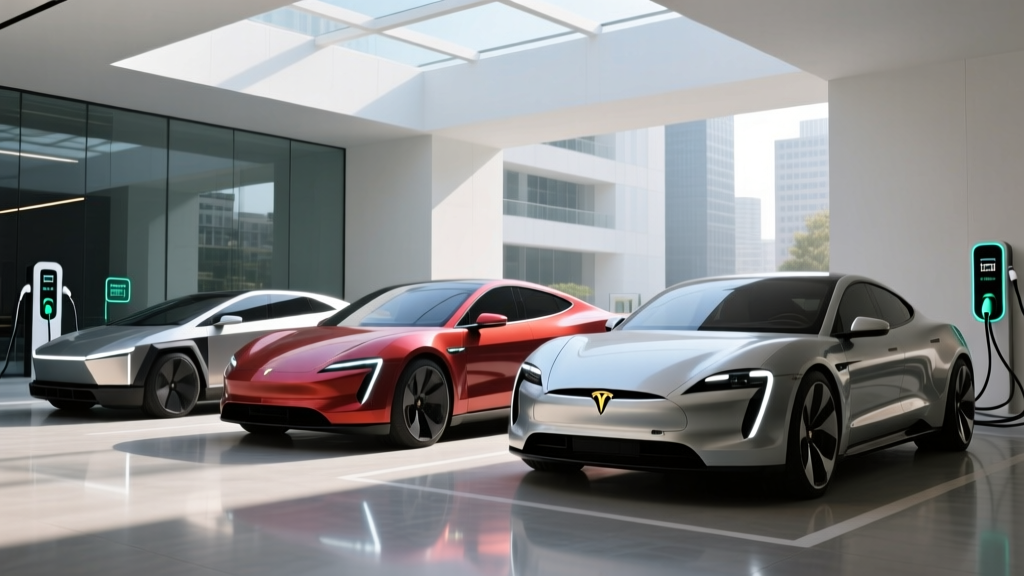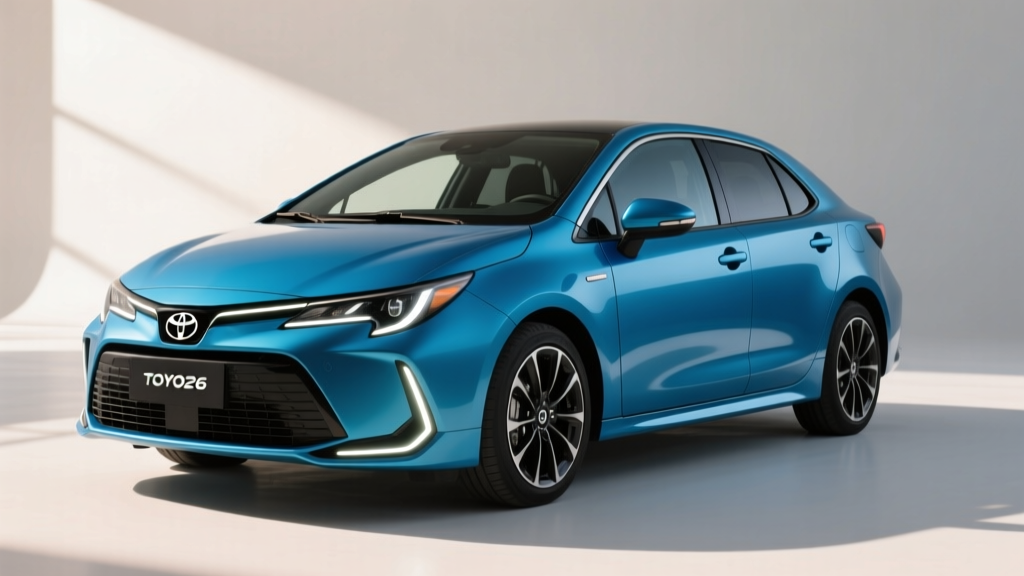
The Toyota Corolla has been the best-selling compact sedan in America for decades, and as of early 2026, Toyota has confirmed a battery-electric successor is coming to the U.S. market. The new Toyota Corolla EV design is shaping up as a compact, front-wheel-drive sedan built on Toyota's next-generation EV platform with an estimated 250-mile EPA range, a ~58 kWh LFP (lithium iron phosphate) battery, NACS (Tesla-style) charging port, and a target starting MSRP near $30,000 before incentives. Toyota has not released final EPA-certified specs or pricing, so every figure in this guide is based on Toyota's official previews, supply-chain reporting, and comparable platform data as of Q1 2026.
What the New Toyota Corolla EV Design Tells Us
Toyota unveiled its next-generation EV architecture in mid-2025, and the Corolla EV is one of the first models confirmed for the U.S. market on this platform. The design language moves away from the bZ4X's crossover styling toward a sleeker, lower-slung sedan profile aimed squarely at the Civic-sized segment. Key design and engineering signals from Toyota's previews include:
- Low-slung battery pack: The next-gen platform uses a thinner, structural battery tray that lowers the center of gravity and increases interior cabin space compared to the bZ4X.
- NACS standard: Toyota confirmed all new U.S.-market EVs will ship with the North American Charging Standard (NACS) port, granting access to Tesla Superchargers without an adapter.
- LFP chemistry: Toyota has indicated the Corolla EV will use lithium iron phosphate cells, prioritizing longevity, thermal stability, and lower cost over maximum energy density.
- Aerodynamic optimization: Flush door handles, an active grille shutter, and a flat underbody are designed to reduce drag coefficient below 0.26 Cd — critical for highway range in a compact sedan.
- Interior layout: A "mega-screen" infotainment display (estimated 14-inch) and a simplified, button-reduced dash follow the trend set by the Crown and refreshed Camry.
Toyota has not published exterior dimensions, but the Corolla EV is expected to ride on a ~106-inch wheelbase — roughly 3 inches longer than the current gas Corolla — to accommodate the battery pack while maintaining a similar overall footprint for urban maneuverability.
Preliminary Specs: Range, Battery, and Charging
Because the Corolla EV is still in pre-production, the following table reflects announced and estimated specifications based on Toyota's platform disclosures and comparable vehicles in the segment. Final EPA-certified numbers will be published closer to launch.
| Specification | Estimated Value | Status |
|---|---|---|
| EPA Range | ~250 miles | Announced target |
| Battery Capacity | ~58 kWh usable | Estimated (platform data) |
| Battery Chemistry | LFP (lithium iron phosphate) | Confirmed by Toyota |
| Peak DC Fast Charge Rate | ~150 kW | Estimated |
| 10–80% DC Fast Charge Time | ~28 minutes (estimated) | Estimated |
| Level 2 (240V) Charge Rate | ~7.7 kW | Estimated |
| Level 2 0–100% Time | ~8 hours | Estimated |
| Connector | NACS (native) | Confirmed |
| Drivetrain | FWD, single motor | Expected (AWD possible) |
| Horsepower | ~200 hp (estimated) | Estimated |
| 0–60 mph | ~7.0 seconds (estimated) | Estimated |
| Battery Warranty | 8 yr / 100,000 mi (expected) | Per Toyota EV precedent |
| Base MSRP (target) | ~$30,000 | Announced target |
Corolla EV vs. Gas Corolla vs. Corolla Hybrid: A Cost Comparison
The biggest question for Corolla shoppers: does going electric actually save money? Here's a five-year cost projection comparing the anticipated Corolla EV against the current gas Corolla LE and Corolla Hybrid LE, assuming 15,000 miles/year, $3.50/gallon regular gas, and $0.14/kWh average home electricity.
| Cost Factor | Corolla EV (est.) | Corolla Gas LE | Corolla Hybrid LE |
|---|---|---|---|
| Purchase Price (MSRP) | $30,000 | $22,550 | $24,050 |
| Federal Tax Credit (§30D) | Up to $7,500* | $0 | Up to $7,500* |
| Effective Purchase Price | $22,500 | $22,550 | $16,550 |
| Fuel/Energy Cost (5 yr) | $3,940 | $8,310 | $5,750 |
| Maintenance (5 yr) | ~$1,800 | ~$3,200 | ~$3,000 |
| Insurance (5 yr avg) | ~$7,500 | ~$6,500 | ~$6,800 |
| 5-Year Total | $35,740 | $40,560 | $32,100 |
*§30D credit eligibility depends on MSRP caps (sedans ≤$55,000), buyer income limits ($150K single / $300K joint), battery critical-mineral and component sourcing rules, and manufacturer compliance. The Corolla Hybrid qualifies under a separate PHEV/HEV credit structure that differs from the BEV rules. Always verify current eligibility at IRS.gov and consult a tax professional. Point-of-sale transfer is available at participating dealers.
The EV's energy savings are substantial — roughly $4,370 less than the gas model over five years — but insurance premiums for EVs run 10–15% higher on average, and the effective purchase price only matches the gas Corolla if the full §30D credit applies. The Corolla Hybrid, which already qualifies for a partial credit and gets an EPA-estimated 50 MPG combined, remains the lowest-total-cost option for buyers who lack reliable home charging.
Charging Reality: Home Setup, Public Networks, and Daily Use
Any EV purchase decision starts with a charging plan. The Corolla EV's expected ~58 kWh battery and NACS connector create a straightforward ownership scenario — if you have the right setup.
Home Charging (Level 2)
At the estimated 7.7 kW Level 2 rate, a full 0–100% charge would take roughly 8 hours on a 240V/32A circuit. For daily use, most owners will plug in overnight and wake up to a full battery. The key requirement is a Level 2 home charger installation, which typically costs:
- Charger hardware: $300–$600 (e.g., ChargePoint Home Flex, Emporia Vue)
- Electrician labor + permit: $500–$2,000 (varies widely by panel proximity and local code)
- Panel upgrade (if needed): $1,500–$3,500 for a 200A service upgrade on older homes
- Federal charger credit (§30C): Up to $1,000 (30% of hardware + install, capped) for qualifying census tracts — check IRS §30C rules
If you rent, live in a condo without charging access, or rely exclusively on street parking, the Corolla EV becomes significantly less convenient. Public DC fast charging at an estimated 150 kW peak rate means a 10–80% session in roughly 28 minutes — adequate for road trips but not a viable daily strategy due to higher per-kWh costs ($0.35–$0.55/kWh at most networks) and time commitment.
Public Charging and NACS Access
Toyota's decision to adopt NACS natively is a significant practical advantage. The Corolla EV will have direct access to over 20,000 Tesla Supercharger stalls across the U.S. without an adapter, plus the growing Electrify America, EVgo, and ChargePoint networks that are adding NACS cables. This eliminates the adapter hassle that current CCS-equipped vehicles (including Toyota's own bZ4X) face at Superchargers.
However, a 150 kW peak rate means the Corolla EV won't match the 250–350 kW capability of Hyundai's E-GMP platform or Tesla's latest architecture. On long road trips, expect slightly longer stops — plan for 30–35 minute breaks at 150 kW chargers rather than the 18–22 minutes possible on faster-charging competitors.
Federal Tax Credit Eligibility: Will the Corolla EV Qualify?
Toyota's target MSRP of ~$30,000 places the Corolla EV well under the §30D sedan cap of $55,000, which is the easy part. The harder questions involve sourcing requirements that have tightened significantly since the Inflation Reduction Act:
- ✅ MSRP under $55,000 sedan cap — Expected to pass
- ⚠️ Buyer income under $150K (single) / $300K (joint) — Buyer-dependent
- ⚠️ Critical minerals sourcing (≥80% from U.S. or FTA partners for full $3,750) — Depends on Toyota's supply chain at launch
- ⚠️ Battery component manufacturing (≥100% North American for full $3,750) — Depends on Toyota's battery plant timeline
- ⚠️ FEOC exclusion (no Chinese-entity battery materials) — Evolving compliance
- ✅ Final assembly in North America — Toyota's Kentucky and Alabama plants are candidates
Decision Framework: Should You Wait for the Corolla EV?
The Corolla EV won't arrive until late 2026 at the earliest (as a 2027 model-year vehicle). Here's a practical framework to decide whether it belongs on your shortlist:
- You have home Level 2 charging (or can install it) and drive under 200 miles/day
- You want a compact sedan with low running costs and Toyota reliability
- Your current vehicle can last another 12–18 months while you wait
- You value NACS Supercharger access and prefer not to use adapters
- You want LFP chemistry for its longer cycle life and tolerance of daily 100% charging
- You rent or lack reliable home charging access
- You need a car now and can't wait until late 2026
- You frequently drive in extreme cold (below 10°F) where EV range loss exceeds 30%
- You regularly take 500+ mile road trips and don't want to plan around charging stops
- The full §30D credit is unlikely for your income/sourcing situation, making the EV's effective price higher
- You need a car within 3–6 months — the Hyundai Kona Electric (EPA 261 mi, ~$33,000), Chevrolet Equinox EV (EPA 319 mi, ~$33,000), or Nissan Leaf (if still available) are purchasable now
Common Misconceptions About the Corolla EV
| Myth | Fact |
|---|---|
| "It'll get 400+ miles of range." | Toyota's target is ~250 miles EPA. Compact sedans with ~58 kWh batteries physically cannot deliver 400 miles with current LFP energy density. |
| "LFP batteries are inferior." | LFP offers longer cycle life (2,000–3,000+ cycles), better thermal stability, and tolerance for 100% daily charging. The trade-off is lower energy density and more cold-weather range loss vs. NMC. |
| "I can charge it at any Tesla Supercharger today." | The Corolla EV is not yet on sale. When it launches with native NACS, it will have direct Supercharger access — but that's a future capability. |
| "The $7,500 tax credit is guaranteed." | Credit eligibility depends on battery sourcing rules that change frequently. Many 2026 EVs qualify for $3,750 or $0. Verify at purchase time. |
| "It's just a gas Corolla with a battery." | The Corolla EV rides on Toyota's dedicated EV platform with a structural battery pack, lower center of gravity, and EV-specific suspension tuning — not a converted gas chassis. |
Frequently Asked Questions
When will the Toyota Corolla EV be available to buy?
Toyota has announced the Corolla EV for the U.S. market but has not confirmed an exact on-sale date. Based on Toyota's production timeline and platform rollout, the earliest realistic arrival is late 2026 as a 2027 model-year vehicle. Pre-orders or reservations may open several months before delivery.
Will the Corolla EV have all-wheel drive?
Toyota has not confirmed drivetrain options. The base model is expected to be front-wheel drive with a single motor (~200 hp estimated). A dual-motor AWD variant is possible but would reduce range and increase price. Toyota's EV platform supports both configurations.
How does the Corolla EV compare to the Hyundai Kona Electric?
The 2026 Kona Electric offers an EPA-estimated 261 miles of range, a 65 kWh NMC battery, 150 kW peak DC charging, and starts at ~$33,000. The Corolla EV targets similar specs (~250 mi, ~58 kWh LFP, ~150 kW, ~$30,000) but with LFP chemistry advantages and native NACS. The Kona is available now; the Corolla EV is not.
Can I charge the Corolla EV on a standard 120V outlet?
Yes, at Level 1 (~1.4 kW), but you'd add only about 4–5 miles of range per hour of charging. A full charge from empty would take over 40 hours. Level 1 is viable only for emergency top-ups or very low daily mileage (under 20 miles/day). A 240V Level 2 installation is strongly recommended.
What happens to the Corolla EV battery after many years?
LFP batteries typically degrade more slowly than NMC, often retaining 85–90% capacity after 150,000+ miles. Toyota is expected to offer an 8-year/100,000-mile battery warranty (consistent with its bZ4X coverage and federal requirements). If the battery falls below ~70% state of health within the warranty period, Toyota would repair or replace it at no cost. Out-of-warranty LFP pack replacement costs are estimated at $8,000–$12,000 based on current market rates for comparable packs.