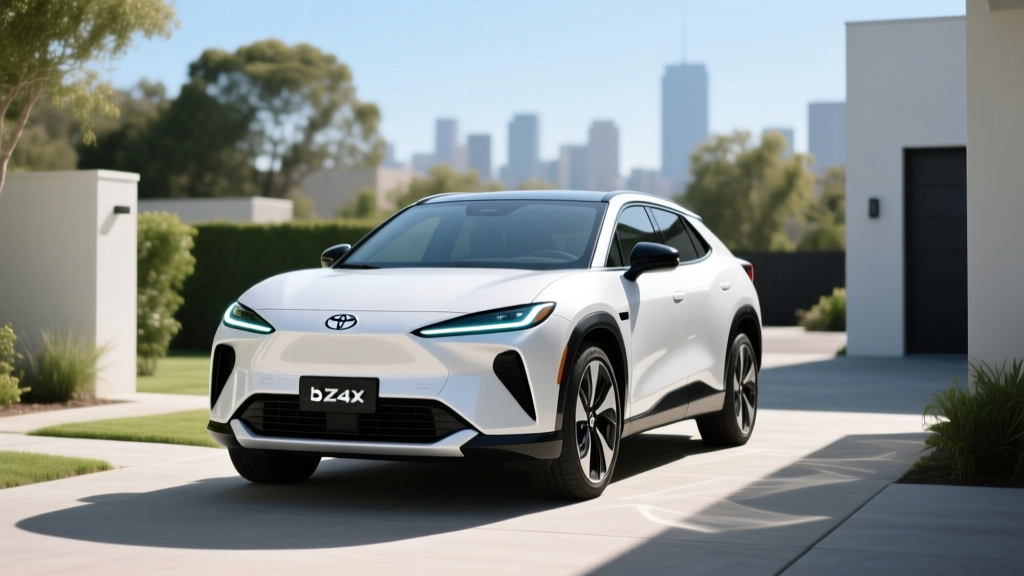
The Toyota bZ4X occupies a unique space in the EV market: it is arguably the most conservative electric crossover available from a legacy automaker, yet it carries Toyota's reputation for bulletproof reliability and an industry-leading battery warranty. For buyers researching Toyota bZ4X rebates and incentives, the math gets interesting fast — between federal tax credits, state-level programs, and Toyota's own lease bonuses, the effective price can drop significantly below the sticker.
But incentives only matter if the underlying vehicle fits your life. This review breaks down the 2026 bZ4X with exact numbers: EPA range versus real-world expectations, DC fast-charging curves, battery chemistry, and the precise IRS §30D rules that determine whether you'll see $7,500 knocked off at the point of sale — or nothing at all.
2026 Toyota bZ4X Specifications at a Glance
| Spec | Value |
|---|---|
| EPA Range (FWD) | 252 miles |
| EPA Range (AWD) | 228 miles |
| Battery (usable) | 71.4 kWh, lithium-ion (NMC) |
| Max DC Fast Charge | 150 kW (FWD) / 150 kW (AWD) |
| 10–80% DC Fast Charge | ~30 minutes |
| Level 2 Home Charge Rate | 7.4 kW (onboard charger) |
| 0–60 mph (FWD) | 7.1 seconds |
| 0–60 mph (AWD) | 5.8 seconds |
| Horsepower (FWD / AWD) | 201 hp / 214 hp |
| MPGe (FWD combined) | 131 MPGe |
| Efficiency (FWD) | 26 kWh / 100 mi |
| Cargo Volume (rear seats up) | 27.7 cu ft |
| Cargo Volume (rear seats folded) | 56.9 cu ft |
| Base MSRP (XLE FWD) | $37,070 (incl. destination) |
| Battery Warranty | 10 years / 150,000 miles |
Real-World Range: What the EPA Number Doesn't Tell You
EPA sticker (FWD): 252 miles
Expect in mixed driving: ~220–240 miles
Sustained highway (70+ mph): ~195–215 miles
Cold weather (below 30°F): ~160–190 miles (30–35% reduction is typical for NMC packs without aggressive preconditioning)
The FWD bZ4X's 252-mile EPA estimate is competitive with the base Hyundai Ioniq 5 and slightly behind the Chevrolet Equinox EV. The AWD variant drops to 228 miles due to the second motor's weight and drag, a penalty worth understanding if you live in a snowy climate.
In real-world highway testing at 70–75 mph, the bZ4X typically delivers 195 to 215 miles before the low-battery warning. This is consistent with most crossovers in this segment — the EPA cycle includes generous city regenerative-braking recovery that highway driving eliminates. The bZ4X does include a heat pump on all trims, which helps mitigate cold-weather range loss compared to EVs without one, but NMC chemistry still suffers in sub-freezing temperatures. Expect a 30–35% range reduction in deep winter if you're not preconditioning the battery while plugged in.
For daily commutes under 80 miles round-trip with home charging, the bZ4X's real-world range is a non-issue. For road trips exceeding 200 miles between charging stops, you'll want to plan conservatively, especially in winter or mountainous terrain.
Charging Speed: DC Fast, Level 2, and the Curve Reality
| Charging Level | Power | Speed (Approx.) |
|---|---|---|
| Level 1 (120V household) | ~1.2 kW | ~3–4 miles per hour |
| Level 2 (240V home/public) | 7.4 kW (max onboard) | ~22–25 miles per hour; full charge in ~9.5 hrs |
| DC Fast Charge (CCS) | 150 kW peak | 10–80% in ~30 min |
The bZ4X peaks at 150 kW on DC fast chargers, which puts it behind rivals like the Hyundai Ioniq 5 (up to 240 kW on 800V architecture) and the Tesla Model Y (up to 250 kW on V3 Superchargers). The 10–80% charge time of approximately 30 minutes is acceptable for road-trip stops but not class-leading.
Understanding the charge curve is critical here. The bZ4X reaches its 150 kW peak only between roughly 10–30% state of charge. Above 50%, the rate tapers significantly, dropping to around 60–80 kW by 70% and further to ~40 kW above 80%. This is standard lithium-ion behavior to protect cell health, but it means charging from 80–100% at a DC fast charger is painfully slow and expensive. Plan to charge to 80% and move on.
At home on a Level 2 charger (240V, 32-amp circuit minimum), the 7.4 kW onboard charger replenishes the 71.4 kWh battery in roughly 9.5 hours from empty. Most owners will plug in overnight and wake to a full charge — the practical reality of EV ownership that makes range anxiety largely irrelevant for those with home charging access.
For 2026, the bZ4X uses the CCS1 connector for DC fast charging. Toyota has confirmed that future models will adopt the Tesla NACS standard, and adapters for accessing Tesla Supercharger networks are expected to be available, but as of this writing the bZ4X relies on Electrify America, EVgo, ChargePoint, and other CCS networks.
Federal Tax Credits, Rebates, and What You'll Actually Pay
The question driving searches for Toyota bZ4X rebates is straightforward: how much can you actually save? The answer depends on a web of federal, state, and manufacturer incentives that stack differently depending on your situation.
Federal §30D Tax Credit: Up to $7,500 (with conditions)
Under the IRS §30D Clean Vehicle Credit, the 2026 bZ4X may qualify for up to $7,500 in federal tax credits, split into two halves:
- $3,750 — Battery Component Requirement: A percentage of battery components must be manufactured or assembled in North America. Toyota has been working to qualify the bZ4X's supply chain for this half.
- $3,750 — Critical Minerals Requirement: A percentage of critical minerals in the battery must be sourced from the U.S. or a free-trade-agreement country.
Whether the bZ4X qualifies for the full $7,500, half ($3,750), or none depends on the current model year's battery sourcing, which the IRS updates periodically on its eligible vehicle list. Always verify the specific VIN and model year against the IRS database before purchasing.
Eligibility Caps You Must Meet
- MSRP cap: The bZ4X qualifies as an SUV/crossover under the §30D rules, with an MSRP cap of $80,000. All bZ4X trims fall well under this limit.
- Buyer income caps (modified AGI): $300,000 joint filers / $225,000 head of household / $150,000 single filers. If your income exceeds these thresholds, you are not eligible for the federal credit.
- Point-of-sale transfer: As of 2024, you can transfer the credit to the dealer at purchase, receiving the discount upfront rather than waiting to claim it on your tax return. This is available for the 2026 model year.
| Trim | MSRP | After Max $7,500 Credit | After $3,750 (Half Credit) |
|---|---|---|---|
| XLE FWD | $37,070 | $29,570 | $33,320 |
| XLE AWD | $39,150 | $31,650 | $35,400 |
| Limited FWD | $43,070 | $35,570 | $39,320 |
| Limited AWD | $45,150 | $37,650 | $41,400 |
Note: Prices include destination charges. State and local incentives vary widely — check the AFDC state incentive database for your area. Tax advice should come from a qualified tax professional; eligibility depends on your individual circumstances.
Toyota Lease Bonuses and Dealer Incentives
Toyota has periodically offered lease cash incentives on the bZ4X — often between $5,000 and $7,500 — which can make leasing significantly cheaper than buying, especially if you don't qualify for the full federal credit due to income limits. Lease incentives are applied by the dealer and can sometimes be stacked with the federal credit (which goes to the leasing company, who may pass savings through as a reduced lease payment). Always ask the dealer for the current incentive breakdown in writing.
Performance, Efficiency, and Daily Drivability
The bZ4X FWD delivers 201 horsepower from a single front-mounted motor, reaching 60 mph in 7.1 seconds. That's adequate for merging and passing but noticeably slower than the Hyundai Ioniq 5 (7.4 seconds for the base RWD, but 5.0 seconds for the dual-motor AWD) or the Tesla Model Y Long Range (4.8 seconds).
The AWD variant, co-developed with Subaru, adds a rear motor for 214 combined horsepower and a 5.8-second 0–60 time. It also includes X-MODE, Subaru's traction-management system, which provides genuine capability in snow, mud, and light off-road conditions — a meaningful differentiator in this segment.
Efficiency is respectable: the FWD model achieves 131 MPGe combined (26 kWh/100 mi), which translates to roughly $0.04–$0.06 per mile on average U.S. electricity rates. Compare that to a 28 MPG gas crossover at $3.50/gallon ($0.125/mile), and the per-mile fuel savings are substantial — approximately $1,200–$1,500 per year for a 15,000-mile driver.
Ride quality is a bZ4X strength. The suspension tuning is comfort-oriented, absorbing road imperfections with a maturity that some sportier rivals sacrifice. Cabin noise levels are low, and the seating position is upright and commanding. The steering is light and precise, if not particularly communicative — this is a crossover for commuting and family duty, not canyon carving.
Interior, Cargo, and Technology
The bZ4X's interior uses sustainable materials including recycled fabrics and plant-based leatherette. Build quality meets Toyota's high standards, with tight panel gaps and durable surfaces.
Passenger space: Front legroom is 41.6 inches; rear legroom is 38.0 inches. Both are competitive for the compact crossover segment, and the flat floor (no transmission tunnel) makes the rear middle seat genuinely usable.
Cargo: 27.7 cubic feet behind the rear seats and 56.9 cubic feet with them folded. There is no front trunk (frunk) — the space under the hood houses electronics. This is a notable omission versus the Ioniq 5 and Model Y, which both offer usable frunk storage.
Infotainment: The 12.3-inch touchscreen runs Toyota's latest Audio Multimedia system with wireless Apple CarPlay and Android Auto, cloud-based navigation, and natural-language voice assistant. Response times are good, and the interface is logical, though some competitors offer larger or more configurable displays.
Driver assistance: Toyota Safety Sense 3.0 is standard on all trims, including:
- Pre-Collision System with pedestrian detection
- Lane Departure Alert with steering assist
- Full-Speed Range Dynamic Radar Cruise Control
- Lane Tracing Assist
- Road Sign Assist
- Proactive Driving Assist (gentle braking/deceleration when approaching slower traffic or curves)
This is a robust Level 2 driver-assist suite — meaning the driver must remain fully engaged and hands on the wheel at all times. It is not self-driving. It is, however, among the best-tuned Level 2 systems for smoothness and lack of false alerts, which matters for daily usability.
Warranty and Long-Term Battery Confidence
Toyota backs the bZ4X's battery with one of the strongest warranties in the industry: 10 years or 150,000 miles (whichever comes first) against defects and capacity loss below 70%. This is double the duration of the industry-standard 8-year/100,000-mile EV battery warranty and reflects Toyota's confidence in the pack's longevity.
The basic vehicle warranty is 3 years/36,000 miles, and the powertrain warranty is 5 years/60,000 miles. Toyota also includes 2 years of complimentary scheduled maintenance and 2 years of roadside assistance.
The bZ4X uses an NMC (nickel manganese cobalt) lithium-ion battery, not the LFP (lithium iron phosphate) chemistry found in some Tesla and BYD models. NMC offers higher energy density (more range per pound) but typically degrades slightly faster over thousands of cycles. Toyota's aggressive warranty and conservative charging-buffer management (the car reserves a larger top and bottom buffer than some competitors) should keep degradation minimal — expect 5–8% capacity loss over the first 100,000 miles based on Toyota's hybrid battery track record and early bZ4X fleet data.
Pros, Cons, and the Verdict
Pros
- Industry-leading 10-year/150,000-mile battery warranty
- Standard Toyota Safety Sense 3.0 on all trims
- Heat pump included standard (improves cold-weather range)
- Comfortable ride quality and low cabin noise
- Subaru-developed AWD with X-MODE for genuine snow/trail capability
- Eligible for up to $7,500 federal tax credit (verify current IRS status)
- Strong Toyota dealer network for service
Cons
- DC fast-charging speed (150 kW peak) trails Ioniq 5, Model Y, and EV6
- No front trunk (frunk)
- Real-world highway range falls notably below EPA estimate
- AWD range penalty (228 mi) is significant
- 0–60 time is unremarkable for the price
- CCS-only for now; NACS adapter situation still evolving
- Rear visibility is compromised by thick C-pillars
Who the bZ4X Suits Best
Buy the bZ4X if: You want a comfortable, conservatively engineered electric crossover from a brand with unmatched reliability reputation, you value the 10-year battery warranty, and your daily driving fits within ~200 real-world miles with home charging available. The AWD variant is a strong pick for snow-belt buyers who want EV efficiency without sacrificing winter traction.
Look elsewhere if: You take frequent road trips where fast-charging speed matters (the Ioniq 5 or Model Y recharge significantly faster), you need maximum range (the Equinox EV or Model Y Long Range offer 300+ miles), or you want the latest in infotainment screen technology and frunk storage.
Frequently Asked Questions
What is the real-world range of the Toyota bZ4X?
The EPA rates the FWD bZ4X at 252 miles and the AWD at 228 miles. In real-world mixed driving, expect 220–240 miles (FWD). Sustained highway driving at 70+ mph drops this to roughly 195–215 miles. In cold weather below 30°F, plan for 160–190 miles depending on cabin heating use and whether you precondition the battery while plugged in.
How fast does the bZ4X charge?
On a DC fast charger, the bZ4X peaks at 150 kW and charges from 10–80% in approximately 30 minutes. At home on a Level 2 (240V) charger, the 7.4 kW onboard rate adds about 22–25 miles per hour, fully charging the battery overnight in ~9.5 hours. Level 1 (120V) trickle charging adds roughly 3–4 miles per hour — usable for topping off, not for daily full recharges.
Does the Toyota bZ4X qualify for the federal EV tax credit?
The bZ4X may qualify for up to $7,500 under the IRS §30D Clean Vehicle Credit, split into two $3,750 halves based on battery component and critical mineral sourcing requirements. Eligibility depends on the specific model year's supply chain status — check the IRS eligible vehicle list before purchasing. Buyer income caps ($150K single / $300K joint) and the $80,000 MSRP cap for SUVs also apply. The credit can be transferred to the dealer at point of sale for an upfront discount.
How much does the bZ4X cost after tax credits?
The base XLE FWD starts at $37,070. With the maximum $7,500 federal credit, the effective price drops to approximately $29,570. If only the half credit ($3,750) applies, the effective price is ~$33,320. State incentives and Toyota lease bonuses can reduce costs further. Always confirm current credit eligibility and dealer incentives at the time of purchase.
Is the bZ4X worth buying versus competitors?
It depends on your priorities. The Hyundai Ioniq 5 charges faster (240 kW peak), offers a frunk, and has slightly more range. The Tesla Model Y provides access to the Supercharger network and quicker acceleration. The Chevrolet Equinox EV offers over 300 miles of range at a competitive price. The bZ4X wins on battery warranty length (10 years vs. the standard 8), Toyota's reliability reputation, ride comfort, and the AWD system's genuine winter capability. If those factors matter more to you than peak charging speed or maximum range, the bZ4X is a compelling choice.
What is the bZ4X's battery chemistry, and how long will it last?
The bZ4X uses an NMC (nickel manganese cobalt) lithium-ion battery with 71.4 kWh of usable capacity. NMC offers good energy density but slightly faster degradation than LFP chemistry over thousands of cycles. Toyota's 10-year/150,000-mile battery warranty (covering capacity below 70%) and conservative buffer management suggest the pack is engineered for long-term durability. Early fleet data and Toyota's hybrid battery history point to 5–8% degradation over 100,000 miles.
Does the bZ4X have a frunk?
No. The bZ4X does not have a front trunk. The space under the hood is occupied by power electronics. Cargo capacity is limited to the rear cargo area: 27.7 cubic feet behind the rear seats, 56.9 cubic feet with them folded.