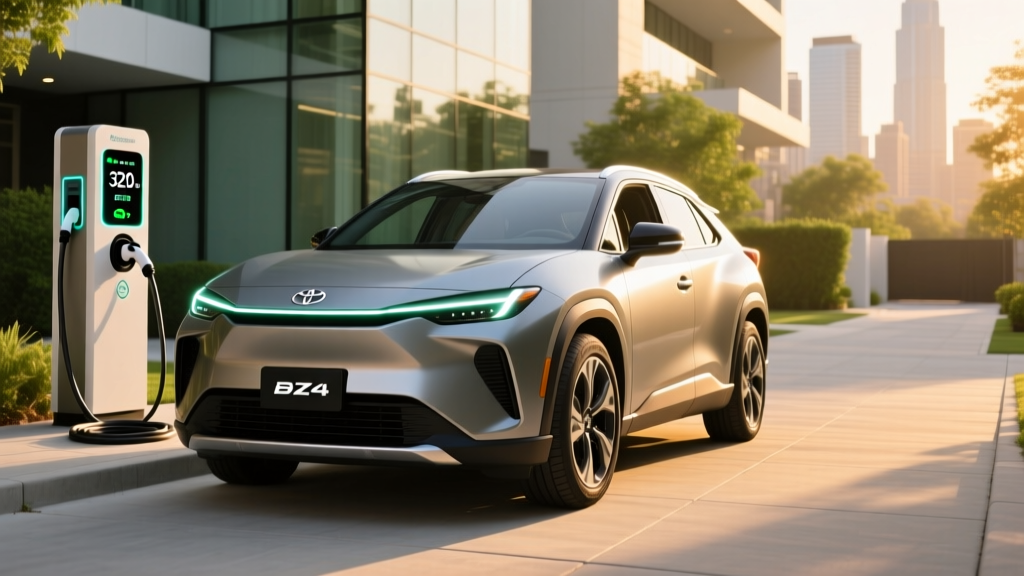
Toyota's bZ4X occupies a strange position in the EV market: it's one of the most recognizable names in the automotive world attached to one of the most debated electric crossovers. For shoppers researching a bZ4X lease, the 2026 model year brings incremental refinements but the core question remains the same — does this compact electric SUV deliver enough range, charging speed, and value to justify a 36-month commitment? This review breaks down every number that matters.
2026 Toyota bZ4X: Quick Verdict
The bZ4X is a competent, comfortable commuter EV that falls short of segment leaders in range and charging speed. Its 252-mile EPA range (FWD) and 150 kW peak DC charging put it behind the Hyundai Ioniq 5, Kia EV6, and Tesla Model Y. Where it wins: Toyota's reputation for reliability, an excellent 10-year/150,000-mile battery warranty, standard Toyota Safety Sense 3.0, and a cabin that prioritizes ergonomics over touchscreen minimalism. A bZ4X lease makes the most sense for Toyota-loyal buyers with reliable home charging who drive under 200 miles per day and value long-term battery coverage over cutting-edge specs.
Range, Battery, and Real-World Efficiency
| Spec | FWD | AWD |
|---|---|---|
| EPA Range | 252 miles | 228 miles |
| Battery (usable) | 71.4 kWh (NMC) | 71.4 kWh (NMC) |
| Horsepower | 201 hp | 214 hp |
| 0–60 mph | 7.1 sec | 5.8 sec |
| Drivetrain | Single motor, FWD | Dual motor, AWD |
| MPGe (combined) | 119 MPGe | 104 MPGe |
| Efficiency (kWh/100 mi) | 28 kWh | 32 kWh |
| Max DC Charge Rate | 150 kW | 150 kW |
| 10–80% DC Time | ~30 min | ~30 min |
| Level 2 Rate | 7.2 kW (~25 mi/hr) | 7.2 kW (~25 mi/hr) |
Real-World Range Reality Check
EPA sticker: 252 miles (FWD) / 228 miles (AWD).
Real-world highway (70–75 mph, mild weather): Expect 210–230 miles (FWD). The bZ4X's boxy shape and 32 kWh/100mi highway consumption eat into range at speed.
Cold weather (below 32°F): Plan for 160–190 miles. The bZ4X uses a resistance heater in most trims rather than a heat pump, which draws significantly more energy in winter. Toyota introduced a heat pump option on higher trims for 2025–2026, which reduces cold-weather loss to roughly 20–25% instead of 30–35%.
Bottom line: If your daily round-trip commute exceeds 180 miles in any season, the bZ4X FWD will require mid-day charging or route planning.
The 71.4 kWh battery pack uses NMC (nickel manganese cobalt) chemistry supplied primarily by CATL and Panasonic depending on build batch. NMC offers higher energy density than LFP but requires more careful state-of-charge management — Toyota recommends keeping daily charge between 20% and 80% for longevity, which effectively gives you about 43 kWh of daily-usable capacity.
Charging Speed: DC Fast, Level 2, and Level 1
| Level | Power (kW) | Rate | Full Charge Time |
|---|---|---|---|
| Level 1 (120V household) | ~1.2 kW | ~4 mi/hr | ~60 hours (0–100%) |
| Level 2 (240V home/public) | 7.2 kW | ~25 mi/hr | ~10 hours (0–100%) |
| DC Fast Charge (CCS) | Peak 150 kW | Up to 130 mi/15 min | 10–80% in ~30 min |
The bZ4X's 150 kW peak DC charging rate is the most common criticism, and it's valid. Here's what that number actually means on a road trip:
- 10–30% SoC: The bZ4X ramps up quickly and sustains close to 140–150 kW. You'll add roughly 80 miles in the first 10 minutes.
- 30–60% SoC: Power holds between 100–130 kW — respectable but below the 200+ kW sustained rates of the Ioniq 5 or EV6 on 350 kW chargers.
- 60–80% SoC: The charge curve tapers significantly to roughly 60–80 kW. This is why the 10–80% time stretches to ~30 minutes.
- Above 80%: Drops below 30 kW. Don't plan to charge past 80% on a road trip unless you have time to spare.
The bZ4X uses the CCS1 connector standard. With Toyota's ongoing transition to NACS (Tesla-style) for future models, the 2026 bZ4X still ships with CCS. Toyota includes a NACS adapter for Supercharger access in many markets, but verify adapter availability with your dealer before signing a lease.
For home charging, the onboard 7.2 kW charger means a full overnight recharge on a Level 2 wallbox. If you're installing a 48-amp Level 2 charger (requiring a 60-amp circuit), expect $800–$2,000 for equipment and electrician labor depending on your panel distance. A home Level 2 setup is essentially mandatory for bZ4X ownership — Level 1 charging at 4 miles per hour is impractical for daily use.
Performance, Ride, and Drivetrain
The FWD bZ4X's 7.1-second 0–60 time is leisurely by EV standards. The AWD model, with its dual-motor setup producing 214 hp and 248 lb-ft of torque, cuts that to 5.8 seconds — adequate for merging but not exciting. Neither version will win stoplight races against a Model Y Long Range (4.8 sec) or an Ioniq 5 AWD (5.0 sec).
Where the bZ4X earns points is ride comfort. The 2,750 mm (108.3-inch) wheelbase and well-tuned suspension absorb highway expansion joints and potholes better than the firmer-riding Hyundai/Kia siblings. Steering is light and predictable. The AWD model uses Toyota's X-MODE system for light off-road traction (snow, mud settings), though ground clearance of 7.1 inches limits any serious trail ambitions.
Regenerative braking offers multiple levels selectable via paddle shifters, but the bZ4X does not provide true one-pedal driving — the regen doesn't bring the car to a complete stop. You'll still use the friction brake pedal at intersections. This is a deliberate Toyota choice, and it frustrates drivers coming from Teslas or Bolts who expect full one-pedal capability.
Interior, Cargo, and Technology
The bZ4X cabin is one of its stronger selling points. Toyota resisted the trend of stuffing every control into a touchscreen. Physical buttons for climate, volume, and defrost remain, and the 12.3-inch infotainment display runs Toyota's latest Audio Multimedia system with wireless Apple CarPlay and Android Auto.
| Measurement | Value |
|---|---|
| Front legroom | 42.2 in |
| Rear legroom | 35.6 in |
| Cargo (rear seats up) | 27.7 cu ft |
| Cargo (rear seats folded) | 56.9 cu ft |
| Frunk | None |
The absence of a frunk (front trunk) is a notable miss — competitors like the Ioniq 5 (0.85 cu ft) and Model Y (4.1 cu ft) offer front storage. The 27.7 cu ft rear cargo area is competitive with the segment, though the Model Y's 30.2 cu ft (rear seats up) edges it out.
Standard technology includes:
- Toyota Safety Sense 3.0: Pre-collision system with pedestrian detection, full-speed adaptive cruise control, lane departure alert with steering assist, lane tracing assist, road sign assist, and automatic high beams.
- Proactive Driving Assist: Gentle braking and deceleration when approaching slower traffic or curves — a Level 2 feature that works well in practice.
- 360-degree camera (available on Limited trim).
- Radiant heater (Limited trim): An infrared panel that warms the driver's lower body, reducing HVAC energy draw in cold weather — a clever efficiency feature.
Notable tech drawbacks: The bZ4X lacks a digital key on most trims, the navigation-based preconditioning for DC charging is less aggressive than Tesla's or Hyundai's (meaning cold-weather fast-charging speeds can disappoint without manual preconditioning), and the instrument cluster's placement above the steering wheel takes adjustment.
Pricing, Trims, and Federal Tax Credit Eligibility
| Trim | MSRP | Max §30D Credit* | Effective Price* |
|---|---|---|---|
| XLE FWD | $38,465 | $7,500 | ~$30,965 |
| XLE AWD | $40,465 | $7,500 | ~$32,965 |
| Limited FWD | $43,265 | $7,500 | ~$35,765 |
| Limited AWD | $45,265 | $7,500 | ~$37,765 |
*Effective price assumes full §30D eligibility. Actual credit depends on battery sourcing, buyer income, and MSRP caps. See details below.
Federal EV tax credit (§30D) eligibility for the bZ4X: As of the current IRS guidance, the bZ4X qualifies for up to $7,500 in federal tax credits, split into two halves:
- $3,750 — Battery components requirement: A percentage of battery components must be manufactured or assembled in North America. Toyota has adjusted bZ4X supply chains to meet this threshold for 2025–2026 model years, but verify with your dealer for your specific VIN.
- $3,750 — Critical minerals requirement: A percentage of critical minerals must be sourced from the U.S. or a free-trade-agreement country. This is the more volatile half — sourcing rules tighten annually.
Buyer eligibility caps (per IRS §30D rules):
- Income limits: Modified AGI must not exceed $150,000 (single), $225,000 (head of household), or $300,000 (married filing jointly).
- MSRP cap: The bZ4X, classified as an SUV, must have an MSRP under $80,000. All trims qualify.
- Point-of-sale transfer: You can transfer the credit to the dealer at purchase, reducing your out-of-pocket cost immediately — or claim it on your tax return.
Lease consideration: Under current IRS guidance, leased EVs may qualify for the commercial clean vehicle credit (§45W) rather than §30D. Many lessors pass this savings through as a "lease cash" incentive, which can make bZ4X lease deals competitive even if purchase-side credit eligibility is uncertain for your situation. Always confirm with the leasing company whether the $7,500 is factored into your lease terms. Consult a tax professional for your specific case.
Who Should Lease the bZ4X (and Who Shouldn't)
Choose the bZ4X if:
- You're a Toyota loyalist who values the brand's service network and long-term reliability reputation.
- Your daily commute is under 120 miles round-trip, and you have Level 2 home charging.
- You want a 10-year battery warranty — Toyota's EV battery coverage is among the best in the industry.
- You prefer physical buttons and a conventional cabin layout over minimalist touchscreen interfaces.
- You live in a mild climate where cold-weather range loss is less severe.
Look elsewhere if:
- You regularly drive 200+ miles between charges — the Ioniq 5 (303 mi EPA) or Model Y (320 mi) serve you better.
- You need fast road-trip charging — the bZ4X's 30-minute 10–80% time is 10–12 minutes slower than 800V competitors.
- You want one-pedal driving or the most advanced driver-assist features.
- You need a frunk for charging cables or groceries.
- You live in a harsh-winter climate and don't have access to a garage — the range penalty without a standard heat pump is significant.
bZ4X vs. Key Competitors
| Spec | Toyota bZ4X (FWD) | Hyundai Ioniq 5 (RWD) | Tesla Model Y (LR RWD) |
|---|---|---|---|
| EPA Range | 252 mi | 303 mi | 320 mi |
| Battery | 71.4 kWh NMC | 77.4 kWh NMC | ~75 kWh (LFP/NMC varies) |
| Peak DC Charge | 150 kW | 235 kW | 250 kW |
| 10–80% Time | ~30 min | ~18 min | ~22 min |
| 0–60 mph | 7.1 sec | 7.0 sec | 5.8 sec |
| Starting MSRP | $38,465 | $42,600 | $44,990 |
| Battery Warranty | 10 yr / 150k mi | 10 yr / 100k mi | 8 yr / 120k mi |
| Cargo (seats up) | 27.7 cu ft | 27.2 cu ft | 30.2 cu ft |
The bZ4X's advantage is price — it undercuts the Ioniq 5 by roughly $4,000 and the Model Y by $6,500 at base MSRP. After the federal credit, the bZ4X XLE FWD at ~$30,965 effective cost is one of the most affordable name-brand electric SUVs available. But that savings comes with trade-offs in range (50–70 fewer miles), charging speed (10–12 extra minutes at DC fast chargers), and technology (no one-pedal driving, no frunk, less aggressive preconditioning).
For a bZ4X lease, the math often works differently than a purchase. Lease residuals, money factors, and manufacturer subvention can make the monthly payment competitive with higher-priced rivals. Toyota Financial Services frequently offers lease cash incentives that effectively bake the tax credit into the deal. Check current lease offers on Toyota's website and compare the total lease cost (monthly payment × term + drive-off fees + disposition fee) against Ioniq 5 and EV6 lease specials in your area.
Warranty and Long-Term Ownership
Toyota backs the bZ4X with one of the strongest EV warranties in the segment:
- EV Battery: 10 years / 150,000 miles (whichever comes first) against defects and capacity loss below 70% of original capacity. This is the longest battery warranty among mainstream competitors.
- Powertrain (electric motors, inverter): 5 years / 60,000 miles basic, with EV-specific components covered under the battery warranty umbrella.
- Basic bumper-to-bumper: 3 years / 36,000 miles.
- Complimentary maintenance: ToyotaCare covers 2 years / 25,000 miles of scheduled maintenance.
- Roadside assistance: 2 years / 25,000 miles.
The 70% capacity retention threshold is standard across the industry. Independent data on bZ4X degradation is still limited given the model's 2023 launch, but early reports from high-mileage owners and fleet data suggest degradation of roughly 5–8% over the first 50,000 miles — in line with NMC pack expectations. The 10-year/150,000-mile coverage provides meaningful peace of mind, especially for lease-to-purchase scenarios.
Pros
- Industry-leading 10-year/150k-mile battery warranty
- Competitive base price (~$30,965 after credit)
- Comfortable ride quality and quiet cabin
- Physical buttons and conventional controls
- Comprehensive Toyota Safety Sense 3.0 standard
- Strong Toyota dealer/service network nationwide
Cons
- Below-average EPA range (252/228 mi)
- Slow DC fast charging vs. 800V competitors
- No one-pedal driving
- No frunk
- Significant cold-weather range loss (no standard heat pump)
- Modest 0–60 performance (7.1 sec FWD)
Frequently Asked Questions
What is the real-world range of the Toyota bZ4X?
The EPA rates the FWD bZ4X at 252 miles and the AWD at 228 miles. In real-world highway driving at 70–75 mph in mild weather, expect 210–230 miles from the FWD model. In cold weather (below freezing), range can drop to 160–190 miles without a heat pump. City driving with regenerative braking recovers some energy, yielding closer to EPA figures.
How fast does the bZ4X charge at home and on the road?
On a DC fast charger, the bZ4X peaks at 150 kW and charges from 10–80% in approximately 30 minutes. At home on a Level 2 (240V) charger, it charges at 7.2 kW, adding about 25 miles of range per hour — a full charge takes roughly 10 hours. On a standard 120V outlet (Level 1), expect about 4 miles per hour, which is only practical for occasional top-ups.
Does the bZ4X qualify for the $7,500 federal EV tax credit?
The bZ4X can qualify for up to $7,500 under IRS §30D, split between battery component ($3,750) and critical mineral ($3,750) requirements. Eligibility depends on your income (under $150k single / $300k joint), the vehicle's MSRP (under $80k for SUVs — all trims qualify), and battery sourcing for your specific build. For leases, the commercial credit (§45W) may apply instead. Always verify with your dealer and a tax professional. See the IRS clean vehicle credit page for current rules.
Is it better to buy or lease the bZ4X?
Leasing can be advantageous because (a) the lessor may pass through the $7,500 commercial credit as lease cash, reducing your monthly payment, (b) you avoid long-term battery degradation risk, and (c) you can upgrade to a more capable EV in 36 months as charging infrastructure and battery technology improve. Buying makes sense if you plan to keep the vehicle 8+ years and want to fully leverage the 10-year battery warranty and federal purchase credit.
How does the bZ4X compare to the Hyundai Ioniq 5 and Tesla Model Y?
The bZ4X is the most affordable of the three after tax credits but has the shortest range (252 vs. 303 vs. 320 miles), slowest DC charging (30 min vs. 18 min vs. 22 min for 10–80%), and least power. The Ioniq 5 leads in charging technology (800V architecture), the Model Y leads in range and Supercharger access, and the bZ4X leads in battery warranty length and base price. See the comparison table above for full specs.
Does the bZ4X have a heat pump for cold weather?
A heat pump is available on Limited trims for the 2025–2026 model years but is not standard on the XLE base trim. Without a heat pump, cold-weather range loss is more severe — roughly 30–35% below the EPA estimate. If you live in a climate with sustained freezing temperatures, prioritize the Limited trim or consider a competitor with a standard heat pump.
What charging connector does the 2026 bZ4X use?
The 2026 bZ4X ships with a CCS1 (Combined Charging System) connector. Toyota has announced a transition to NACS (Tesla's connector) for future models, and a NACS adapter may be available for Supercharger access — confirm availability with your dealer. The bZ4X can charge at Electrify America, EVgo, ChargePoint, and other CCS-compatible networks.
Sources: EPA Fuel Economy – Toyota bZ4X, Toyota bZ4X Official Specifications, IRS New Clean Vehicle Tax Credit.