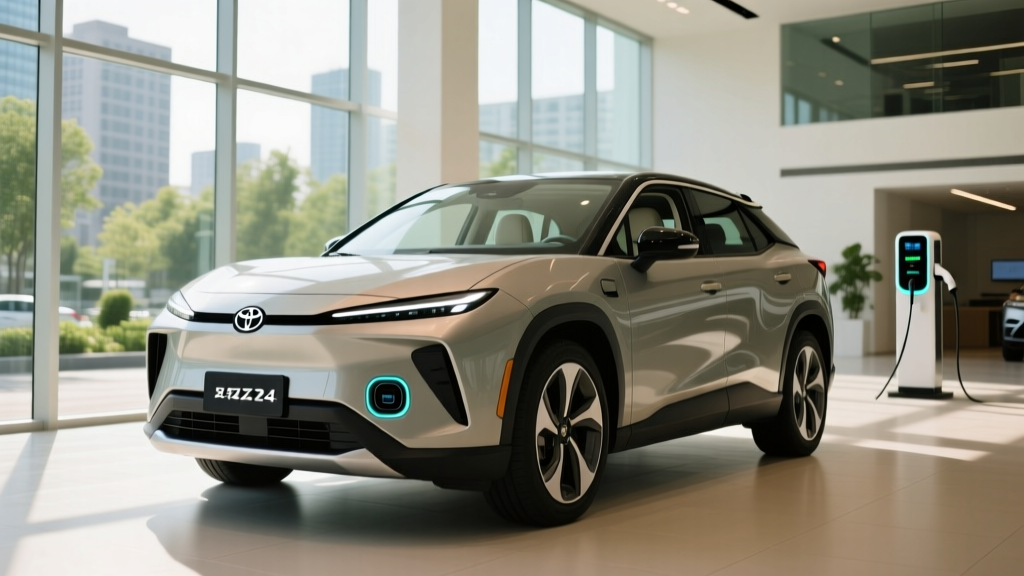
Quick Verdict: A Practical, If Conservative, Electric Crossover
The Toyota bZ4X doesn't chase headlines with 400-mile range claims or sub-3-second sprints. Instead, Toyota's first mass-market BEV delivers a well-built, comfortable cabin, predictable efficiency, and the brand's legendary reliability reputation — wrapped in a package that starts under $38,000. For buyers transitioning from a RAV4 or Highlander who want electric without radical change, the bZ4X's interior quality and straightforward tech make it a compelling daily driver. But if you prioritize cutting-edge infotainment or maximum fast-charging speed, competitors like the Hyundai Ioniq 5 and Tesla Model Y have clear advantages.
2026 Toyota bZ4X Core Specifications
| Attribute | Value |
|---|---|
| EPA Range | 252 miles (FWD), 228 miles (AWD) |
| Battery Capacity | 71.4 kWh usable (NMC lithium-ion) |
| Peak DC Fast Charge | 150 kW |
| 10-80% DC Charge Time | ~30 minutes |
| Level 2 Home Charge Rate | 7.2 kW (~23 miles/hr) |
| 0-60 mph | 7.1 sec (FWD) / 5.8 sec (AWD) |
| Horsepower | 201 hp (FWD) / 214 hp (AWD) |
| EPA Efficiency | 119 MPGe combined (FWD) |
| Base MSRP (XLE FWD) | $37,070 |
| Battery/Powertrain Warranty | 8 years / 100,000 miles |
Range and Efficiency: EPA Numbers vs. Real-World Driving
The 2026 Toyota bZ4X carries a 252-mile EPA estimated range in front-wheel-drive XLE trim, dropping to 228 miles with the dual-motor all-wheel-drive system. Those numbers are competitive for a compact electric crossover but trail the Hyundai Ioniq 5 (303 miles) and Tesla Model Y Long Range (330 miles) by a significant margin.
Efficiency is rated at 119 MPGe combined (FWD), translating to roughly 28 kWh per 100 miles. That's respectable but not class-leading — the Ioniq 5 achieves 132 MPGe combined thanks to its more aerodynamic profile and slightly lighter weight. In practical terms, expect to spend about $4.50-$6.00 per 100 miles on electricity at national average residential rates ($0.16/kWh), compared to $12-$15 for a 28 MPG gas crossover.
One nuance worth noting: the bZ4X's range estimate display is notably conservative. Many owners report the "guess-o-meter" showing 10-15% less range than the battery's actual state of charge would deliver. This isn't a flaw — it's Toyota deliberately underpromising to avoid range-anxiety scenarios. But it can make the car feel like it has less range than it actually does until you learn to trust the percentage readout over the miles-remaining estimate.
Charging Speed: Home Level 2 and DC Fast Charging
Charging is where the bZ4X shows its most notable limitation relative to competitors. The 150 kW peak DC fast-charge rate is adequate for road trips but significantly slower than the Hyundai Ioniq 5's 800-volt architecture (which peaks at 240 kW and charges 10-80% in 18 minutes). The bZ4X's 10-80% charge takes approximately 30 minutes at a compatible 150+ kW station.
| Charging Level | Power | Time / Rate | Typical Use Case |
|---|---|---|---|
| Level 1 (120V household) | 1.2 kW | ~4 miles per hour | Emergency / overnight top-up |
| Level 2 (240V home) | 7.2 kW | ~23 miles per hour / 9.5 hours (0-100%) | Daily home charging |
| DC Fast Charge | 150 kW peak | 10-80% in ~30 minutes | Road trips |
Home charging setup: The bZ4X's 7.2 kW onboard charger means a full charge from empty takes about 9.5 hours on a 240-volt Level 2 station. Most owners will plug in overnight and wake up to a full battery — perfectly adequate for daily driving under 150 miles. For Level 2 installation, budget $600-$1,200 for a quality 32-amp or 40-amp home charger (like the ChargePoint Home Flex or Emporia Vue) plus $500-$2,000 for electrician installation, depending on your panel capacity and run length.
Charging curve reality: Like most EVs, the bZ4X doesn't sustain its 150 kW peak for the entire session. Expect peak speeds between 20-60% state of charge, with the rate tapering to 50-70 kW above 70% and further slowing above 85%. This is why manufacturers quote 10-80% times rather than 0-100% — the last 20% can take as long as the first 80%.
Connector-wise, the 2026 bZ4X uses the CCS1 (Combined Charging System) standard, compatible with Electrify America, EVgo, and most non-Tesla DC fast-charger networks. Toyota has announced a transition to NACS (Tesla's connector) for future models, but the 2026 bZ4X retains CCS. Tesla Supercharger access requires an adapter (included with some trims, ~$200 aftermarket).
Interior Space, Cargo, and Cabin Quality
The bZ4X's interior is where Toyota's conservative approach pays dividends for traditional car buyers. The cabin materials, fit-and-finish, and ergonomics feel familiar and well-executed — closer to a premium RAV4 than a tech-forward EV like the Ioniq 5 or Tesla Model Y.
Passenger space: The bZ4X offers 101.5 cubic feet of passenger volume, with 42.1 inches of front legroom and 35.3 inches in the rear. That rear legroom is competitive with the segment, though the Ioniq 5's dedicated EV platform yields a flatter floor and slightly more spacious feel. The bZ4X's raised battery pack does create a modest floor hump in the rear footwell, but it's not obtrusive.
Cargo capacity: Behind the rear seats, you get 27.7 cubic feet — enough for a week's groceries or two large suitcases. Fold the 60/40-split rear seats and capacity expands to 56.9 cubic feet. Notably, the bZ4X lacks a front trunk (frunk), a missed opportunity given the packaging freedom of a dedicated EV platform. Competitors like the Ioniq 5 (0.85 cu ft frunk) and Ford Mustang Mach-E (4.7 cu ft frunk) offer bonus front storage.
Infotainment: The bZ4X uses Toyota's Audio Multimedia system with a 12.3-inch touchscreen (8-inch on base XLE), wireless Apple CarPlay and Android Auto, and cloud-based navigation. The system is functional and responsive, but the interface feels a generation behind Hyundai's or Tesla's in terms of speed and visual polish. Voice commands via "Hey Toyota" work reliably for basic navigation and climate requests. Physical buttons for climate and volume are retained — a win for usability over touch-only competitors.
Driver assistance: Toyota Safety Sense 3.0 is standard, including adaptive cruise control, lane-keeping assist, automatic emergency braking, and blind-spot monitoring. This is a SAE Level 2 driver-assist system — it requires the driver to remain engaged and hands on the wheel. It's competent for highway cruising but doesn't offer hands-free capability like GM's Super Cruise or Ford's BlueCruise.
Pricing, Trims, and Federal Tax Credit Eligibility
The 2026 Toyota bZ4X is offered in two main trims: XLE (base) and Limited (premium). All-wheel drive is a $2,080 upgrade on both trims.
| Trim | Drivetrain | MSRP | Key Features |
|---|---|---|---|
| XLE | FWD | $37,070 | 18" wheels, 8" screen, heated seats |
| XLE | AWD | $39,150 | Dual-motor, 214 hp, 228-mi range |
| Limited | FWD | $43,070 | 20" wheels, 12.3" screen, panoramic roof, heat pump |
| Limited | AWD | $45,150 | All Limited features + AWD |
Federal tax credit eligibility: Under IRS §30D rules, the bZ4X may qualify for up to $7,500 in federal tax credits, but eligibility depends on three factors: (1) your taxable income must not exceed $150,000 (single) or $300,000 (joint filers); (2) the vehicle MSRP must be under $80,000 for SUVs (all bZ4X trims qualify); and (3) the battery must meet critical-mineral and battery-component sourcing requirements that phase in annually. As of 2026, Toyota has confirmed that the bZ4X qualifies for the full $7,500 credit, and it can be transferred to the dealer at point of sale as an instant rebate. Always verify current eligibility at IRS.gov before purchasing, as sourcing rules tighten each year.
With the full credit applied, the XLE FWD drops to approximately $29,570 — competitive with a well-equipped RAV4 Hybrid and a compelling entry point into EV ownership. Many states offer additional rebates (California's CVRP, Colorado's $5,000 credit, etc.), which can stack on top of the federal credit. Check your state's energy office for current programs.
Performance and Driving Dynamics
The bZ4X isn't positioned as a performance EV, and the numbers reflect that. The 201-horsepower FWD model hits 0-60 mph in 7.1 seconds — adequate for merging and passing but noticeably slower than the Ioniq 5 (5.2 sec) or Model Y (5.0 sec). The AWD variant's 214 hp and 5.8-second 0-60 is more confident, with the dual-motor setup providing sure-footed traction in rain and light snow.
Ride quality is a strength. The bZ4X's suspension tuning prioritizes comfort over sportiness, soaking up potholes and expansion joints with composure. Steering is light and precise, though feedback is minimal. The low center of gravity (battery pack under the floor) keeps body roll well-controlled in corners, and the 4,300-pound curb weight feels managed rather than ponderous.
Regenerative braking offers two modes: a mild setting that mimics a gas car's coasting behavior, and a stronger "B" mode that provides substantial one-pedal driving capability (though not a full stop without using the brake pedal). The transition between regen and friction braking is smooth — a common pain point in early EVs that Toyota has clearly addressed.
Who Should Buy the Toyota bZ4X?
- Commuters driving under 120 miles daily who can charge at home overnight
- Toyota loyalists who want EV benefits without a steep learning curve
- Two-car households using the bZ4X as a daily driver with a gas/hybrid backup for long trips
- Urban and suburban buyers who value cabin quietness and smooth stop-and-go driving
- You regularly drive 250+ miles between charges (range is limiting)
- You need fast road-trip charging (150 kW is slow vs. 800V competitors)
- You want cutting-edge tech or hands-free driving (Ioniq 5, Model Y, or Cadillac Lyriq offer more)
- You need maximum cargo space (no frunk, and 56.9 cu ft max is less than some rivals)
Pros and Cons at a Glance
- Competitive pricing after $7,500 federal credit
- Comfortable, quiet cabin with familiar Toyota ergonomics
- Standard Toyota Safety Sense 3.0 (comprehensive ADAS)
- Strong 8-year / 100,000-mile battery warranty
- Smooth ride quality and composed handling
- Physical buttons for climate and volume
- 252-mile range trails Ioniq 5 (303 mi) and Model Y (330 mi)
- 150 kW DC charging is slow for 2026 standards
- No front trunk (frunk)
- Infotainment feels dated vs. competitors
- AWD range drops to 228 miles
- Conservative range display can feel misleading
Frequently Asked Questions
What is the real-world range of the Toyota bZ4X?
The EPA estimates 252 miles for FWD and 228 miles for AWD. In real-world driving, expect 220-235 miles on highway trips at 70 mph, and 175-200 miles in cold weather (below 35°F). The bZ4X's range display is conservative — trust the battery percentage over the miles-remaining estimate.
How fast does the bZ4X charge at home and on the road?
At home on a 240V Level 2 charger (7.2 kW), expect ~23 miles of range per hour, or a full charge in ~9.5 hours. On DC fast chargers, the bZ4X peaks at 150 kW and charges 10-80% in about 30 minutes — adequate but slower than 800V competitors like the Ioniq 5 (18 minutes).
Does the Toyota bZ4X qualify for the $7,500 federal tax credit?
Yes, as of 2026, the bZ4X qualifies for the full $7,500 federal tax credit under IRS §30D, provided your income is under $150,000 (single) or $300,000 (joint) and you meet battery-sourcing requirements. The credit can be transferred to the dealer at point of sale as an instant rebate. Verify current rules at IRS.gov.
Is the bZ4X worth buying vs. the Hyundai Ioniq 5 or Tesla Model Y?
If you prioritize cabin comfort, Toyota reliability, and a familiar driving experience, the bZ4X is a strong choice — especially after the $7,500 credit brings the XLE FWD under $30,000. But if range (303-330 mi), fast charging (18-25 min), or cutting-edge tech matter more, the Ioniq 5 or Model Y are objectively more capable EVs. Test-drive all three and weigh what matters for your daily driving.
What's the battery warranty on the bZ4X?
Toyota covers the bZ4X's battery pack for 8 years or 100,000 miles, whichever comes first. The warranty guarantees the battery will retain at least 70% of its original capacity during that period. Toyota's reputation for hybrid battery longevity (the Prius has 25+ years of proven durability) suggests the bZ4X's NMC pack should exceed these minimums in real-world use.
Does the bZ4X have a frunk (front trunk)?
No. Despite riding on a dedicated EV platform (e-TNGA), the bZ4X does not offer a front trunk. All cargo space is in the rear hatch (27.7 cu ft behind rear seats, 56.9 cu ft with seats folded). This is a notable omission given competitors like the Ioniq 5, Mach-E, and Model Y all offer frunk storage.