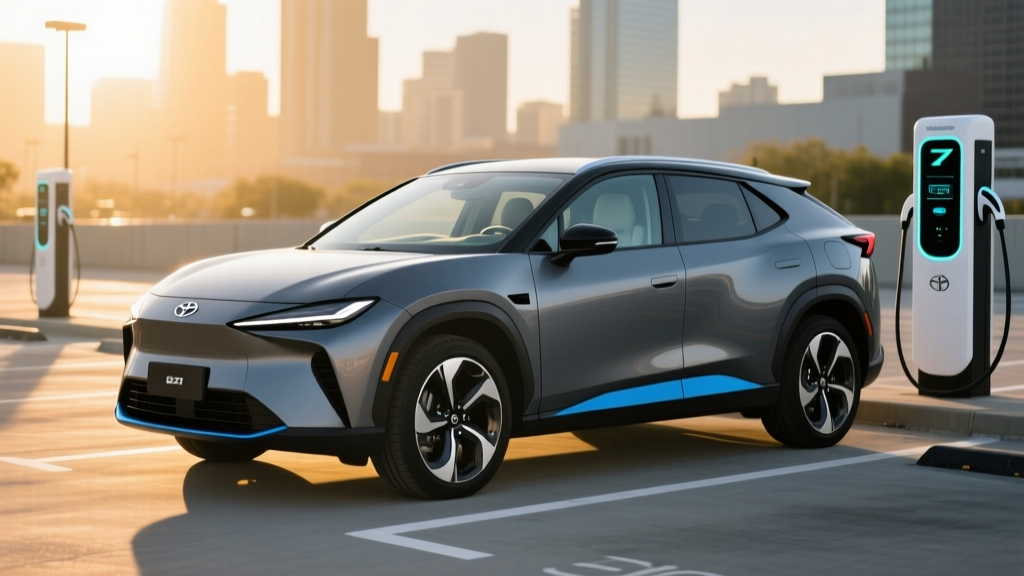
Bottom line: Toyota's current EV offering is the bZ4X crossover, priced from $37,070 with an EPA-estimated 252 miles of range (FWD). It's a competent but not class-leading EV. For most Toyota shoppers, a RAV4 Prime PHEV or a Camry Hybrid delivers better value unless you specifically want a battery-electric vehicle with home charging access. The bZ4X qualifies for partial federal tax credit depending on battery sourcing and your income — check current IRS rules before assuming the full $7,500.
Toyota's EV Strategy: Why the bZ4X Matters (and Why It Doesn't)
Toyota has historically bet heavily on hybrids and hydrogen, entering the battery-electric market later than competitors. The bZ4X, launched for the 2023 model year and updated incrementally through 2026, remains Toyota's sole mass-market EV in the US. Unlike Hyundai's Ioniq 5 or Tesla's Model Y, the bZ4X wasn't designed from the ground up as a performance EV — it's a practical commuter crossover aimed at existing Toyota loyalists transitioning from a RAV4 or Highlander.
For 2026, Toyota continues to sell the bZ4X in XLE and Limited trims with either front-wheel drive (FWD) or all-wheel drive (AWD). The AWD version, co-developed with Subaru (which sells the near-identical Solterra), sacrifices some range for traction. Toyota has also announced future EVs on its dedicated e-TNGA platform, but as of early 2026, the bZ4X is what you can actually buy.
bZ4X Specs: Range, Battery, and Charging Numbers
| Spec | bZ4X FWD (XLE) | bZ4X AWD (XLE) |
|---|---|---|
| EPA Range | 252 miles | 228 miles |
| Battery (usable) | 71.4 kWh (NMC) | 71.4 kWh (NMC) |
| Efficiency | 119 MPGe combined | 104 MPGe combined |
| Peak DC Fast Charge | ~150 kW | ~150 kW |
| 10–80% DCFC Time | ~30 minutes | ~30 minutes |
| Level 2 (240V) Charge Rate | ~6.6 kW | ~6.6 kW |
| Horsepower | 201 hp | 214 hp |
| 0–60 mph | ~7.1 seconds | ~6.5 seconds |
| Base MSRP | $37,070 | $40,570 |
| Battery Warranty | 8 yr / 100,000 mi | 8 yr / 100,000 mi |
Real-world range reality: The EPA's 252-mile figure for the FWD model assumes mixed driving. Expect 210–230 miles on a highway road trip at 70+ mph, and 180–200 miles in freezing winter conditions where cabin heating and battery chemistry reduce efficiency by 15–30%. The AWD model's 228-mile EPA sticker translates to roughly 190–210 miles in real-world highway use.
Charging speed is where the bZ4X falls behind rivals. While Hyundai's Ioniq 5 can peak at 240 kW and charge 10–80% in roughly 18 minutes, the bZ4X's ~150 kW peak means you'll spend closer to 30 minutes at a DC fast charger. The charge curve also tapers noticeably above 80%, so charging to 100% on a road trip is a time penalty best avoided unless necessary.
bZ4X vs. Gas and Hybrid: What the Cost Data Shows
Most Toyota cross-shoppers aren't choosing between the bZ4X and a Tesla — they're choosing between the bZ4X and a RAV4 Hybrid or RAV4 Prime PHEV. Here's how the numbers compare over five years and 75,000 miles:
| Cost Factor | bZ4X FWD | RAV4 Hybrid (AWD) | RAV4 Prime PHEV |
|---|---|---|---|
| Base MSRP | $37,070 | $33,575 | $44,590 |
| Est. Federal Tax Credit | Up to $7,500* | $0 | Up to $7,500* |
| Effective Purchase Price | ~$29,570 | $33,575 | ~$37,090 |
| Fuel/Energy (75k mi) | ~$3,750** | ~$6,250 | ~$4,200 |
| Maintenance (75k mi) | ~$1,200 | ~$2,800 | ~$2,200 |
| 5-Year Total (purchase + fuel + maint.) | ~$34,520 | ~$42,625 | ~$43,490 |
* Federal §30D tax credit eligibility depends on battery critical-mineral sourcing, buyer income caps ($150k single / $300k joint), and MSRP caps ($80k for SUVs). Credit may be applied at point of sale. Verify current rules at IRS.gov.
** Electricity cost assumes $0.16/kWh national average and 3.5 mi/kWh efficiency. Gas costs assume $3.50/gal and 39 MPG combined (RAV4 Hybrid). Your local rates vary significantly.
The bZ4X wins on five-year operating cost — but only if you qualify for the full tax credit and charge primarily at home on affordable electricity. If you pay $0.30+/kWh at public DC fast chargers or can't access the credit, the RAV4 Hybrid's lower sticker and no-plug convenience become compelling. The RAV4 Prime PHEV offers 42 miles of electric-only range for daily commuting plus a gas engine for road trips, making it the most versatile option for one-car households without reliable home charging.
Real-World Ownership: What First-Time Toyota EV Buyers Must Know
Home Charging Is Non-Negotiable for Most Owners
The bZ4X's 6.6 kW Level 2 onboard charger means a full charge from empty takes roughly 11 hours on a 240V home circuit. Most owners plug in nightly and wake up to a full battery. A Level 2 home charger (like a ChargePoint Home Flex or Emporia V2) costs $500–$700 for the unit, plus $500–$2,000 for professional installation depending on your panel capacity and wiring run. If your home has a 200-amp panel with spare capacity, installation is straightforward. Older homes with 100-amp panels may need a $1,500–$3,000 panel upgrade.
Without home charging, the bZ4X becomes a compromise. Public DC fast charging at 150 kW peak costs $0.30–$0.50/kWh at networks like Electrify America or EVgo, pushing your per-mile energy cost close to what a RAV4 Hybrid burns in gas. Plan for this reality before purchasing.
Cold Climate? Expect Range Loss
The bZ4X uses NMC (nickel-manganese-cobalt) battery chemistry, which performs adequately in cold but still loses 15–30% of range in sub-freezing temperatures. Toyota includes a battery preconditioning feature for DC fast charging, but unlike Tesla or Hyundai, the bZ4X's heat pump availability varies by trim and market. If you live in Minnesota or Maine, budget for 175–190 miles of real winter range in the FWD model and plan road trips accordingly.
Insurance Costs More Than You'd Expect
EV insurance premiums run 15–25% higher than comparable gas vehicles due to battery replacement costs and specialized repair requirements. Expect to pay $1,800–$2,400 annually for the bZ4X depending on your state, driving record, and coverage level. Get quotes before signing a purchase agreement.
Federal Tax Credit: Does the bZ4X Qualify?
§30D Clean Vehicle Credit requirements (2026):
- MSRP cap: Vehicle must be under $80,000 (SUV/truck) — the bZ4X qualifies at ~$37k–$45k
- Buyer income cap: AGI under $150,000 (single) or $300,000 (joint)
- Battery sourcing: Critical minerals and battery components must meet escalating domestic/free-trade-partner thresholds — this is where Toyota's supply chain may limit the credit to a partial $3,750 or the full $7,500 depending on the model year and build date
- Point-of-sale transfer: You can apply the credit as a discount at the dealer rather than waiting for tax filing
- Final assembly: Must occur in North America — the bZ4X is assembled in Japan, which disqualifies it from the new-vehicle §30D credit
This last point is critical: because the bZ4X is built in Japan, it does not qualify for the new-vehicle federal tax credit under current §30D rules requiring North American final assembly. This fundamentally changes the cost equation versus a US-built EV like the Tesla Model Y, Ford Mustang Mach-E, or even the RAV4 Prime (assembled in Canada, which does qualify). Always verify the latest eligibility on fueleconomy.gov before purchasing.
Common Toyota EV Misconceptions — Addressed With Facts
| Myth | Fact |
|---|---|
| "The bZ4X gets 252 miles no matter what" | EPA is a lab estimate. Highway driving at 75 mph yields ~210–230 miles; winter drops this further. |
| "Toyota batteries don't degrade" | All NMC batteries lose capacity over time. Toyota warranties 70% retention at 8 years/100,000 miles. Expect ~10–15% loss over that period. |
| "I can charge at any public station" | The bZ4X uses the CCS1 connector. It cannot use Tesla Superchargers without an adapter (NACS transition is ongoing; confirm adapter availability for your model year). |
| "EVs cost more to own than gas cars" | Over 5 years with home charging and available credits, the bZ4X can cost less. Without credits or home charging, a RAV4 Hybrid often wins. |
| "Toyota doesn't make real EVs" | The bZ4X is a fully electric vehicle with a 71.4 kWh battery. It's simply not as range- or charge-optimized as purpose-built EV competitors. |
Decision Framework: Should You Buy the Toyota bZ4X?
Choose the Toyota bZ4X if:
- You're a current Toyota owner who wants to stay in the brand ecosystem
- You have reliable home Level 2 charging and a commute under 80 miles round-trip
- You value Toyota's dealer network and 8-year/100,000-mile battery warranty
- You don't frequently road-trip more than 200 miles in a single day
Choose a RAV4 Prime PHEV instead if:
- You can't install a home charger
- You take frequent road trips and don't want to plan around DC fast chargers
- You want 42 miles of daily electric commuting with gas-engine backup
- You want a vehicle that qualifies for the §30D credit (Canadian assembly)
Choose a competing EV (Ioniq 5, Model Y, EV6) if:
- You want 300+ miles of EPA range
- You need 200+ kW DC fast charging for road trips
- You want access to Tesla's Supercharger network (NACS-equipped vehicles)
- Performance and tech features are higher priorities than brand loyalty
Frequently Asked Questions
Does Toyota make any other electric cars besides the bZ4X?
As of early 2026, the bZ4X is Toyota's only battery-electric vehicle sold in the US. Toyota has announced plans for additional bZ-series models and a next-generation EV platform, but none are available for purchase yet. The Subaru Solterra is a near-identical twin of the bZ4X built on the same e-TNGA platform.
How long does it take to charge the bZ4X at home?
On a Level 2 (240V) home charger at 6.6 kW, a full charge from near-empty takes approximately 11 hours. Most owners charge from 20–80% overnight in about 6–7 hours. On a standard 120V outlet (Level 1), expect roughly 3–4 miles of range per hour of charging — usable only for overnight top-ups, not full charges.
Is the bZ4X good for road trips?
It's workable but not ideal. With 228–252 miles of EPA range and a 150 kW peak charge rate, you'll stop every 180–200 miles on the highway and spend ~30 minutes at each DC fast charger. Compare this to the Ioniq 5's 303-mile range and 18-minute 10–80% charge. Route planning with apps like PlugShare or A Better Routeplanner is essential.
What's the battery replacement cost for the bZ4X?
Out-of-warranty battery replacement for the bZ4X is estimated at $12,000–$18,000 based on current NMC pack pricing. However, the 8-year/100,000-mile warranty (10 years/150,000 miles in California and CARB states) covers defects and capacity loss below 70%. Most owners will never need a full replacement.
Can I use Tesla Superchargers with the bZ4X?
Not natively. The bZ4X uses the CCS1 connector. Tesla has begun opening select Superchargers to non-Tesla EVs via the Magic Dock adapter or through NACS adapters, but compatibility with the bZ4X depends on adapter availability from Toyota. Check Toyota's official guidance and the NHTSA for the latest connector-transition information.