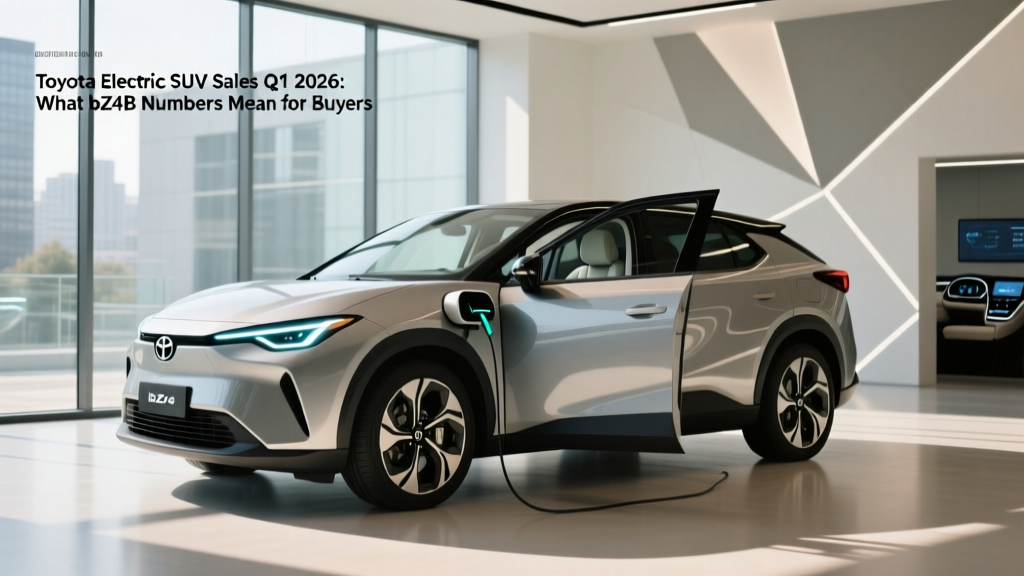
Toyota's all-electric SUV strategy lives or dies on a single model right now: the bZ4X. As Toyota electric SUV sales Q1 2026 data rolls in, shoppers are asking the practical questions — is the bZ4X worth buying over a RAV4 Hybrid, what does it actually cost to own, and does it deliver on range? Here's the direct answer before we get into the numbers.
Quick Answer: Toyota's Electric SUV Position in Q1 2026
The 2026 Toyota bZ4X remains Toyota's only battery-electric SUV sold in the U.S., starting at approximately $38,465 (FWD, before incentives). It offers an EPA-estimated 252 miles of range (FWD) and peaks at 150 kW DC fast charging. Q1 sales signals indicate Toyota is moving more units thanks to refreshed pricing and expanded lease deals, but the bZ4X still trails the RAV4 Hybrid in total volume by a wide margin. For buyers with home Level 2 charging and moderate commutes, it's a solid entry — but the RAV4 Prime PHEV often makes more financial sense for those without reliable charging access.
2026 Toyota bZ4X: The Specs That Matter
Before evaluating sales momentum, you need the hard numbers. The 2026 bZ4X carries over the updated powertrain and battery introduced for the prior model year, with minor trim and pricing adjustments. Here's the complete spec breakdown:
| Specification | bZ4X FWD | bZ4X AWD |
|---|---|---|
| Base MSRP | $38,465 | $40,465 |
| EPA Range | 252 mi | 228 mi |
| Battery (usable) | 71.4 kWh, NMC | 71.4 kWh, NMC |
| Efficiency | 131 MPGe (combined) | 114 MPGe (combined) |
| Peak DC Fast Charge | 150 kW | 150 kW |
| 10–80% DC Charge Time | ~30 min | ~30 min |
| Level 2 Charge Rate | 7.2 kW (L1772) | 7.2 kW (J1772) |
| Horsepower | 201 hp | 214 hp |
| 0–60 mph | 7.1 sec | 6.5 sec |
| Cargo Volume | 27.7 cu ft (rear seats up) | 27.7 cu ft (rear seats up) |
| Battery Warranty | 8 yr / 100,000 mi | 8 yr / 100,000 mi |
Real-World Range Reality Check
The EPA rates the bZ4X FWD at 252 miles, but expect 210–230 miles on sustained highway driving at 70+ mph. In cold weather (below 32°F), range can drop to 170–195 miles due to battery heating demands and cabin climate use. The AWD model's 228-mile EPA figure shrinks further under these conditions. If your daily round-trip commute exceeds 120 miles and you lack mid-route charging, this is a meaningful limitation.
Why Toyota Electric SUV Sales Q1 Trends Matter for Buyers
Sales volume isn't just a scoreboard — it directly affects your ownership experience. Higher Q1 sales figures for the bZ4X signal a few things worth knowing:
- Dealer inventory is loosening. After years of tight allocation, Toyota dealers in major metros are showing more bZ4X stock, which means less markup pressure and more room to negotiate.
- Lease deals are aggressive. Toyota has been offering lease incentives that, when combined with the §30D federal tax credit (passed through the lessor), can drop effective monthly payments below a RAV4 Hybrid lease in some markets.
- Parts and service familiarity is growing. More units on the road means more Toyota service departments gaining hands-on experience with the bZ4X's e-TNGA platform.
That said, the bZ4X's sales volume remains a fraction of the RAV4 family. Toyota sold roughly 10 RAV4s (gas and hybrid combined) for every 1 bZ4X through most of 2025, and that ratio has shifted only modestly entering 2026. The takeaway: Toyota is committed to electrification, but the market is telling us that most buyers still choose hybrid when given the option.
bZ4X vs. RAV4 Hybrid vs. RAV4 Prime: The Ownership Cost Showdown
This is the comparison every Toyota SUV shopper needs. Let's break down the numbers across purchase price, fueling, and five-year operating costs.
| Factor | bZ4X FWD (EV) | RAV4 Hybrid AWD | RAV4 Prime PHEV |
|---|---|---|---|
| Base MSRP | $38,465 | $34,425 | $44,590 |
| Federal Tax Credit (§30D) | Up to $7,500* | None (HEV) | Up to $7,500* |
| Effective Price After Credit | ~$30,965 | $34,425 | ~$37,090 |
| EPA Range / Electric-Only | 252 mi | N/A (hybrid) | 42 mi EV + 540 mi total |
| Efficiency | 131 MPGe | 39 MPG combined | 94 MPGe / 38 MPG |
| Annual Fuel/Energy Cost† | ~$650 | ~$1,550 | ~$900 (mixed use) |
| Home Charging Required? | Strongly recommended | No | Recommended for EV mode |
| Maintenance (5-yr est.) | ~$1,800 | ~$3,200 | ~$2,800 |
*§30D credit eligibility depends on MSRP caps, buyer income limits, battery sourcing requirements, and point-of-sale transfer rules. Verify current-year eligibility at IRS.gov and consult a tax professional.
†Annual fuel/energy costs based on 15,000 miles/year, $0.16/kWh national average for home charging, and $3.50/gal regular unleaded. Actual costs vary by region and utility rate. Source: fueleconomy.gov.
5-Year Total Cost of Ownership Estimate
| Category | bZ4X FWD | RAV4 Hybrid | RAV4 Prime |
|---|---|---|---|
| Net Purchase (after credit) | $30,965 | $34,425 | $37,090 |
| Energy/Fuel (5 yr) | $3,250 | $7,750 | $4,500 |
| Maintenance (5 yr) | $1,800 | $3,200 | $2,800 |
| Insurance (5 yr est.) | $9,500 | $7,800 | $8,600 |
| Depreciation (est.) | $14,200 | $11,500 | $13,800 |
| 5-Year Total | $59,715 | $64,675 | $66,790 |
Key insight: The bZ4X wins on 5-year TCO primarily due to the federal tax credit and lower energy/maintenance costs. However, higher insurance premiums and steeper depreciation (common across most EVs) partially offset those gains. The RAV4 Hybrid remains the lowest-risk option for buyers without home charging or who drive in extreme cold climates.
Charging the bZ4X: What First-Time EV Buyers Must Know
If you're transitioning from gas to electric, the bZ4X's charging profile deserves close attention — it's where many first-time EV owners encounter surprises.
Level 1 (120V household outlet): Adds roughly 3–4 miles of range per hour. A full charge from empty takes over 20 hours. This works only as a trickle-charge supplement if you drive fewer than 30 miles daily.
Level 2 (240V home charger): At the bZ4X's 7.2 kW onboard charger rate, you'll add about 25 miles of range per hour. A full charge takes roughly 10 hours — ideal for overnight replenishment. Home Level 2 installation typically costs $800–$2,500 depending on panel capacity and run length. If your home has a 100-amp electrical panel, expect an additional $1,500–$3,000 for a panel upgrade to 200 amps.
DC Fast Charging: The bZ4X peaks at 150 kW, which is adequate but not class-leading. Competitors like the Hyundai Ioniq 5 (peak 240 kW on 800V architecture) charge noticeably faster. In real-world testing, the bZ4X sustains its peak rate only briefly before tapering — expect a 10–80% session to take approximately 30 minutes at a properly rated station. Above 80% state of charge, the rate drops sharply to protect the NMC battery, so DC fast charging above 80% is inefficient for time spent.
Home Charging Decision Framework
- If you have a garage or dedicated parking spot with 240V access: The bZ4X is a strong daily driver. Install a Level 2 charger (J1772 connector, 32–40 amp circuit) and wake up to a full battery every morning.
- If you rely on street parking or apartment living without charging: The bZ4X becomes significantly less practical. Public DC fast charging costs $0.30–$0.48/kWh (roughly double home rates), and weekly 30-minute charging sessions add up in time. Consider the RAV4 Hybrid or RAV4 Prime instead.
- If you have workplace Level 2 charging: Viable, but confirm reliability and availability — shared workplace chargers can be occupied or out of service.
Common bZ4X Misconceptions vs. Reality
| Myth | Fact |
|---|---|
| "The bZ4X can't handle cold weather." | It includes a battery preconditioning system and available heat pump (standard on some trims). Range loss in sub-freezing temps is real (~20–30%), but the bZ4X manages it comparably to other NMC-based EVs. Preconditioning while plugged in mitigates the worst losses. |
| "Toyota's EV reliability is unproven." | The bZ4X shares the e-TNGA platform with the Subaru Solterra. Toyota's 8-year/100,000-mile battery warranty and 10-year/150,000-mile powertrain coverage are among the strongest in the segment. Early reliability data from 2023–2025 models shows no systemic failure patterns. |
| "It qualifies for the full $7,500 tax credit automatically." | §30D eligibility requires meeting MSRP caps (SUVs: $80,000 — bZ4X qualifies), buyer income limits ($150K single / $300K joint), and critical-mineral/battery-component sourcing thresholds. These rules change annually. Verify at IRS.gov before purchasing. |
| "150 kW charging is too slow for road trips." | For most road trips with 2–3 hour driving intervals, a 25–30 minute DC fast charge aligns with a rest stop. The limitation is real on 500+ mile single-day drives, where the Hyundai Ioniq 5 or Tesla Model Y offer a time advantage. |
| "The bZ4X has no frunk." | Correct — the bZ4X lacks a front trunk. All cargo space (27.7 cu ft behind rear seats, 56.9 cu ft with seats folded) is in the rear. This is a packaging trade-off of the e-TNGA platform. |
Who Should Buy the bZ4X — And Who Shouldn't
Actionable Decision Framework
Choose the Toyota bZ4X if:
- You have reliable Level 2 home or workplace charging
- Your daily driving is under 120 miles round-trip
- You want Toyota's warranty and dealer network backing an EV
- You qualify for the §30D credit, bringing the effective price below $32,000
- You value a quiet, smooth commute and want to eliminate oil changes and most powertrain maintenance
Choose the RAV4 Hybrid or RAV4 Prime instead if:
- You lack home charging access (apartment, street parking, no 240V circuit)
- You regularly drive in temperatures below 20°F with trips exceeding 150 miles
- You take frequent 400+ mile road trips and don't want to plan around DC fast charger locations
- Your household income exceeds §30D caps, eliminating the bZ4X's price advantage
- You need maximum cargo flexibility (the RAV4 Prime's packaging offers slightly more usable space and a frunk-equivalent under-floor area)
What's Next: Toyota's Electric SUV Pipeline Beyond 2026
Toyota has signaled a broader electric SUV lineup is coming, including a larger three-row EV SUV expected for the 2027 model year and next-generation models on an updated platform with improved charging speeds. However, none of these are currently available for purchase. If you need an electric Toyota SUV today, the bZ4X is the only option. If you can wait 12–18 months, the next generation may address the bZ4X's charging-speed and range limitations — but announced specs should always be treated as preliminary until EPA certification and pricing are confirmed.
For the latest safety ratings, check the bZ4X's scores at NHTSA.gov and IIHS.org before finalizing your purchase.
Frequently Asked Questions
Is the Toyota bZ4X eligible for the $7,500 federal tax credit in 2026?
It can be, but eligibility is not automatic. The bZ4X's MSRP falls well under the $80,000 SUV cap. However, you must meet IRS income limits ($150,000 single filer / $300,000 joint), and the vehicle's battery must satisfy critical-mineral and component-sourcing thresholds that are updated annually. The credit can now be transferred at the point of sale, reducing your purchase price directly. Confirm eligibility at fueleconomy.gov and IRS.gov before signing.
How does the bZ4X's real-world range compare to its EPA rating?
Expect 210–230 miles on highway-heavy driving in moderate temperatures (50–80°F). In cold weather below freezing, plan for 170–195 miles. City driving with regenerative braking can match or slightly exceed the 252-mile EPA figure. The gap between EPA and real-world is typical for EVs and not unique to Toyota.
Does the bZ4X support NACS (Tesla) charging?
The 2026 bZ4X uses the J1772/CCS1 connector standard. Toyota has announced a transition to NACS for future models, but the current bZ4X requires a CCS-to-NACS adapter for Tesla Supercharger access. Toyota has indicated adapter compatibility with the Supercharger network — confirm specific adapter availability and network access through Toyota's app before relying on it for a trip.
What does bZ4X insurance cost compared to a RAV4 Hybrid?
Expect bZ4X insurance premiums to run 15–25% higher than an equivalently trimmed RAV4 Hybrid. EV insurance costs more due to higher repair costs for battery-adjacent damage and elevated vehicle values. Average annual premiums fall in the $1,800–$2,200 range depending on your state, driving record, and coverage level. Get quotes before purchasing — the difference can erase some of the fuel savings.
How long will the bZ4X battery last before needing replacement?
Toyota warranties the battery for 8 years or 100,000 miles (whichever comes first) against capacity loss below 70%. Industry data on NMC batteries of this generation suggests 10–15% degradation over 100,000 miles under normal use. Full battery replacement costs are estimated at $8,000–$14,000 out of warranty, though most owners will never need one within the vehicle's typical ownership cycle. Avoid frequent DC fast charging above 90% SoC and regular deep discharges to 0% to maximize longevity.
Should I wait for Toyota's next electric SUV instead of buying the bZ4X now?
If your current vehicle is functional and you don't need to buy in the next 6 months, waiting is reasonable. Toyota's next-generation electric SUVs are expected to feature faster charging (potentially 250+ kW) and longer range. However, pricing, tax credit eligibility, and availability remain unconfirmed. If you need a vehicle now and the bZ4X fits your driving pattern and charging situation, the current incentives make it financially compelling.