The Short Answer
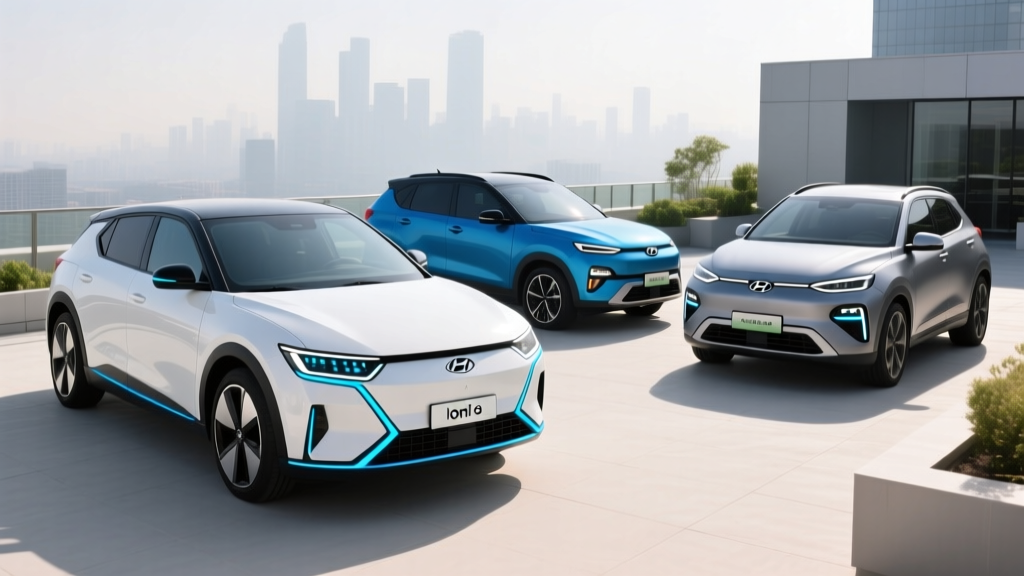
If you're shopping for an electric Hyundai SUV in 2026, you have two primary choices: the Hyundai Ioniq 5 (midsize crossover, EPA range up to 318 miles, starting ~$42,900) and the Hyundai Kona Electric (subcompact, EPA range up to 261 miles, starting ~$33,550). The Ioniq 5 delivers faster DC charging (peak 240 kW, 10–80% in ~18 minutes on a 350 kW charger) and more interior space; the Kona EV wins on affordability and urban efficiency. Both use NMC lithium-ion batteries, qualify for varying portions of the federal §30D tax credit depending on battery-sourcing compliance, and come with Hyundai's 10-year/100,000-mile battery warranty.
Hyundai's Electric SUV Lineup at a Glance
Hyundai currently sells two fully electric SUVs in the US market, plus a plug-in hybrid variant of the Tucson for buyers who want partial electrification without full BEV commitment. Here's how the pure-electric models stack up on paper:
| Spec | 2026 Hyundai Ioniq 5 (Long Range RWD) | 2026 Hyundai Ioniq 5 (Long Range AWD) | 2026 Hyundai Kona Electric (SEL) |
|---|---|---|---|
| EPA Range | 318 mi | 290 mi | 261 mi |
| Battery (usable) | 77.4 kWh, NMC | 77.4 kWh, NMC | 65.0 kWh, NMC |
| Peak DC Charge Rate | 240 kW | 240 kW | 100 kW |
| 10–80% DC Time | ~18 min (350 kW station) | ~18 min (350 kW station) | ~43 min (150 kW station) |
| Level 2 Charge Rate | 10.9 kW | 10.9 kW | 7.2 kW |
| Horsepower | 168 hp | 320 hp | 201 hp |
| 0–60 mph | 7.2 sec | 4.5 sec | 7.6 sec |
| MPGe (combined) | 114 MPGe | 101 MPGe | 105 MPGe |
| Cargo Volume | 27.2 cu ft (rear seats up) | 27.2 cu ft | 25.5 cu ft |
| Base MSRP | ~$42,900 | ~$47,400 | ~$33,550 |
| Battery Warranty | 10 yr / 100,000 mi | 10 yr / 100,000 mi | 10 yr / 100,000 mi |
Source: fueleconomy.gov and Hyundai USA spec sheets. Real-world range varies with temperature, terrain, and driving style.
Real-World Range Reality Check
EPA sticker: 318 miles (Ioniq 5 RWD) / 261 miles (Kona EV)
Expect in practice: ~260–280 miles highway at 70 mph in the Ioniq 5 RWD; ~210–230 miles highway in the Kona EV. In freezing weather (below 32°F), plan for 20–30% range reduction unless you precondition the battery while plugged in. Hyundai's heat pump (standard on Ioniq 5, available on Kona EV higher trims) mitigates cold-weather losses compared to resistive heating, but physics still applies.
Electric Hyundai SUV vs Gas and Hybrid: The Cost Math
Many buyers cross-shop the Ioniq 5 against the gas-powered Hyundai Tucson or the Tucson Hybrid/PHEV. Here's a data-driven comparison over five years and 75,000 miles of driving:
| Cost Factor (5 yr / 75k mi) | Ioniq 5 RWD (BEV) | Tucson Hybrid (HEV) | Tucson Gas (2.5L) |
|---|---|---|---|
| Base MSRP | $42,900 | $33,200 | $30,250 |
| Est. Federal Tax Credit (§30D) | Up to $3,750* | $0 | $0 |
| Fuel / Electricity Cost | ~$3,400 (home charging at $0.14/kWh) | ~$6,800 (38 MPG, $3.50/gal) | ~$8,900 (28 MPG, $3.50/gal) |
| Maintenance | ~$1,200 | ~$2,800 | ~$3,200 |
| Est. Insurance (5 yr total) | ~$9,500 | ~$7,800 | ~$7,500 |
| 5-Year Total (before incentives) | ~$57,000 | ~$50,600 | ~$49,850 |
| 5-Year Total (after credit) | ~$53,250 | ~$50,600 | ~$49,850 |
*Federal §30D credit availability for the Ioniq 5 depends on battery component and critical-mineral sourcing requirements under current IRS rules. The credit may be $3,750 or $7,500 depending on compliance, and is subject to buyer income caps ($150k single / $300k joint) and the $80,000 SUV MSRP cap. Check IRS §30D guidance and confirm with a tax professional. Point-of-sale transfer is available through registered dealers.
The BEV still carries a higher upfront cost, but the fuel and maintenance gap narrows the total significantly. If you drive more than 15,000 miles annually or pay less than $0.12/kWh for home electricity (common with time-of-use plans), the Ioniq 5 can break even or pull ahead within the ownership period.
Charging at Home and on the Road: What You Actually Need
Home Charging Setup
The Ioniq 5's 10.9 kW Level 2 onboard charger means a full charge from empty in roughly 7.5 hours on a 48-amp Level 2 station — easily overnight. The Kona EV's 7.2 kW charger needs about 9.5 hours for a full charge.
| Item | Typical Cost Range | Notes |
|---|---|---|
| Level 2 Charger (hardware) | $350–$700 | ChargePoint Home Flex, Emporia Level 2, Wallbox Pulsar Plus |
| Electrician (240V/50A circuit) | $800–$2,500 | Depends on panel proximity, conduit run length |
| Permit & inspection | $50–$300 | Varies by municipality |
| Panel upgrade (if needed) | $1,500–$3,500 | Required if your panel is 100A or maxed out |
| Total (no panel upgrade) | $1,200–$3,500 | Most homes with 200A service |
Important: If you live in an apartment or lack off-street parking, home Level 2 charging may not be feasible. Public DC fast charging exclusively is possible but adds cost (typically $0.30–$0.48/kWh vs $0.10–$0.16/kWh at home) and time. Hyundai includes two years of complimentary 30-minute DC fast-charging sessions at Electrify America stations with new Ioniq 5 purchases, which helps during the transition period.
DC Fast Charging and the Charge Curve
The Ioniq 5's 800-volt architecture is a genuine differentiator. At a 350 kW Electrify America or compatible station, it peaks at roughly 240 kW and sustains high rates through the 10–60% window. However, like all lithium-ion batteries, charging tapers significantly above 80% to protect cell longevity. A 10–80% session takes ~18 minutes, but 80–100% can add another 20+ minutes. Plan road trips around 10–80% charges for optimal efficiency.
The Kona EV, on a conventional 400-volt platform, peaks at 100 kW and takes roughly 43 minutes for a 10–80% session at a 150 kW charger. It's adequate for daily use and occasional road trips but noticeably slower on long highway runs.
Real-World Ownership Considerations
Climate and Range
If you live in the northern US or mountain states, cold-weather range loss is a real factor. Expect the Ioniq 5 RWD to deliver roughly 220–250 miles in sustained sub-freezing temperatures without preconditioning. Using the heat pump and preconditioning while still plugged in recovers some of that loss. In hot desert climates (Arizona, Nevada), battery thermal management handles cooling well, but sustained 110°F+ temperatures can slightly accelerate long-term degradation.
Driving Patterns
The electric Hyundai SUV lineup rewards predictable commuting patterns. If your daily round-trip is under 80 miles with home charging, either model works seamlessly. If you regularly drive 200+ miles one-way or tow (the Ioniq 5 is rated for 2,300 lbs with trailer brakes), the AWD Ioniq 5 with its 320 hp and larger battery is the more practical pick. For frequent road trippers, the 800V fast-charging advantage of the Ioniq 5 becomes a tangible time-saver — roughly 15 fewer minutes per stop compared to the Kona EV.
Insurance and Depreciation
EV insurance premiums run 15–25% higher than comparable gas vehicles, driven by higher repair costs and battery replacement risk. Expect $160–$200/month for the Ioniq 5 depending on your driving record and state. Depreciation on Hyundai EVs has been steeper than Tesla historically, though the Ioniq 5 has held value better than the Kona EV due to its stronger market position and 800V platform appeal.
Common Misconceptions About Hyundai EVs
| Myth | Fact |
|---|---|
| "The battery will need replacing in 5 years." | Hyundai's NMC cells are warranted for 10 years/100,000 miles at 70% capacity retention. Independent data from fleet vehicles shows typical degradation of 8–12% over 100,000 miles. A full battery replacement (if ever needed outside warranty) runs $8,000–$14,000, but is rare. |
| "You can't road-trip an EV." | The Ioniq 5's 318-mile EPA range and 18-minute 10–80% charging make 500+ mile days feasible with one or two stops. The Electrify America network covers major interstate corridors. However, rural routes in the Dakotas, parts of Montana, and west Texas remain charging deserts — plan accordingly. |
| "The $7,500 tax credit applies to everyone." | The §30D credit has MSRP caps ($80,000 for SUVs), buyer income caps ($150k single / $300k joint), and battery-sourcing requirements that change annually. The Ioniq 5's credit amount varies — confirm the current year's eligibility on irs.gov before purchasing. |
| "EVs have no maintenance costs." | No oil changes or spark plugs, but tires wear 15–20% faster on EVs due to weight and instant torque. Brake fluid, cabin air filters, wipers, and coolant still need service. Budget ~$200–$300/year. |
| "Hyundai's ADAS is self-driving." | Highway Driving Assist 2 (HDA2) is an SAE Level 2 driver-assistance system. It handles steering, acceleration, and braking on highways, but you must keep your hands on the wheel and eyes on the road. It is not autonomous driving. |
SAE Automation Level: What HDA2 Actually Does
Hyundai's Highway Driving Assist 2 is classified as SAE Level 2 — partial automation. The system can center the vehicle in its lane, maintain following distance, and execute lane changes when you activate the turn signal. However, the driver remains fully responsible for monitoring the environment and must intervene at any time. This is the same automation tier as Tesla Autopilot and Ford BlueCruise. Only Level 4 robotaxi services (Waymo, Zoox) operate without a human driver, and those are geofenced to specific cities.
The Decision Framework: Which Electric Hyundai SUV Is Right for You?
Choose the Ioniq 5 if:
- Your budget allows $42,000+ and you want the longest range and fastest charging
- You take road trips of 200+ miles at least a few times per year
- You need AWD and 320 hp for mountain passes, snow, or towing (2,300 lbs)
- You value the 800V architecture for future-proofing on high-power chargers
- Interior space matters — 27.2 cu ft cargo with rear seats up, plus a front trunk (frunk)
Choose the Kona Electric if:
- You want the most affordable entry point at ~$33,550 before incentives
- Your daily commute is under 60 miles round-trip
- You primarily drive in urban and suburban settings
- Road trips are infrequent, or you're willing to accept slower 100 kW DC charging
- A smaller footprint makes parking and city driving easier
Choose the Tucson PHEV instead if:
- You lack reliable home charging access
- You frequently drive in areas with sparse DC fast-charging infrastructure
- You want 33 miles of electric-only range for commuting plus a gas engine for unlimited range
- Your budget is closer to $37,000 and you want to avoid range planning altogether
Federal Tax Credit and Incentive Checklist
§30D Federal Tax Credit Requirements (2026)
- Vehicle type: Must be a new plug-in EV or fuel-cell vehicle
- MSRP cap: ≤ $80,000 for SUVs, vans, and trucks (Ioniq 5 and Kona EV qualify)
- Buyer income cap: AGI ≤ $150,000 (single) / $225,000 (head of household) / $300,000 (joint)
- Battery sourcing: Percentage thresholds for critical minerals and battery components manufactured in the US or FTA countries increase annually — check current-year requirements
- Point-of-sale transfer: You can transfer the credit to the dealer at purchase for an immediate price reduction, even if you owe less in taxes than the credit amount
- Verification: Confirm eligibility at fueleconomy.gov and consult a tax professional for your specific situation
Some states and utilities offer additional rebates — California's CVRP, Colorado's state credit, and various utility time-of-use rate programs can stack on top of the federal credit. Check your state energy office and local utility for current programs.
Frequently Asked Questions
Is the Hyundai Ioniq 5 eligible for the full $7,500 federal tax credit?
It depends on the current year's battery-sourcing compliance. The Ioniq 5 has historically qualified for $3,750 (meeting critical-mineral requirements but not full battery-component requirements). Hyundai has been working to shift more battery manufacturing to the US (via the Georgia Metaplant), which may improve eligibility. Always verify the exact credit amount on fueleconomy.gov for the specific model year and trim you're purchasing.
How long does a Hyundai EV battery actually last?
Hyundai warranties its EV batteries for 10 years or 100,000 miles against capacity dropping below 70%. Real-world data from high-mileage Ioniq 5 fleet vehicles suggests 8–12% degradation at 100,000 miles, meaning you'd still have roughly 88–92% of original capacity. Most owners will not need a battery replacement within normal ownership periods. Avoid habitual DC fast charging above 90% and frequent deep discharges below 10% to maximize longevity.
Can I charge a Hyundai EV at a Tesla Supercharger?
Starting in 2025, Hyundai EVs sold in North America began transitioning to the NACS (Tesla) connector. For 2026 model-year vehicles, check whether your specific trim ships with NACS or CCS. If your Ioniq 5 or Kona EV has a CCS port, you can use Tesla Superchargers (V3 and V4) with a Hyundai-provided or third-party NACS adapter. Tesla's Supercharger network remains the most reliable and widespread DC fast-charging option in the US.
How much does it cost to charge a Hyundai Ioniq 5 at home?
Charging the 77.4 kWh battery from 10% to 90% (roughly 62 kWh) costs approximately $8.70 at the US average residential rate of $0.14/kWh. That translates to roughly $0.04 per mile driven — compared to $0.12–$0.15 per mile for a gas-powered Tucson at $3.50/gallon. Over 15,000 miles per year, home charging saves roughly $1,200–$1,500 in fuel costs annually.
What's the difference between the Ioniq 5 and the upcoming Ioniq 7?
The Ioniq 7 (announced, expected late 2026 or 2027) is a larger three-row SUV on Hyundai's E-GMP platform, targeting 300+ miles of range and seating for up to seven. It will compete with the Kia EV9 and Tesla Model X. Until it goes on sale, the Ioniq 5 remains Hyundai's primary midsize electric SUV. We'll update this guide with confirmed specs and pricing when the Ioniq 7 becomes available for purchase.
Do Hyundai EVs have one-pedal driving?
Yes. Both the Ioniq 5 and Kona Electric offer multiple regenerative braking levels, selectable via steering-wheel paddles. Level 3 (maximum regen) enables one-pedal driving in most city conditions — lifting off the accelerator brings the vehicle to a complete stop without touching the brake pedal. The Ioniq 5 also offers an "i-Pedal" mode for true one-pedal operation with automatic hold.
For the latest EPA ratings, visit fueleconomy.gov. For safety ratings, check NHTSA and IIHS. Tax credit rules are subject to change — always verify with the IRS and a qualified tax advisor before purchase.