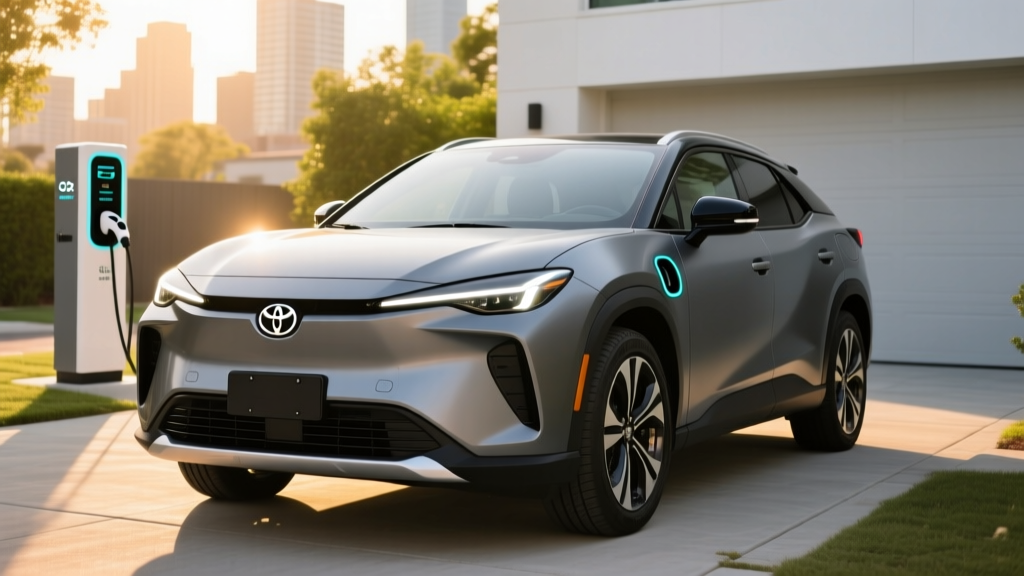
Quick Verdict: The Toyota bZ4X AWD in 2026
The Toyota bZ4X AWD enters the 2026 model year as a competent, if unremarkable, entry in the compact electric crossover segment. With dual-motor all-wheel drive producing 214 horsepower (a notable improvement over the earlier 201 hp rating from the launch-year model), an EPA-estimated range of up to 228 miles, and a starting MSRP around $43,090, it occupies a middle ground between mainstream affordability and premium EV offerings. It's a sensible pick for Toyota loyalists transitioning to electric, but buyers cross-shopping against the Hyundai Ioniq 5 AWD, Tesla Model Y Long Range, or Ford Mustang Mach-E will find competitors that charge faster, drive farther, and offer more interior space.
The bZ4X AWD's strongest suit is its familiar, non-intimidating driving character and Toyota's reputation for long-term reliability. Its weakest links remain middling DC fast-charge speeds and a battery pack that's smaller than most rivals. If your commute is under 40 miles round-trip and you have reliable home charging, the bZ4X AWD does the job quietly and capably. Road-trippers and cold-climate buyers should look elsewhere — or at least budget expectations accordingly.
Range, Efficiency, and Real-World Expectations
| Spec | Value |
|---|---|
| EPA Range (AWD) | 228 miles |
| Battery (usable) | 72.8 kWh (NMC lithium-ion) |
| Drivetrain | Dual-motor AWD |
| Horsepower | 214 hp combined |
| 0–60 mph | ~5.8 seconds |
| EPA Efficiency | 104 MPGe combined (31 kWh/100 mi) |
| Max DC Fast Charge | 150 kW (peak) |
| 10–80% DC Charge | ~30 minutes |
| Level 2 Home Charge Rate | 7.4 kW (~25 mi/hr) |
| Cargo Volume (rear seats up) | 27.7 cu ft |
| Cargo Volume (rear seats folded) | 56.9 cu ft |
| Base MSRP (AWD XLE) | $43,090 |
| Battery Warranty | 8 years / 100,000 miles |
The 228-mile EPA sticker applies to the AWD XLE trim on standard wheels. In real-world mixed driving, expect 195–215 miles in moderate temperatures. Sustained highway driving at 70+ mph drops range to roughly 175–195 miles due to aerodynamic drag and the lack of a heat pump on certain trims. In sub-freezing winter conditions (below 30°F), range loss of 25–35% is typical, putting effective range at 150–175 miles — a meaningful limitation for anyone without reliable home Level 2 charging.
The bZ4X uses a 72.8 kWh usable battery pack with NMC (nickel-manganese-cobalt) chemistry, supplied in partnership with Panasonic. NMC offers higher energy density than LFP, which helps keep the pack physically compact, but it also means Toyota recommends limiting routine charges to 80% for daily use to preserve long-term battery health — unlike LFP packs that tolerate regular 100% charges. This effectively reduces your daily usable range to roughly 180 miles unless you're planning a longer trip.
Efficiency is rated at 104 MPGe combined, or about 31 kWh per 100 miles. That's competitive but not class-leading: the Hyundai Ioniq 5 AWD achieves 110 MPGe combined, and the Tesla Model Y Long Range AWD posts 122 MPGe. Over 15,000 miles of annual driving, the difference translates to roughly $50–$80 more in electricity costs per year — minor in isolation but indicative of the bZ4X's heavier, less aerodynamic platform.
Charging Speed: DC Fast Charging and Home Level 2
Charging remains the bZ4X AWD's most conspicuous weakness relative to the competition. The peak DC fast-charge rate is 150 kW, and while that number sounds adequate, the sustained charge curve tells a more nuanced story.
| Charging Level | Power / Rate | Speed | Notes |
|---|---|---|---|
| Level 1 (120V outlet) | 1.2 kW | ~4 mi/hr | Emergency/trickle only |
| Level 2 (240V home) | 7.4 kW | ~25 mi/hr | Full charge in ~10 hours |
| DC Fast Charge | 150 kW peak | 10–80% in ~30 min | Tapers significantly above 60% SoC |
On a 150 kW (or higher) DC fast charger with a preconditioned battery, the bZ4X AWD can add approximately 150 miles of range in 30 minutes. However, the charge curve tapers early — peak rates hold only between roughly 10% and 40% state of charge, then step down progressively. Charging from 80% to 100% on DC is painfully slow, adding perhaps 20 miles in 15+ minutes. This is a common EV pattern, but the bZ4X's taper starts earlier than competitors like the Ioniq 5 (which sustains 200+ kW longer thanks to its 800V architecture).
For home charging, the onboard charger accepts up to 7.4 kW on a Level 2 (240V) circuit. That means a full 0–100% charge takes roughly 10 hours — plan for overnight charging. A 48-amp hardwired Level 2 station (like a ChargePoint Home Flex or Tesla Wall Connector with J1772 adapter) is ideal. Installation costs typically run $800–$2,000 depending on your electrical panel's capacity and the distance from panel to charger location. According to fueleconomy.gov, most EV owners find Level 2 home charging covers 80%+ of their driving needs.
The bZ4X uses the J1772 connector for AC charging and CCS1 for DC fast charging. As Toyota transitions toward NACS (the Tesla charging standard) across its lineup, 2026 models may include a NACS adapter or native NACS port on later production runs — check with your dealer for the specific connector on your vehicle. Toyota has confirmed access to Tesla Supercharger stations via adapter for bZ4X owners, significantly expanding the available fast-charging network.
Performance and Driving Dynamics
The dual-motor AWD powertrain sends power to both axles for a combined output of 214 horsepower and 248 lb-ft of torque. The 0–60 mph sprint takes approximately 5.8 seconds — adequate for merging and passing but noticeably behind the Hyundai Ioniq 5 AWD (5.2 sec) and Tesla Model Y Long Range (5.0 sec). The bZ4X AWD doesn't feel slow in daily driving; it simply lacks the instant-torque punch that EVs are known for.
Ride quality is where the bZ4X earns points. The suspension is tuned for comfort over sportiness, absorbing road imperfections with a composed, planted feel that will be familiar to RAV4 and Camry drivers. Steering is light and predictable. Road noise is well-managed at city speeds but becomes noticeable above 65 mph — a consequence of the aerodynamic profile and tire choice.
Regenerative braking offers multiple levels selectable via paddle shifters behind the steering wheel. However, the bZ4X does not offer true one-pedal driving (where the car comes to a complete stop using regen alone). You'll still use the friction brake pedal for final stopping, which may disappoint EV veterans accustomed to the one-pedal experience in a Tesla or Hyundai.
The AWD system is electronic, using the rear motor to provide traction as needed rather than a mechanical linkage. In light snow and rain, the system performs well. For serious off-road use or heavy towing, this is not the vehicle — the bZ4X has no official tow rating and is designed strictly as a passenger crossover.
Interior, Tech, and Cargo
Inside, the bZ4X follows a more conventional design path than some rivals. The centerpiece is a 12.3-inch touchscreen running Toyota's latest infotainment system with wireless Apple CarPlay and Android Auto, built-in navigation, and voice assistant. The interface is responsive and logically organized, though the screen sits relatively far from the driver compared to the angled displays in a Hyundai or Kia.
The instrument cluster uses a positioned-ahead-of-the-wheel design that some drivers find awkward — taller drivers may find the steering wheel rim blocks the lower portion of the display. Toyota addressed this with a telescoping wheel adjustment, but it's a compromise that doesn't affect competitors with traditional or head-up instrument layouts.
Toyota Safety Sense 3.0 comes standard on all trims, bundling adaptive cruise control, lane-keeping assist, automatic emergency braking with pedestrian detection, and blind-spot monitoring. This is a SAE Level 2 driver-assistance system — it supports the driver but requires full attention and hands-on-wheel engagement at all times. It is not autonomous or "self-driving." Toyota's system is competent for highway cruising, but it doesn't offer the hands-free capability of GM's Super Cruise or Ford's BlueCruise on mapped highways.
Passenger space is adequate for a compact crossover: 42.1 inches of front legroom and 35.3 inches in the rear. Two adults can sit comfortably behind a tall driver, though the sloping roofline reduces rear headroom for passengers over 6 feet. Cargo capacity is 27.7 cubic feet behind the rear seats and 56.9 cubic feet with them folded — respectable but below the Model Y's 76 cubic feet and the Ioniq 5's 59.3 cubic feet. There is no front trunk (frunk), which is a missed opportunity for small-item storage.
Pricing, Trims, and Federal Tax Credit Eligibility
| Trim | MSRP | Destination | Est. Total | Federal Credit Eligibility |
|---|---|---|---|---|
| XLE AWD | $43,090 | $1,350 | $44,440 | Eligible (see below) |
| Limited AWD | $47,560 | $1,350 | $48,910 | Eligible (see below) |
The 2026 bZ4X AWD is offered in two trims: XLE and Limited. The XLE includes heated front seats, a heated steering wheel, the 12.3-inch touchscreen, and Toyota Safety Sense 3.0. The Limited adds a panoramic fixed-glass roof, SofTex-trimmed seats, a 360-degree camera, a JBL premium audio system, and a hands-free power liftgate.
Regarding the federal EV tax credit under IRS §30D: the bZ4X AWD's eligibility depends on three key criteria that change periodically:
- MSRP Cap: SUVs/crossovers must be priced at or below $80,000. Both bZ4X AWD trims clear this threshold.
- Buyer Income Cap: Modified adjusted gross income must not exceed $150,000 (single), $225,000 (head of household), or $300,000 (joint filers).
- Battery Sourcing Requirements: Critical minerals and battery components must meet escalating domestic/free-trade-partner sourcing percentages. The bZ4X's Panasonic-supplied battery has historically met partial requirements, potentially qualifying for $3,750 (half credit) or $7,500 (full credit) depending on the current-year sourcing rules.
As of early 2026, the bZ4X AWD has qualified for at least the $3,750 partial credit, with full $7,500 eligibility dependent on the latest critical-minerals sourcing determination. The credit can now be transferred to the dealer at point of sale as an instant discount, rather than waiting until tax filing. Always confirm eligibility with your dealer and consult the IRS clean vehicle credit page or a tax professional before purchase, as sourcing rules and eligible-vehicle lists update regularly.
How It Compares to Key Competitors
The compact electric SUV segment is crowded, and the bZ4X AWD faces stiff competition. Here's how it stacks up against three primary rivals:
Hyundai Ioniq 5 AWD: The Ioniq 5 offers 266 miles of EPA range, 320 hp, 800V ultra-fast charging (10–80% in ~18 minutes at 350 kW chargers), and more cargo space. Starting MSRP is similar. It outperforms the bZ4X in nearly every measurable spec and is the segment benchmark for charging speed.
Tesla Model Y Long Range AWD: With 310+ miles of range, access to the Supercharger network natively, and a lower starting price after credits, the Model Y remains the volume leader. Its minimalist interior and panel-gap consistency are common complaints, but the efficiency and infrastructure advantages are significant.
Ford Mustang Mach-E AWD (Extended Range): Offers up to 290 miles of range, BlueCruise hands-free driving on approved highways, and a sportier driving character. Interior quality and infotainment are strong. Slightly higher starting price.
Pros
- Comfortable, car-like ride quality familiar to Toyota buyers
- Standard Toyota Safety Sense 3.0 with robust ADAS suite
- Competitive pricing with available federal tax credit
- Strong resale value reputation (Toyota brand equity)
- 8-year/100,000-mile battery warranty
Cons
- Below-average EPA range (228 mi) vs. 260–310+ mi competitors
- Slow DC fast charging (150 kW peak, ~30 min 10–80%)
- No one-pedal driving mode
- No front trunk (frunk) for additional storage
- Instrument cluster visibility issue for taller drivers
- Real-world winter range drops to ~150–175 miles
Who Should Buy the Toyota bZ4X AWD?
The bZ4X AWD is best suited for:
- Toyota loyalists who want to stay within the brand ecosystem and value the dealer network and long-term reliability reputation.
- Daily commuters with round-trip drives under 60 miles who can charge at home overnight on Level 2.
- Mild-climate drivers in regions where winter range loss is less severe.
- Buyers who prioritize comfort and familiarity over performance metrics and maximum range.
It's not ideal for frequent road-trippers (the 228-mile range and 30-minute charge stops add significant travel time), cold-climate residents (effective winter range is tight), or performance-oriented drivers who want the instant-torque thrill of a faster EV.
Warranty and Long-Term Ownership
Toyota backs the bZ4X with a 3-year/36,000-mile basic warranty and a 5-year/60,000-mile powertrain warranty. The high-voltage battery carries an 8-year/100,000-mile warranty covering defects and capacity loss below 70% of original capacity. This is standard for the industry and matches competitors like Hyundai (which also offers 8/100,000 on its battery) but falls short of Tesla's 8-year/120,000-mile coverage on the Model Y.
Long-term battery degradation data for the bZ4X is still limited given the model's 2023 launch, but NMC chemistry typically retains 85–90% capacity after 100,000 miles under normal use. Following Toyota's recommendation to charge to 80% daily and avoid frequent DC fast charging will help preserve battery health over the ownership period.
Frequently Asked Questions
What is the real-world range of the Toyota bZ4X AWD?
The EPA rates it at 228 miles, but real-world mixed driving yields approximately 195–215 miles in moderate weather. Highway-only driving at 70+ mph drops that to 175–195 miles, and sub-freezing winter temperatures can reduce range to 150–175 miles.
How fast does the bZ4X AWD charge at home and on DC fast chargers?
On a Level 2 home charger (7.4 kW), a full charge takes about 10 hours, adding roughly 25 miles of range per hour. On a DC fast charger, it peaks at 150 kW and charges from 10–80% in approximately 30 minutes, though the charge curve tapers significantly above 60% state of charge.
Does the Toyota bZ4X AWD qualify for the $7,500 federal EV tax credit?
It qualifies for at least $3,750 and potentially the full $7,500 depending on current battery-sourcing rules under IRS §30D. Both trims are under the $80,000 MSRP cap. Buyer income limits apply ($150K single / $300K joint). The credit can be transferred at point of sale. Verify current eligibility on the IRS website before purchasing.
Is the bZ4X AWD worth buying over the Hyundai Ioniq 5 or Tesla Model Y?
On pure specs — range, charging speed, cargo space — the Ioniq 5 and Model Y outperform the bZ4X. However, if you prioritize Toyota's dealer network, brand reliability, and a more traditional driving experience, the bZ4X is a solid, if conservative, choice. Test-drive all three before deciding.
Does the bZ4X have one-pedal driving?
No. The bZ4X offers adjustable regenerative braking via steering-wheel paddles, but it does not bring the vehicle to a complete stop using regen alone. You'll need to use the brake pedal for final stops.
Can I use Tesla Superchargers with the bZ4X?
Yes. Toyota provides access to Tesla's Supercharger network via a NACS adapter (included or available depending on production date). This significantly expands fast-charging options, especially in areas where CCS networks like Electrify America have limited coverage.