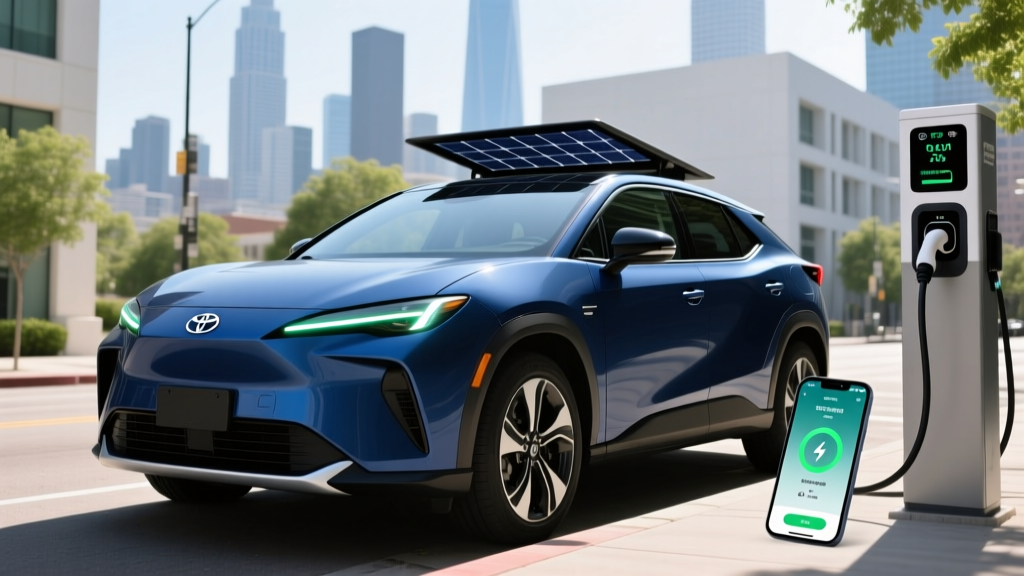
The 2023 Toyota bZ4X arrived with enormous expectations — Toyota's first dedicated battery-electric vehicle, built on the e-TNGA platform shared with the Subaru Solterra. But early adopters quickly discovered a vehicle that splits opinion: competent and comfortable in daily driving, yet noticeably behind Korean rivals on range and charging speed. If you're evaluating a used or remaining-new 2023 bZ4X in 2026, the question isn't whether it's a bad EV — it's whether its compromises matter for your specific use case.
This review breaks down the 2023 bZ4X with the exact numbers buyers need: real-world range reconciliation, charging-curve behavior, current federal tax credit eligibility under IRS §30D rules, and a clear verdict on who should — and shouldn't — put this on their shortlist.
Range, Battery, and Efficiency: The Numbers That Matter
The 2023 bZ4X comes in two drivetrain configurations with meaningfully different range outcomes. The front-wheel-drive (FWD) model carries an EPA-estimated 252 miles of range, while the all-wheel-drive (AWD) variant drops to 228 miles. Both use a 71.4 kWh lithium-ion battery pack (approximately 64 kWh usable, with a large top/bottom buffer to protect long-term health) built with NMC (nickel-manganese-cobalt) chemistry supplied by Panasonic.
| Scenario | FWD (EPA 252 mi) | AWD (EPA 228 mi) |
|---|---|---|
| City / moderate driving | ~240–260 mi | ~220–240 mi |
| Highway (70–75 mph) | ~210–230 mi | ~190–210 mi |
| Cold weather (below 32°F) | ~175–200 mi | ~160–180 mi |
| Combined realistic daily | ~220–240 mi | ~200–215 mi |
Source: EPA estimates via fueleconomy.gov; real-world figures based on owner reports and independent testing. Cold-weather losses of 20–30% are typical for NMC packs without a dedicated heat-pump preconditioning system.
The bZ4X's efficiency is middling. The FWD model achieves 131 MPGe combined (roughly 26 kWh/100 mi), while the AWD drops to 119 MPGe combined (~29 kWh/100 mi). For comparison, the Hyundai Ioniq 5 RWD achieves 132 MPGe with a significantly larger battery and more range. The bZ4X's relatively heavy curb weight (~4,170 lbs FWD) and conservative aerodynamics work against it on the highway.
Charging Speed: Where the bZ4X Falls Behind
Charging performance is the 2023 bZ4X's most discussed weakness. Toyota equipped it with a maximum DC fast-charge rate of 150 kW on paper, but real-world charging curves tell a more nuanced story. The battery's thermal management system is conservative — peak rates are rarely sustained, and the curve tapers aggressively above 60% state of charge (SoC).
| Charging Level | Power / Rate | Time / Speed |
|---|---|---|
| Level 1 (120V household) | ~1.4 kW | ~4 mi/hr added |
| Level 2 (240V home/public) | 6.6 kW (onboard charger) | ~22 mi/hr; full charge in ~9.5 hrs |
| DC Fast Charge (CCS) | 150 kW peak | 10–80% in ~30 min (real-world ~35–40 min due to taper) |
| DC Fast Charge above 80% | Drops below 40 kW | 80–100% adds ~25–30 additional min |
That 10–80% time of roughly 30 minutes under ideal conditions (warm battery, low SoC start, 150+ kW station) is acceptable but not competitive. The Hyundai Ioniq 5 and Kia EV6, with their 800V architectures, achieve 10–80% in approximately 18 minutes. For road-trippers who fast-charge multiple times per trip, that 12-minute gap per stop adds up.
The bZ4X uses the CCS1 connector for DC fast charging and a J1772 inlet for Level 2. Toyota did not adopt NACS (Tesla's connector) for the 2023 model year. Owners can access Tesla Superchargers only via a CCS-to-NACS adapter, and only at Supercharger stalls equipped with the Magic Dock — availability of which remains limited in 2026.
Home charging reality: The 6.6 kW onboard charger means a full charge from empty takes about 9.5 hours on a Level 2 home station. Most owners who plug in nightly at home will never notice — you'll replenish a day's driving (40–60 miles) in roughly 2–3 hours. But if you rely on public Level 2 chargers during errands, the 6.6 kW ceiling means slower top-ups than the 11.5 kW chargers found in the Ford Mustang Mach-E.
Performance and Drivetrain
| Spec | FWD | AWD |
|---|---|---|
| Powertrain | Single front motor | Dual motor (front + rear) |
| Horsepower | 201 hp | 214 hp |
| Torque | 196 lb-ft | 248 lb-ft |
| 0–60 mph | ~7.1 sec | ~5.8 sec |
| Top Speed | ~112 mph | ~112 mph |
| Towing Capacity | Not rated | Not rated |
The AWD model's 5.8-second 0–60 time is genuinely quick for daily driving and highway merging. Toyota's e-AWD system uses independent front and rear motors with an X-MODE drive setting (borrowed from Subaru) that provides legitimate light off-road and snow traction. Regenerative braking offers multiple levels adjustable via paddle shifters, though the bZ4X does not offer true one-pedal driving — the vehicle creeps at low speed rather than coming to a complete stop via regen alone.
Ride quality is a genuine strength. The e-TNGA platform gives the bZ4X a low center of gravity, and Toyota tuned the suspension for comfort over sportiness. Road noise is well-isolated, and the steering is predictably weighted, if not particularly engaging.
Interior, Cargo, and Technology
Inside, the bZ4X presents a clean, modern cabin with Toyota's latest 12.3-inch infotainment touchscreen running Toyota Audio Multimedia. Wireless Apple CarPlay and Android Auto are standard. A 7-inch digital driver display sits behind the steering yoke (or conventional wheel — Toyota offered both, with the yoke being a no-cost option). The center console uses a distinctive floating design that opens up storage space below.
Passenger and cargo dimensions:
- Front legroom: 42.1 inches
- Rear legroom: 35.3 inches
- Cargo behind rear seats: 27.7 cu ft
- Cargo with rear seats folded: 56.9 cu ft
- No front trunk (frunk) — the space is occupied by HVAC and power electronics
Rear-seat space is adequate but not generous for the class. The Hyundai Ioniq 5 offers 39.4 inches of rear legroom and a flat floor that makes the cabin feel considerably airier. The bZ4X's lack of a frunk is a missed opportunity — competitors use that space for charging cables and groceries.
Driver assistance: Every 2023 bZ4X comes equipped with Toyota Safety Sense 3.0, which includes adaptive cruise control, lane-keeping assist, automatic emergency braking with pedestrian detection, blind-spot monitoring, and rear cross-traffic alert. This is a Level 2 SAE driver-assistance system — it supports the driver but requires continuous attention and hands-on-wheel engagement. It is not autonomous driving.
Pricing, Trims, and Federal Tax Credit Eligibility
The 2023 bZ4X launched with two trims: XLE and Limited. By 2026, remaining new inventory is scarce, so most buyers are evaluating the used market or certified pre-owned programs.
| Trim | Drivetrain | Original MSRP | Destination | Total Before Credit |
|---|---|---|---|---|
| XLE | FWD | $43,215 | $1,395 | $44,610 |
| XLE | AWD | $45,315 | $1,395 | $46,710 |
| Limited | FWD | $47,915 | $1,395 | $49,310 |
| Limited | AWD | $49,015 | $1,395 | $50,410 |
Federal tax credit eligibility (§30D): The 2023 bZ4X was assembled in Japan, which disqualified it from the full $7,500 federal tax credit under the final-assembly requirement that took effect in August 2022. However, Toyota structured a lease workaround — leasing the bZ4X qualified for a $7,500 credit passed through as a capitalized-cost reduction, because leased vehicles fall under commercial-credit rules (§45W) that bypass the assembly requirement. Many 2023 buyers used this lease strategy.
For 2026 used-EV buyers: a pre-owned 2023 bZ4X may qualify for the used-EV tax credit of up to $4,000 (30% of the sale price, capped at $4,000) under §25E, provided:
- The vehicle is purchased from a licensed dealer (not private-party)
- The sale price is $25,000 or less
- The buyer's adjusted gross income is ≤$75,000 (single), $112,500 (head of household), or $150,000 (joint)
- The buyer has not claimed a used-EV credit in the prior 3 years
Given that used 2023 bZ4X prices in 2026 typically range from $22,000–$30,000 depending on mileage and condition, the $4,000 used credit is achievable on lower-mileage XLE FWD examples. Always confirm eligibility with a tax professional and verify current rules at irs.gov.
Warranty and Long-Term Battery Outlook
Toyota backs the 2023 bZ4X with:
- Basic warranty: 3 years / 36,000 miles
- Powertrain warranty: 5 years / 60,000 miles
- EV battery warranty: 8 years / 100,000 miles (covers defects and capacity loss below 70% of original capacity)
The 70% retention threshold is industry-standard but worth noting — Toyota will only replace the battery under warranty if it degrades below 70% of its original 71.4 kWh capacity within 8 years or 100,000 miles. Early data from 2023 bZ4X owners suggests modest degradation: most report 94–97% state of health (SoH) after 30,000–40,000 miles. The large usable-capacity buffer (roughly 7 kWh reserved at top and bottom) is protective but means you're working with 64 kWh in practice.
NMC chemistry in the bZ4X offers higher energy density than LFP (lithium iron phosphate), giving Toyota more range in a compact package. The trade-off is that NMC cells are more sensitive to sustained high-SoC storage and extreme temperatures. Best practices: avoid routinely charging to 100% unless needed for a long trip, and use preconditioning when possible before DC fast charging.
Competitive Positioning: Is the 2023 bZ4X Worth Buying?
The 2023 bZ4X competes in a segment crowded with strong alternatives. Here's how it stacks up against the most relevant rivals on the used market in 2026:
| Spec | Toyota bZ4X XLE FWD | Hyundai Ioniq 5 SEL RWD | Kia EV6 Wind RWD | VW ID.4 Pro |
|---|---|---|---|---|
| EPA Range | 252 mi | 303 mi | 310 mi | 275 mi |
| Battery (kWh) | 71.4 (NMC) | 77.4 (NMC) | 77.4 (NMC) | 82 (NMC) |
| DC Fast Charge Peak | 150 kW | 235 kW (800V) | 235 kW (800V) | 170 kW |
| 10–80% Time | ~30 min | ~18 min | ~18 min | ~29 min |
| 0–60 mph | 7.1 sec | 7.0 sec | 7.2 sec | 7.7 sec |
| Cargo (rear up) | 27.7 cu ft | 27.2 cu ft | 24.4 cu ft | 30.3 cu ft |
| Used Price Range (2026) | $22K–$30K | $26K–$34K | $27K–$35K | $22K–$29K |
The bZ4X's used-market pricing is its strongest competitive argument in 2026. Because it depreciated more steeply than the Ioniq 5 or EV6, you can often find a 2023 bZ4X XLE for $2,000–$5,000 less than a comparable Ioniq 5. If range and charging speed are not your top priorities, that value gap is significant.
Choose the bZ4X if:
- You want a used EV under $25,000 that may still qualify for the $4,000 used-EV credit
- Your daily commute is under 80 miles round-trip and you charge at home
- You value Toyota's reputation for build quality and dealer network
- You rarely road-trip more than 200 miles without stopping overnight
Look elsewhere (Ioniq 5, EV6, ID.4) if:
- You need 280+ miles of real-world range for regular highway trips
- You rely on DC fast charging and want sub-20-minute 10–80% times
- You need maximum rear-seat legroom or a frunk
- You live in a cold climate where the bZ4X's 20–30% range loss compounds its shorter EPA number
Pros and Cons at a Glance
- Strong used-market value — often $22K–$26K in 2026
- Comfortable ride quality and low cabin noise
- Standard Toyota Safety Sense 3.0 (comprehensive ADAS suite)
- X-MODE AWD system provides real snow/light-trail capability
- 8-year/100,000-mile battery warranty
- May qualify for $4,000 used-EV tax credit under §25E
- 252-mile max EPA range trails most competitors by 25–60 miles
- DC fast charging peaks at 150 kW with aggressive taper — 30+ min 10–80%
- No frunk; cargo space average for the segment
- 6.6 kW onboard L2 charger slower than 11+ kW competitors
- CCS1 connector limits Tesla Supercharger access (adapter + Magic Dock required)
- Cold-weather range loss significant due to limited battery preconditioning
Who Is the 2023 Toyota bZ4X Best For?
The 2023 bZ4X is a home-charging commuter first and foremost. If you have reliable Level 2 access at home or work, drive under 100 miles daily, and want a comfortable, well-built crossover with Toyota's dealer support and a strong used-market deal, the bZ4X delivers. It's also a reasonable choice for two-car households where the second vehicle handles longer trips.
It is not the right choice for frequent road-trippers, apartment-dwellers without home charging, or cold-climate drivers who need maximum range confidence. For those buyers, the Ioniq 5, EV6, or even a used Tesla Model Y offer meaningfully better range and charging infrastructure access.
Frequently Asked Questions
What is the real-world range of the 2023 Toyota bZ4X?
In mixed driving at moderate temperatures, expect roughly 220–240 miles from the FWD model and 200–215 miles from the AWD. Highway driving at 70+ mph reduces this to around 210–230 miles (FWD). In cold weather below freezing, plan for 175–200 miles (FWD) due to cabin heating demands and reduced battery efficiency.
How fast does the 2023 bZ4X charge at home and on the road?
At home on a 240V Level 2 station, the bZ4X charges at 6.6 kW, adding about 22 miles of range per hour and reaching a full charge in approximately 9.5 hours. On a DC fast charger, it peaks at 150 kW and takes roughly 30–40 minutes to go from 10% to 80%, depending on battery temperature and station output.
Does the 2023 bZ4X qualify for the federal EV tax credit?
As a new vehicle, the 2023 bZ4X did not qualify for the $7,500 §30D purchase credit because it was assembled in Japan. However, it qualified via lease (commercial credit). In 2026, a used 2023 bZ4X purchased from a dealer for $25,000 or less may qualify for the up-to-$4,000 used-EV credit under §25E, subject to buyer income limits. Verify current rules at irs.gov.
Is the bZ4X better than the Subaru Solterra?
They are mechanically identical (same e-TNGA platform, same battery, same motors). The Solterra includes standard AWD across all trims and offers slightly more ground clearance (8.3 inches vs. the bZ4X's 7.1 inches), making it marginally better for light off-pavement use. The bZ4X offers a FWD option with slightly more range. Pricing and features differ slightly by trim. Choose based on dealer proximity, pricing, and whether you want FWD efficiency (bZ4X) or standard AWD (Solterra).
How long will the bZ4X battery last?
Toyota warranties the battery for 8 years/100,000 miles against defects and capacity loss below 70%. Early owner data shows 94–97% state of health after 30,000–40,000 miles, suggesting the NMC pack is holding up well. With proper care (avoiding routine 100% charges, minimizing DC fast charging in extreme heat), most owners should see well over 150,000 miles before meaningful degradation impacts daily usability.
Can I charge the bZ4X at Tesla Superchargers?
Only with a CCS-to-NACS adapter, and only at Supercharger stalls equipped with Tesla's Magic Dock integrated adapter. As of 2026, Magic Dock availability remains limited to select stations. For reliable road-trip charging, plan around Electrify America, EVgo, and ChargePoint CCS networks.