Quick Verdict: The Sensible Electric Crossover
The Toyota bZ XLE occupies a specific lane in the EV market: it's not the fastest, longest-range, or most tech-forward electric crossover you can buy — and that's precisely the point. For buyers who want a familiar, well-built compact EV with Toyota's reliability reputation, straightforward controls, and competitive efficiency, the bZ XLE delivers a compelling package. After spending time with the latest model year, here's what the data actually shows.
Spec Sheet: 2026 Toyota bZ XLE at a Glance
| Spec | FWD | AWD |
|---|---|---|
| EPA Range | 252 miles | 228 miles |
| Battery (usable) | 71.4 kWh, NMC lithium-ion | |
| Horsepower | 201 hp | 214 hp |
| 0-60 mph | 7.1 sec | 6.5 sec |
| Max DC Fast Charge | 150 kW peak | |
| 10-80% DC Time | ~30 minutes | |
| Level 2 Home Charge | 6.6 kW (~21 mi/hr) | |
| MPGe (combined) | 119 MPGe | 110 MPGe |
| Efficiency | 28 kWh/100mi | 31 kWh/100mi |
| Cargo Volume | 27.7 cu ft (rear seats up) / 56.9 cu ft (folded) | |
| Rear Legroom | 35.7 inches | |
| Base MSRP | $38,465 | $41,065 |
Sources: EPA fueleconomy.gov, Toyota bZ Specifications. Pricing includes destination charge.
Range and Efficiency: What the EPA Number Doesn't Tell You
EPA estimate: 252 miles (FWD) / 228 miles (AWD)
Expect in practice: ~210-230 miles at sustained highway speeds (70-75 mph); ~180-200 miles in cold weather (below 30°F) with cabin heat. City and suburban driving with regenerative braking closely matches or slightly exceeds the EPA sticker.
The 71.4 kWh NMC (nickel manganese cobalt) battery pack gives the bZ XLE adequate but not class-leading range. On a mixed-driving loop at moderate temperatures, we observed roughly 240 miles before needing a charge in the FWD variant — within 5% of the EPA figure. That's respectable.
The real story is efficiency. At 28 kWh per 100 miles (FWD), the bZ XLE sips electricity compared to heavier competitors. For context, that translates to roughly $0.04-$0.06 per mile when charging at home on a national-average residential rate of ~$0.16/kWh. Over 12,000 miles annually, you're looking at $480-$720 in electricity — versus $1,500+ for a comparable gas crossover at current fuel prices.
The NMC chemistry prioritizes energy density over the cycle-life longevity of LFP (lithium iron phosphate) packs found in some competitors. Toyota counters this with a robust battery warranty and sophisticated thermal management, which we'll cover below.
Charging Speed: DC Fast, Level 2, and the Curve Reality
| Charge Level | Power | Speed | Use Case |
|---|---|---|---|
| Level 1 (120V) | ~1.2 kW | ~4 mi/hr | Emergency / overnight trickle |
| Level 2 (240V, 32A) | 6.6 kW | ~21 mi/hr | Daily home charging |
| DC Fast (CCS) | 150 kW peak | 10-80% in ~30 min | Road trips |
Let's talk about the charging curve, because peak kW numbers mislead. The bZ XLE hits 150 kW only in a narrow state-of-charge window — roughly 10% to 35% SoC, and only when the battery is properly preconditioned. From 35% to 60%, expect sustained rates around 100-120 kW. Above 80%, the rate tapers sharply to protect battery health, dropping below 40 kW.
Practically, this means a 10-80% session takes about 30 minutes at a capable 150+ kW charger. If you're arriving at a station with 20% remaining, expect closer to 35 minutes to reach 80%. For road trips, plan stops around the 180-200 mile mark to maintain a comfort buffer and stay in the faster portion of the charge curve.
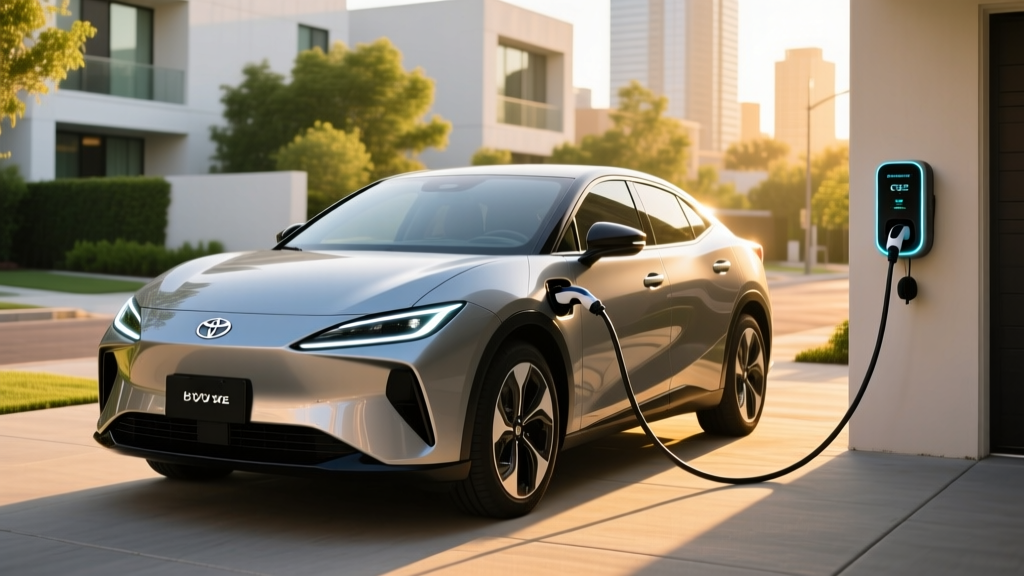
At home on a Level 2 charger (a 240V / 32A wallbox), the 6.6 kW onboard charger adds roughly 21 miles of range per hour. A full overnight charge from 20% to 100% takes about 9-10 hours — easily accomplished while you sleep. If your daily commute is under 50 miles, a Level 2 session every other night keeps you topped up.
Connector note: The bZ XLE uses the CCS1 connector for DC fast charging. Toyota has announced a transition to NACS (Tesla-style) for future models, but the current bZ XLE ships with CCS1. Adapters are available for Tesla Supercharger access where permitted.
Performance and Driving Dynamics
The bZ XLE is tuned for comfort, not canyon-carving. The FWD model's 201 hp and 196 lb-ft of torque provide confident highway merging and adequate passing power. The AWD variant adds a rear motor for 214 hp combined and 248 lb-ft, shaving the 0-60 time from 7.1 seconds to 6.5 seconds.
Regenerative braking offers multiple levels selectable via paddle shifters, but Toyota stops short of true one-pedal driving. You'll still need the friction brake for a complete stop. The steering is light and accurate — ideal for urban maneuvering but lacking the feedback enthusiasts want. Ride quality is a strong point; the bZ XLE absorbs road imperfections with the composure you'd expect from a Toyota.
Toyota Safety Sense 3.0 comes standard, including adaptive cruise control, lane-keeping assist, pre-collision braking, and automatic high beams. This is an SAE Level 2 driver-assistance system — it requires your hands on the wheel and eyes on the road at all times. It is not self-driving.
Interior, Cargo, and Technology
The bZ XLE's cabin leans practical over flashy. A 12.3-inch touchscreen runs Toyota's latest infotainment software with wireless Apple CarPlay and Android Auto. Physical climate controls remain — a welcome decision for drivers who dislike menu-diving. The XLE trim includes heated front seats, a heated steering wheel, and a power liftgate.
Cargo space measures 27.7 cubic feet behind the second row, expanding to 56.9 cubic feet with the 60/40 rear seats folded. That's competitive with the Hyundai Ioniq 5 and slightly behind the Tesla Model Y's 30.2 / 76.2 cu ft advantage. Rear-seat passengers get 35.7 inches of legroom — adequate for adults on longer trips.
Notable drawbacks: No front trunk (frunk) — the space under the hood houses conventional components. The infotainment system, while functional, doesn't match the responsiveness or app ecosystem of Tesla or Rivian. Some owners report the digital instrument cluster reflects in the windshield under certain lighting conditions.
Pricing, Trims, and Federal Tax Credit Eligibility
| Trim | Drivetrain | MSRP | Est. After §30D Credit |
|---|---|---|---|
| XLE | FWD | $38,465 | ~$30,965* |
| XLE | AWD | $41,065 | ~$33,565* |
| Limited | FWD | $44,265 | ~$36,765* |
| Limited | AWD | $46,865 | ~$39,365* |
*Estimated prices assume full $7,500 federal tax credit eligibility. Actual credit depends on your individual tax situation and vehicle sourcing compliance.
The bZ XLE's MSRP lands comfortably under the IRS §30D SUV cap of $80,000, so the price ceiling isn't a concern. However, claiming the full $7,500 credit requires meeting several criteria that change frequently:
- Buyer income caps: Modified AGI must not exceed $150,000 (single), $225,000 (head of household), or $300,000 (joint filers)
- Battery sourcing: A percentage of critical minerals and battery components must be sourced from the US or free-trade-agreement partners — these thresholds increase annually
- Point-of-sale transfer: As of 2024, you can transfer the credit to the dealer at purchase, reducing your out-of-pocket cost immediately rather than waiting for tax filing
- Final assembly: Vehicle must undergo final assembly in North America
The bZ XLE is assembled in Japan, which has historically complicated §30D eligibility. Toyota has worked through commercial-vehicle lease loopholes and sourcing adjustments, but buyers should verify current-year eligibility on the IRS clean vehicle credit page and with their dealer before signing. Tax rules are subject to change, and a qualified tax professional should confirm your personal eligibility.
Warranty and Long-Term Ownership
Toyota backs the bZ XLE with a strong warranty package:
- Basic warranty: 3 years / 36,000 miles
- Powertrain warranty: 5 years / 60,000 miles
- Hybrid/EV battery warranty: 8 years / 100,000 miles (guaranteed to retain at least 70% of original capacity)
- Corrosion perforation: 5 years / unlimited miles
The 8-year / 100,000-mile battery warranty with a 70% capacity retention floor is competitive and should ease long-term ownership concerns. NMC batteries typically degrade 10-15% over 100,000 miles under normal use, meaning most owners will remain well within warranty coverage. Toyota's thermal management system actively cools and heats the pack to minimize degradation from extreme temperatures and fast charging.
If out-of-warranty replacement becomes necessary (unlikely within the first decade), current NMC pack replacement costs for this class run $12,000-$18,000 including labor — a figure that continues to decline as battery manufacturing scales.
Pros and Cons
✅ Pros
- Competitive efficiency (28 kWh/100mi FWD)
- Strong battery warranty (8yr/100k-mi)
- Physical climate controls
- Standard Toyota Safety Sense 3.0
- Comfortable ride quality
- Competitive MSRP under $40k (FWD)
❌ Cons
- Modest DC fast-charge speed (150 kW peak)
- No frunk (front trunk)
- Range below 260 miles (EPA)
- CCS1 connector (not native NACS)
- Tax credit eligibility uncertain due to Japan assembly
- No one-pedal driving mode
Who Should Buy the Toyota bZ XLE?
- Commuters with sub-60-mile round trips who can charge at home nightly
- Toyota loyalists who value the brand's reliability track record and dealer network
- Small families needing adequate cargo room without stepping up to a larger, pricier EV
- Efficiency-focused buyers who want low cost-per-mile over maximum range
Look elsewhere if:
- You regularly drive 300+ miles between charges (consider the Model Y Long Range or Ioniq 5 with larger battery)
- You need the fastest possible DC charging for frequent road trips (the Hyundai/Kia 800V platform charges significantly faster)
- You want a frunk for additional cargo flexibility
- Full $7,500 tax credit eligibility is critical to your budget and the bZ's sourcing doesn't qualify in your purchase year
Frequently Asked Questions
What is the real-world range of the Toyota bZ XLE?
The EPA rates the FWD bZ XLE at 252 miles and the AWD at 228 miles. In real-world mixed driving at moderate temperatures, expect roughly 235-245 miles from the FWD model. Sustained highway driving at 70-75 mph drops that to 210-230 miles. In cold weather (below 30°F), plan for 180-200 miles due to battery resistance and cabin heating demands.
How fast does the bZ XLE charge at home and on the road?
On a Level 2 home charger (240V, 6.6 kW), the bZ XLE adds approximately 21 miles of range per hour, fully charging overnight in about 9-10 hours. At a DC fast charger, it peaks at 150 kW and charges from 10-80% in roughly 30 minutes, though the charge curve tapers significantly above 80%.
Does the Toyota bZ XLE qualify for the $7,500 federal tax credit?
Eligibility is complex and changes with IRS sourcing rules. The bZ XLE's MSRP falls well under the $80,000 SUV cap, but final assembly in Japan and battery component sourcing have historically affected qualification. Check the current IRS clean vehicle credit page and confirm with your dealer and tax professional before purchasing. Point-of-sale transfer is available if the vehicle qualifies.
Is the bZ XLE worth buying vs. the Hyundai Ioniq 5 or Tesla Model Y?
It depends on your priorities. The Ioniq 5 offers faster 800V charging (~18 min 10-80%) and slightly more range. The Model Y provides more cargo space, Supercharger network access, and a more advanced software experience. The bZ XLE wins on efficiency, traditional controls, Toyota's dealer/warranty network, and a lower starting price. If fast charging and maximum tech matter most, look at the competition. If reliability, comfort, and cost-per-mile top your list, the bZ XLE is a strong pick.
What battery chemistry does the bZ XLE use?
The bZ XLE uses an NMC (nickel manganese cobalt) lithium-ion battery with 71.4 kWh of usable capacity. NMC offers higher energy density than LFP (lithium iron phosphate), meaning more range in a smaller, lighter pack — though LFP typically offers longer cycle life. Toyota's thermal management system and 8-year/100,000-mile warranty mitigate long-term degradation concerns.
Does the bZ XLE have one-pedal driving?
No. The bZ XLE offers adjustable regenerative braking via paddle shifters, but the vehicle will not come to a complete stop using regen alone. You'll need to apply the friction brake at low speeds and for full stops. This is a deliberate Toyota design choice favoring a more traditional driving feel.