Quick Verdict: The Toyota bZ Limited in 2026
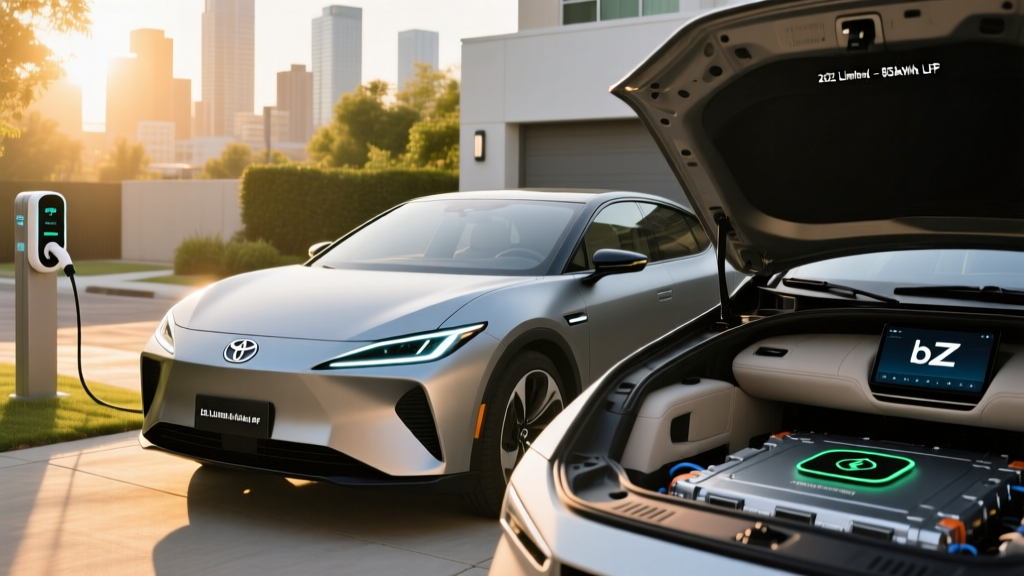
The 2026 Toyota bZ Limited (badged globally as the bZ4X in higher trims) occupies a specific niche: a mainstream compact electric crossover from the world's largest automaker, priced to undercut the Hyundai Ioniq 5 and Ford Mustang Mach-E while offering Toyota's reputation for reliability. The Limited trim is the range-topper, adding a panoramic fixed-glass roof, heated and ventilated front seats, a 360-degree camera, and Toyota's full Safety Sense 3.0 suite. But the bZ platform's modest 71.4 kWh battery and peak 150 kW charging rate mean this EV prioritizes daily practicality over road-trip dominance.
For buyers who want a comfortable, well-equipped electric commuter with strong dealer support and a proven warranty, the bZ Limited delivers. For those planning frequent 300-mile highway stretches or cold-climate ownership, the real-world range limitations demand honest consideration before signing the paperwork.
Range, Efficiency & the Real-World Reality Check
Real-World Expectation: 215–235 miles in mixed highway driving at 70 mph; 180–200 miles in sub-30°F winter conditions with cabin heat active. City/regenerative-heavy driving can approach or slightly exceed the EPA sticker.
The front-wheel-drive bZ trims achieve a slightly higher 258-mile EPA rating, but the Limited trim comes exclusively with Toyota's X-Mode all-wheel-drive system, which pairs two electric motors for a combined 214 horsepower and 248 lb-ft of torque. That AWD system costs roughly 6 miles of range versus FWD equivalents.
Efficiency lands at 102 MPGe combined (city: 114 / highway: 90), or roughly 33 kWh per 100 miles, according to fueleconomy.gov. That's respectable but trails the Hyundai Ioniq 5 (114 MPGe combined) and the Tesla Model Y Long Range (122 MPGe combined). The bZ's boxy crossover shape and ~4,300-pound curb weight work against highway efficiency.
The 71.4 kWh usable battery uses NMC (nickel manganese cobalt) chemistry, supplied by Panasonic for the North American market. NMC offers higher energy density than LFP but is more sensitive to sustained high-state-of-charge storage. Toyota recommends daily charging to 80% and only charging to 100% when a long trip is planned within 24 hours — a best practice that preserves long-term capacity.
| Spec | Value |
|---|---|
| EPA Range (AWD Limited) | 252 miles |
| Battery Capacity (usable) | 71.4 kWh, NMC chemistry |
| Drivetrain | Dual-motor AWD (X-Mode) |
| Horsepower / Torque | 214 hp / 248 lb-ft |
| 0–60 mph | 6.5 seconds |
| Max DC Fast Charge | 150 kW (peak) |
| 10–80% DC Fast Charge | ~30 minutes |
| Level 2 Charge Rate | 7.2 kW (~25 miles/hr) |
| EPA Efficiency | 102 MPGe / 33 kWh/100mi |
| Cargo Volume (rear seats up) | 27.7 cu ft |
| Cargo Volume (rear seats folded) | 56.9 cu ft |
| Rear Legroom | 35.7 inches |
| Base MSRP (Limited AWD) | $44,000 |
| Battery Warranty | 8 years / 100,000 miles |
Charging Speed: DC Fast, Level 2 & the Curve Reality
| Charging Level | Power / Rate | Time or Miles Added |
|---|---|---|
| Level 1 (120V household) | ~1.2 kW | ~4 miles per hour |
| Level 2 (240V home, 32A) | 7.2 kW | ~25 miles per hour; 0–100% in ~9.5 hours |
| DC Fast Charge (peak) | 150 kW | 10–80% in ~30 minutes |
The bZ Limited uses the CCS1 connector for DC fast charging. Toyota has not adopted the NACS (Tesla) port on the bZ platform as of the 2026 model year, though adapters are available for Supercharger access. At a compatible 150 kW or higher DC station (Electrify America, EVgo, ChargePoint), the bZ peaks at roughly 150 kW — but that peak is short-lived.
Here's the charging-curve reality most spec sheets omit: the bZ sustains approximately 120–140 kW between 10% and 40% state of charge, then tapers progressively. From 40% to 60%, you'll see roughly 90–100 kW. Above 80%, the rate drops below 40 kW as the battery management system prioritizes cell longevity. A 10–80% session takes about 30 minutes in ideal (warm battery, preconditioned) conditions. In cold weather without preconditioning, expect 38–45 minutes for the same session.
The bZ does support battery preconditioning when a DC fast charger is set as the navigation destination. This warms the pack to optimal charging temperature and is essential for achieving advertised charge times in temperatures below 50°F. Always use nav-routing to a charger — skipping preconditioning can cut peak charge rates by 30–40%.
For home Level 2 charging, the 7.2 kW onboard charger means a full 0–100% charge takes approximately 9.5 hours. Most owners charging from 20% to 80% daily will need roughly 6 hours — easily handled overnight on a standard 240V/32A home charger installation.
Performance, Ride Quality & Daily Driving
The dual-motor AWD powertrain produces 214 horsepower — adequate for merging and passing but not thrilling. The 6.5-second 0–60 mph time trails the Ioniq 5 AWD (5.2 seconds) and the Model Y Long Range (4.8 seconds). Toyota tuned the bZ for comfort over aggression, and the result is a composed, quiet ride with well-damped suspension over rough pavement.
Regenerative braking offers multiple levels via paddle shifters behind the steering wheel, but the bZ does not offer true one-pedal driving in the way a Nissan Leaf or Tesla does. Even at maximum regen, the vehicle creeps at low speed and requires the brake pedal for a complete stop. This is a deliberate Toyota choice — drivers accustomed to traditional brake feel tend to prefer it, but EV veterans may find it underwhelming.
The X-Mode AWD system includes traction settings for snow, mud, and sand, plus hill-descent control. It's not an off-roader, but it handles light unpaved roads and icy commutes with confidence. Ground clearance is 7.1 inches — competitive with the segment.
Interior, Tech & the Limited Trim Advantage
The Limited trim justifies its premium over the base bZ with meaningful upgrades:
- 12.3-inch touchscreen with wireless Apple CarPlay and Android Auto
- Panoramic fixed-glass roof (no shade — tinted glass only)
- Heated and ventilated front seats with synthetic leather upholstery
- Heated steering wheel
- 360-degree surround-view camera
- Wireless phone charging pad (15W Qi)
- 9-speaker JBL premium audio
- Digital rearview mirror with camera feed
The infotainment system runs Toyota's latest Audio Multimedia platform. Response times are acceptable but not class-leading — the interface feels a generation behind Tesla's or Hyundai's in fluidity. Physical buttons for climate control and volume are a welcome inclusion for drivers who dislike touchscreen-only layouts.
Passenger space is generous for the compact crossover segment: 35.7 inches of rear legroom accommodates adults comfortably, and the flat floor (no transmission tunnel) makes the middle seat usable. Cargo volume at 27.7 cu ft behind the rear seats is competitive, expanding to 56.9 cu ft with seats folded. There is no front trunk (frunk) — the space under the hood houses power electronics.
Toyota Safety Sense 3.0 is standard across all trims and includes:
- Pre-Collision System with pedestrian and cyclist detection
- Lane Departure Alert with Steering Assist
- Lane Tracing Assist (centering in marked lanes)
- Dynamic Radar Cruise Control (full stop-and-go adaptive cruise)
- Road Sign Assist
- Proactive Driving Assist (gentle deceleration when approaching slower traffic)
Pricing, Tax Credits & Ownership Economics
| Item | Amount |
|---|---|
| Base MSRP (Limited AWD) | $44,000 |
| Destination Charge | $1,350 |
| As-Tested Price (with options) | $45,800–$47,200 |
| Federal Tax Credit (§30D, if eligible) | Up to $7,500 (point-of-sale transfer available) |
| Effective Price After Max Credit | ~$36,500–$38,350 |
The $44,000 MSRP for the Limited AWD trim clears the IRS §30D price cap of $80,000 for SUVs, crossovers, and vans. However, the full $7,500 federal tax credit is not guaranteed for every buyer. Eligibility under current IRS rules requires meeting all of the following:
- Buyer income caps: Modified AGI must not exceed $150,000 (single), $225,000 (head of household), or $300,000 (joint filers)
- MSRP cap: Vehicle base price must be ≤$80,000 for SUVs/crossovers — the bZ Limited qualifies
- Battery component sourcing: Increasing percentages of battery components must be manufactured or assembled in North America (phased thresholds by year)
- Critical minerals: Increasing percentages of critical minerals must be sourced from the U.S. or free-trade-agreement countries
- Point-of-sale transfer: Buyers can transfer the credit to the dealer at purchase, reducing the sale price directly rather than waiting for a tax refund
The battery-sourcing and critical-minerals requirements are the most variable factors. Toyota sources Panasonic cells for the bZ, and the supply chain's compliance with annual threshold changes determines whether the vehicle qualifies for the full $7,500, a partial $3,750, or no credit at all. Check the latest eligibility list on fueleconomy.gov before purchasing, as these determinations update throughout the year.
For a buyer who qualifies for the full $7,500 credit via point-of-sale transfer, the effective price of the bZ Limited drops to approximately $36,500 plus destination — making it one of the most affordable AWD electric crossovers on the market.
Pros, Cons & Who Should Buy the bZ Limited
- Comfortable, quiet ride quality tuned for daily commuting
- Strong standard safety suite (TSS 3.0) across all trims
- Competitive pricing after federal tax credit (~$36,500 effective)
- Toyota's dealer network and 8-year/100,000-mile battery warranty
- Physical buttons for climate and volume — practical over trendy
- X-Mode AWD with useful traction settings for snow and light off-road
- 252-mile EPA range trails Ioniq 5 (303 mi) and Model Y (330 mi)
- 150 kW peak DC charging is slow vs. 240–350 kW competitors
- No one-pedal driving mode — a miss for EV-experienced drivers
- No front trunk (frunk) — lost cargo utility
- Infotainment system feels dated vs. segment leaders
- Panoramic glass roof has no retractable shade — cabin heat in summer
- Choose the bZ Limited if: You prioritize ride comfort, dealer support, and safety tech over maximum range; your daily commute is under 80 miles round-trip; you have reliable home Level 2 charging; and you want an AWD crossover at a strong post-credit price.
- Look elsewhere if: You regularly drive 250+ miles between charges, need the fastest possible DC charging for road trips, want hands-free highway driving (BlueCruise/Super Cruise), or demand one-pedal regen and a frunk.
- Key competitors to cross-shop: Hyundai Ioniq 5 (more range, faster charging, 800V architecture), Ford Mustang Mach-E (sportier handling, longer range), Tesla Model Y (Supercharger network, best efficiency, but no Apple CarPlay).
Warranty & Long-Term Ownership
Toyota backs the bZ with a solid warranty package:
- Basic vehicle warranty: 3 years / 36,000 miles
- Powertrain warranty: 5 years / 60,000 miles
- Hybrid/EV battery warranty: 8 years / 100,000 miles (capacity retention above 70% of original)
- Corrosion perforation: 5 years / unlimited miles
- Roadside assistance: 2 years / 25,000 miles
The 8-year/100,000-mile battery warranty is standard for the segment and matches Hyundai, Ford, and most competitors. Toyota's 70% capacity retention threshold means the warranty triggers if the battery degrades below 70% of its original 71.4 kWh capacity within the warranty period. In practice, NMC batteries with proper care (avoiding sustained 100% storage, using preconditioning for DC charging) typically retain 85–90% capacity at 100,000 miles based on industry degradation data. A full battery replacement outside warranty would cost an estimated $12,000–$16,000 based on current parts pricing — a figure to keep in mind for second-owner considerations.
Frequently Asked Questions
What is the real-world range of the Toyota bZ Limited?
The EPA rates the AWD Limited at 252 miles. In real-world highway driving at 70 mph with moderate temperatures, expect 215–235 miles. In cold weather (below 30°F) with cabin heating, range drops to approximately 180–200 miles. City driving with regenerative braking can approach or slightly exceed the EPA figure.
How fast does the Toyota bZ Limited charge at home and on the road?
At home on a 240V Level 2 charger (7.2 kW), the bZ adds roughly 25 miles of range per hour, with a full charge taking about 9.5 hours. On DC fast charging, the bZ peaks at 150 kW and charges from 10% to 80% in approximately 30 minutes under ideal conditions. Cold weather without preconditioning extends this to 38–45 minutes.
Does the Toyota bZ Limited qualify for the $7,500 federal EV tax credit?
The bZ Limited's $44,000 MSRP clears the $80,000 SUV cap. However, full credit eligibility depends on battery component sourcing and critical-minerals requirements that change annually. Buyer income must also fall below IRS thresholds ($150K single / $300K joint). Check current eligibility on fueleconomy.gov and consult a tax professional before relying on the credit. Point-of-sale transfer to the dealer is available if eligible.
Is the Toyota bZ Limited worth buying over the Hyundai Ioniq 5 or Tesla Model Y?
The bZ Limited wins on ride comfort, physical controls, and effective post-credit pricing. The Ioniq 5 offers more range (303 mi AWD), dramatically faster charging (800V / 240 kW), and a more modern interior. The Model Y leads in efficiency, Supercharger network access, and cargo space. If daily comfort and Toyota dealer support matter most, the bZ is compelling. If range and charging speed are priorities, cross-shop the Ioniq 5 and Model Y seriously.
Does the Toyota bZ have one-pedal driving?
No. The bZ offers adjustable regenerative braking via steering-wheel paddles, but even at maximum regen, the vehicle does not come to a complete stop without brake-pedal input. Toyota designed this to mimic conventional brake feel. Drivers who prefer one-pedal driving will find this a notable omission.
What connector does the Toyota bZ Limited use?
The bZ Limited uses a CCS1 connector for DC fast charging and a J1772 inlet for Level 1 and Level 2 AC charging. It does not have a native NACS (Tesla) port. An adapter is required to use Tesla Superchargers, and not all Supercharger stalls have been opened to non-Tesla vehicles as of 2026 — check the Tesla app for station compatibility.