The Rivian R1T as a Truck Camp Platform: Quick Verdict
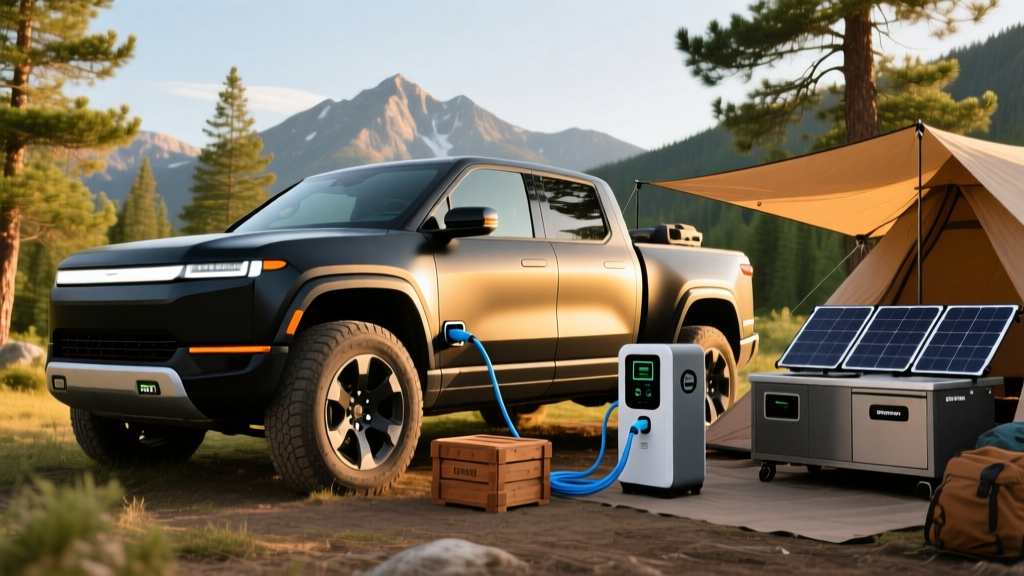
The Rivian R1T occupies a strange niche in the electric truck world. With a 4.5-foot bed, Gear Tunnel, and quad-motor or dual-motor powertrains, it is not a traditional full-size pickup — but for truck camp enthusiasts willing to adapt, it offers silent off-grid operation, vehicle-to-load power potential, and enough range to reach most trailheads without a generator. If you're evaluating a Rivian truck camp build, this review covers every spec that matters: range under load, charging speed in remote areas, payload capacity, and whether the R1T's battery and drivetrain can handle the extra weight of a camper shell or lightweight slide-in.
Range Reality Check
EPA Estimated Range: 352 miles (Dual-Motor Max Pack, 2025–2026 model years)
Real-World Expectation: 280–310 miles mixed driving; 240–270 miles sustained highway at 70–75 mph; 200–230 miles in cold weather (below 32°F) with a camper shell adding ~400–600 lbs of payload. The Max Pack's 141 kWh usable battery gives you a buffer, but aerodynamic drag from a topper and added rolling resistance from heavier tires will cut efficiency noticeably.
Rivian R1T Core Specs at a Glance
| Specification | Dual-Motor Standard | Dual-Motor Max Pack | Quad-Motor Max Pack |
|---|---|---|---|
| EPA Range | 270 mi | 352 mi | 328 mi |
| Battery (Usable) | 92 kWh (NMC) | 141 kWh (NMC) | 141 kWh (NMC) |
| Horsepower | 533 hp | 533 hp | 1,025 hp |
| 0–60 mph | 4.5 sec | 4.5 sec | 3.0 sec |
| Drivetrain | AWD (Dual-Motor) | AWD (Dual-Motor) | AWD (Quad-Motor) |
| Max Tow Capacity | 11,000 lbs | 11,000 lbs | 11,000 lbs |
| Payload Capacity | ~1,760 lbs | ~1,760 lbs | ~1,760 lbs |
| Bed Length | 4.5 ft (54 in) | 4.5 ft (54 in) | 4.5 ft (54 in) |
| MPGe (Combined) | 70 MPGe | 73 MPGe | 70 MPGe |
| Base MSRP (2025/2026) | $69,900 | $83,900 | $99,900 |
Sources: fueleconomy.gov, Rivian official specifications.
Charging Speed: DC Fast, Level 2, and Remote Charging Realities
For any Rivian truck camp build, charging logistics define your trip radius. The R1T uses the NACS (North American Charging Standard) connector natively on 2025+ models, granting access to Tesla Superchargers via Rivian's adapter program and the expanding NACS network.
| Charging Level | Power / Rate | Speed (Approx.) | Notes |
|---|---|---|---|
| Level 1 (120V) | 1.4 kW | ~3–4 mi/hr | Emergency/trickle only; impractical for camp use |
| Level 2 (240V, 48A) | 11.5 kW | ~25–28 mi/hr | Full charge in ~12–14 hrs (Max Pack); ideal for home base |
| DC Fast Charge | Peak 200 kW | 10–80% in ~30 min (Max Pack) | Charge curve tapers above 80%; sustained avg ~130–150 kW |
Charging curve reality: The R1T Max Pack peaks near 200 kW between roughly 10–35% State of Charge, then progressively tapers. Expect 10–80% in about 30 minutes at a capable 250+ kW charger, but 80–100% can take an additional 25–30 minutes. For truck camp trips, plan charging stops around the 20–80% sweet spot to minimize downtime.
Remote charging consideration: Many overlanding destinations lack DC fast chargers. A portable Level 2 EVSE (like the Rivian Wall Connector used with a NEMA 14-50 outlet at a campground) can recover ~25 miles of range per hour — enough to top off overnight at sites with 240V hookups.
Truck Camp Payload and Bed Limitations
The R1T's 4.5-foot bed is the primary constraint for any truck camp conversion. Traditional slide-in campers designed for 6.5–8 ft beds will not fit. Here's what does work within the ~1,760 lb payload envelope:
- Lightweight camper shells/toppers: 150–300 lbs (fiberglass or aluminum); preserves most payload for gear and passengers
- Compact slide-in campers (custom-fit): Companies like AT Overlander and Four Wheel Campers have explored short-bed configurations in the 800–1,200 lb range — tight but feasible if you stay under Gross Vehicle Weight Rating (GVWR)
- Rivian Gear Tunnel: 11 cu ft of lockable, climate-controlled storage between the cab and bed — unique to the R1T and ideal for camp kitchen setups, tools, or recovery gear
- Bed storage system: The R1T's under-bed storage compartment adds additional secured cargo volume
Critical weight math: With a 1,760-lb payload, subtract passenger weight (e.g., two adults at ~370 lbs combined), and you have roughly 1,390 lbs remaining for a camper shell, gear, water, and supplies. A 1,000-lb slide-in leaves only ~390 lbs for everything else — tight for extended trips. The Max Pack battery adds vehicle curb weight but does not change payload capacity.
Real-World Range with a Camper Load
EPA range figures assume a stock vehicle under controlled conditions. Adding a camper shell, rooftop tent, or slide-in changes the equation:
Estimated Range Impact — Camper Configurations
- Stock R1T Max Pack: 352 mi EPA → ~300 mi real-world mixed
- With lightweight topper + gear (~400 lbs added): ~270–290 mi mixed; ~240 mi highway
- With compact slide-in (~1,000 lbs added + aero penalty): ~240–260 mi mixed; ~210 mi highway
- Cold weather (20°F) + camper load: Subtract another 15–25% → ~180–220 mi effective range
These are estimates based on observed efficiency drops of 10–20% for added weight and aerodynamic drag in EV trucks. The R1T's energy consumption typically sits at 42–48 kWh/100 mi stock; expect 50–58 kWh/100 mi under camper load.
For context, the EPA's fueleconomy.gov lists the R1T Max Pack at approximately 46 kWh/100 mi combined. Under camper load, your effective cost per mile rises, and your charging stops become more frequent — plan for a DC fast charge every 200 miles or so on highway overlanding routes.
Pricing, Trims, and Federal Tax Credit Eligibility
| Trim | Base MSRP | Federal §30D Credit | Effective Price (if eligible) |
|---|---|---|---|
| Dual-Motor Standard Pack | $69,900 | Up to $7,500* | ~$62,400 |
| Dual-Motor Max Pack | $83,900 | Up to $7,500* | ~$76,400 |
| Quad-Motor Max Pack | $99,900 | Up to $7,500* | ~$92,400 |
*IRS §30D eligibility caveats (2025–2026 rules):
- MSRP cap: Pickup trucks must have an MSRP at or below $80,000 to qualify. This means the Dual-Motor Standard and Max Pack trims are eligible, but the Quad-Motor at $99,900 exceeds the cap and does not qualify for the federal credit.
- Buyer income limits: Modified Adjusted Gross Income (MAGI) must not exceed $150,000 (single), $225,000 (head of household), or $300,000 (joint filing).
- Battery sourcing: The credit is split into two halves ($3,750 + $3,750) based on critical mineral and battery component sourcing requirements. Rivian's battery supply chain has been evolving; verify current-year sourcing compliance on IRS.gov before purchase.
- Point-of-sale transfer: Eligible buyers can transfer the credit to the dealer at purchase, reducing the out-of-pocket price immediately rather than waiting for tax filing.
Driver Assistance, Tech, and Off-Grid Features
The R1T comes equipped with Rivian's Driver+ system, which includes adaptive cruise control, lane centering, and automatic emergency braking. This is an SAE Level 2 driver-assistance system — the driver must remain attentive and keep hands on the wheel at all times. It is not autonomous driving.
SAE Automation Level: Level 2
Rivian Driver+ provides partial automation (steering + acceleration/braking assistance) under driver supervision. It does not replace the driver. Comparable to Tesla Autopilot, Ford BlueCruise, or GM Super Cruise in automation level — not to be confused with Level 4 robotaxi services like Waymo.
Standout tech for truck camp use:
- Camp Kitchen (optional): Rivian's slide-out Camp Kitchen accessory integrates into the Gear Tunnel with a two-burner induction cooktop, sink, and utensil storage — designed specifically for the R1T
- Vehicle-to-Load (V2L) potential: The R1T's large battery can theoretically power external devices; Rivian has explored bi-directional charging capabilities, enabling campsite power without a generator
- Over-the-air updates: Continuous software improvements to range estimation, thermal management, and driver assists
- 15.6-inch center display: Includes topographic trail maps, range prediction by route elevation, and waypoint navigation useful for overlanding
- Four-corner air suspension: Adjustable ride height from 7.9 to 14.9 inches of ground clearance — critical for trail access with a camper load
Notable drawbacks:
- 4.5-foot bed severely limits traditional slide-in camper options
- No integrated bed power outlets (120V) as of current model years — aftermarket solutions required for camp power
- Service center network remains limited outside major metro areas — a concern for remote overlanding trips
- Insurance costs run 15–30% higher than comparable ICE trucks
Warranty Coverage
Rivian provides the following warranty structure, which is relevant for truck camp buyers putting additional stress on the drivetrain:
- Battery pack: 8 years / 175,000 miles (retains ≥70% capacity)
- Powertrain: 8 years / 175,000 miles
- Bumper-to-bumper: 5 years / 60,000 miles
- Roadside assistance: 5 years / 60,000 miles
The 175,000-mile battery and powertrain warranty is among the most generous in the EV truck segment. The 70% capacity retention threshold is standard; note that adding sustained heavy payloads may accelerate wear on suspension components not covered under the powertrain warranty.
Who the Rivian R1T Truck Camp Build Suits Best
Choose the R1T for Truck Camping If:
- You prioritize silent, zero-exhaust campsite operation over maximum bed space
- Your trips are within 200–250 miles of a charging corridor or destination with 240V access
- You prefer a lightweight topper or Rivian's Camp Kitchen over a heavy slide-in camper
- You value adjustable air suspension for trail clearance with variable loads
- You want the Gear Tunnel as a dedicated, secure gear storage zone
Look Elsewhere If:
- You need a full-size 6.5–8 ft bed for a traditional slide-in truck camper
- Your overlanding routes regularly exceed 300 miles between charging options
- You tow a heavy camper trailer (towing cuts EV range by 30–50%)
- You require established dealer service networks in rural areas
Rivian R1T vs. Key Competitors for Truck Camp Use
| Feature | Rivian R1T Max Pack | Ford F-150 Lightning Ext. Range | Chevrolet Silverado EV 4WT |
|---|---|---|---|
| EPA Range | 352 mi | 320 mi | 440 mi (commercial trim) |
| Bed Length | 4.5 ft | 5.5 ft | 5 ft 11 in |
| Payload | ~1,760 lbs | ~2,235 lbs | ~1,800 lbs |
| DC Fast Charge Peak | 200 kW | 150 kW | 200+ kW |
| Base MSRP | $83,900 | ~$73,000 | ~$74,800 |
| Unique Camp Feature | Gear Tunnel + Camp Kitchen | Pro Power Onboard (7.2 kW) | Multi-Flex tailgate |
The F-150 Lightning's longer bed and Pro Power Onboard (providing up to 7.2 kW of 120V/240V output) make it more practical for traditional truck camp builds requiring bed space and integrated campsite power. The R1T counters with superior ground clearance, the Gear Tunnel, and a more refined off-road suspension — better suited to technical trail access than heavy payload hauling.
Pros
- 352-mile Max Pack range provides overlanding buffer
- Air suspension adjusts for camper load leveling
- Gear Tunnel is a unique, lockable gear solution
- Silent campsite operation — no generator noise or fumes
- Strong 8-year/175,000-mile battery warranty
- NACS access to Tesla Supercharger network
Cons
- 4.5-foot bed limits camper options severely
- No built-in 120V bed outlets for camp power
- Payload of ~1,760 lbs restricts heavy slide-ins
- Quad-Motor exceeds $80K MSRP cap — no federal credit
- Service centers sparse in rural/remote regions
- Cold-weather range loss compounds with camper drag
Frequently Asked Questions
What is the real-world range of the Rivian R1T with a camper?
With a lightweight topper and gear (~400 lbs added), expect 270–290 miles mixed driving from the Max Pack. A heavier slide-in camper (~1,000 lbs) reduces that to approximately 240–260 miles. Cold weather below freezing can cut these figures by another 15–25%. Always plan charging stops with a 20% buffer below your estimated range.
How fast does the R1T charge on DC fast chargers and at home?
On a capable DC fast charger, the R1T Max Pack peaks at 200 kW and charges from 10–80% in approximately 30 minutes, with tapering above 80%. At home on a Level 2 (240V, 48A) charger, it adds roughly 25–28 miles of range per hour, taking 12–14 hours for a full Max Pack charge. Level 1 (120V) is impractical for daily or camp use at only 3–4 miles per hour.
How much does the Rivian R1T cost after federal tax credits?
The Dual-Motor Standard Pack at $69,900 and Dual-Motor Max Pack at $83,900 can qualify for up to $7,500 under IRS §30D, bringing effective prices to approximately $62,400 and $76,400 respectively — provided the buyer meets income caps ($150K single / $300K joint) and the vehicle meets battery sourcing requirements. The Quad-Motor at $99,900 exceeds the $80,000 truck MSRP cap and does not qualify. Always verify current rules at IRS.gov.
Is the Rivian R1T worth buying for truck camping vs. the F-150 Lightning?
It depends on your build. If you need a longer bed for a traditional slide-in camper and integrated 120V/240V campsite power, the F-150 Lightning (with Pro Power Onboard) is more practical. If you prioritize off-road trail access, air suspension, the Gear Tunnel, and a more compact adventure-oriented platform, the R1T is the better choice. Neither is ideal for heavy towing with a camper trailer.
Does the Rivian R1T qualify for the federal EV tax credit?
The Dual-Motor trims (Standard and Max Pack) qualify for up to $7,500 under §30D if the buyer meets income limits and the vehicle's battery components satisfy critical mineral and sourcing thresholds. The Quad-Motor trim exceeds the $80,000 MSRP cap for trucks and is ineligible. Credit can be transferred at point of sale. Consult a tax professional and check IRS §30D guidelines for your specific situation.
Can I put a slide-in camper on a Rivian R1T?
Technically yes, but only compact, lightweight slide-ins designed for short beds (~4.5 ft). You must stay within the ~1,760 lb payload limit, which includes passengers and all gear. Most traditional truck campers designed for 6.5–8 ft beds will not fit. Companies specializing in compact and ultralight campers are your best option.