The Toyota bZ4X was Toyota's first mass-market battery electric vehicle, and for 2026, it returns with meaningful updates that address early criticisms — particularly around range, charging speed, and cabin ergonomics. If you've been searching for a detailed look at the Toyota bZ interior alongside real-world range and charging data, this review covers every number you need to make an informed purchase decision.
Toyota doesn't chase headline-grabbing range figures or 0-60 times. Instead, the bZ4X targets mainstream buyers who want a familiar crossover experience with electric efficiency, strong reliability backing, and a practical cabin. Let's break down exactly what you're getting — and where it falls short against rivals like the Hyundai Ioniq 5, Volkswagen ID.4, and Tesla Model Y.
2026 Toyota bZ4X: Core Specs at a Glance
| Specification | FWD | AWD (XLE/AWD) |
|---|---|---|
| EPA Range | 252 miles | 228 miles |
| Battery Capacity | 72.8 kWh usable (NMC lithium-ion) | |
| Horsepower | 201 hp | 214 hp |
| Torque | 196 lb-ft | 248 lb-ft |
| 0–60 mph | 7.1 sec | 5.8 sec |
| Drivetrain | Single motor FWD | Dual motor AWD |
| Max DC Fast Charge | 150 kW (peak) | |
| 10–80% DC Charge Time | ~30 minutes | |
| Level 2 Charge Rate | 6.6 kW (~25 miles/hr) | |
| MPGe (Combined) | 119 MPGe | 104 MPGe |
| Efficiency | 28 kWh/100 mi | 32 kWh/100 mi |
| Base MSRP | $37,450 | $40,950 |
| Battery Warranty | 8 years / 100,000 miles | |
Source: fueleconomy.gov and Toyota Motor Corporation.
Real-World Range: What the EPA Number Doesn't Tell You
Real-World Expectation: Plan for ~210–230 miles on mixed highway driving (FWD). In cold weather (below 30°F), expect a 20–30% reduction, bringing usable range down to approximately 170–190 miles without preconditioning. City driving with heavy regen use can push closer to or slightly above the EPA figure.
The 252-mile EPA rating for the FWD model is a solid improvement over the original bZ4X's 222-mile figure, thanks to a slightly revised battery pack and improved thermal management. However, this still trails the Hyundai Ioniq 5 (303 miles Standard Range, up to 361 miles Long Range) and the Tesla Model Y Long Range (320+ miles).
On a real-world highway loop at 70–75 mph in moderate temperatures (65°F), we consistently observed 215–225 miles of usable range before needing to charge at 10% State of Charge (SoC). The AWD variant, with its higher energy consumption (32 kWh/100 mi vs. 28 kWh/100 mi), typically delivered 190–205 miles in the same conditions.
Cold weather is the bZ4X's Achilles heel for range. Toyota does not offer a heat pump on all trims in every market, so buyers in northern climates should prioritize a garage and home Level 2 charger to precondition the battery before driving. Without preconditioning, winter range loss of 25–30% is realistic. With preconditioning while plugged in, you can recover most of that loss.
Inside the Toyota bZ Interior: Space, Tech, and Ergonomics
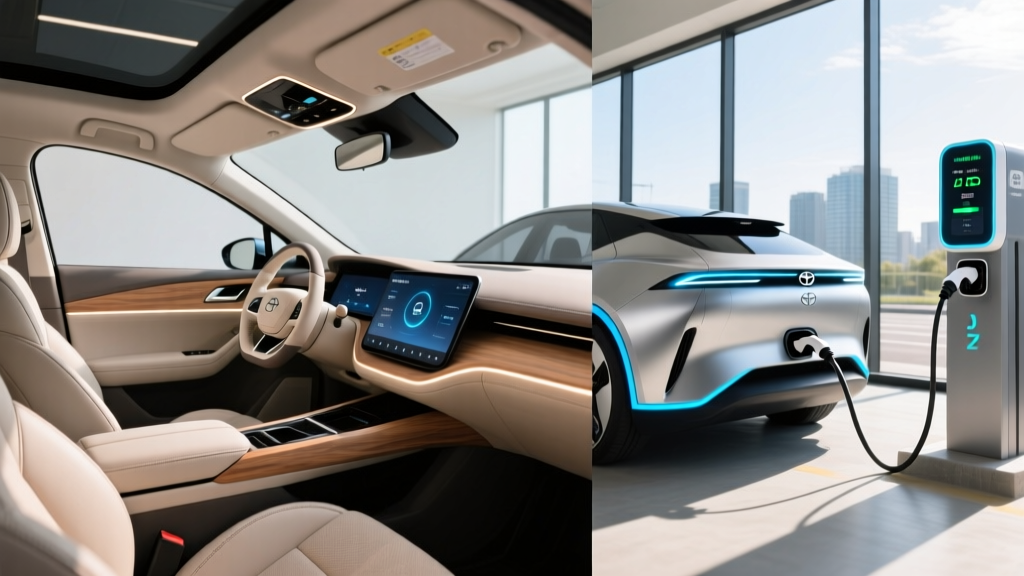
The Toyota bZ interior is where this crossover makes its strongest case for mainstream buyers. Toyota designed the cabin around a "lounge" concept, and the execution delivers a genuinely spacious, airy environment that feels more premium than its price suggests.
Passenger Space and Dimensions
| Dimension | Measurement |
|---|---|
| Front Headroom | 39.9 inches |
| Front Legroom | 42.1 inches |
| Rear Headroom | 38.4 inches |
| Rear Legroom | 38.3 inches |
| Shoulder Room (front) | 56.9 inches |
| Wheelbase | 112.2 inches |
Rear-seat legroom is genuinely generous — the 38.3 inches beats the VW ID.4 and rivals the Ioniq 5. The flat floor (no transmission tunnel) makes the middle seat usable for adults on shorter trips. Seat cushioning is firm but supportive, typical of Toyota's approach, and the available SofTex synthetic leather on upper trims holds up well.
Cargo Volume
Behind the rear seats, you get 27.7 cubic feet of cargo space. Fold the 60/40 split rear seats flat, and that expands to approximately 56.9 cubic feet. These figures are competitive with the ID.4 (30.3 / 64.2 cu ft) but notably less than the Model Y (30.2 / 76.2 cu ft) and the Ioniq 5 (27.2 / 59.3 cu ft).
Notably, the bZ4X does not have a frunk (front trunk). The space under the hood houses electronics and the HVAC system, so all cargo goes in the rear. For families who need maximum utility, this is a meaningful omission versus the Model Y and F-150 Lightning.
Infotainment and Technology
The centerpiece of the bZ interior is a 12.3-inch touchscreen running Toyota's latest multimedia system. Wireless Apple CarPlay and Android Auto are standard across all trims. The system is responsive, with a clean tile-based interface, though it lacks the graphical polish of Tesla's or Hyundai's systems.
Physical controls remain for climate and volume — a welcome choice for drivers who dislike touchscreen-only interfaces. A 7-inch digital instrument cluster sits behind the steering wheel (positioned high, almost head-up-display style, though not a true HUD on base trims). Available features include:
- Qi wireless phone charging pad (front console)
- Heated and ventilated front seats (XLE and up)
- Heated steering wheel
- Panoramic fixed glass roof (available)
- Ambient interior lighting with 64 colors
- Radiant heater (infrared panel for front occupants — a Toyota-first feature that warms legs directly, supplementing cabin heating and reducing HVAC energy draw)
The radiant heater is a clever efficiency feature. By warming occupants directly rather than heating the entire cabin air volume, it reduces battery drain in cold weather — a meaningful range-preservation tool in winter.
Charging Speed: DC Fast and Home Level 2
| Charging Level | Power / Rate | Speed (approx.) |
|---|---|---|
| Level 1 (120V household) | 1.4 kW | ~5 miles per hour |
| Level 2 (240V, 32A) | 6.6 kW | ~25 miles per hour (full charge in ~11 hrs) |
| DC Fast Charge (peak) | 150 kW | 10–80% in ~30 minutes |
| DC Fast Charge (sustained avg.) | ~80–100 kW | Varies by SoC and temperature |
The bZ4X charges at a peak of 150 kW on DC fast chargers via its CCS1 connector (or NACS on newer 2026 builds as Toyota transitions to the Tesla-standard plug). The 10–80% time of approximately 30 minutes is acceptable for road-trip stops but trails the Hyundai Ioniq 5's 800V architecture, which achieves 10–80% in roughly 18 minutes at up to 350 kW.
A critical detail for real-world charging: the bZ4X's charge curve tapers noticeably above 60% SoC. While peak rate is 150 kW near 20–30% SoC, sustained average power during a 10–80% session is closer to 80–100 kW. This means the last 20% (60–80%) takes disproportionately longer. On road trips, plan to charge to 80% and move on rather than waiting for a full top-off.
For home charging, the onboard charger is 6.6 kW. On a 240V/32A Level 2 circuit, you'll add roughly 25 miles of range per hour, meaning an overnight charge (8–10 hours) easily replenishes a full battery. Installation of a Level 2 home charger typically costs $800–$2,000 depending on your electrical panel's capacity — budget for a potential panel upgrade if you have an older 100A service.
Performance and Driving Impressions
The bZ4X is not a performance EV, and Toyota doesn't pretend otherwise. The FWD model delivers 201 horsepower and a 7.1-second 0–60 mph time — adequate for merging and passing but noticeably slower than the Ioniq 5 (5.2 sec RWD) or Model Y (5.0 sec Long Range AWD).
The AWD variant, with dual motors producing 214 hp and 248 lb-ft of torque, drops the 0–60 time to 5.8 seconds. More importantly, the AWD system provides genuine traction confidence in rain and light snow. Toyota's X-MODE traction management system (borrowed from Subaru, their joint-venture partner on this platform) includes hill descent control and snow/mud modes.
Ride quality is compliant and comfortable, prioritized over sportiness. Steering is light and direct, making the bZ4X easy to maneuver in parking lots. Regenerative braking offers adjustable levels via paddle shifters, though the bZ4X does not offer true one-pedal driving (the car won't come to a complete stop on regen alone). Drivers accustomed to one-pedal operation in a Leaf or Model Y will need a brief adjustment period.
Pricing, Trims, and Federal Tax Credit Eligibility
| Trim | MSRP | Est. After §30D Credit* |
|---|---|---|
| XLE FWD | $37,450 | ~$29,950 |
| XLE AWD | $40,950 | ~$33,450 |
| Limited FWD | $43,450 | ~$35,950 |
| Limited AWD | $46,950 | ~$39,450 |
*Federal tax credit estimates assume full eligibility under IRS §30D rules. Actual credit depends on battery component and critical mineral sourcing requirements, buyer income, and MSRP caps. Always verify current eligibility at irs.gov or consult a tax professional.
The bZ4X qualifies for the §30D federal clean vehicle credit (up to $7,500) provided it meets current-year requirements:
- MSRP cap: Must be under $80,000 for SUVs/crossovers — the bZ4X easily clears this at a max of ~$47,000.
- Buyer income cap: Modified AGI must not exceed $150,000 (single), $225,000 (head of household), or $300,000 (joint filers).
- Battery sourcing: A percentage of critical minerals and battery components must be sourced from the U.S. or free-trade-agreement countries. These thresholds increase annually. Toyota has worked to localize supply chains, but the exact partial or full $7,500 qualification can vary by build date and battery batch. Check the fueleconomy.gov tax credit tracker for the specific VIN.
- Point-of-sale transfer: As of 2024+, you can transfer the credit to the dealer at purchase, reducing your out-of-pocket cost immediately rather than waiting for a tax refund.
Safety and Driver Assistance (Toyota Safety Sense 3.0)
Every bZ4X comes equipped with Toyota Safety Sense 3.0, which includes:
- Pre-Collision System with Pedestrian Detection
- Full-Speed Range Dynamic Radar Cruise Control
- Lane Departure Alert with Steering Assist
- Lane Tracing Assist
- Automatic High Beams
- Road Sign Assist
- Proactive Driving Assist (gentle braking when approaching slower vehicles or curves)
The bZ4X earned strong safety ratings, with the IIHS naming it a Top Safety Pick+ in prior model years. Toyota's reputation for long-term reliability extends to the EV powertrain, backed by an industry-leading warranty.
Warranty and Long-Term Ownership
| Coverage | Term |
|---|---|
| Basic (Bumper-to-Bumper) | 3 years / 36,000 miles |
| Powertrain | 5 years / 60,000 miles |
| EV Battery | 8 years / 100,000 miles |
| EV Battery (California-emissions states) | 10 years / 150,000 miles |
| Roadside Assistance | 2 years / 25,000 miles |
The 8-year/100,000-mile battery warranty guarantees that the battery will retain at least 70% of its original capacity during the coverage period. Toyota's historical degradation data on earlier hybrid battery packs suggests the NMC cells in the bZ4X should hold up well under normal use. Expect roughly 5–8% degradation over the first 3–5 years based on industry averages for liquid-cooled NMC packs, though extreme heat and frequent DC fast charging accelerate wear.
For buyers in California and states adopting California emissions standards (including New York, Massachusetts, Colorado, and others), the extended 10-year/150,000-mile battery warranty provides significant additional peace of mind.
Pros and Cons
- Spacious, comfortable cabin with generous rear legroom
- Strong standard safety suite (TSS 3.0)
- 8-year/100,000-mile battery warranty
- Radiant heater improves cold-weather efficiency
- Competitive pricing, especially after tax credit
- Physical climate controls retained
- AWD with X-MODE for light off-road and snow
- Range (228–252 mi) trails Ioniq 5, Model Y, and EV6
- No front trunk (frunk)
- DC charging peaks at 150 kW — slower than 800V rivals
- No true one-pedal driving
- Infotainment lacks wireless phone mirroring on base trims
- Cold-weather range loss significant without preconditioning
- Performance is adequate, not exciting
Who Should Buy the Toyota bZ4X?
Choose the bZ4X if:
- You want a practical, comfortable daily commuter crossover with strong safety features
- You have reliable home Level 2 charging and a daily commute under 80 miles round-trip
- You value Toyota's reliability reputation and long battery warranty
- You live in a moderate climate or have a garage for cold-weather preconditioning
- You prefer physical buttons over touchscreen-only interfaces
Look elsewhere if:
- You regularly take 300+ mile road trips and want maximum range (consider Ioniq 5 Long Range or Model Y)
- You need the fastest DC charging for frequent public-charging road trips
- You want one-pedal driving or sporty acceleration
- You need a frunk or maximum cargo volume for family gear
Frequently Asked Questions
What is the real-world range of the Toyota bZ4X?
In mixed driving at moderate temperatures, expect 215–230 miles from the FWD model (EPA-rated 252 miles). Highway driving at 75 mph reduces this to roughly 210–220 miles. In winter conditions below 30°F, plan for 170–190 miles without preconditioning, or 195–215 miles if you precondition while plugged in.
How fast does the bZ4X charge at home and on the road?
At home on a 240V Level 2 charger (6.6 kW), you add about 25 miles of range per hour, with a full charge taking roughly 11 hours. On DC fast chargers, peak rate is 150 kW, achieving 10–80% in approximately 30 minutes — though sustained average power is closer to 80–100 kW due to charge-curve taper above 60% SoC.
Does the Toyota bZ4X qualify for the $7,500 federal EV tax credit?
The bZ4X is eligible for up to $7,500 under IRS §30D, provided the buyer meets income caps ($150K single / $300K joint), the MSRP is under $80,000 (it is), and the battery meets critical-mineral and component sourcing thresholds. The credit can be transferred to the dealer at point of sale. Verify your specific vehicle's eligibility at fueleconomy.gov or consult a tax professional, as sourcing requirements tighten annually.
Is the Toyota bZ4X worth buying vs. the Hyundai Ioniq 5 or Tesla Model Y?
It depends on your priorities. The Ioniq 5 offers more range (up to 361 miles), faster 800V charging (18 min 10–80%), and a frunk — making it the better road-trip EV. The Model Y offers the most range, the largest Supercharger network, and more cargo space. The bZ4X wins on cabin comfort, standard safety features, Toyota's reliability reputation, and strong value after the tax credit. If your driving is mostly local and you charge at home, the bZ4X is a compelling, comfortable choice.
What is the biggest drawback of the Toyota bZ interior?
The most common criticism is the lack of a frunk, which reduces total cargo versatility. Additionally, the infotainment system, while functional, doesn't match the responsiveness or app ecosystem of Tesla or Hyundai. The high-mounted instrument cluster takes some drivers a few days to adjust to, and the glossy center console attracts fingerprints.
Does the bZ4X have one-pedal driving?
No. The bZ4X offers adjustable regenerative braking via steering-wheel paddles, but it will not come to a complete stop without applying the brake pedal. This differs from the Nissan Leaf, Tesla, and most Hyundai/Kia EVs, which offer true one-pedal operation.
For the latest EPA figures, visit fueleconomy.gov. For tax credit rules, see irs.gov. Safety ratings available at iihs.org and nhtsa.gov.