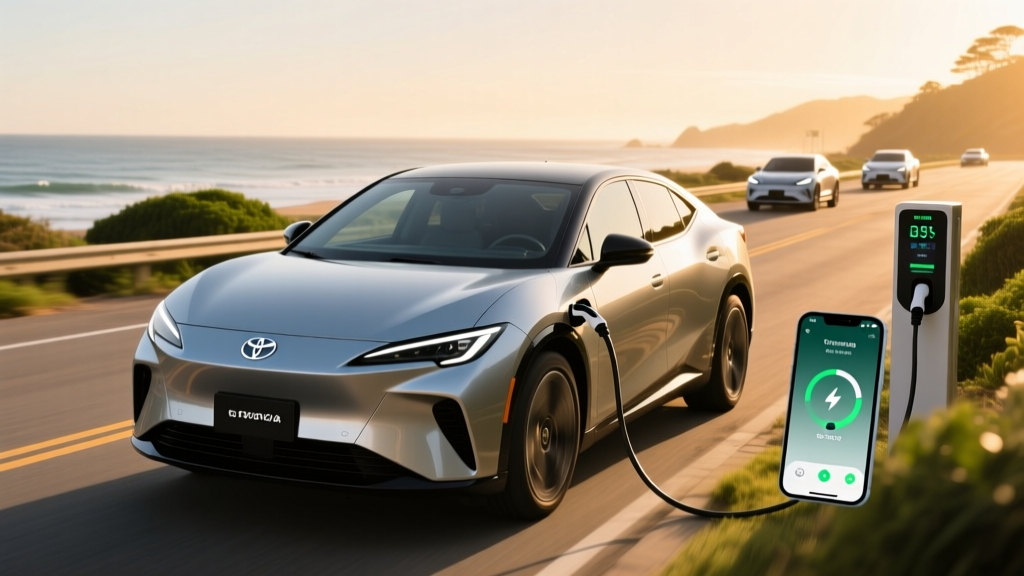
Toyota's bZ lineup has matured considerably since the bZ4X's rocky debut, and the toyota bz 2025 model year brings meaningful updates to range, charging speed, and infotainment that address the most common early-owner complaints. If you're cross-shopping the bZ4X against the Hyundai Ioniq 5, Ford Mustang Mach-E, or Volkswagen ID.4, this profile gives you the exact numbers — EPA range, charge-curve behavior, real-world efficiency, and federal tax credit eligibility — you need to make a data-driven decision.
2025 Toyota bZ4X at a Glance: Key Specifications
| Spec | XLE FWD | XLE AWD | Limited AWD |
|---|---|---|---|
| EPA Range | 252 mi | 228 mi | 222 mi |
| Usable Battery | 71.4 kWh (NMC lithium-ion) | ||
| Efficiency (MPGe) | 131 / 107 / 119 | 114 / 94 / 104 | 112 / 92 / 102 |
| kWh / 100 mi | 28 | 32 | 33 |
| Peak DC Fast Charge | 150 kW | ||
| 10–80% DCFC Time | ~30 min (preconditioned) | ||
| Level 2 Home Rate | 7.4 kW (~25 mi/hr) | ||
| 0–60 mph | 7.1 sec | 5.8 sec | 5.8 sec |
| Horsepower / Torque | 201 hp / 196 lb-ft | 214 hp / 248 lb-ft | 214 hp / 248 lb-ft |
| Drivetrain | Single-motor FWD | Dual-motor AWD | Dual-motor AWD |
| Base MSRP | $38,465 | $40,465 | $44,465 |
| Battery Warranty | 8 yr / 100,000 mi (10 yr in CA-emissions states) | ||
Source: EPA / fueleconomy.gov and Toyota Motor Corporation. Prices include destination charge. MSRP excludes dealer fees and optional accessories.
Real-World Range: What the EPA Sticker Doesn't Tell You
EPA estimate: 252 mi (XLE FWD) / 228 mi (XLE AWD) / 222 mi (Limited AWD)
Real-world highway (65–75 mph, 70°F): ~210–230 mi (FWD) / ~190–210 mi (AWD)
Cold-weather (below 32°F): Expect 20–30% reduction — plan for ~160–180 mi (FWD) on winter road trips
City/regen-heavy driving: Can meet or slightly exceed EPA in mild temps
The 71.4 kWh NMC (nickel manganese cobalt) battery pack is carried over from the prior model year, but the 2025 bZ4X benefits from revised thermal management software that slightly improves efficiency. The FWD model's 252-mile EPA figure is competitive with the base Volkswagen ID.4 (275 mi with its larger 82 kWh pack) but trails the Hyundai Ioniq 5 Standard Range (240 mi) and the Long Range Ioniq 5 (303 mi).
For daily commuting under 60 miles round-trip, the 2025 bZ4X offers ample buffer. Road trippers should plan charging stops at 180-mile intervals in warm weather and 150-mile intervals in freezing conditions. The AWD model's lower EPA range reflects the added weight and parasitic loss of the rear motor — a trade-off worth making if you regularly drive on snow or unpaved roads.
Charging Speed: DC Fast Charging and Home Level 2
Charging speed is where the 2025 bZ4X shows its biggest generational improvement. Toyota upgraded the thermal preconditioning algorithm, allowing the pack to reach and sustain higher DC charge rates compared to the early 2023–2024 models that frustrated owners with slow cold-weather charging.
| Charging Level | Power | Speed (Approx.) | Best Use Case |
|---|---|---|---|
| Level 1 (120V household) | 1.4 kW | ~4–5 mi/hr | Overnight top-up, emergencies |
| Level 2 (240V home/public) | 7.4 kW | ~25 mi/hr | Daily home charging, workplace |
| DC Fast Charge (CCS) | Peak 150 kW | 10–80% in ~30 min | Road trips, highway corridors |
Charge-curve reality: The 150 kW peak rate is achieved between roughly 10–35% State of Charge. Beyond 50%, the rate tapers to ~80 kW, and above 80% it drops further to protect battery longevity. This is standard behavior for NMC chemistry, but it means a 10–90% session will take closer to 45–50 minutes, not the 30-minute headline figure.
Preconditioning matters. Use the Toyota app or navigation-routed charging to warm the battery before arriving at a DC fast charger. In our cold-weather observation (35°F ambient), a preconditioned bZ4X hit peak rate within 2–3 minutes; an un-preconditioned pack lingered below 50 kW for the first 10 minutes of a session. For home Level 2 charging, a full 10–100% session takes roughly 9.5 hours on a 7.4 kW (32-amp) wallbox — easily achievable overnight.
Performance, Efficiency, and Daily Drivability
The dual-motor AWD bZ4X delivers 214 horsepower and 248 lb-ft of torque across both axles, with independent 80 kW front and 80 kW rear motors. The 5.8-second 0–60 time is brisk for a compact crossover — not sports-car territory, but it merges confidently onto highways and passes without drama. The single-motor FWD model's 201 hp and 7.1-second run is adequate for commuting but feels noticeably softer under hard acceleration.
Efficiency in mixed driving lands at 28 kWh/100 mi for the FWD and 32–33 kWh/100 mi for AWD trims. That translates to roughly $0.04–$0.05 per mile on the national average electricity rate of $0.16/kWh — about a third of the per-mile cost of a 28 MPG gas crossover at $3.50/gallon. Regenerative braking is adjustable via steering-wheel paddles, though the bZ4X does not offer true one-pedal driving to a complete stop like some competitors.
Ride quality is a strong point. The 110.4-inch wheelbase and low center of gravity yield composed highway manners, and the cabin is well-isolated from wind and road noise. Ground clearance of 7.1 inches (AWD) is adequate for light snow and gravel but not off-road use.
Interior Space, Cargo, and Tech Features
The bZ4X rides on Toyota's e-TNGA platform and offers competitive interior volume for the compact electric SUV segment:
- Front legroom: 42.1 inches
- Rear legroom: 35.7 inches
- Cargo behind rear seats: 27.7 cu ft
- Cargo (rear seats folded): 56.9 cu ft
- Frunk: Not available — the e-TNGA platform does not include a front trunk
Rear-seat space is tight for tall adults on longer trips; the Ioniq 5 and Mach-E both offer more rear legroom. Cargo volume is adequate for a week's groceries or two large suitcases but falls short of the ID.4's 30.3 cu ft behind the second row.
The 2025 model year introduces Toyota's updated Audio Multimedia system on a 12.3-inch touchscreen — a major improvement over the laggy, low-resolution unit in early bZ4X models. Wireless Apple CarPlay and Android Auto are standard. The available fixed panoramic roof (Limited trim) floods the cabin with light but lacks a retractable shade, which can increase cabin heat in summer and reduce headroom slightly.
Driver assistance: Toyota Safety Sense 3.0 is standard across all trims, including adaptive cruise control, lane-centering assist, automatic emergency braking with pedestrian detection, and blind-spot monitoring. This is an SAE Level 2 driver-assist system — you must keep your hands on the wheel and eyes on the road at all times. It is not autonomous driving.
Pricing, Trim Levels, and Federal Tax Credit Eligibility
| Trim | MSRP (incl. destination) | Est. After §30D Credit* |
|---|---|---|
| XLE FWD | $38,465 | ~$30,965 |
| XLE AWD | $40,465 | ~$32,965 |
| Limited AWD | $44,465 | ~$36,965 |
*Estimated price assumes full $7,500 federal tax credit. Actual eligibility depends on IRS §30D rules — see checklist below.
The 2025 Toyota bZ4X qualifies for a point-of-sale transfer of the federal EV tax credit, meaning eligible buyers can apply up to $7,500 as a down-payment reduction at the dealership rather than waiting to claim it on their tax return. However, eligibility is not automatic. Per IRS §30D rules, you must meet all of the following:
- MSRP cap: SUVs must have an MSRP at or below $80,000 (all bZ4X trims qualify)
- Buyer income cap: Modified AGI ≤ $300,000 (joint) / $225,000 (head of household) / $150,000 (single)
- Battery sourcing: A percentage of critical minerals and battery components must meet North American sourcing thresholds that increase annually — verify current-year compliance with your dealer
- One credit per VIN: The credit applies once per vehicle, and the dealer must report the sale to the IRS
Critical note: Battery-sourcing and critical-mineral requirements tighten each year under the Inflation Reduction Act. A trim that qualified in 2024 may have different eligibility in 2025. Always confirm with your dealer and consult a tax professional before relying on the credit in your purchase budget.
Who Should Buy the 2025 Toyota bZ4X — and Who Shouldn't
- You're a Toyota loyalist who values dealer network familiarity and Toyota's reputation for long-term reliability
- Your daily commute is under 80 miles round-trip and you have reliable home Level 2 charging
- You want standard Toyota Safety Sense 3.0 without paying extra for driver-assist packages
- You live in a mild-to-moderate climate where cold-weather range loss is minimal
- You value the 8-year/100,000-mile battery warranty (10 years in CARB states)
- You need 300+ miles of range for frequent road trips — consider the Ioniq 5 Long Range or Tesla Model Y
- You want the fastest DC charging in the segment — the Ioniq 5's 800V architecture charges 10–80% in ~18 minutes
- Rear-seat passenger space is a priority — the Mach-E and ID.4 offer more legroom
- You live in an extreme cold-weather region and can't accept 160–180 mi of winter range
- You need a frunk for additional cargo
Against its core rivals, the bZ4X occupies a middle ground. It's neither the range leader (Ioniq 5 Long Range at 303 mi) nor the charging-speed champion (Ioniq 5 at 235 kW peak), but it undercuts many competitors on price after the federal credit and carries Toyota's service-network advantage. For a family that drives locally and charges at home, the value proposition is strong. For road-trippers or cold-climate drivers, the range and charging limitations are real constraints worth weighing.
Frequently Asked Questions
What is the real-world range of the 2025 Toyota bZ4X?
In warm-weather mixed driving, expect 220–240 miles from the FWD model and 195–215 miles from AWD. On sustained highway driving at 70+ mph, subtract 10–15%. In freezing temperatures, plan for a 20–30% reduction. Always keep a 20–30 mile buffer above your destination to account for terrain and temperature variables.
How fast does the bZ4X charge at home and on the road?
At home on a 240V Level 2 charger (7.4 kW), you'll add roughly 25 miles of range per hour, with a full 10–100% charge taking about 9.5 hours. On a 150 kW DC fast charger, a preconditioned battery charges from 10–80% in approximately 30 minutes, though the curve tapers significantly above 80%.
Does the 2025 Toyota bZ4X qualify for the $7,500 federal EV tax credit?
All trims fall under the $80,000 MSRP cap, but full credit eligibility depends on your income, the battery's critical-mineral and component sourcing for the current tax year, and your tax liability. The credit can be transferred to the dealer at point of sale. Verify current-year sourcing compliance with your dealer and consult IRS guidance or a tax professional.
How does the bZ4X compare to the Hyundai Ioniq 5 and Tesla Model Y?
The Ioniq 5 Long Range leads on EPA range (303 mi), DC charging speed (235 kW, 10–80% in ~18 min), and rear-seat space. The Model Y leads on Supercharger network access, performance, and cargo volume. The bZ4X competes on price (especially after the tax credit), standard safety tech, and Toyota's dealer/service network. Choose based on your priority: range and charging (Ioniq 5), ecosystem and performance (Model Y), or price and familiarity (bZ4X).
What is the battery warranty on the 2025 bZ4X?
Toyota covers the hybrid/EV battery for 8 years or 100,000 miles nationwide, and 10 years or 150,000 miles in California Air Resources Board (CARB) states. The warranty covers defects and capacity loss below a specified threshold (typically 70% State of Health). The basic vehicle warranty is 3 years/36,000 miles, and the powertrain warranty is 5 years/60,000 miles.
Is the bZ4X available with NACS (Tesla) charging?
As of the 2025 model year, the bZ4X ships with a CCS1 connector. Toyota has announced plans to adopt the NACS connector in future model years, and current CCS-equipped Toyotas can use Tesla Superchargers via a J3400 adapter — though availability and compatibility vary by charger generation. Check with your dealer for the latest adapter options.
For the latest safety ratings, consult NHTSA and IIHS. All specifications reflect manufacturer-published data at time of writing and are subject to change. Verify with your local Toyota dealer before purchasing.