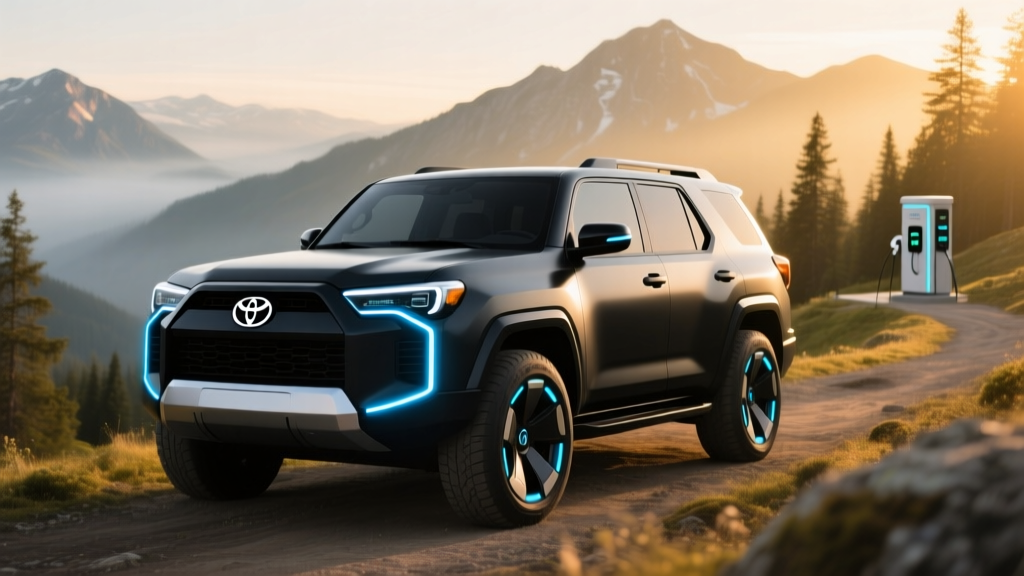
The Short Answer: No Fully Electric 4Runner Exists Yet
As of the 2026 model year, Toyota does not offer a battery-electric (BEV) 4Runner. There is no Toyota 4Runner electric vehicle on sale, and Toyota has not officially announced a zero-emission 4Runner with a firm production date. What Toyota does sell is the sixth-generation 4Runner with an i-FORCE MAX hybrid powertrain — a traditional parallel hybrid (HEV), not a plug-in. It pairs a 2.4-liter turbocharged four-cylinder with a small electric motor integrated into the transmission, delivering 326 horsepower and 465 lb-ft of torque while achieving an EPA-estimated 23 MPG combined. If you need a true plug-in or battery-electric Toyota SUV today, the closest options are the RAV4 Prime (PHEV) or the bZ4X (BEV), neither of which matches the 4Runner's body-on-frame off-road capability.
What Toyota Actually Offers: The 2026 4Runner Powertrain Lineup
The sixth-generation 4Runner, introduced for the 2025 model year and continuing into 2026, rides on Toyota's TNGA-F body-on-frame platform — the same architecture underpinning the Tacoma, Land Cruiser, and Sequoia. Buyers get two powertrain choices:
| Spec | i-FORCE (Gas Turbo) | i-FORCE MAX (Hybrid) |
|---|---|---|
| Engine | 2.4L turbo I4 | 2.4L turbo I4 + electric motor |
| Horsepower | 278 hp | 326 hp |
| Torque | 317 lb-ft | 465 lb-ft |
| Transmission | 8-speed automatic | 8-speed automatic |
| EPA Combined MPG | ~21 MPG | ~23 MPG |
| Drivetrain | RWD / 4WD | RWD / 4WD |
| Towing Capacity | Up to 6,000 lbs | Up to 6,000 lbs |
| Hybrid Battery | None | 1.87 kWh NiMH (not plug-in) |
| Electric-Only Driving | No | Minimal (low-speed assist only) |
The i-FORCE MAX hybrid is a self-charging hybrid, meaning it recovers energy through regenerative braking and the engine — you never plug it in. The 1.87 kWh nickel-metal hydride battery is far too small for meaningful electric-only range. Think of it as a torque-boost and efficiency-improvement system rather than an electrified drivetrain in the way most EV buyers think about the term.
Why No Electric 4Runner Yet? The Platform Challenge
Toyota's TNGA-F platform was engineered primarily for internal combustion and hybrid powertrains. Converting a body-on-frame off-roader to battery-electric involves fundamental engineering trade-offs:
- Weight: A body-on-frame SUV with serious off-road hardware already weighs over 4,600 lbs. Adding a 100+ kWh battery pack for 300+ miles of range could push curb weight past 5,500 lbs, degrading off-road dynamics and tire wear.
- Off-road durability: Battery packs mounted low on a chassis must survive rock strikes, deep water fording, and extreme articulation — a harder engineering problem than in a crossover BEV.
- Towing range penalty: BEVs lose 40-50% of range when towing. A 4Runner rated for 6,000 lbs would see its range crater on a trailer haul, undermining one of its core use cases.
- Market positioning: Toyota has prioritized BEV investment in higher-volume segments (bZ4X, upcoming bZ SUV lineup) and kept hybrid tech for its truck/SUV lineup where range flexibility matters most.
Toyota's stated strategy, as outlined in its multi-pathway electrification plan, keeps HEVs, PHEVs, hydrogen fuel cells, and BEVs all in development. The company has signaled that body-on-frame models like the Tacoma and 4Runner will likely receive plug-in hybrid variants before going fully electric — similar to the approach taken with the Tacoma's expected PHEV variant.
Cost Comparison: 4Runner Hybrid vs. a Hypothetical 4Runner EV
Since no electric 4Runner exists, let's model what ownership would look like comparing the real i-FORCE MAX hybrid against a theoretical 4Runner BEV with similar capability — and against a gas-only competitor.
| Cost Category | 4Runner i-FORCE MAX (HEV) | Hypothetical 4Runner BEV | Jeep Wrangler 4xe (PHEV) |
|---|---|---|---|
| Base MSRP (est.) | $52,000 | $60,000 (projected) | $51,795 |
| Federal Tax Credit (§30D) | $0 (not plug-in) | Up to $7,500* | Up to $3,750* |
| Annual Fuel/Energy Cost | ~$2,600 (gas) | ~$850 (home charging) | ~$1,600 (gas + electric) |
| 5-Year Fuel Total | $13,000 | $4,250 | $8,000 |
| 5-Year Maintenance | ~$3,500 | ~$1,800 | ~$3,800 |
| Estimated Insurance (5yr) | ~$9,500 | ~$10,500 | ~$9,800 |
| 5-Year Total (excl. depreciation) | $78,000 | $69,050 | $73,395 |
*Federal tax credit eligibility under IRS §30D depends on MSRP caps ($80,000 for SUVs), buyer income limits ($300K joint / $150K single), battery critical-mineral sourcing, and North American assembly. Verify current-year rules before purchasing. Credits shown are maximum possible; actual amounts vary by trim and buyer.
The hypothetical BEV saves roughly $8,750 over five years in fuel and maintenance, but that assumes reliable home Level 2 charging access and doesn't account for potentially steeper BEV depreciation in the truck/SUV segment. For buyers without home charging, public DC fast-charging costs ($0.35-$0.50/kWh at networks like Electrify America) would push the BEV energy cost closer to $1,400-$1,800/year, narrowing the gap significantly.
Real Alternatives: What to Buy If You Want an Electrified 4Runner-Type SUV
Decision Framework: Which Electrified SUV Fits Your Needs?
Choose the Toyota 4Runner i-FORCE MAX (HEV) if:
- You need genuine body-on-frame off-road capability (locking differentials, crawl control, multi-terrain select)
- You tow regularly (up to 6,000 lbs)
- You lack home charging access and can't rely on public infrastructure
- You want Toyota's hybrid reliability track record with no range-anxiety compromise
- Your annual mileage is moderate (under 15,000 miles), minimizing the fuel-cost penalty
Choose the Jeep Wrangler 4xe (PHEV) if:
- You want some electric-only driving (EPA-estimated 21 miles electric range)
- You have home Level 2 charging and a commute under 20 miles
- You want removable doors/roof and serious Trail Rated off-road chops
- You're willing to accept higher complexity (two powertrains to maintain long-term)
Choose the Rivian R1S (BEV) if:
- You want zero tailpipe emissions and instant electric torque for off-roading
- You can install a home Level 2 charger (240V/48A recommended)
- Your budget accommodates a $75,000+ starting price (before potential credits)
- You prioritize acceleration (0-60 in ~3.5 seconds for dual-motor) over traditional SUV feel
- You're comfortable with a startup brand and its service network limitations
Choose the Toyota RAV4 Prime (PHEV) if:
- You want Toyota reliability with genuine plug-in capability (42 miles EPA electric range)
- You don't need body-on-frame construction or extreme off-road ability
- You want the best fuel economy in the group (94 MPGe combined on electric, 38 MPG gas-only)
- Your budget is closer to $44,000-$48,000
Common Misconceptions About a 4Runner EV
| Myth | Fact |
|---|---|
| "The 4Runner hybrid is a plug-in you can charge at home." | The i-FORCE MAX is a conventional (non-plug-in) hybrid. It has no charging port and no meaningful electric-only range. It self-charges via regen braking and the engine. |
| "Toyota is releasing a 4Runner EV in 2026." | As of early 2026, Toyota has made no official announcement of a battery-electric 4Runner with a confirmed production date. Rumors circulate, but nothing is on the order books. |
| "An electric 4Runner would be worse off-road." | Not necessarily. EVs offer instant torque at zero RPM, precise individual-wheel torque vectoring, and a low center of gravity. The Rivian R1S and Hummer EV demonstrate strong off-road capability. The challenge is underbody battery protection and range while crawling. |
| "The hybrid 4Runner qualifies for the $7,500 federal EV tax credit." | It does not. IRS §30D credits apply only to plug-in electric vehicles (BEVs and PHEVs) meeting battery-sourcing and assembly requirements. Conventional HEVs are ineligible. Check IRS guidelines for current rules. |
| "I should wait for the electric 4Runner before buying." | With no confirmed timeline, waiting could mean 3-5+ years. If you need a 4Runner now, the i-FORCE MAX hybrid offers meaningful torque and efficiency gains over the base turbo with no charging dependency. |
What First-Time EV Buyers Should Know (If You're Cross-Shopping)
If the search for a Toyota 4Runner electric vehicle has you considering EVs for the first time, here are the practical realities that spec sheets don't always highlight:
Home charging is the foundation. Roughly 80% of EV charging happens at home. A Level 2 home charger (240V, 32-48 amps) adds 25-35 miles of range per hour and costs $500-$2,000 to install, depending on whether your electrical panel needs an upgrade. Without home charging, EV ownership becomes significantly less convenient and more expensive per mile.
EPA range overstates real-world highway driving. Expect 10-15% less range at sustained 70-80 mph highway speeds compared to the EPA sticker. In cold weather (below 30°F), range can drop 20-30% due to battery chemistry limitations and cabin heating demands. A 300-mile EPA-rated BEV may deliver 210-240 real-world miles in winter highway conditions.
DC fast charging slows above 80%. Manufacturers quote peak charge rates (e.g., 250 kW), but that rate only holds between roughly 10-50% state of charge. Above 80%, charging slows dramatically to protect the battery. A "10-80% in 20 minutes" claim may become 80-100% in another 25 minutes. Plan road-trip stops to charge only to 80% unless you need the full battery.
kW vs. kWh — know the difference. Kilowatts (kW) measure power — how fast energy flows during charging. Kilowatt-hours (kWh) measure energy — the total capacity of the battery. A 100 kWh battery charging at 150 kW will not fill in 40 minutes because the charge rate tapers. Think of kW as the hose diameter and kWh as the bucket size.
Insurance costs more for BEVs. According to industry data, EV insurance premiums run 15-25% higher than comparable gas vehicles due to higher repair costs (specialized parts, battery replacement risk, and fewer qualified body shops). Get quotes before purchasing.
Bottom Line: What Should You Do?
The Toyota 4Runner electric vehicle doesn't exist yet, and Toyota hasn't committed to a timeline. The 2026 4Runner i-FORCE MAX hybrid is a capable, torque-rich SUV that improves fuel economy modestly over the gas-only model while preserving the off-road and towing capability the 4Runner name demands. If electrification is a priority for your next SUV purchase, the Rivian R1S, Jeep Wrangler 4xe, or Toyota RAV4 Prime each offer varying degrees of plug-in capability — but none perfectly replicate the 4Runner's combination of price, body-on-frame durability, and Toyota dealership network coverage.
For buyers who want to stay in the Toyota family and reduce fuel consumption without changing their driving habits, the i-FORCE MAX is the pragmatic choice today. Keep watching Toyota's announcements for a potential Tacoma PHEV or next-generation 4Runner plug-in — those would signal the direction the 4Runner will eventually follow.
Will Toyota make an all-electric 4Runner?
Toyota has not announced a battery-electric 4Runner as of early 2026. The company's multi-pathway strategy suggests that a plug-in hybrid 4Runner is more likely in the near term than a full BEV, following the expected trajectory of the Tacoma lineup. Toyota's body-on-frame models have been the slowest to electrify due to towing, off-road, and range requirements.
Does the 2026 4Runner hybrid need to be plugged in?
No. The i-FORCE MAX is a conventional parallel hybrid (HEV), not a plug-in hybrid (PHEV). It charges its small 1.87 kWh battery through regenerative braking and the gasoline engine. There is no charging port and no electric-only driving mode beyond minimal low-speed assist.
How much does the 2026 4Runner i-FORCE MAX cost?
The i-FORCE MAX hybrid powertrain is available on SR5 i-FORCE MAX and higher trims, with pricing starting around $52,000 and reaching $63,000+ for a fully loaded TRD Pro. As a conventional hybrid, it does not qualify for the federal §30D plug-in vehicle tax credit.
What Toyota SUVs are available as plug-in or electric?
As of 2026, Toyota offers the RAV4 Prime as a plug-in hybrid (42 miles EPA electric range, 94 MPGe) and the bZ4X as a battery-electric SUV (EPA range up to 252 miles, 114 MPGe). Neither is body-on-frame or offers the off-road capability of the 4Runner. The upcoming bZ large SUV (three-row, expected late 2026 or 2027) may bridge some of that gap but remains unconfirmed for final specs.
Is a hybrid 4Runner worth the premium over the gas model?
The i-FORCE MAX adds roughly $2,000-$3,000 over equivalent gas-only trims and delivers a 2 MPG combined improvement plus a significant torque increase (465 vs. 317 lb-ft). For towing and off-road crawling, the extra low-end torque is immediately noticeable. The fuel savings alone won't pay back the premium quickly — at 15,000 miles/year and $3.50/gallon, you'd save roughly $250/year. The upgrade is worth it for the performance benefit more than the efficiency gain. Source: fueleconomy.gov.