Why "Totaled Tesla" Searches Are Surging in 2026
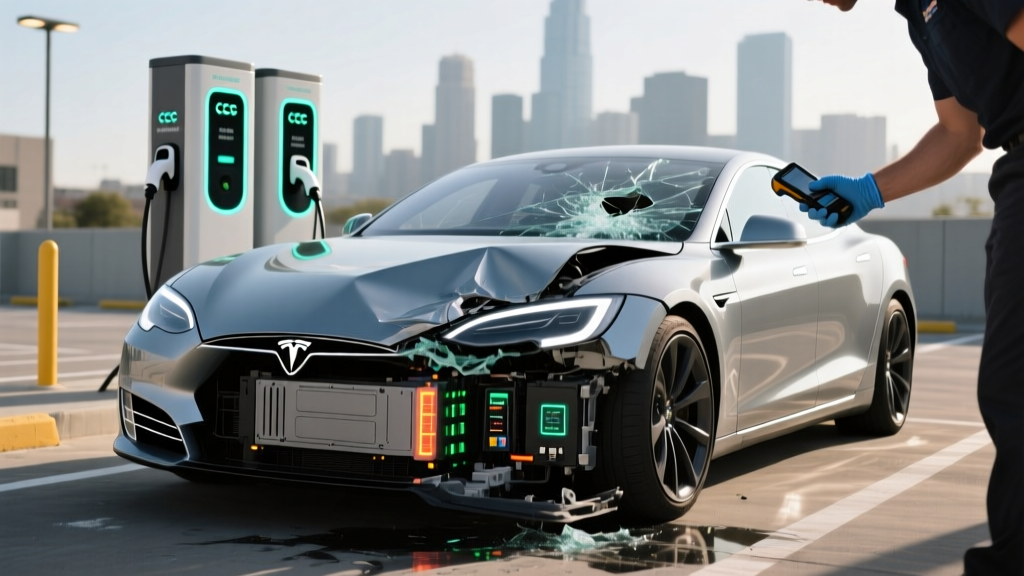
Searches for totaled Tesla have climbed steadily as the fleet ages, insurance carriers tighten EV write-off thresholds, and salvage-title Teslas flood auction sites like Copart and IAAI. A Tesla is declared a total loss when repair costs approach or exceed its actual cash value (ACV) — and because EV repair bills are often 20-30% higher than comparable ICE vehicles (driven by high-voltage safety protocols, proprietary structural battery packs, and aluminum-intensive bodies), the total-loss threshold is hit more often than owners expect.
This guide breaks down the mechanical, financial, and regulatory realities of a totaled Tesla in 2026: what insurers actually do with a wrecked Model 3, Model Y, Model S, or Model X; why a minor-looking fender-bender can trigger a write-off; what happens to the 4680 or LFP battery pack; and whether buying a salvage-title Tesla is ever a smart move.
What Actually Triggers a Total-Loss Declaration on a Tesla
Each state sets its own total-loss threshold — typically 70% to 100% of ACV. In states like Texas (100% threshold) a car must cost more than its full value to repair, while in states like Florida (80%) or Indiana (70%), a moderate collision can push a Tesla over the line quickly.
Tesla-specific factors that accelerate total-loss decisions:
- Structural battery pack: On Model Y (and refreshed Model 3 Highland), the 4680 structural pack is bonded to the unibody. Damage to the pack enclosure or shear points often mandates full replacement — a $16,000–$22,000 line item.
- High-voltage safety teardown: Any intrusion near the orange HV cabling requires certified Tesla-approved body shops to de-energize, inspect, and re-certify the system — adding $3,000–$6,000 in labor before a single panel is replaced.
- Gigacastings: Single-piece front and rear megacastings on Model Y mean rear-end damage that would be a $4,000 repair on a bolted-subframe SUV becomes a $14,000+ structural replacement on a Tesla.
- Parts availability: Tesla's direct-to-consumer parts channel can extend cycle times 4-8 weeks, pushing storage and rental-car costs high enough to tip the ACV math.
According to IIHS repairability studies, Teslas consistently rank among the most expensive vehicles to repair after moderate overlap crashes — a key reason insurers total them at lower damage thresholds than legacy OEMs.
The 2026 Tesla Lineup at a Glance: What's on the Road Getting Totaled
Before assessing a totaled Tesla, it helps to know what you're actually looking at. Here are the current-production 2026 specs that drive ACV and repair decisions:
| Model | EPA Range | Battery (kWh / Chemistry) | Peak DC Charge kW | 10-80% Time | 0-60 mph | Base MSRP |
|---|---|---|---|---|---|---|
| Model 3 RWD | 363 mi | ~60 kWh LFP | 170 kW | ~30 min | 5.8 s | $44,130 |
| Model 3 Long Range AWD | 430 mi | ~75 kWh NMC | 250 kW | ~25 min | 4.2 s | $51,130 |
| Model Y Long Range AWD | 330 mi | ~82 kWh NMC | 250 kW | ~25 min | 4.8 s | $52,630 |
| Model S LR | 402 mi | ~100 kWh NMC | 250 kW | ~30 min | 3.1 s | $84,130 |
| Model X LR | 348 mi | ~100 kWh NMC | 250 kW | ~32 min | 3.8 s | $89,130 |
Insurance Payouts: How Carriers Value a Totaled Tesla
Most carriers use CCC One, Mitchell, or Audatex to calculate ACV based on regional comparable sales, mileage, condition, and optional equipment (FSD, Acceleration Boost, wraps). Three 2026-specific dynamics skew Tesla ACV:
- Depreciation reset: Tesla's aggressive 2023-2024 price cuts cratered used values, meaning a 2022 Model Y LR that cost $67,000 new may ACV at $32,000-$36,000 today — making even $26,000 in repairs a total loss.
- FSD transferability: Tesla occasionally allows FSD (Supervised) transfers during promotional windows, but as of 2026 the $8,000 option is typically non-transferable at total loss — insurers usually add only $2,000-$3,000 of FSD value to ACV.
- Salvage-title stigma: A rebuilt-title Tesla trades at 45-60% of clean-title value, so the insurer's recovery from selling the wreck to Copart (often $8,000-$14,000 for a repairable Model Y) offsets the payout.
Typical 2026 ACV Ranges by Model (Clean Title, Avg. Miles)
| Model | 2022 MY | 2024 MY | 2025 MY |
|---|---|---|---|
| Model 3 RWD | $22k–$26k | $30k–$34k | $36k–$40k |
| Model 3 LR | $27k–$32k | $36k–$41k | $42k–$47k |
| Model Y LR | $28k–$33k | $38k–$43k | $44k–$49k |
| Model S LR | $48k–$56k | $68k–$76k | $78k–$84k |
The Battery Question: What Happens to the Pack After a Total Loss
The traction battery is the single most valuable component on a totaled Tesla — often 35-50% of the vehicle's residual value. Post-crash handling follows strict protocols:
- Undamaged packs: Removed by certified recyclers (Redwood Materials, Li-Cycle, Cirba Solutions) and either re-certified for Tesla's reman program or resold to independent EV shops for $10,000-$18,000.
- Compromised packs: Any thermal-event history, coolant intrusion, or cell deformation triggers hazmat handling under DOT rules. These packs are shredded for black-mass recovery — nickel, cobalt, lithium, and copper.
- LFP vs NMC salvage value: NMC packs command higher recycling payouts (nickel/cobalt content), while LFP packs are increasingly reused in stationary storage because their degradation curve is flatter.
Tesla's standard battery warranty — 8 years/100,000 miles for Model 3 RWD, 8 years/120,000 miles for LR trims, 8 years/150,000 miles for Model S/X with a 70% capacity retention floor — is voided by a salvage title. This is the single biggest ownership consequence of buying a rebuilt Tesla.
Buying a Salvage-Title Tesla: The 2026 Risk Matrix
Auction sites list thousands of totaled Teslas monthly. Before bidding, understand what you're inheriting:
Potential Upsides
- 30-50% discount vs clean-title equivalent
- Repairable cosmetic damage on otherwise sound drivetrains
- Cheap donor cars for independent shops needing parts
- Off-grid / stationary battery conversions
Real Risks
- Zero factory battery / drivetrain warranty
- Tesla may disable Supercharger access on flood-damaged or rebuilt titles
- FSD (Supervised) rarely transfers; Autopilot basic functions remain
- Insurance for a rebuilt title is limited (liability only at most carriers)
- No federal §30D tax credit eligibility on used rebuilt-title purchases
- Resale pool shrinks to ~15% of normal buyer audience
Tesla's official position, documented in their support articles, is that vehicles with salvage or rebuilt titles are ineligible for Supercharger network access if the total-loss designation stemmed from flood, fire, or HV-system damage. In practice, many cosmetic-rebuild owners report Supercharger access remaining active — but this is not guaranteed and Tesla has revoked access post-facto in documented cases.
Tax-Credit Implications When Your Tesla Gets Totaled
If you claimed the federal §30D clean vehicle credit on a Tesla that was later totaled, the IRS does not claw back the credit — it was valid at point of sale. However, there are downstream considerations:
- Replacement vehicle: The §30D credit is per-VIN, per-buyer (once every 3 years for new EVs under 2026 rules). If you claimed it on your totaled Tesla, you must wait out the 3-year window before claiming again on a new EV.
- Used EV credit (§25E): Up to $4,000 / 30% on used EVs under $25,000 — but rebuilt-title vehicles are generally excluded because dealers cannot certify battery sourcing and MSRP-cap rules.
- Insurance payout taxation: Payouts are not taxable income unless they exceed your cost basis (rare, given depreciation).
Current §30D eligibility rules for a new replacement Tesla (per IRS.gov §30D guidance):
- Buyer AGI caps: $150k single / $225k HOH / $300k MFJ
- MSRP caps: $55,000 sedans (Model 3), $80,000 SUVs/trucks (Model Y, X)
- Battery critical-minerals and North-American-assembly sourcing requirements — as of 2026, most U.S.-built Model 3/Y trims qualify for the full $7,500, but always confirm via the IRS VIN-lookup tool at purchase
- Point-of-sale transfer to the dealer is allowed, reducing out-of-pocket cost
Should You Repair, Replace, or Walk Away? A Decision Framework
When an insurer offers a total-loss settlement, you typically have three paths:
- Accept the payout and surrender the title: Cleanest path. Carrier sells the wreck to salvage; you take the ACV check and buy a replacement. Best when ACV is close to current used-market pricing.
- Owner-retain the salvage: You keep the wrecked Tesla, receive ACV minus salvage value (often $8k-$14k less), and repair it yourself or at an independent shop. Only sensible if you have a trusted EV body shop and can live without factory warranty and potentially without Supercharger access.
- Dispute the ACV: Use CCC market-scan reports, recent Autolist/CarGurus comps, and documented upgrades (PPF, FSD, wheels) to negotiate. Successful disputes add $2,000-$5,000 in 60% of cases per consumer-advocacy data.
FAQ: Totaled Tesla Questions Answered
Can a Tesla be repaired after being declared a total loss?
Yes, but only if you owner-retain the salvage title, complete repairs at a certified shop, pass a state salvage inspection, and register it as "rebuilt." Expect 40-50% lower resale value, no factory warranty, and potentially restricted Supercharger access.
Does Tesla still honor warranty on a rebuilt-title car?
No. Tesla's new-vehicle, battery, and drive-unit warranties are voided by a salvage or rebuilt title. Some third-party warranty companies offer limited EV powertrain coverage for rebuilt titles, but exclusions are extensive.
Will a flood-totaled Tesla ever be safe to drive?
Generally no. Saltwater intrusion into HV components causes latent corrosion and thermal-event risk months or years later. Tesla explicitly disables Supercharger access on flood-branded VINs, and most reputable shops refuse to certify them.
How long does a Tesla insurance payout take in 2026?
Typical timeline: 7-14 days from total-loss declaration to payment if there's no lienholder; 14-28 days with a lender involved. Storage fees at Tesla-approved body shops can exceed $100/day, so moving quickly matters.
Does my insurance premium go up after a total-loss claim on a Tesla?
Yes, in most states. A total-loss at-fault claim typically increases premiums 25-45% for 3-5 years. Tesla's own insurance product (where available) uses real-time driving data and may be more forgiving for a single claim.
Can I buy a totaled Tesla from Copart and register it?
Yes in most states, after repair and a salvage inspection. Some states (notably Massachusetts and parts of New York) have stricter rebuilt-title rules that make registration difficult. Always check your state DMV before bidding.
The Bottom Line on Totaled Teslas in 2026
A totaled Tesla is rarely the financial catastrophe owners fear — insurance payouts generally reflect real market values, and the federal tax credit you claimed at purchase stays yours. The real risk is on the buy side: salvage-title Teslas look like bargains but carry voided warranties, uncertain Supercharger access, and a tiny resale pool. Unless you're a skilled EV technician or buying strictly for parts/stationary storage, the math almost always favors taking the insurance check and starting fresh with a clean-title, §30D-eligible replacement. For the latest state-specific total-loss thresholds, check the NHTSA and your state's DOI portal before making any retention decision.