The Tesla Model 3 at Its Fastest: A 2025 Speed and Performance Profile
Search for "top speed Tesla Model 3" and you'll find a surprising spread of answers — 149 mph for the Long Range RWD, 162 mph for the Performance AWD. But top speed is only one axis of what makes a performance EV compelling. This profile breaks down the 2025 Tesla Model 3 lineup across every metric that matters to a buyer: real-world range, DC fast-charging curves, battery chemistry, total cost after the §30D federal tax credit, and whether the Performance trim's $54,990 sticker actually delivers proportional value over the Long Range.
Tesla refreshed the Model 3 for the 2024 model year (internally dubbed "Highland") and carries those updates into 2025 with a new Long Range RWD trim, ventilated seats, and a rear touchscreen. The platform remains the same aluminum-intensive sedan architecture, but the refinements are meaningful: improved NVH, a faster 15.4-inch front display, and subtle efficiency gains that push the Long Range AWD past 340 miles EPA.
Spec Table: Every 2025 Model 3 Trim at a Glance
| Spec | Long Range RWD | Long Range AWD | Performance AWD |
|---|---|---|---|
| Base MSRP | $44,130 | $47,130 | $54,990 |
| Top Speed | 149 mph | 149 mph | 163 mph |
| 0–60 mph | 4.9 sec | 4.2 sec | 2.9 sec |
| Horsepower | ~315 hp | ~384 hp | ~510 hp |
| Drivetrain | RWD (single motor) | AWD (dual motor) | AWD (dual motor) |
| EPA Range | 363 mi | 341 mi | 315 mi |
| Battery (usable) | ~79 kWh (NMC) | ~79 kWh (NMC) | ~79 kWh (NMC) |
| Max DC Fast Charge | 250 kW | 250 kW | 250 kW |
| 10–80% DCFC Time | ~25 min | ~25 min | ~25 min |
| Level 2 Rate (11.5 kW) | ~44 mi/hr | ~44 mi/hr | ~44 mi/hr |
| MPGe (combined) | 134 MPGe | 125 MPGe | 119 MPGe |
| Efficiency | 25 kWh/100 mi | 27 kWh/100 mi | 29 kWh/100 mi |
| Battery Warranty | 8 yr / 120,000 mi | 8 yr / 120,000 mi | 8 yr / 120,000 mi |
Sources: fueleconomy.gov, Tesla spec sheets. Prices include $1,390 destination. Long Range RWD uses 18" wheels; AWD uses 18" for max range.
Real-World Range vs. the EPA Sticker
The gap between EPA and reality comes down to testing cycles: EPA range uses a mix of city regenerative braking and moderate highway speeds. Sustained 80 mph interstate driving — the scenario that causes range anxiety on road trips — consumes energy faster because aerodynamic drag scales with the square of velocity. Tesla's heat pump, standard on all 2025 Model 3 trims, mitigates cold-weather cabin heating draw significantly compared to resistive heaters, but battery chemistry still loses kinetic activity in the cold, reducing accessible capacity temporarily.
For daily commuting under 60 miles round-trip, even the Performance trim's real-world range is a non-issue. For road trips, the practical rule is to plan stops at ~200-mile intervals, which keeps you in the 20–80% state-of-charge sweet spot where DC fast charging is fastest.
Charging Speed: DC Fast, Level 2, and the 80% Taper
| Charging Level | Power | Miles Added per Hour | Notes |
|---|---|---|---|
| Level 1 (120V household) | ~1.4 kW | ~5 mi/hr | Emergency/overnight trickle only |
| Level 2 (240V, 48A) | 11.5 kW | ~44 mi/hr | Full charge in ~7–8 hours |
| DC Fast (V3 Supercharger) | Peak 250 kW | ~175 mi in 15 min | 10–80% in ~25 min; tapers sharply above 80% |
| DC Fast (V4 Supercharger) | Peak 250 kW (cab) | Similar to V3 | Newer cabinet, same vehicle-side limit |
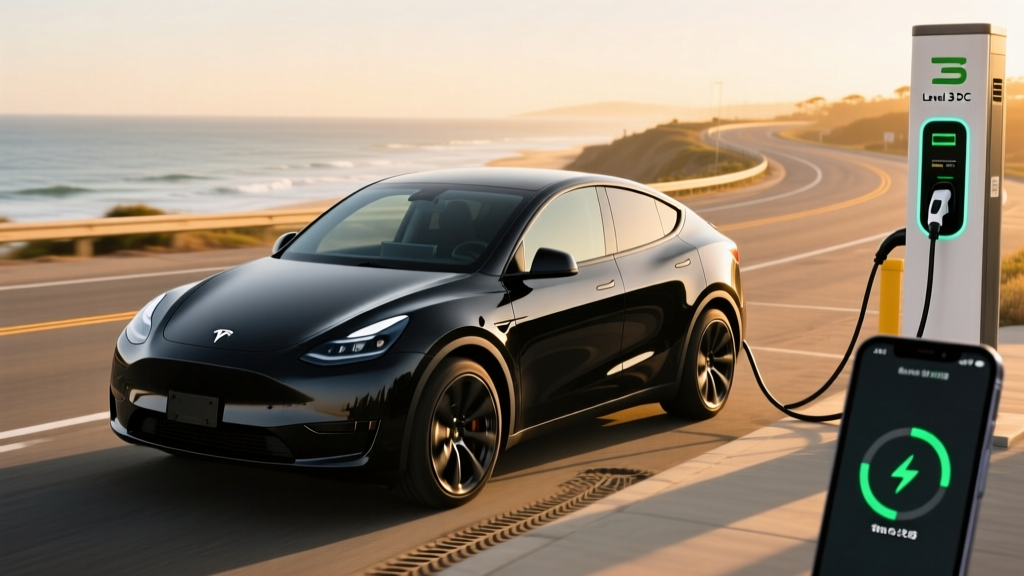
All 2025 Model 3 trims peak at 250 kW on a V3 or V4 Supercharger, but that peak only holds between roughly 10% and 35% state of charge. By 50% SoC, the rate has tapered to ~150 kW; by 80%, it drops below 60 kW. This charge-curve taper is why Tesla's navigation system recommends stopping at 80% on road trips — charging from 80% to 100% can take nearly as long as 10% to 80%.
The Model 3 still uses the Tesla (NACS) connector natively. With the broader Supercharger network now open to other brands via Magic Dock adapters, Tesla owners retain the advantage of the most reliable and dense DC fast-charging network in the U.S., consistently showing 95%+ station uptime according to third-party audits.
For home charging, a 48-amp Level 2 wall connector on a 60-amp circuit delivers 11.5 kW, replenishing the full ~79 kWh battery overnight. Installation typically runs $800–$2,000 depending on panel proximity and local permit fees. If your home has a 200-amp panel with spare capacity, this is straightforward; older 100-amp panels may require a $1,500–$3,000 upgrade.
Battery Chemistry, Degradation, and Warranty
The 2025 Model 3 Long Range and Performance trims use NMC (nickel-manganese-cobalt) lithium-ion cells in a ~79 kWh usable pack. Tesla does not publish exact cell supplier details for every batch, but Panasonic and LG Energy Solution remain primary suppliers for U.S.-built Long Range and Performance vehicles. (The discontinued Standard Range RWD previously used LFP chemistry, which tolerates daily 100% charging better but offers lower energy density.)
Tesla's battery warranty covers 8 years or 120,000 miles (whichever comes first) with a minimum 70% capacity retention threshold. Real-world degradation data aggregated from TeslaFi fleets shows typical NMC packs losing roughly 5–8% capacity in the first 50,000 miles, then degrading more slowly. At 150,000 miles, most Model 3 packs retain 85–90% of original capacity — well above the warranty floor.
Out-of-warranty battery replacement for a Model 3 Long Range currently runs $12,000–$16,000 at Tesla service centers, including labor. That figure has declined from $20,000+ estimates in 2020 as cell costs have fallen and refurbished packs become available.
Pricing, Tax Credits, and the Real Cost to Buy
| Trim | MSRP (incl. dest.) | §30D Credit | Effective Price |
|---|---|---|---|
| Long Range RWD | $44,130 | Up to $7,500 | ~$36,630 |
| Long Range AWD | $47,130 | Up to $7,500 | ~$39,630 |
| Performance AWD | $54,990 | Up to $7,500 | ~$47,490 |
The IRS §30D clean vehicle credit offers up to $7,500 for new EVs, but eligibility hinges on three moving targets for 2025:
- MSRP cap: Sedans must be under $55,000. All Model 3 trims qualify (the Performance at $54,990 squeaks under the cap).
- Buyer income cap: Modified AGI must not exceed $150,000 (single), $225,000 (head of household), or $300,000 (joint). Above those thresholds, no credit.
- Battery sourcing: The credit splits into $3,750 for critical-minerals compliance and $3,750 for battery-component compliance. As of 2025, vehicles with any battery components from a "foreign entity of concern" (FEOC) lose the $3,750 component half. Tesla has restructured its supply chain significantly, and the Model 3 has historically qualified for the full $7,500 — but always verify current eligibility on the fueleconomy.gov credit lookup before purchasing.
Since 2024, the credit can be transferred to the dealer at point of sale, reducing your purchase price directly rather than waiting for a tax refund. This effectively makes the $36,630 Long Range RWD one of the best-value performance sedans on the market.
Interior, Tech, and Driver Assistance
The 2025 Model 3 interior is minimalist by design: a 15.4-inch center touchscreen handles all infotainment, climate, and vehicle controls. A new 8-inch rear touchscreen (standard on all trims) gives back-seat passengers climate and media control. Ventilated front seats, ambient lighting, and improved sound insulation over the pre-2024 model are welcome upgrades.
Cargo space: 23 cu ft combined (trunk + frunk). Rear legroom measures 35.2 inches — adequate for adults but tighter than a Hyundai Ioniq 6 (38.4 in). The frunk adds ~3.1 cu ft for charging cables or a small bag.
Driver assistance: Tesla's Autopilot (SAE Level 2) is standard, including adaptive cruise and lane-centering. Full Self-Driving (Supervised) is a $8,000 option that adds automatic lane changes, traffic-light recognition, and city-street navigation — but it remains SAE Level 2, meaning the driver must remain fully engaged and hands-on at all times. It is not autonomous driving. BlueCruise and Super Cruise from Ford and GM offer comparable Level 2 hands-free highway driving on mapped roads.
Who Should Buy the Model 3 — and Who Shouldn't
Pros
- Class-leading efficiency (134 MPGe LR RWD)
- Access to Tesla Supercharger network
- Sub-3-second 0–60 on Performance trim
- Over-the-air updates add features post-purchase
- Strong resale value relative to EV segment
- Full $7,500 credit eligibility (verify sourcing)
Cons
- No physical buttons; everything through touchscreen
- Rear legroom tighter than rivals
- FSD at $8,000 is expensive for Level 2
- Performance trim sacrifices 48 mi of EPA range
- No Apple CarPlay / Android Auto
- Insurance premiums run 20–40% above gas equivalents
Buy the Model 3 Long Range RWD if: You want maximum range and value, commute under 80 miles daily, and don't need AWD. At ~$36,630 after the credit, it's arguably the best deal in the Tesla lineup.
Buy the Performance AWD if: Track capability matters, you want the 163 mph top speed and 2.9-second 0–60, and you accept the 48-mile range penalty and firmer ride. The 2025 Performance includes an adaptive damper system and Track Mode V2 that make it a genuine sports-sedan competitor to the BMW M3.
Look elsewhere if: You need back-seat space for tall adults (check the Ioniq 6 or BMW i4), want Apple CarPlay, or prefer physical controls. If road-trip charging anxiety is a primary concern, Tesla's Supercharger network still gives the Model 3 an edge, but the Hyundai Ioniq 5's 800V architecture charges to 80% in 18 minutes — 7 minutes faster.
Frequently Asked Questions
What is the actual top speed of the Tesla Model 3?
The 2025 Model 3 Long Range (RWD and AWD) is electronically limited to 149 mph. The Performance AWD raises that limiter to 163 mph. These are manufacturer-governed top speeds, achievable with sufficient battery state of charge and favorable conditions. Sustained driving at these speeds will drain the battery extremely quickly — expect under 100 miles of range at 150+ mph due to exponential aerodynamic drag.
Does the Tesla Model 3 qualify for the full $7,500 federal tax credit?
As of 2025, all Model 3 trims fall under the $55,000 MSRP sedan cap. Eligibility for the full $7,500 depends on your income (AGI limits apply) and the current battery-sourcing compliance status, which can shift as supply chains change. Always check fueleconomy.gov for the latest VIN-specific eligibility before signing a purchase agreement.
How does the Model 3 Performance compare to the BMW i4 M50?
The Model 3 Performance (2.9 sec 0–60, 315 mi EPA, ~$47,490 after credit) undercuts the BMW i4 M50 (3.3 sec, 270 mi EPA, ~$67,000 before credit) on both acceleration and price. The i4 wins on interior material quality, physical controls, and Apple CarPlay. For pure performance-per-dollar, the Model 3 Performance is hard to beat.
Is the 250 kW charging speed the fastest in its class?
No. Hyundai/Kia's E-GMP platform (Ioniq 5, EV6) supports 800V architecture allowing up to 350 kW peak on compatible chargers, achieving 10–80% in ~18 minutes vs. the Model 3's ~25 minutes. However, 350 kW chargers are less common than 250 kW stations, and Tesla's Supercharger network reliability often compensates for the slower peak rate in real-world road trips.
What's the real-world range of the Model 3 in winter?
In sustained sub-freezing temperatures (20–35°F), expect a 15–25% range reduction across all trims. A Long Range RWD stickered at 363 miles will realistically deliver 270–310 miles in winter highway driving. Preconditioning the battery while plugged in recovers some of this loss and is essential for maintaining DC fast-charge speeds in cold weather.