The Real Cost of Owning an EV in Texas (2026 Breakdown)
Texas has become one of the most active EV markets in the U.S., with buyers drawn by the promise of lower fuel costs, reduced maintenance, and a patchwork of incentives. But the math of EV ownership is more nuanced than "plug in and save." Between federal tax credits under IRS §30D, utility rebates from providers like Oncor and Austin Energy, higher insurance premiums, and shifting resale values, the true five-year cost of an electric vehicle requires a careful ledger.
This guide breaks down every major cost category — purchase price, charging, insurance, maintenance, and depreciation — using real 2026 data and a concrete vehicle example: the 2026 Hyundai Ioniq 5 SEL AWD (84 kWh usable battery, NMC chemistry, EPA-estimated 290 miles of range, 320 hp, 0-60 in 5.1 seconds, starting at $47,600 MSRP). We'll also map out which Texas EV credits and federal incentives you may actually qualify for — and which ones are more limited than they appear.
Federal Tax Credit: IRS §30D Rules for 2026
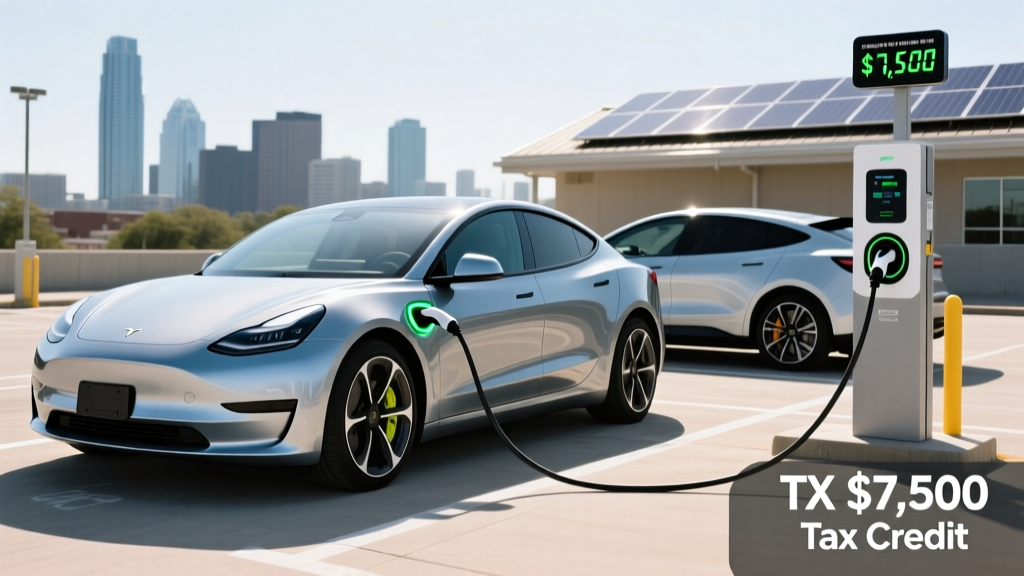
The federal Clean Vehicle Credit under IRS §30D remains the single largest purchase incentive for EV buyers, offering up to $7,500. But qualifying in 2026 is far from automatic. The credit is split into two halves — $3,750 for battery component sourcing and $3,750 for critical mineral sourcing — and each has escalating annual requirements.
§30D Eligibility Checklist (2026 Tax Year)
- Income caps: Modified AGI must not exceed $150,000 (single), $225,000 (head of household), or $300,000 (married filing jointly)
- MSRP caps: Vehicle MSRP must not exceed $55,000 for sedans/wagons or $80,000 for SUVs, vans, and pickups
- Battery component sourcing: A specified percentage of battery components must be manufactured or assembled in North America (threshold increases annually through 2029)
- Critical mineral sourcing: A specified percentage of critical minerals must be sourced from the U.S. or a free-trade-agreement partner (threshold also increases annually)
- Foreign Entity of Concern (FEOC) exclusion: Vehicles with battery components or critical minerals from a FEOC (primarily China and Russia) are disqualified — this rule tightened significantly in 2025-2026
- Point-of-sale transfer: You can transfer the credit to the dealer at purchase to reduce the sale price, rather than waiting to claim it on your tax return
- One credit per person per year: The credit is nonrefundable — if your tax liability is less than $7,500, you cannot carry the remainder forward
What this means in practice: Many popular 2026 models — including certain trims of the Tesla Model Y, Ford Mustang Mach-E, and Hyundai Ioniq 5 — may qualify for the full $7,500, a partial $3,750, or nothing at all depending on their battery supply chain for that model year. The DOE's fueleconomy.gov tax credit lookup tool is the most reliable way to verify a specific vehicle's eligibility before you buy. Always confirm at the point of sale, as manufacturers update sourcing throughout the year.
Texas-Specific Incentives and Utility Rebates
Important: Texas does not currently offer a statewide purchase rebate or income-tax credit for EVs (Texas has no state income tax, which limits the mechanism for a state-level credit). However, several utility-level and local incentives exist, and they change frequently. Always verify current availability with your provider or municipality.
Utility Rebates and Programs (Examples)
- Oncor (Dallas/Fort Worth area): Has historically offered rebates for residential Level 2 charger installation (up to $1,500 in past programs) and EV purchase incentives. Availability varies by program year.
- Austin Energy: Offers rebates for home charging equipment and has run EV purchase incentive programs. Also provides a special EV rate plan for off-peak charging.
- Entergy Texas: Has offered residential charging equipment rebates in select program years.
- City of Houston / City of San Antonio (CPS Energy): Municipal utilities occasionally run limited-time purchase or charger rebates.
Texas EV Registration Fee
Be aware: Texas charges an additional $200 annual registration fee for electric vehicles (on top of standard registration), enacted to offset lost gas-tax revenue. Over five years, this adds $1,000 to your ownership cost — a line item gas-car owners don't face.
5-Year Total Cost of Ownership: The Full Math
Below is a five-year TCO estimate for a 2026 Hyundai Ioniq 5 SEL AWD driven 15,000 miles per year in Texas, compared against a comparably priced gas-powered crossover (2026 Toyota RAV4 XLE AWD, MSRP ~$33,500, EPA 30 MPG combined). We assume Texas-average electricity and fuel prices, and include the $7,500 federal credit where applicable.
| Cost Category | Hyundai Ioniq 5 SEL AWD (EV) | Toyota RAV4 XLE AWD (Gas) |
|---|---|---|
| Base MSRP | $47,600 | $33,500 |
| Federal tax credit (§30D) | -$7,500 (if eligible) | $0 |
| Effective purchase price | $40,100 | $33,500 |
| Texas EV registration fee (5 yrs) | $1,000 | $0 |
| Fuel/Energy cost (5 yrs, 75k mi) | $4,500 (est. home + public mix) | $9,375 (est. at $3.75/gal, 30 MPG) |
| Insurance (5 yrs) | $11,250 (est. $2,250/yr avg) | $8,500 (est. $1,700/yr avg) |
| Maintenance (5 yrs) | $1,500 | $4,000 |
| Depreciation (5 yrs, est.) | $18,000 | $13,500 |
| Estimated 5-Year TCO | $68,350 | $68,875 |
Key takeaway: With the full $7,500 federal credit and home charging, the Ioniq 5's five-year cost approaches parity with the RAV4 despite a higher sticker price. Without the credit — or if you rely heavily on expensive public DC fast charging — the EV becomes more expensive. Your mileage (literally) will vary based on driving habits, electricity rates, insurance profile, and whether you charge at home.
Charging vs. Gas: Cost Per Mile in Texas
The fuel savings argument for EVs hinges on where and how you charge. Texas electricity rates vary widely — from around $0.10/kWh in some deregulated markets to $0.16/kWh or more, depending on your provider and plan. Public DC fast charging is significantly more expensive.
| Charging Method | Cost per kWh | Ioniq 5 Efficiency (mi/kWh) | Cost per Mile |
|---|---|---|---|
| Home Level 2 (off-peak plan) | $0.10 | 3.4 mi/kWh (EPA ~114 MPGe combined) | $0.029 |
| Home Level 2 (standard rate) | $0.14 | 3.4 mi/kWh | $0.041 |
| Public DC fast charger (avg) | $0.38 | 3.4 mi/kWh | $0.112 |
| Gas RAV4 (30 MPG, $3.75/gal) | — | — | $0.125 |
At home on an off-peak rate, the Ioniq 5 costs roughly 3 cents per mile — about one-quarter the cost of the gas RAV4. But if you rely primarily on public DC fast charging at $0.38/kWh (common on networks like Electrify America or EVgo without a subscription), your cost per mile approaches that of a gas vehicle. The economics of EV ownership in Texas strongly favor home charging.
Real-World Range Reality
The Ioniq 5 SEL AWD carries an EPA-estimated 290 miles of range. In real-world Texas highway driving at 75 mph in summer heat (A/C running), expect approximately 250-265 miles. In mild spring/fall conditions at moderate speeds, you may achieve or slightly exceed the EPA figure. Cold-weather range loss is minimal in most of Texas compared to northern states, but Panhandle winters can reduce range by 10-15%.
Maintenance Savings: Where EVs Pull Ahead
EVs have dramatically fewer moving parts than internal-combustion vehicles — no engine oil, no transmission fluid, no spark plugs, no timing belts, and no exhaust system. Regenerative braking also significantly reduces brake pad wear, often extending pad life to 100,000+ miles.
| Maintenance Item | EV (Ioniq 5) | Gas (RAV4) |
|---|---|---|
| Oil changes | None | ~$250/yr (2x/year) |
| Brake pad replacement | Rarely needed (regen) | ~$300-500 every 40k mi |
| Transmission fluid | None (single-speed) | ~$150 every 60k mi |
| Air filter / cabin filter | Cabin filter only (~$50/yr) | Engine + cabin (~$80/yr) |
| Coolant / other fluids | Minimal | Periodic replacement |
| Estimated annual maintenance | ~$300/yr | ~$800/yr |
Over five years, the Ioniq 5 saves an estimated $2,500 in maintenance compared to the RAV4. Hyundai also covers the battery pack with a 10-year/100,000-mile warranty (capacity retention threshold: 70% of original capacity), reducing the risk of a catastrophic battery replacement bill within the ownership period.
Insurance Costs: The Uncomfortable Truth
EVs are typically 15-30% more expensive to insure than comparable gas vehicles. The reasons are structural:
- Higher repair costs: EV battery packs and power electronics are expensive to replace after collision damage. Even minor rear-end collisions can trigger battery safety inspections costing thousands.
- Specialized labor: Fewer body shops are certified to work on high-voltage systems, increasing labor rates and repair timelines.
- Higher vehicle MSRP: Insurers factor in replacement cost; a $47,600 Ioniq 5 costs more to insure than a $33,500 RAV4.
- Parts availability: EV-specific parts (battery modules, inverters) can have longer lead times, increasing rental-car and storage costs for insurers.
For our Ioniq 5 example, expect average annual premiums of $2,000-$2,500 in Texas (varies heavily by zip code, driving record, and coverage level), compared to roughly $1,500-$1,900 for the RAV4. Over five years, this adds $1,500-$3,000 in extra insurance cost that partially offsets fuel and maintenance savings. Always get a quote from your insurer before purchasing.
Depreciation and Resale Value
EV depreciation has been volatile. From 2022-2024, aggressive price cuts by Tesla and others caused used EV values to drop sharply — some models lost 40-50% of their value in two years. The market has stabilized somewhat in 2025-2026, but EVs still tend to depreciate faster than popular gas vehicles in the first three years.
For a 2026 Ioniq 5 SEL AWD at $47,600 MSRP (effective $40,100 after the federal credit), a reasonable five-year depreciation estimate is 40-45% of the effective purchase price, or approximately $16,000-$18,000 in retained-value loss. The RAV4, by contrast, historically retains 55-60% of its value at five years, translating to roughly $13,500-$15,000 in depreciation.
Factors working in EVs' favor: Battery health data (verifiable State of Health), expanding charging infrastructure, and growing used-EV demand. Factors working against: Rapid technology obsolescence (newer models charge faster and go farther), potential battery replacement costs for out-of-warranty vehicles, and the $7,500 credit effectively resetting the baseline for used-EV pricing.
Putting It Together: Who Saves and Who Doesn't
Choose an EV in Texas if:
- You qualify for the full $7,500 federal credit (verify on fueleconomy.gov)
- You can install a Level 2 home charger (garage or driveway access with a 240V circuit)
- You drive 12,000+ miles per year (higher mileage amplifies fuel savings)
- Your utility offers an off-peak EV rate plan (sub-$0.12/kWh)
- You plan to keep the vehicle 5+ years (amortizing the higher purchase price)
Stick with gas or hybrid if:
- You cannot charge at home and would rely on public DC fast charging
- You do not qualify for the federal credit (income or vehicle sourcing)
- You drive fewer than 8,000 miles per year (fuel savings won't offset higher costs)
- You trade vehicles every 2-3 years (depreciation will outpace savings)
Frequently Asked Questions
How much does it really cost to own an EV over 5 years in Texas?
For a mid-range EV like the 2026 Hyundai Ioniq 5 SEL AWD, the five-year total cost of ownership is approximately $65,000-$72,000 depending on your electricity rate, insurance profile, and whether you qualify for the $7,500 federal tax credit. This is roughly comparable to a gas crossover like the Toyota RAV4 — the EV saves on fuel and maintenance but costs more in insurance, registration, and depreciation.
Do I qualify for the federal EV tax credit?
Eligibility under IRS §30D depends on your modified adjusted gross income (under $150K single / $300K joint), the vehicle's MSRP (under $55K for cars, $80K for SUVs/trucks), and whether the vehicle's battery meets 2026 sourcing thresholds for North American components and critical minerals. The credit can be transferred to the dealer at point of sale. Always verify your specific vehicle's eligibility on fueleconomy.gov and consult a tax professional.
How much do I save on fuel and maintenance in Texas?
Charging at home on a Texas off-peak rate (~$0.10/kWh), an EV like the Ioniq 5 costs about 3 cents per mile versus 12.5 cents per mile for a 30-MPG gas crossover — saving roughly $4,500-$5,000 over 75,000 miles. Maintenance savings add another $2,000-$2,500 over five years (no oil changes, reduced brake wear). Combined savings: approximately $6,500-$7,500 over five years.
Are EVs more expensive to insure in Texas?
Yes, typically 15-30% more than comparable gas vehicles. For a $47,600 EV, expect annual premiums of $2,000-$2,500 versus $1,500-$1,900 for a $33,500 gas crossover. The gap is driven by higher repair costs, specialized labor requirements, and the vehicle's higher replacement value. Shop quotes from multiple insurers — some now offer EV-specific discounts.
How well do EVs hold their value?
EV depreciation has been steeper than gas vehicles in recent years, with typical five-year depreciation of 40-50% of MSRP. However, the federal tax credit effectively lowers your cost basis, and the used-EV market is maturing. Models with strong battery health data and proven reliability (Hyundai/Kia, Tesla) tend to hold value better. Expect improvement as the market stabilizes and battery longevity data becomes more transparent.
Are there Texas-specific EV incentives beyond the federal credit?
Texas does not offer a statewide purchase rebate, but utility companies (Oncor, Austin Energy, CPS Energy, Entergy) periodically offer rebates for home charger installation and, occasionally, EV purchases. These programs change annually. Texas also charges a $200/year EV registration surcharge. Check with your local utility and municipality for current programs.