The Bulletproof Question: What Tesla Actually Claims
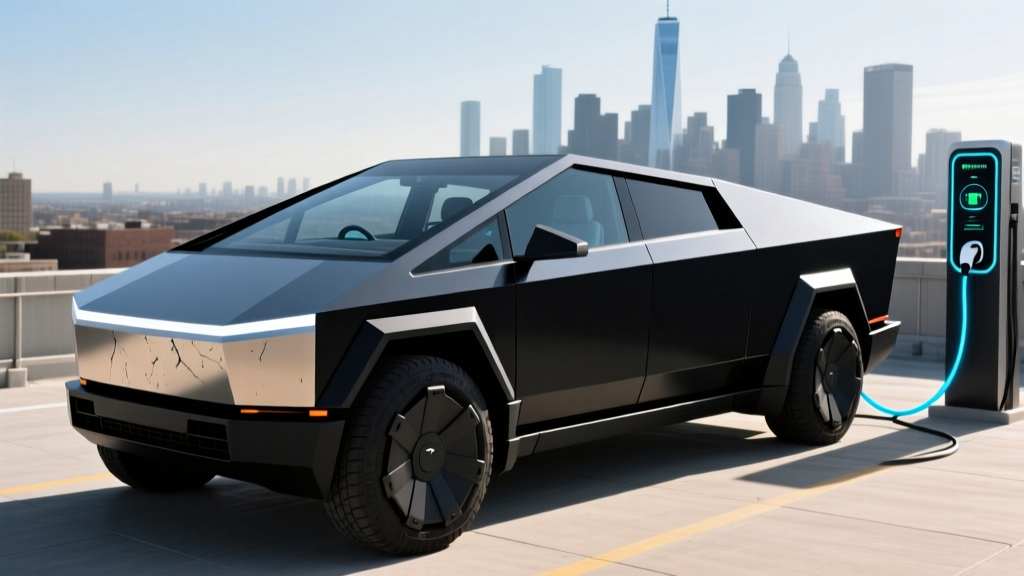
When Elon Musk famously hurled a metal ball at the Cybertruck's window during the 2019 reveal — and it shattered — the internet decided the truck's "bulletproof" marketing was theater. But the production Cybertruck that arrived in late 2023 and continues into the 2026 model year tells a more nuanced story. The ultra-hard 30X cold-rolled stainless steel exoskeleton is genuinely resistant to small-arms fire in specific calibers, and Tesla has demonstrated 9mm handgun round resistance in controlled tests. However, "bulletproof" is not an official ballistic rating (like NIJ Level III or IV), and the truck's glass, seams, undercarriage, and tire sidewalls remain vulnerable. The real question for buyers in 2026 isn't whether it stops bullets — it's whether this polarizing electric truck delivers where it counts: range, charging speed, utility, and value.
This review puts the Cybertruck through the lens of a real owner: EPA range versus highway reality, DC fast-charge curves, home charging logistics, total cost after federal incentives, and how it stacks up against the Ford F-150 Lightning and Rivian R1T.
2026 Cybertruck Trims, Pricing, and Federal Tax Credit Reality
The 2026 Tesla Cybertruck is offered in three trims. Pricing has shifted since launch as Tesla adjusted to demand and competition. Here is where the lineup stands:
| Trim | Drivetrain | Base MSRP | §30D Credit Eligibility | Effective Price (est.) |
|---|---|---|---|---|
| Long Range (Dual Motor AWD) | Dual Motor AWD | $79,990 | Not eligible (MSRP exceeds $80K truck cap) | $79,990 |
| Cyberbeast (Tri-Motor AWD) | Tri-Motor AWD | $99,990 | Not eligible (MSRP exceeds $80K truck cap) | $99,990 |
| Rear-Wheel Drive (RWD) | Single Motor RWD | $60,990 (announced, limited availability) | Eligible if MSRP ≤ $80K and buyer meets income/sourcing rules | ~$53,490 (with $7,500 credit) |
The IRS §30D clean vehicle credit imposes strict rules: the buyer's modified adjusted gross income must not exceed $150,000 (single) or $300,000 (joint), the truck's MSRP must be at or below the $80,000 cap for pickups/SUVs, and the battery must meet critical-mineral and component sourcing thresholds that tighten annually. As of 2026, the Long Range and Cyberbeast trims exceed the MSRP cap and do not qualify. The base RWD model, when available, may qualify — but buyers should verify current-year sourcing requirements with a tax professional and confirm eligibility via the IRS portal before purchase. The credit can be transferred at the point of sale to reduce the purchase price directly.
EPA Range, Real-World Expectations, and Efficiency
Real-World Expectation: Expect 260–290 miles on highway road trips at 70–75 mph. In cold weather (below 30°F), range drops an additional 15–25%, putting winter highway range closer to 210–245 miles. City driving with regenerative braking recovers some efficiency.
The Cybertruck's angular, wedge-shaped design is striking but aerodynamically compromised compared to sleeker EVs. Its estimated drag coefficient hovers around 0.34–0.38 — worse than a Model Y (~0.23) and a meaningful factor at highway speeds where air resistance dominates energy consumption. EPA efficiency figures place the Long Range at approximately 2.0 kWh/mile (roughly 50 kWh/100 mi), which translates to an MPGe rating in the mid-50s. That is substantially less efficient than a Rivian R1T Dual-Motor (around 1.9 kWh/mi) and far behind any sedan or crossover EV.
For context, a 340-mile EPA sticker is workable for most commutes and moderate road trips, but owners planning frequent 300+ mile highway drives or towing will interact with the Supercharger network often. Towing a 5,000-lb trailer can cut range nearly in half, dropping real-world tow range to 150–180 miles — a hard limit that demands careful route planning.
Battery Chemistry, Capacity, and Longevity
The 2026 Cybertruck Long Range and Cyberbeast use a structural battery pack with an estimated usable capacity of approximately 123 kWh. Tesla employs a nickel-based NMC (nickel-manganese-cobalt) chemistry in the 4680-format cells manufactured at Giga Texas. NMC offers higher energy density than LFP (lithium iron phosphate), which is necessary given the truck's mass (roughly 6,600–6,800 lbs curb weight) and the range targets Tesla set.
The trade-off: NMC cells benefit from staying between 20–80% state of charge for daily use, unlike LFP batteries that tolerate regular 100% charges. Tesla's battery management system includes a buffer (typically 3–5 kWh unusable) to protect longevity. The battery and drive unit warranty covers 8 years or 120,000 miles, whichever comes first, with a minimum 70% capacity retention threshold — consistent with Tesla's truck-class coverage.
| Specification | Long Range AWD | Cyberbeast (Tri-Motor) |
|---|---|---|
| EPA Range | 340 miles | 320 miles |
| Battery (usable) | ~123 kWh (NMC, 4680 cells) | ~123 kWh (NMC, 4680 cells) |
| Horsepower | 600 hp | 845 hp |
| 0–60 mph | 3.9 seconds | 2.6 seconds |
| Top Speed | 112 mph | 130 mph |
| Max Tow Rating | 11,000 lbs | 11,000 lbs |
| Payload Capacity | 2,500 lbs | 2,500 lbs |
| Bed Length | 6 ft (72 in) | 6 ft (72 in) |
| Cargo Volume (bed + frunk) | ~67 cu ft bed + ~7 cu ft frunk | ~67 cu ft bed + ~7 cu ft frunk |
| Ground Clearance | Up to 17.4 in (adaptive air suspension) | Up to 17.4 in (adaptive air suspension) |
| Battery/Drive Unit Warranty | 8 yr / 120,000 mi | 8 yr / 120,000 mi |
Charging Speed: DC Fast Charging and Home Level 2
The Cybertruck's 800-volt-class architecture enables impressive DC fast-charge rates — but as with all EVs, peak kW is not sustained kW. Here is the full charging picture:
| Charging Level | Max Power | Speed / Time | Connector |
|---|---|---|---|
| DC Fast Charge (V4 Supercharger) | Peak ~350 kW | 10–80% in ~20 minutes (sustained avg ~230 kW) | NACS (native) |
| DC Fast Charge (3rd-party CCS w/ adapter) | Peak ~250 kW (varies by station) | 10–80% in ~28–35 minutes | NACS (Tesla provides CCS adapter) |
| Level 2 Home (Tesla Wall Connector, 48A) | 11.5 kW | ~30–33 miles of range per hour; full charge ~11–12 hours | NACS |
| Level 2 Home (40A / NEMA 14-50) | 9.6 kW | ~25–27 miles per hour; full charge ~13–14 hours | NACS (Mobile Connector) |
| Level 1 (120V standard outlet) | ~1.4 kW | ~3–4 miles per hour; full charge 35+ hours | NACS (Mobile Connector) |
Charge-curve reality: The Cybertruck hits its peak ~350 kW only between roughly 10–30% state of charge on a V4 Supercharger with a preconditioned battery. Above 50% SoC, the rate tapers significantly, dropping to ~120 kW by 70% and below 50 kW past 85%. This taper is why the 10–80% time (~20 min) is a far more useful metric than the peak kW headline. On a road trip, plan 20-minute stops every 220–250 miles for comfort and efficiency — not the 340-mile maximum.
For home charging, the Cybertruck's massive 123 kWh battery means Level 2 charging from near-empty takes all night. Most owners who plug in nightly at 11.5 kW will start each morning near their charge limit, which is the ideal EV ownership pattern. A 60-amp circuit with a Tesla Wall Connector is strongly recommended; budget $800–$2,000 for professional installation depending on panel proximity and local permitting. Homes with older 100-amp electrical panels may need a panel upgrade ($1,500–$3,000+) to support a 48-amp continuous EV circuit.
Performance, Ride Quality, and the Stainless Exoskeleton
The Cyberbeast's 2.6-second 0–60 mph time is supercar territory in a 6,800-pound truck, and the instant torque delivery makes it feel even quicker in real-world roll-ons. The Long Range's 3.9-second sprint is hardly slow. Both trims feature adaptive air suspension that adjusts ride height from ~9 inches (entry/exit mode) to 17.4 inches (off-road), giving genuine trail capability that surprises given the truck's on-road performance.
The stainless steel exoskeleton — the feature that prompts the "bulletproof" question — is undeniably tough. Tesla has demonstrated resistance to 9mm rounds on the body panels, and the steel is dent-resistant in ways that aluminum and stamped steel are not. But the practical ownership story is more complicated:
- Panel repair: Stainless steel body panels cannot be repaired at conventional body shops. Collision damage often requires full panel replacement, and insurance premiums reflect this. Early Cybertruck owners have reported comprehensive insurance quotes 30–50% higher than comparable F-150 Lightnings.
- Fingerprints and finish: The raw stainless finish shows fingerprints, water spots, and smudges aggressively. Owners frequently apply ceramic coatings or PPF (paint protection film) — an added $1,500–$3,000 expense.
- Panel gaps: Production Cybertrucks have drawn scrutiny for inconsistent panel gaps, a known challenge with stainless steel forming. Tesla has improved this through 2024–2026 production runs, but buyers should inspect deliveries carefully.
- Glass vulnerability: The "armor glass" Tesla markets is laminated and stronger than standard automotive glass, but it is not bulletproof and has shown susceptibility to rock chips and cracking on highways — a common complaint in owner forums.
Tech, Interior, and Driver Assistance
The Cybertruck interior is minimalist even by Tesla standards. A single 18.5-inch front touchscreen handles infotainment, climate, vehicle controls, and navigation. A rear 9.4-inch screen serves second-row passengers. There is no traditional instrument cluster — speed and drive info live on the touchscreen's left edge. The yoke-style steering wheel (standard) takes genuine adaptation, particularly for three-point turns and low-speed maneuvering where hand-over-hand is natural in conventional trucks.
Driver assistance: The Cybertruck ships with Tesla's Basic Autopilot (adaptive cruise + lane centering). Enhanced Autopilot ($6,000) adds auto lane-change, navigate on Autopilot, and smart summon. Full Self-Driving (Supervised) remains a $8,000 add-on or $99/month subscription.
All Tesla driver-assistance features — including FSD (Supervised) — are SAE Level 2 systems. The driver must remain fully engaged, hands on the yoke, and eyes on the road at all times. This is not self-driving. Tesla's naming convention ("Full Self-Driving") is misleading; the system requires constant supervision and the driver is liable for all actions.
Other notable tech: the Cybertruck includes steer-by-wire (no mechanical connection between the yoke and the wheels), four-wheel steering for a tighter turning circle (~35 ft), a powered tonneau cover that locks the bed, 120V/240V bed outlets for job-site or camping use (up to 11.5 kW output via Powershare), and Tesla's Sentry Mode and Dashcam recording.
Notable drawbacks: The rear visibility is poor due to the sloping bed cover and lack of a rear window. Tesla relies entirely on the backup camera, which is functional but a compromise versus a physical mirror view. The ride on 20-inch wheels can be firm over broken pavement, and road noise at highway speed is more pronounced than in a Rivian R1T or F-150 Lightning — partly due to the angular aero profile and stainless steel resonance.
Cybertruck vs. F-150 Lightning vs. Rivian R1T: Which Should You Buy?
Choose the F-150 Lightning if: You want a traditional truck experience with EV benefits, need the widest dealer/service network, prefer conventional controls, and value lower insurance costs. Best for: fleet buyers, traditional truck owners transitioning to electric, and those who need easy body repair access.
Choose the Rivian R1T if: You want the best blend of off-road capability, build quality, adventure features (gear tunnel, camp kitchen), and a more refined interior. Best for: outdoor enthusiasts, families who camp, and buyers who want a premium truck without the polarizing design.
- Class-leading acceleration (2.6s Cyberbeast)
- Native NACS — full Supercharger network access
- 11,000-lb tow rating and 2,500-lb payload
- 800V architecture enables ~350 kW peak DC charging
- Steer-by-wire + 4-wheel steering = tight turning circle
- Stainless exoskeleton resists dents and minor impacts
- Powershare V2L: up to 11.5 kW output from bed outlets
- No federal tax credit on Long Range or Cyberbeast (MSRP cap)
- High insurance premiums due to stainless repair costs
- Poor rear visibility; no rear window
- Yoke steering requires significant adaptation
- Real-world highway range well below 340-mi EPA sticker
- Efficiency of ~2.0 kWh/mi is poor for an EV
- Limited service center capacity for body/panel work
- Glass is not "armor" — vulnerable to rock chips
Who the Cybertruck Actually Suits
The Cybertruck works best for a specific buyer: someone who wants a high-performance electric truck, has reliable home Level 2 charging, tows or hauls occasionally rather than daily, and is comfortable being a visible early adopter. It is less suited for buyers who need discreet, low-maintenance transportation, those in regions with limited Tesla service infrastructure, or anyone whose budget cannot absorb the insurance premium uplift and lack of federal incentive on the higher trims.
For daily commuting under 60 miles round-trip with home charging, any trim works well. For frequent long-distance towing or rural ownership far from Superchargers, the F-150 Lightning's broader CCS network access (via adapters) and conventional service options may be more pragmatic. For adventure-oriented families, the Rivian R1T's gear tunnel and more conventional interior layout offer better livability.
Frequently Asked Questions
Is the Tesla Cybertruck actually bulletproof?
The stainless steel exoskeleton panels have demonstrated resistance to 9mm handgun rounds in Tesla's controlled demonstrations. However, the Cybertruck does not carry an official NIJ ballistic rating. The glass, undercarriage, wheel wells, and panel seams are not armored. "Bullet-resistant body panels" is more accurate than "bulletproof vehicle."
What is the real-world range of the Cybertruck on a road trip?
On a 70–75 mph highway drive in moderate temperatures (60–80°F), expect 260–290 miles from the Long Range trim's 340-mile EPA estimate. In cold weather (below 30°F), that drops to roughly 210–245 miles. Towing cuts range by 40–50%, yielding 150–180 miles with a heavy trailer.
How fast does the Cybertruck charge at home and on the road?
On a V4 Supercharger, the Cybertruck peaks at ~350 kW and charges 10–80% in approximately 20 minutes, though sustained average is closer to ~230 kW due to charge-curve taper. At home on a 48-amp Level 2 Wall Connector (11.5 kW), it adds roughly 30–33 miles per hour, requiring 11–12 hours for a full charge from near-empty.
Does the 2026 Cybertruck qualify for the $7,500 federal EV tax credit?
Only the base RWD trim (MSRP $60,990) may qualify, and only if the buyer meets IRS §30D income limits ($150K single / $300K joint), the battery meets critical-mineral and component sourcing thresholds, and the vehicle is placed in service in the current tax year. The Long Range ($79,990) and Cyberbeast ($99,990) exceed the $80,000 MSRP cap for trucks and do not qualify. Always verify with a tax professional before purchase.
Is the Cybertruck worth buying over the F-150 Lightning or Rivian R1T?
It depends on priorities. The Cybertruck wins on acceleration, Supercharger network access, and tow rating. The F-150 Lightning wins on service accessibility, conventional truck ergonomics, and tax credit eligibility on multiple trims. The Rivian R1T wins on build quality, off-road refinement, and adventure-oriented design. None is universally "best" — each serves a different truck buyer.
How much does it cost to insure a Cybertruck?
Insurance premiums for the Cybertruck run 30–50% higher than comparable electric trucks, driven by stainless steel panel replacement costs, limited body shop familiarity, and high repair totals from minor collisions. Owners report annual premiums of $3,500–$5,500 depending on state, driving record, and coverage level. Get quotes before ordering.
What is the Cybertruck's bed size and cargo capacity?
The bed is 6 feet long (72 inches) with a width of approximately 47 inches between the wheel wells. The powered tonneau cover is lockable and supports up to 300 lbs on top. Combined with the front trunk (frunk) at ~7 cu ft and a sail-pillar storage area, total enclosed cargo volume is practical for most truck tasks, though shorter than a traditional 6.5- or 8-foot truck bed.