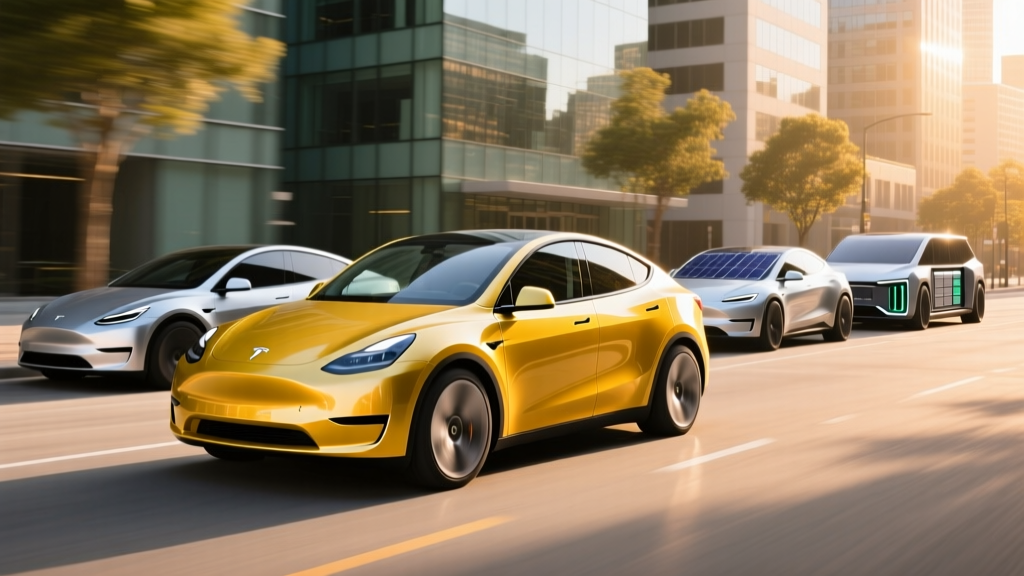
If you've been searching for a Tesla yellow, you've probably noticed something frustrating: Tesla doesn't currently offer a factory yellow paint option on any of its production vehicles. Unlike legacy automakers that rotate bold colors through their lineups, Tesla keeps its paint palette deliberately narrow — and a true yellow has been absent from the configurator for years. But that doesn't mean you can't get a yellow Tesla. Between aftermarket wraps, Tesla's premium Quicksilver option (which reads as a warm champagne-gold in certain light), and the broader 2026 Tesla lineup, there are real paths to standing out in a sea of white, gray, and black EVs.
This guide covers everything you need to know about getting a yellow Tesla in 2026, then dives deep into the specs, range, charging, and pricing of the vehicles you'd be wrapping — with a focus on the best-selling Model Y and Model 3.
Does Tesla Offer a Yellow Paint Color in 2026?
The short answer: no. As of the 2026 model year, Tesla's factory paint options across the Model 3, Model Y, Model S, and Model X lineup include:
- Pearl White Multi-Coat — standard (no upcharge)
- Solid Black — $2,000 upcharge
- Deep Blue Metallic — $2,000 upcharge
- Ultra Red — $2,500 upcharge (Model S/X) or $2,000 (Model 3/Y)
- Quicksilver — $3,000 upcharge (available on Model S, Model X, and select Model 3/Y trims)
- Midnight Cherry Red — $2,500 (Model S/X Cyberbeast and Plaid)
Quicksilver is the closest Tesla comes to a warm, eye-catching hue — it shifts between silver, champagne, and pale gold depending on lighting. But it's not yellow. Tesla previously offered a Midnight Silver Metallic and has experimented with special-order colors at its Fremont and Gigafactory Texas facilities, but a production yellow remains absent.
How to Get a Yellow Tesla: Wraps, PPF, and Custom Paint
The most popular route to a Tesla yellow is a vinyl wrap. A full-body professional wrap typically costs between $2,500 and $5,000 depending on material quality, shop reputation, and whether you add paint protection film (PPF) underneath. Here's what to know:
- Vinyl wrap lifespan: 5–7 years with proper care; premium cast vinyl (3M, Avery Dennison) lasts longest
- Warranty impact: A wrap does not void Tesla's vehicle warranty, but improper removal that damages paint could affect body panel claims
- PPF + wrap combo: Adding PPF before wrapping ($1,500–$3,000) protects the factory paint underneath and makes future wrap removal cleaner
- DIY wrap kits: Available for $500–$1,200 but require significant skill; professional installation is strongly recommended for full-body coverage
Some owners opt for custom resprays, which run $5,000–$10,000+ at a quality body shop. This is permanent and may affect resale value more than a removable wrap.
2026 Tesla Model Y: Full Specs, Range, and Charging
Since the Model Y is the Tesla most buyers consider — and the most commonly wrapped — here's a complete spec breakdown for the 2026 model year. The refreshed "Juniper" Model Y continues with the updates introduced in early 2025.
| Spec | Long Range RWD | Long Range AWD | Performance AWD |
|---|---|---|---|
| EPA Range | 320 miles | 300 miles | 280 miles |
| Battery (usable) | ~75 kWh (NMC) | ~75 kWh (NMC) | ~75 kWh (NMC) |
| Drivetrain | Rear-Wheel Drive | Dual-Motor AWD | Dual-Motor AWD |
| Horsepower | 346 hp | 384 hp | 456 hp |
| 0–60 mph | 5.8 sec | 4.8 sec | 3.5 sec |
| MPGe (combined) | 123 MPGe | 117 MPGe | 111 MPGe |
| Efficiency | 27 kWh/100mi | 29 kWh/100mi | 30 kWh/100mi |
| Max DC Fast Charge | 250 kW | 250 kW | 250 kW |
| 10–80% DCFC Time | ~25 min | ~25 min | ~25 min |
| Level 2 Home Charge | 11.5 kW (~44 mi/hr) | 11.5 kW (~44 mi/hr) | 11.5 kW (~44 mi/hr) |
| Cargo (rear seats up) | 30.2 cu ft | 30.2 cu ft | 30.2 cu ft |
| Cargo (rear seats down) | 72.1 cu ft | 72.1 cu ft | 72.1 cu ft |
| Front Trunk (Frunk) | 4.1 cu ft | 4.1 cu ft | 4.1 cu ft |
| Rear Legroom | 40.5 in | 40.5 in | 40.5 in |
| Towing Capacity | 3,500 lbs | 3,500 lbs | 3,500 lbs |
Source: fueleconomy.gov and Tesla's official 2026 specifications.
The EPA rates the 2026 Model Y Long Range RWD at 320 miles. In real-world highway driving at 70–75 mph, expect roughly 260–280 miles before needing to charge. In cold weather (below 32°F), range can drop an additional 15–30%, putting winter highway range closer to 220–240 miles. City driving with regenerative braking recovers more energy and gets you closer to the EPA sticker. Tesla's heat pump, standard on all 2026 models, mitigates cold-weather losses better than older EVs but doesn't eliminate them.
Charging the Model Y: Home, Public, and Supercharger Network
The Model Y's charging ecosystem remains one of Tesla's strongest ownership advantages. Here's the breakdown by charging level:
| Level | Power | Miles Added per Hour | Typical Use Case |
|---|---|---|---|
| Level 1 (120V) | ~1.4 kW | ~4–5 mi/hr | Emergency/trickle only |
| Level 2 (240V, 48A) | 11.5 kW | ~44 mi/hr | Home overnight charging |
| DC Fast (Supercharger V3) | Up to 250 kW | ~1,000+ mi/hr (peak) | Road trips, 10–80% in ~25 min |
| DC Fast (Supercharger V4) | Up to 250 kW* | Similar to V3 | Newer stations with CCS adapter built in |
*V4 cabinets support higher peak rates for future vehicles; current Model Y peaks at 250 kW.
Charging curve reality: The Model Y peaks at 250 kW only between roughly 10–30% state of charge. By 50% SoC, the rate tapers to ~150 kW, and above 80% it drops sharply to protect battery longevity. This is why Tesla (and the car's navigation) recommends charging to 80% on road trips — the last 20% can take as long as the first 60%.
Home charging cost: At the US average residential electricity rate of ~$0.17/kWh (per EIA data), a full 75 kWh charge costs roughly $12.75 — the equivalent of about 3.5 gallons of gas. For a typical 30-mile daily commute, you're spending under $1/day on fuel.
2026 Model Y Pricing, Trims, and Federal Tax Credit
| Trim | Base MSRP | Federal §30D Credit | Effective Price* |
|---|---|---|---|
| Long Range RWD | $44,990 | Up to $7,500 (if eligible) | ~$37,490 |
| Long Range AWD | $47,990 | Up to $7,500 (if eligible) | ~$40,490 |
| Performance AWD | $52,490 | Up to $7,500 (if eligible) | ~$44,990 |
*Effective price assumes full §30D credit eligibility. Destination fee ($1,390) not included. Paint, wheels, and FSD add to final price.
Critical §30D eligibility caveats (per IRS.gov):
- MSRP cap: SUVs/vans/pickups must be under $80,000 — all Model Y trims qualify
- Income cap: Modified AGI must not exceed $150,000 (single), $225,000 (head of household), or $300,000 (joint)
- Battery sourcing: The credit splits into two halves ($3,750 each) — one for critical minerals sourcing and one for battery component manufacturing. Tesla's US-built batteries generally qualify for the full $7,500, but sourcing rules tighten annually. Always verify current-year eligibility on the IRS website or with a tax professional before purchasing
- Point-of-sale transfer: As of 2024, buyers can transfer the credit to the dealer at purchase, reducing the upfront price rather than waiting for a tax refund. Tesla supports this at delivery
Tech, Driver Assistance, and Interior
The 2026 Model Y continues with Tesla's minimalist interior — a single 15.4-inch touchscreen handles all infotainment, climate, and vehicle settings. Key tech highlights:
- Autopilot (standard): Adaptive cruise control + lane-keeping assist. This is SAE Level 2 — you must keep your hands on the wheel and eyes on the road at all times
- Full Self-Driving Supervised ($8,000 or $99/month): Adds automatic lane changes, navigation-guided on/off-ramp maneuvers, traffic light/stop sign recognition, and Smart Summon. Despite the name, this remains SAE Level 2 — full driver supervision is required. It is not autonomous driving
- Ventilated front seats (new with Juniper refresh)
- Power-folding second row with one-touch release
- Ambient lighting with customizable color strips across the dash
- 16-speaker premium audio with immersive sound
- Over-the-air updates continue to add features post-purchase
Tesla's Autopilot and FSD (Supervised) are Level 2 driver-assistance systems, not self-driving technology. You are legally and practically responsible for the vehicle at all times. NHTSA continues to investigate Autopilot-related incidents. Never use FSD as a substitute for attentive driving, and be especially cautious in construction zones, adverse weather, and unmapped areas.
Model Y vs. Key Competitors: Is It Still the Default Choice?
The refreshed Model Y faces real competition in 2026. Here's how it stacks up against its closest rivals:
| Spec | Tesla Model Y LR AWD | Hyundai Ioniq 5 AWD | Ford Mustang Mach-E ER AWD |
|---|---|---|---|
| EPA Range | 300 mi | 290 mi | 290 mi |
| Battery | ~75 kWh NMC | 84 kWh NMC | 91 kWh NMC |
| Max DC Charge | 250 kW | 350 kW (800V) | 150 kW |
| 10–80% Time | ~25 min | ~18 min | ~38 min |
| 0–60 mph | 4.8 sec | 5.1 sec | 5.1 sec |
| Base MSRP (AWD) | $47,990 | $50,900 | $48,995 |
| Cargo (rear up) | 30.2 cu ft | 27.2 cu ft | 29.7 cu ft |
| §30D Credit | Up to $7,500 | Up to $7,500 | Up to $7,500 |
Where Model Y wins: Supercharger network access (the most reliable DC fast-charging network in North America), cargo space, efficiency (fewer kWh per mile), and software/OTA maturity.
Where competitors win: The Ioniq 5 charges significantly faster thanks to its 800V architecture (18 min vs 25 min for 10–80%). The Mach-E offers a more traditional interior with physical buttons. Both Hyundai and Ford dealers provide in-person service that Tesla's mobile-ranger-and-few-service-centers model sometimes can't match in rural areas.
Warranty, Battery Longevity, and Ownership Costs
Tesla's warranty coverage for the 2026 Model Y:
- Basic Vehicle: 4 years / 50,000 miles
- Battery & Drive Unit: 8 years / 120,000 miles (Long Range) — guaranteed to retain at least 70% of original capacity during the warranty period
- Battery chemistry: The Long Range and Performance trims use NMC (nickel manganese cobalt) cells. Tesla recommends charging NMC batteries to 80% for daily use and 100% only before long trips to minimize degradation
Degradation data: Based on aggregated fleet data from Tesla's 2025 Impact Report and independent tracking (Teslanomics by Recurrent), Model Y batteries typically lose about 8–12% of capacity over the first 100,000 miles. After that initial drop, degradation slows significantly. Many Model 3/Y vehicles have exceeded 200,000 miles on the original battery pack with 85%+ state of health.
Insurance note: Tesla insurance premiums tend to run 15–30% higher than comparable non-Tesla EVs due to repair costs and parts pricing. Get quotes before ordering — Tesla's own insurance product (available in most states) can sometimes undercut third-party insurers.
- Class-leading efficiency (27–30 kWh/100mi)
- Supercharger network — the most reliable DC charging in the US
- Spacious cargo area (30.2 cu ft + 4.1 cu ft frunk)
- Strong over-the-air update track record
- Full §30D tax credit eligibility (verify annually)
- 3,500-lb towing capacity for the segment
- No factory yellow paint option — wrap required ($2,500–$5,000)
- DC fast charging slower than 800V competitors (Ioniq 5, EV6)
- Minimalist interior frustrates some buyers (no physical buttons, no instrument cluster)
- Service center availability limited in rural markets
- Higher insurance premiums than rivals
- FSD is expensive ($8,000) and remains Level 2 — not autonomous
Who Should Buy the Model Y (and Wrap It Yellow)?
Choose the Model Y if: You prioritize charging network reliability, cargo versatility, and software features. It's the strongest all-around pick for suburban families, daily commuters with home charging, and road-trippers who value Supercharger density.
Look elsewhere if: You need the fastest possible DC charging (Hyundai Ioniq 5/Kia EV6 with 800V), want a traditional interior with physical controls (Ford Mach-E, VW ID.4), or live in a rural area far from Tesla service centers.
Wrap it yellow if: You want to personalize a vehicle you'll keep for 5+ years. A quality vinyl wrap in a bold yellow (think "Speed Yellow" or "Solar Yellow" from 3M's catalog) costs $3,000–$4,500 installed, lasts 5–7 years, and is fully removable without damaging the factory paint — preserving resale value.
Frequently Asked Questions
Does Tesla make a yellow car?
No. Tesla does not currently offer a yellow factory paint option on any 2026 production model. The closest warm-tone option is Quicksilver ($3,000), which reads as champagne-gold in direct sunlight. For a true yellow, owners use aftermarket vinyl wraps ($2,500–$5,000) or custom resprays.
What is the real-world range of the 2026 Tesla Model Y?
The EPA rates the Long Range RWD at 320 miles and the Long Range AWD at 300 miles. In real-world highway driving at 70–75 mph, expect 260–280 miles (RWD) or 245–265 miles (AWD). In freezing temperatures, subtract another 15–30%. City driving with regenerative braking gets you closer to EPA numbers.
How fast does the Model Y charge at home and on the road?
At home on a Level 2 (240V, 48A) charger, the Model Y adds about 44 miles of range per hour — a full overnight charge from 20% to 80% takes roughly 6–7 hours. On a Tesla Supercharger V3/V4, it peaks at 250 kW and charges from 10% to 80% in approximately 25 minutes, though the rate tapers significantly above 50% state of charge.
How much does a 2026 Model Y cost after the federal tax credit?
The Long Range RWD starts at $44,990. If you qualify for the full $7,500 §30D federal tax credit (income under $150K single/$300K joint, and the vehicle meets battery sourcing requirements), the effective price drops to approximately $37,490 before destination fees and options. Always verify current-year eligibility at IRS.gov.
Does wrapping a Tesla void the warranty?
No. A professionally installed vinyl wrap does not void Tesla's vehicle, battery, or drive unit warranty. However, if wrap removal damages the paint (rare with quality installations), cosmetic claims may be denied. Tesla's 8-year/120,000-mile battery warranty and 4-year/50,000-mile basic warranty remain fully intact.
Is the Tesla Model Y worth buying over the Hyundai Ioniq 5 or Ford Mach-E?
It depends on your priorities. The Model Y wins on efficiency, cargo space, and Supercharger access. The Ioniq 5 charges faster (18 min vs 25 min for 10–80%) and has a more distinctive design. The Mach-E offers a conventional interior layout and broad Ford dealer service coverage. All three qualify for the $7,500 federal credit (verify eligibility). If charging network reliability and cargo volume are your top concerns, the Model Y remains the strongest pick.