US Postal Service Electric Vehicle: The Short Answer
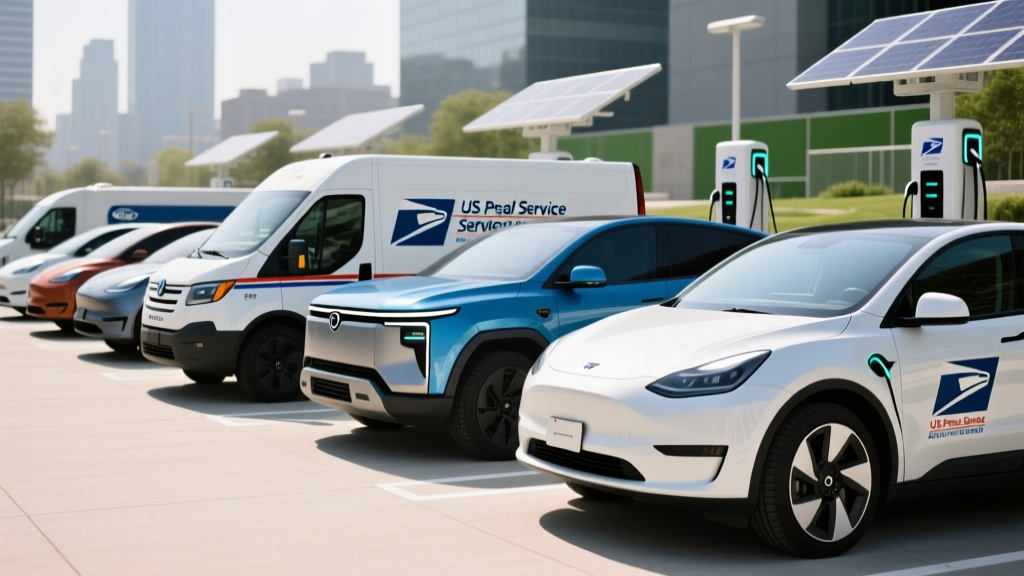
The US Postal Service (USPS) is deploying up to 66,000 electric delivery vehicles by 2028 as part of its Next Generation Delivery Vehicle (NGDV) program, with 45,000 mandated to be battery-electric under a 2022 contract restructuring. The USPS electric vehicle fleet is being built primarily by Oshkosh Defense, with supplemental Ford E-Transit vans already in service. For everyday EV shoppers, the USPS electrification matters because it accelerates public charging infrastructure buildout in rural and suburban areas, normalizes commercial EV adoption, and creates a secondary market for fleet-rated EV components and service networks.
Why the USPS Electric Vehicle Fleet Matters to EV Buyers
The USPS operates one of the largest civilian vehicle fleets in the world — roughly 230,000 vehicles covering 70 million miles per day. The decision to electrify a substantial portion of that fleet, announced initially in 2021 and significantly revised in July 2022 under pressure from the EPA and the Biden administration, represents a structural shift in how Americans will encounter EVs in daily life.
For private EV buyers, the USPS rollout has three concrete implications:
- Infrastructure spillover: USPS depot charging installations often require utility upgrades and grid reinforcement in areas that previously lacked DC fast-charging access. Those upgrades benefit nearby residents.
- Service network expansion: As Oshkosh and Ford service tens of thousands of electric delivery vehicles, certified EV technicians become more common — reducing the "no one nearby can fix it" problem that plagues rural EV owners.
- Used-market supply: Fleet vehicles typically cycle out of service after 8–12 years. By the early 2030s, well-maintained, commercial-grade electric vans will begin entering the used market.
NGDV Electric Specs: Range, Battery, and Charging
The Oshkosh-built NGDV electric variant is not a consumer vehicle, but its specifications reveal how fleet-grade EVs are engineered for stop-and-go duty cycles rather than highway range. Here is what is publicly documented as of 2026:
| Specification | NGDV BEV (Oshkosh) | Ford E-Transit (USPS Supplemental) |
|---|---|---|
| Battery Chemistry | NMC (Lithium Nickel Manganese Cobalt) | NMC |
| Usable Battery Capacity | ~95 kWh (estimated) | 68 kWh usable |
| EPA-Equivalent Range | ~70–90 miles (route-dependent) | 126 miles (EPA, low-roof cargo van) |
| Peak DC Fast Charge Rate | ~115 kW (estimated) | 115 kW |
| Level 2 Charge Rate | ~19.2 kW | 10.5 kW (AC) |
| 10–80% DC Fast Charge Time | ~45 minutes (estimated) | ~45 minutes at 115 kW |
| Horsepower | Not publicly rated | 266 hp |
| Payload Capacity | ~1,700 lbs (estimated) | 3,880 lbs (cargo van) |
| Warranty | Fleet contract terms | 8 yr / 100,000 mi battery |
Real-world context: The NGDV's range looks modest by consumer standards, but mail delivery routes average 15–25 miles per day with over 1,000 stops. The vehicle returns to the depot nightly for Level 2 charging, so highway range is irrelevant to its duty cycle. This is a critical distinction: fleet EVs are optimized for predictable, short routes with overnight charging, not road trips.
Cost Comparison: Electric vs. Gas USPS Fleet Vehicles
The USPS has been historically reliant on the Grumman LLV (Long Life Vehicle), a gas-powered van introduced in 1987 with an EPA rating of roughly 17 MPG combined. Many LLVs have exceeded 200,000 miles but cost the USPS an estimated $5,000+ per year in maintenance per vehicle due to age-related failures. Here is how the economics compare:
| Cost Factor | Grumman LLV (Gas) | NGDV BEV (Electric) |
|---|---|---|
| Acquisition Cost | ~$25,000 (1990s, fully depreciated) | ~$60,000–$75,000 (estimated, per unit contract) |
| Fuel / Energy Cost per Mile | ~$0.22/mi (at $3.50/gal, 17 MPG) | ~$0.08/mi (at $0.13/kWh, ~2.5 kWh/mi) |
| Annual Fuel/Energy (15,000 mi/yr) | ~$3,300 | ~$1,200 |
| Estimated Annual Maintenance | $5,000+ (aging fleet) | ~$1,500–$2,000 (no oil, fewer moving parts) |
| 5-Year Fuel + Maintenance | ~$41,500 | ~$16,000–$18,500 |
| Lifespan | 20+ years (with heavy repair) | 15–20 years (projected, battery replacement TBD) |
Key takeaway: The USPS electric vehicle costs more upfront but saves an estimated $23,000–$25,000 over five years in fuel and maintenance alone — before factoring in emissions reductions or the cost of catastrophic LLV failures (fires, breakdowns on route). This mirrors the consumer EV ownership equation almost exactly: higher purchase price, lower operating cost, with the break-even point typically arriving in years 4–6 depending on mileage.
Charging Infrastructure: What USPS Depot Buildout Means for You
The USPS has contracted for depot-level charging installations across hundreds of facilities. Most depots are installing Level 2 (19.2 kW) chargers for overnight charging, with select hubs adding DC fast chargers (150+ kW) for mid-route top-ups and fleet flexibility.
This matters to residential EV buyers because:
- Utility transformer upgrades at USPS facilities often increase local grid capacity, making it easier for nearby homes to get 240V/48A Level 2 installations without costly panel upgrades.
- Public charging networks sometimes co-locate near fleet depots — Electrify America, EVgo, and ChargePoint have all expanded into areas where fleet demand justified the grid investment.
- Cold-weather regions benefit disproportionately: USPS depots in states like Minnesota, Wisconsin, and Maine are installing heated, covered charging bays that demonstrate cold-climate EV viability to skeptical local buyers.
Real-world caveat: If you live near a USPS depot undergoing electrification, check with your utility about available circuit capacity before assuming a home Level 2 install will be straightforward. Depot upgrades don't automatically translate to residential feeder-line improvements.
Common Misconceptions About the USPS EV Fleet
| Myth | Fact |
|---|---|
| "The USPS abandoned gas vehicles entirely." | The 2022 contract mandates 45,000 EVs out of up to 66,000 NGDVs. The remaining ~21,000 will be gas-powered ICE variants for routes where electrification is not yet feasible. |
| "Electric mail trucks can't handle cold weather." | NGDV BEVs include battery thermal management systems. Real-world range loss in sub-20°F conditions is estimated at 20–30%, but routes average only 20 miles — well within the reduced buffer. |
| "Taxpayers are overpaying for electric trucks." | The initial $6 billion contract was restructured in 2022. Per-vehicle cost is estimated at $60,000–$75,000, comparable to commercial electric vans. Five-year TCO is significantly lower than replacing the LLV fleet with new gas vehicles. |
| "These EVs will break down like the old LLVs." | The NGDV is a ground-up new design, not a retrofit. Electric powertrains have far fewer failure points than a 35-year-old ICE van. Ford's E-Transit, already in USPS service, carries an 8-year/100,000-mile battery warranty. |
| "I can buy a USPS electric vehicle." | Not currently. The NGDV is built exclusively for USPS under a defense contract. Decommissioned units may eventually reach surplus auctions, but none have cycled out yet as of 2026. |
What the USPS EV Rollout Teaches First-Time EV Buyers
The USPS fleet electrification is essentially a 66,000-unit case study in practical EV ownership. The lessons transfer directly to consumer buyers:
1. Match the Vehicle to the Duty Cycle
The USPS doesn't need 300 miles of range — it needs 90 reliable miles with overnight charging. If your daily commute is under 40 miles round-trip and you can charge at home, a 200–250 mile EPA-rated EV is more than sufficient. Don't pay a premium for range you'll never use.
2. Level 2 Home Charging Is the Foundation
Every USPS EV returns to a depot with Level 2 infrastructure. For consumer owners, a home Level 2 charger (240V, 32–48A) is non-negotiable for convenient ownership. Expect to budget $800–$2,500 for equipment and electrician installation, with a possible $1,000–$3,000 panel upgrade if your home has a 100A service.
3. Maintenance Savings Are Real but Not Instant
The USPS saves roughly $3,000/year per vehicle in maintenance. Consumer EV owners report similar proportional savings: no oil changes, no spark plugs, no transmission fluid, and regenerative braking that extends pad life to 100,000+ miles. But upfront costs are higher, and insurance premiums for EVs run 10–20% above comparable gas vehicles in most states.
4. Cold Climate Is Manageable with Planning
The USPS operates in International Falls, Minnesota (average January low: -6°F) and still plans to deploy EVs there. The key is battery preconditioning, garage charging, and route/range awareness. Consumer EVs with heat pumps (standard on most 2025–2026 models from Hyundai, Kia, Tesla, and BMW) lose only 15–25% range in cold weather, not the 40% seen in older models without thermal management.
Decision Framework: Should the USPS EV Program Influence Your Purchase?
Choose an EV now if:
- You drive under 60 miles/day and have home or workplace Level 2 charging access
- You live in an area where USPS depot buildout has improved local grid capacity or public charging options
- You want to capture the §30D federal tax credit (up to $7,500, subject to MSRP caps of $55,000 for sedans / $80,000 for SUVs and trucks, buyer income limits, and battery-sourcing requirements)
- Your second vehicle or a PHEV can cover occasional long trips
Wait or choose a PHEV/HEV if:
- You lack reliable home or workplace charging and live in a charging-desert area
- You regularly drive 200+ miles in cold weather without access to DC fast charging along your route
- Your apartment or HOA prohibits Level 2 charger installation
- You need to tow over 3,500 lbs frequently (EV towing range loss of 40–50% is well documented)
Federal Tax Credit Context for 2026 EV Buyers
The USPS is purchasing vehicles through federal procurement, so the §30D consumer tax credit does not apply to fleet purchases. But for private buyers, understanding current credit rules is essential:
- Credit amount: Up to $7,500 for new EVs, up to $4,000 for used EVs (30% of sale price, max $4,000)
- MSRP caps: $55,000 for sedans; $80,000 for SUVs, pickup trucks, and vans
- Income limits: AGI must not exceed $300,000 (married filing jointly), $225,000 (head of household), $150,000 (single)
- Battery sourcing: Critical minerals and battery components must meet escalating domestic/free-trade-agreement percentages — this eliminates many models from full credit eligibility in 2026
- Point-of-sale transfer: Buyers can transfer the credit to the dealer at purchase, reducing the sale price directly rather than waiting for a tax refund
Always verify eligibility on IRS.gov and consult a tax professional — sourcing rules change annually and vary by model and build date.
Frequently Asked Questions
Can I buy a USPS electric delivery vehicle?
No. The Oshkosh NGDV is manufactured exclusively for the USPS under a federal contract. Ford E-Transit vans used by USPS are the same model available to consumers and commercial fleets, so you can purchase an E-Transit directly from a Ford dealer starting around $45,000 MSRP.
How many electric vehicles does the USPS have in 2026?
As of early 2026, the USPS has taken delivery of several thousand NGDV units (both BEV and ICE variants) and has supplemented its fleet with approximately 9,200 Ford E-Transit electric vans purchased separately. The full 66,000-vehicle NGDV order is expected to be fulfilled by 2028.
Does the USPS EV fleet use Tesla Superchargers?
No. USPS vehicles charge primarily at depot-installed Level 2 and DC fast chargers using CCS1 connectors. The USPS charging infrastructure is contracted through federal procurement and uses commercial fleet charging providers, not the Tesla Supercharger network.
Will USPS electrification lower EV prices for consumers?
Indirectly, yes. Large fleet orders drive battery cell demand, which helps scale manufacturing and reduce per-kWh costs. The USPS order also validates the commercial EV market, encouraging more manufacturers to enter the space. However, direct consumer price reductions depend more on battery chemistry costs, competition, and tariff policy than on any single fleet contract.
What happens to USPS electric vehicle batteries at end of life?
Fleet battery disposal is governed by federal procurement sustainability requirements. Most commercial EV batteries at 70–80% state of health are suitable for stationary energy storage (second-life applications). USPS battery recycling contracts are expected to follow standard lithium-ion recycling pathways through companies like Redwood Materials and Li-Cycle.
Sources: IRS §30D Clean Vehicle Credits, fueleconomy.gov EV Side-by-Side, USPS Office of Inspector General fleet reports, Ford Motor Company E-Transit specifications.