If you've searched for Tesla wire, you're likely navigating Tesla's charging ecosystem — from the bundled Mobile Connector to the hardwired Wall Connector and the NACS plug standard now adopted across the industry. This guide breaks down every "Tesla wire" option available in 2026, with exact kW rates, installation costs, and compatibility data so you can charge efficiently at home and on the road.
What "Tesla Wire" Actually Means in 2026
"Tesla wire" isn't a single product — it's a colloquial search term covering Tesla's entire charging cable lineup. In 2026, that includes three core products:
- Tesla Mobile Connector — the portable charging cable bundled with new vehicles
- Tesla Wall Connector — the hardwired or plug-in home Level 2 charging station
- NACS (North American Charging Standard) — Tesla's proprietary connector, now the industry standard adopted by Ford, GM, Rivian, Hyundai, and others
Understanding which "Tesla wire" you need depends on your charging scenario: overnight home charging, road-trip DC fast charging, or destination charging. Let's break down each option with real numbers.
Tesla Mobile Connector: The Portable Tesla Wire
Every new Tesla (Model 3, Model Y, Model S, Model X, and Cybertruck) ships with the Tesla Mobile Connector — a portable charging cable that adapts to different outlets. Here's what it delivers in 2026:
| Outlet Type | Max Power (kW) | Miles of Range per Hour | Full Charge Time (82 kWh Battery) |
|---|---|---|---|
| Standard 120V (NEMA 5-15) | 1.3 kW | 3-4 mi/hr | ~60+ hours |
| 240V (NEMA 14-50) | 7.7 kW (32A) | ~30 mi/hr | ~10-11 hours |
| 240V (NEMA 6-50) | 7.7 kW (32A) | ~30 mi/hr | ~10-11 hours |
Real-world note: The Mobile Connector on a standard 120V outlet is an emergency trickle — fine for topping off a PHEV, but inadequate for daily BEV use. Most Tesla owners need at least a NEMA 14-50 outlet (common for electric dryers/RVs) to achieve practical overnight charging. If your garage lacks a 240V outlet, budget $300-$800 for a licensed electrician to install one.
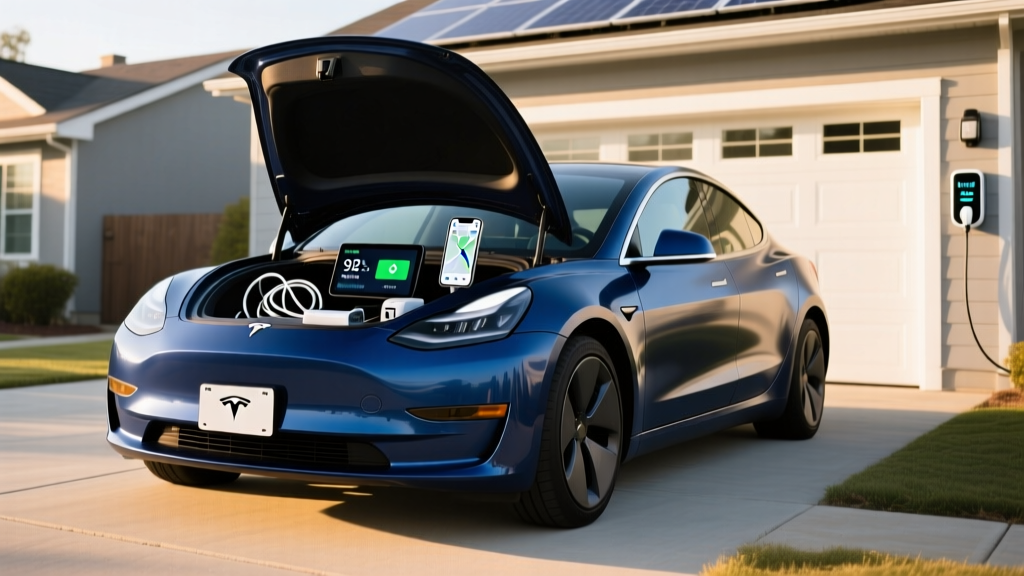
The Mobile Connector kit includes interchangeable adapter plugs and retails for $200 if purchased separately. It's IP-rated for outdoor use but not designed for permanent outdoor mounting — store it in the frunk or garage when not in use.
Tesla Wall Connector: The Dedicated Home Tesla Wire
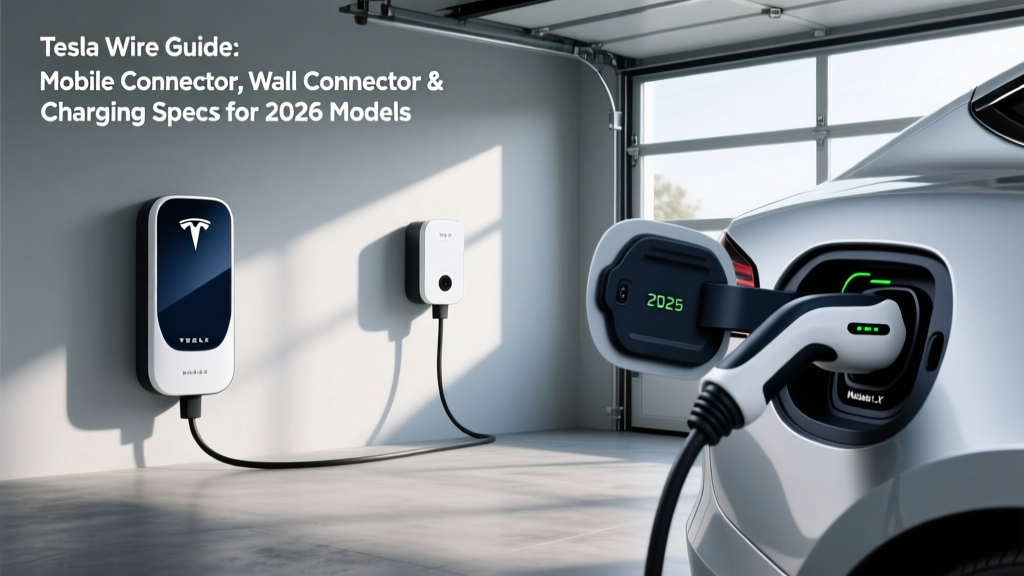
For daily home charging, the Tesla Wall Connector is the gold standard. Hardwired to a 60-amp circuit (48A continuous), it delivers up to 11.5 kW — enough to add ~44 miles of range per hour on a Model 3 or Model Y.
| Spec | Wall Connector (Hardwired 60A) | Mobile Connector (NEMA 14-50) |
|---|---|---|
| Max Power | 11.5 kW (48A) | 7.7 kW (32A) |
| Miles/HR (Model Y) | ~44 mi/hr | ~30 mi/hr |
| Full Charge (82 kWh) | ~7-8 hours | ~10-11 hours |
| Installation Cost | $500-$1,500 (electrician + permit) | $0 (if 14-50 exists) or $300-$800 |
| Wi-Fi / OTA Updates | Yes | No |
| Load Sharing (2+ units) | Yes | No |
Installation reality check: The Wall Connector unit itself costs $475 from Tesla. But installation varies wildly based on your electrical panel. A simple install (panel nearby, no upgrade needed) runs $500-$800. If your home has a 100-amp panel and needs a 200-amp upgrade, expect $2,000-$4,000 total. Always get a quote from a licensed electrician before purchasing — the Tesla Home Charging page lists certified installers by zip code.
NACS: The Tesla Wire Standard Now Powering the Industry
In 2024-2025, Tesla's proprietary connector was formally adopted as the North American Charging Standard (NACS). By 2026, nearly every major automaker — Ford, GM, Rivian, Hyundai, Kia, Volvo, BMW, Mercedes — has transitioned to NACS for new EVs. This means:
- Tesla Superchargers now serve non-Tesla EVs (via the Tesla app and NACS plug)
- Non-Tesla EVs can access the 25,000+ Supercharger network without adapters
- CCS adapters are available for older Teslas (Model S/X pre-2025) that need to use legacy CCS networks
The NACS connector is physically smaller and lighter than CCS, with no locking mechanism required. For Tesla owners, this means your "Tesla wire" ecosystem is now the dominant charging standard in North America — a significant long-term ownership advantage as public infrastructure standardizes around NACS.
DC Fast Charging: Tesla Supercharger Speeds in 2026
When people search "Tesla wire," they're often asking about Supercharger speeds. Here's the 2026 reality:
| Vehicle | Peak DC Charge Rate | 10-80% Time | Max Range Added in 15 Min |
|---|---|---|---|
| Model 3 (Highland, 2024+) | 250 kW | ~25 min | ~175 miles |
| Model Y (Juniper, 2025+) | 250 kW | ~22 min | ~190 miles |
| Cybertruck | 350 kW (V4 stalls) | ~18 min | ~200 miles |
| Model S / Model X (2026) | 250 kW | ~28 min | ~160 miles |
Charging curve reality: Peak kW is not sustained kW. A Model Y hits 250 kW only between 10-30% State of Charge (SoC), then tapers to ~150 kW by 50%, and ~75 kW above 80%. This is why Tesla quotes "10-80%" times — charging above 80% is painfully slow and should be avoided on road trips unless necessary. Preconditioning the battery (automatic when navigating to a Supercharger) is critical to hitting peak speeds; without it, expect 30-50% slower charging in cold weather.
Tesla Wire Compatibility: What Fits What in 2026?
With NACS now the industry standard, connector compatibility has simplified — but there are still edge cases:
| Charger / Cable | Tesla (2020-2026) | Non-Tesla NACS (Ford, GM, etc.) | Legacy CCS Vehicles |
|---|---|---|---|
| Tesla Mobile Connector | ✓ Native | ✓ Native (NACS) | ✗ (requires NACS-to-CCS adapter) |
| Tesla Wall Connector | ✓ Native | ✓ Native (NACS) | ✗ (requires adapter, not recommended) |
| Tesla Supercharger (NACS) | ✓ Native | ✓ Native (via Tesla app) | ✓ (with Magic Dock adapter at select stalls) |
| Electrify America / EVgo (CCS) | ✓ (with CCS adapter, $175 from Tesla) | ✗ (NACS vehicles need CCS-to-NACS adapter) | ✓ Native |
Key takeaway: If you own a 2026 Tesla, your NACS "Tesla wire" is now the universal plug. The only scenario where you need an adapter is accessing legacy CCS networks (Electrify America, some EVgo stations) — Tesla sells a CCS adapter for $175. For 95%+ of your charging, the native NACS connection is all you need.
Cost to Charge: Tesla Wire Economics vs. Gas
Charging at home with your Tesla wire (Mobile Connector or Wall Connector) is dramatically cheaper than gas. Here's the 2026 math:
- Home electricity (national avg): $0.16/kWh
- Tesla Model Y (82 kWh battery): $13.12 for a full charge
- Model Y range (EPA): 320 miles
- Cost per mile (home): $0.041
- Gas equivalent (25 MPG, $3.50/gal): $0.14/mile
That's a 3.4x cost advantage for home charging. Supercharger pricing varies by location and time-of-use, typically $0.28-$.40/kWh — still 40-60% cheaper than gas per mile, but not the bargain that home charging is. For maximum savings, pair your Wall Connector with a time-of-use utility plan and charge overnight at off-peak rates ($0.08-$0.12/kWh in many markets).
Installation & Safety: What Your Electrician Needs to Know
Before buying a Wall Connector, understand the electrical requirements:
- Circuit: 60-amp dedicated circuit (breaker), 48A continuous draw
- Wire gauge: 6 AWG copper (or 4 AWG aluminum) for a 60A circuit
- Panel capacity: Your main panel must have spare capacity. A 200-amp panel with existing heavy loads (electric heat, dryer, oven) may need a load calculation or upgrade
- Permit: Most jurisdictions require an electrical permit ($50-$200) and inspection
- Alternative: If a 60A circuit isn't feasible, the Wall Connector can be configured for 40A or 32A circuits — consult your electrician
Never use extension cords or adapter chains to extend your Tesla wire. Voltage drop over long extension cords reduces charging speed and creates fire risk. If your parking spot is far from the panel, budget for proper conduit and wire runs.
FAQ: Tesla Wire Questions Answered
Can I use a Tesla Wall Connector with a non-Tesla EV?
Yes. Since 2025, the Wall Connector ships with a NACS plug, which is now the standard connector on Ford, GM, Rivian, Hyundai, and other 2026 EVs. Any NACS-equipped vehicle can use the Tesla Wall Connector for Level 2 home charging.
Is the Tesla Mobile Connector waterproof?
The Mobile Connector is rated for outdoor use (IP-rated) and can handle rain. However, Tesla recommends storing it indoors when not in use to prevent UV degradation and connector corrosion over time. Never submerge the connector or use it in standing water.
How long is the Tesla Wall Connector cable?
The Wall Connector comes with a 24-foot cable (standard) or 18-foot cable. The 24-foot version is recommended for most installations to provide flexibility in parking position. Tesla also offers an 8.5-foot "Gen 3" cable for tight garage setups.
Do I need a Tesla wire adapter for public charging?
In 2026, most public DC fast-charging networks (Tesla Superchargers, many Electrify America and EVgo stations) have transitioned to NACS. If you encounter a legacy CCS-only charger, Tesla's CCS adapter ($175) enables compatibility. For Level 2 public charging (J1772 connectors at hotels, malls), Tesla includes a J1772 adapter with every vehicle.
What's the warranty on Tesla charging cables?
The Mobile Connector and Wall Connector carry a 4-year warranty from Tesla. The vehicle's charge port and onboard charger are covered under Tesla's 8-year/100,000-mile (Model 3/Y) or 8-year/150,000-mile (Model S/X) battery and drive unit warranty.
Can I charge my Tesla with solar panels?
Yes. The Wall Connector integrates with Tesla's Solar Inverter and Powerwall via the Tesla app, allowing you to prioritize solar-generated electricity for charging. This can reduce your effective charging cost to near-zero during peak solar production hours. Third-party solar systems also work — any grid-tied solar reduces your net electricity cost.
Verdict: Which Tesla Wire Setup Is Right for You?
Choose the Mobile Connector (120V) if: You drive <30 miles/day, have no 240V outlet, and need a temporary/emergency charging solution.
Choose the Mobile Connector (NEMA 14-50) if: You already have a 240V dryer/RV outlet, rent your home, or want portability for travel.
Choose the Wall Connector (hardwired 60A) if: You own your home, drive 40+ miles/day, want fastest home charging, and plan to stay 3+ years.
Skip Tesla hardware if: You're a non-Tesla EV owner with a NACS vehicle — third-party NACS Wall Connectors (ChargePoint, Emporia) offer similar performance at competitive prices.
The "Tesla wire" ecosystem in 2026 is mature, reliable, and now industry-standard. For most owners, the combination of a hardwired Wall Connector at home and the Supercharger network on the road provides the most seamless charging experience in the EV market. Budget $500-$1,500 for professional installation, pair it with a time-of-use utility plan, and you'll charge for pennies per mile while adding 44 miles of range every hour you're plugged in.
Sources: Tesla Home Charging Installation, U.S. Department of Energy EV Charging, IRS Clean Vehicle Credits