You've seen the Tesla bumper sticker slogans — love them or hate them, they've become shorthand for the EV debate. But strip away the tribalism, the memes, and the Twitter discourse, and the 2026 Tesla Model 3 remains one of the most data-dense electric sedans on the market. With a refreshed Highland platform, updated battery chemistry, and continued Supercharger network dominance, the Model 3 earns its place in driveways based on engineering, not bumper-sticker bravado.
This review cuts through the noise with hard numbers: real-world range reconciliation, charge-curve behavior, §30D tax credit mechanics, and the ownership economics that actually matter when you're signing a purchase agreement.
2026 Tesla Model 3: Core Specifications at a Glance
| Specification | RWD (Base) | Long Range AWD | Performance AWD |
|---|---|---|---|
| EPA Range | 272 mi | 341 mi | 315 mi |
| Battery (usable) | ~60 kWh (LFP) | ~75 kWh (NMC) | ~75 kWh (NMC) |
| Drivetrain | Rear-Wheel Drive | Dual-Motor AWD | Dual-Motor AWD |
| 0-60 mph | 5.8 sec | 4.2 sec | 2.9 sec |
| Horsepower | 271 hp | 346 hp | 510 hp |
| MPGe (combined) | 132 MPGe | 134 MPGe | 121 MPGe |
| Efficiency (kWh/100mi) | 25 kWh/100mi | 25 kWh/100mi | 28 kWh/100mi |
| Peak DC Fast Charge | 170 kW | 250 kW | 250 kW |
| 10-80% DC Time | ~28 min | ~25 min | ~25 min |
| Level 2 Home Charge | 11.5 kW (~44 mi/hr) | 11.5 kW (~44 mi/hr) | 11.5 kW (~44 mi/hr) |
| Base MSRP | $38,990 | $45,490 | $52,990 |
| Battery Warranty | 8 yr / 100,000 mi | 8 yr / 120,000 mi | 8 yr / 120,000 mi |
Source: EPA fueleconomy.gov and Tesla official order pages. Prices reflect 2026 model year, destination included.
Real-World Range: What the EPA Sticker Doesn't Tell You
Long Range AWD: EPA 341 miles. Expect ~280-310 miles in mixed highway driving (70-80 mph sustained), and ~230-260 miles in freezing temperatures with cabin heating active.
RWD (LFP): EPA 272 miles. Expect ~225-250 miles highway, ~190-210 miles in deep cold. LFP chemistry holds voltage more consistently but has lower energy density, meaning less total buffer.
The Model 3 Highland's thermal management system is among the best in the industry — Tesla's heat pump (standard on all trims) recovers waste heat from the drivetrain to warm the cabin, reducing the cold-weather range penalty compared to resistive-heating EVs. However, physics is physics: any battery loses 15-30% of usable capacity below 20°F, and the Model 3 is no exception.
On a 75°F day at 65 mph, the Long Range AWD can stretch past 320 real-world miles. Push that to 80 mph on an interstate in Arizona summer heat with A/C blasting, and you'll see closer to 275. This is consistent with IIHS testing protocols and independent EV range loops.
Charging Speed: DC Fast, Level 2, and the Charge-Curve Reality
| Charging Method | Power | Miles Added Per Hour | Notes |
|---|---|---|---|
| Level 1 (120V outlet) | ~1.2 kW | ~3-5 mi/hr | Emergency/top-up only |
| Level 2 (240V, 48A) | 11.5 kW | ~44 mi/hr | Full charge overnight (~7-8 hrs) |
| DC Fast (RWD peak) | 170 kW | ~700+ mi/hr (peak) | 10-80% in ~28 min; tapers hard above 80% |
| DC Fast (LR/Perf peak) | 250 kW | ~1,000+ mi/hr (peak) | 10-80% in ~25 min; tapers above 80% |
kW vs kWh reminder: kW is the rate of charging (like water flow from a hose); kWh is the total battery capacity (the size of the tank). A 250 kW peak doesn't mean you're charging at 250 kW the entire session.
The Model 3 Long Range peaks at 250 kW on a V3 Supercharger but sustains that peak only between roughly 10-30% State of Charge (SoC). From 30-60%, it tapers to ~175 kW; from 60-80%, it drops to ~100 kW. Above 80%, expect sub-50 kW speeds as the Battery Management System (BMS) protects cell longevity. This is why Tesla's own navigation system targets 80% for road-trip stops — pushing past 80% on a DC charger is rarely time-efficient.
For home charging, a Wall Connector or equivalent Level 2 station on a 60-amp circuit delivers 11.5 kW, adding ~44 miles per hour of charging. Most owners plug in nightly and wake up full — the real question is whether your home electrical panel supports a 60-amp dedicated circuit (many 100-amp panels will need an upgrade, costing $1,500-$3,000 depending on your region).
Battery Chemistry: LFP vs NMC in the Model 3 Lineup
Tesla uses two distinct battery chemistries across the Model 3 range, and the choice matters for how you own the car:
| Factor | LFP (RWD Base) | NMC (Long Range / Performance) |
|---|---|---|
| Energy Density | Lower (~160 Wh/kg) | Higher (~260 Wh/kg) |
| Cycle Life | 3,000+ cycles | 1,500-2,000 cycles |
| Cold Performance | Weaker below 32°F | Better in cold climates |
| Charging to 100% | Recommended weekly for calibration | Avoid daily 100%; target 80-90% |
| Cobalt Content | Zero cobalt | Contains cobalt/nickel |
| Weight | Heavier per kWh | Lighter per kWh |
The RWD Model 3 uses CATL-sourced LFP (Lithium Iron Phosphate) cells. LFP's key advantage is longevity — Tesla's own data and third-party fleet analyses show LFP packs degrading less than 10% over 200,000 miles. The trade-off is lower energy density (hence the shorter 272-mile EPA range) and reduced performance in sub-freezing temperatures.
The Long Range and Performance trims use NMC (Nickel Manganese Cobalt) chemistry with higher energy density, enabling the 341-mile range and stronger cold-weather performance. However, Tesla recommends daily charging to 80-90% for NMC packs to minimize calendar degradation — you'll only charge to 100% before long trips.
Performance, Interior Space, and Technology
The 2026 Model 3 Highland refresh addressed the most common complaints about earlier models: ride quality, cabin noise, and material finish. Acoustic glass, revised suspension tuning, and ventilated front seats are now standard across all trims.
Passenger and cargo dimensions:
- Front headroom: 40.3 in | Rear headroom: 37.8 in
- Front legroom: 42.7 in | Rear legroom: 35.2 in
- Trunk: 23 cu ft | Frunk (front trunk): 3.1 cu ft
- Total cargo: 26.1 cu ft (rear seats upright)
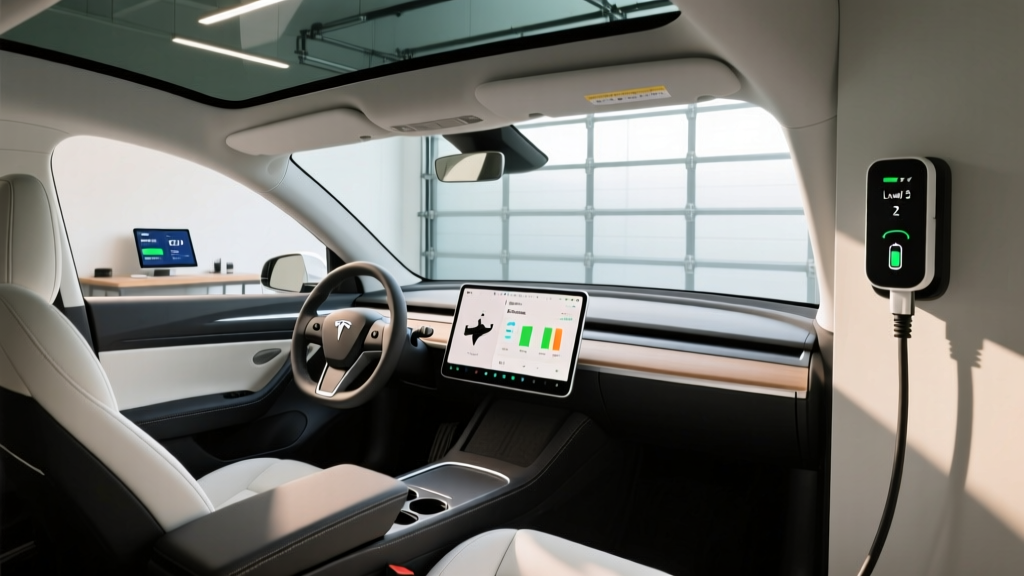
The rear seat remains tighter than a Hyundai Ioniq 6 or BMW i4, and the lack of a traditional instrument cluster (everything routes through the 15.4-inch center touchscreen) continues to polarize buyers. Rear passengers get their own 8-inch screen for climate and media controls — a Highland addition.
Driver assistance: Basic Autopilot (lane centering + adaptive cruise) is standard. Enhanced Autopilot ($6,000) adds auto lane change, navigate-on-autopilot, and auto park. Full Self-Driving (Supervised) remains a $8,000 add-on or $99/month subscription.
Despite the "Full Self-Driving" branding, Tesla's FSD (Supervised) is a Level 2 driver-assist system under SAE J3016 definitions. The driver must remain actively engaged, hands on or near the wheel, and eyes on the road at all times. This is not autonomous driving. Level 4 systems (no driver required) are currently limited to geofenced robotaxi services like Waymo in select cities.
Pricing, Trims, and Federal Tax Credit Eligibility
| Trim | Base MSRP | As-Tested (common config) | §30D Credit Eligibility | Effective Price (with credit) |
|---|---|---|---|---|
| RWD | $38,990 | $40,490 (w/ paint + wheels) | Eligible — up to $7,500 | ~$31,490 - $32,990 |
| Long Range AWD | $45,490 | $47,990 (w/ FSD sub + paint) | Eligible — up to $7,500 | ~$37,990 - $40,490 |
| Performance AWD | $52,990 | $55,490 (w/ Track Pack) | Eligible — up to $7,500 | ~$45,490 - $47,990 |
IRS §30D tax credit rules (2026): The federal EV tax credit offers up to $7,500 for qualifying new EVs, but eligibility hinges on three interlocking requirements:
- MSRP cap: Sedans must be under $55,000 MSRP (all Model 3 trims qualify)
- Buyer income cap: AGI ≤ $150,000 (single) / $300,000 (joint) / $225,000 (head of household)
- Battery sourcing: Critical minerals and battery components must meet phased-in domestic/free-trade sourcing thresholds — Tesla's US-built battery packs currently meet these requirements, but verify at purchase as rules tighten annually
- Point-of-sale transfer: As of 2024+, the credit can be applied at purchase as an instant rebate rather than waiting for tax filing
Always verify current eligibility on IRS.gov before signing a purchase agreement. Sourcing rules change annually, and a model that qualifies in January may face partial credit reduction by December depending on supply-chain shifts.
Pros and Cons: The Honest Assessment
Pros
- Best-in-class Supercharger network reliability (17,000+ US stalls)
- Excellent efficiency: 25 kWh/100mi translates to ~$0.04-$0.05/mile at home charging rates
- Over-the-air updates continuously add features
- LFP battery longevity in the RWD trim is outstanding
- Strong resale value relative to most EV competitors
- Heat pump standard — cold-weather efficiency advantage
Cons
- Touchscreen-only controls (no physical buttons for climate, wipers, or glovebox)
- Rear seat space is tight for taller passengers vs. Ioniq 6 or BMW i4
- FSD (Supervised) costs $8,000 and remains Level 2 — not autonomous
- Insurance premiums run 15-25% higher than comparable gas sedans
- RWD LFP battery struggles in sustained sub-20°F climates
- No Apple CarPlay or Android Auto — Tesla-only ecosystem
Who Should Buy the 2026 Model 3?
Choose the Model 3 RWD if: You commute under 40 miles daily, charge at home, live in a moderate climate, and want the lowest entry price with maximum battery cycle life. The LFP pack is built to outlast the car.
Choose the Model 3 Long Range AWD if: You road-trip regularly (200+ miles between stops), live in a cold climate, or need dual-motor traction for snow. The 341-mile EPA range gives real 280-mile highway comfort.
Choose the Model 3 Performance if: You want a genuine sports sedan that happens to be electric — 2.9-second 0-60, Track Mode, and adaptive dampers. Just accept the range trade-off and higher insurance cost.
Look elsewhere if: You need rear-seat space for tall adults (Ioniq 6 is roomier), you demand physical buttons (BMW i4), or you want Apple CarPlay integration (Hyundai, Ford, BMW).
Frequently Asked Questions
What is the real-world range of the 2026 Tesla Model 3?
The Long Range AWD delivers an EPA-estimated 341 miles, but real-world highway driving at 75 mph yields approximately 280-310 miles in moderate temperatures. In freezing conditions (below 20°F), expect 230-260 miles with cabin heating active. The RWD LFP model (EPA 272 miles) delivers roughly 225-250 miles highway and 190-210 in deep cold.
How fast does the Model 3 charge at home and on DC fast chargers?
On a 240V Level 2 home charger (48A/11.5 kW), the Model 3 adds approximately 44 miles of range per hour — a full overnight charge from 20% to 100% takes about 7-8 hours. On DC fast chargers, the Long Range and Performance trims peak at 250 kW, reaching 10-80% in roughly 25 minutes. The RWD peaks at 170 kW, taking about 28 minutes for the same 10-80% session. Charging slows substantially above 80% SoC to protect battery health.
How much does the Model 3 cost after the federal EV tax credit?
The RWD Model 3 starts at $38,990 MSRP and can drop to approximately $31,490 after the full $7,500 §30D federal credit — assuming your income falls within the cap ($150K single / $300K joint) and the battery sourcing requirements are met at the time of purchase. The Long Range AWD drops from $45,490 to roughly $37,990. Always verify current eligibility at IRS.gov before purchasing, as sourcing thresholds tighten each year.
Does the 2026 Tesla Model 3 qualify for the full $7,500 federal tax credit?
As of early 2026, all three Model 3 trims qualify for the full $7,500 credit because they are assembled in the US (Fremont, CA), their MSRPs fall under the $55,000 sedan cap, and Tesla's battery supply chain meets the critical-minerals and component-sourcing thresholds. However, buyer income caps apply, and sourcing rules are subject to annual changes. The credit can now be transferred at point of sale as an instant rebate.
Is the Model 3 worth buying versus competitors like the Ioniq 6 or BMW i4?
The Model 3 wins on Supercharger network access, efficiency (25 kWh/100mi is best-in-class), and long-term software support. The Hyundai Ioniq 6 offers a more spacious rear seat and physical controls at a similar price. The BMW i4 provides a more traditional luxury interior with Apple CarPlay but charges at a slower DC peak (205 kW) and costs more. If Supercharger reliability and OTA updates matter most, the Model 3 still leads. If interior space or CarPlay are dealbreakers, cross-shop the Ioniq 6.
What's the biggest drawback of owning a Tesla Model 3?
The touchscreen-only interface is the most common owner complaint — adjusting climate, wipers, mirrors, and even opening the glovebox requires navigating menus while driving. Insurance costs also run 15-25% higher than equivalent gas sedans due to repair-cost data. And while FSD (Supervised) is marketed aggressively, it remains a Level 2 system requiring full driver attention — it is not self-driving.
How long will the Model 3 battery last?
Tesla warranties the battery for 8 years/100,000 miles (RWD) or 8 years/120,000 miles (Long Range/Performance), guaranteeing at least 70% capacity retention over that period. Fleet data shows LFP packs in the RWD trim losing roughly 5-8% capacity over 150,000 miles, while NMC packs in the Long Range lose 8-12% over the same distance. Replacement cost, if needed out of warranty, runs approximately $12,000-$16,000 depending on the pack.