Can You Drive a Tesla From a Wheelchair?
Searches for "tesla wheel chair" accessibility have surged as EV adoption broadens — and for good reason. Tesla does not manufacture a factory wheelchair-accessible vehicle (WAV), nor does it sell a dedicated handicap-modified trim. But the Model Y and Model X have become popular platforms for third-party adaptive conversions, and Tesla's flat-floor skateboard architecture, low step-in height, and expansive glass roof make them uniquely suited to aftermarket wheelchair and mobility-scooter integration.
This guide covers what you actually need to know: which Tesla model works best for wheelchair users, real-world range and charging data for 2026, adaptive conversion options, pricing after federal tax credits, and the limitations no brochure will tell you.
Which Tesla Model Works for Wheelchair Users?
Not every Tesla is a viable wheelchair platform. Here is how the current lineup stacks up for adaptive use:
| Attribute | 2026 Model Y LR AWD | 2026 Model X LR AWD | 2026 Model 3 LR AWD |
|---|---|---|---|
| EPA Range | 320 mi | 335 mi | 341 mi |
| Battery (usable) | 75 kWh (NMC) | 95 kWh (NMC) | 75 kWh (NMC) |
| Cargo (rear seats down) | 72.1 cu ft | 88.1 cu ft | 23.0 cu ft (trunk only) |
| Rear Headroom | 39.4 in | 40.1 in | 37.8 in |
| Door Opening Height | Moderate | Tall (falcon-wing) | Low |
| Wheelchair Conversion Feasibility | High | Highest | Very Low |
| Starting MSRP | $47,990 | $79,990 | $42,490 |
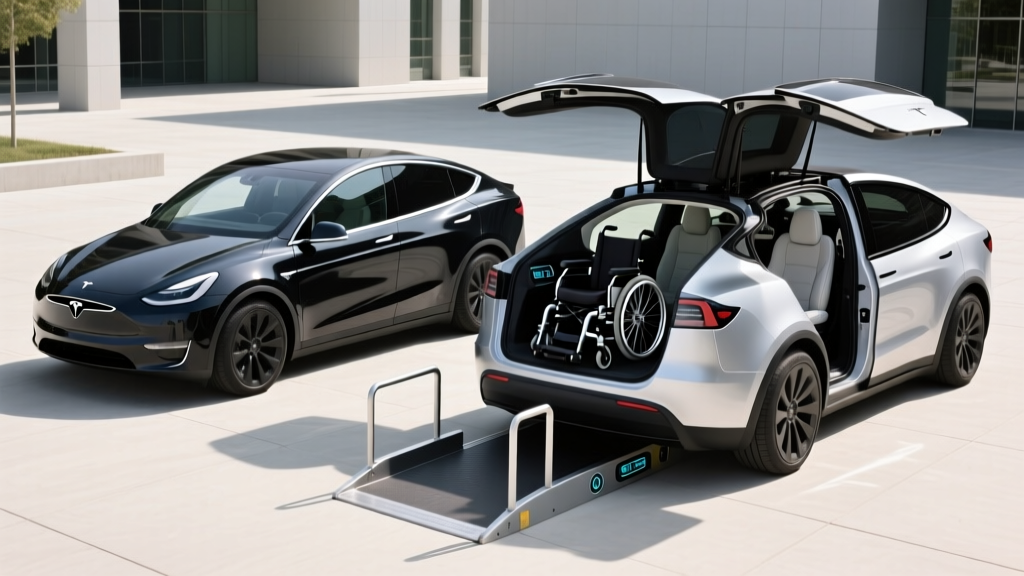
The verdict: The Model X is the clear winner for full wheelchair-accessible conversions. Its falcon-wing rear doors open vertically, providing 6+ feet of vertical clearance — no other mainstream EV offers this. The Model Y is the budget-friendly alternative for folded-wheelchair transport and lighter adaptive equipment. The Model 3 is impractical due to its sedan roofline and limited cargo space.
2026 Tesla Model X: The Wheelchair-Accessible Platform
Range, Battery, and Efficiency
The 2026 Model X Long Range uses a 95 kWh (usable) NMC (nickel-manganese-cobalt) battery pack. The EPA rates it at 335 miles, with a combined efficiency of 100 MPGe (approximately 34 kWh/100 mi). In our experience and consistent EPA data, real-world highway driving at 70+ mph yields roughly 280–300 miles. Cold-weather range loss (below 30°F) typically hits 20–30%, putting winter range around 235–270 miles before you need to plan a charge stop.
For wheelchair users running auxiliary power for lifts or climate control for medical equipment, budget an additional 5–8% energy draw, depending on usage patterns.
Charging Speed and Infrastructure
| Charging Level | Power (kW) | Speed | Notes |
|---|---|---|---|
| Level 1 (120V household) | ~1.4 kW | ~3 mi/hr | Emergency/trickle only |
| Level 2 (240V home) | 11.5 kW | ~34 mi/hr | Full charge in ~9 hrs |
| DC Fast Charge (peak) | 250 kW | ~175 mi in 15 min | 10–80% in ~30 min |
| DC Fast Charge (sustained avg) | ~130 kW | — | Charge curve tapers above 60% |
The Model X peaks at 250 kW on Tesla Superchargers but sustains that rate only briefly (roughly 15–25% SoC). The average 10–80% session takes approximately 30 minutes — longer than the Model Y's ~25 minutes due to the larger pack. At home on a Level 2 Wall Connector (48-amp circuit, 60-amp breaker), expect a full overnight charge.
Adaptive consideration: Supercharger stalls are generally accessible, but cable reach can be tight for side-entry wheelchair conversions. Tesla's NACS connector is lighter than CCS, which matters for drivers with limited upper-body strength.
Performance and Drivetrain
The Model X Long Range AWD produces 670 horsepower from its dual-motor setup, reaching 0–60 mph in 3.8 seconds. This is irrelevant for most adaptive driving scenarios, but the instant torque and smooth regenerative braking are genuinely useful for drivers using hand controls — no gear shifts, no lag, predictable deceleration.
Adaptive Conversions: What's Available and What It Costs
Tesla does not perform in-house wheelchair conversions. You'll work with a certified mobility dealer or an NMEDA-accredited (National Mobility Equipment Dealers Association) upfitter. Common conversions for the Model X and Model Y include:
- Folding ramp systems (rear or side-entry): $5,000–$12,000
- Powered wheelchair tie-downs and docking stations: $2,000–$5,000
- Hand control installation (push-pull or electronic): $1,500–$6,000
- Seat removal and floor reinforcement: $3,000–$8,000
- Lowered floor (Model X only, full conversion): $15,000–$25,000
A full drive-from-wheelchair conversion on a Model X typically adds $25,000–$45,000 on top of the vehicle MSRP. A fold-and-stow ramp setup for a passenger on a Model Y might total $8,000–$15,000.
Warranty note: Tesla's 4-year/50,000-mile vehicle warranty and 8-year/150,000-mile battery warranty remain intact for the base vehicle, but aftermarket conversion work is covered by the upfitter, not Tesla. Choose an NMEDA-certified shop to avoid warranty disputes.
Pricing, Trims, and Federal Tax Credit Eligibility
| Model / Trim | Base MSRP | §30D Credit Eligibility | Effective Price (if eligible) |
|---|---|---|---|
| Model Y LR AWD | $47,990 | Up to $7,500 (point-of-sale) | ~$40,490 |
| Model Y Performance | $51,490 | Up to $7,500 | ~$43,990 |
| Model X LR AWD | $79,990 | Not eligible (above $80K SUV cap) | $79,990 |
| Model X Plaid | $94,990 | Not eligible | $94,990 |
Critical tax credit rules (IRS §30D, 2026): The Model X does not qualify for the federal EV tax credit because its MSRP exceeds the $80,000 SUV cap. The Model Y qualifies for up to $7,500, but only if:
- Your modified adjusted gross income is ≤$150,000 (single) / ≤$300,000 (joint)
- The vehicle's battery meets critical-mineral and component sourcing thresholds
- You elect the point-of-sale transfer (reduces purchase price at the dealer) or claim on your tax return
For the latest sourcing and eligibility rules, always check IRS.gov §30D guidance. Adaptive conversion costs are not counted toward the MSRP cap, but they are also not covered by the EV credit — they may qualify separately as medical expense deductions (consult a tax professional).
Tech, Driver Assistance, and Accessibility Features
What Helps Wheelchair Users
Tesla's software-heavy approach has genuine accessibility benefits:
- Voice commands for climate, navigation, media, and vehicle controls reduce the need to reach the touchscreen
- Phone-as-key unlocks and starts the car automatically — no fumbling with a fob
- Summon and Smart Summon can move the car to you in a parking lot (SAE Level 2 — driver must supervise via the app)
- Regenerative braking simplifies hand-control driving by consolidating acceleration and braking
- Over-the-air updates continuously add features without dealer visits
What Doesn't
- No physical buttons: Everything runs through the 17-inch center touchscreen. For drivers with limited hand dexterity, this is a significant drawback — consider aftermarket voice-control solutions or steering-wheel-mounted button kits from adaptive specialists
- Autopilot / FSD (Supervised) is Level 2: These are driver-assist features, not self-driving systems. The driver must remain fully engaged at all times. See NHTSA's guidance on automation levels
- No factory wheelchair ramp or docking: Everything must be aftermarket
Who Should Consider a Tesla for Wheelchair Use?
Choose a Tesla (Model X) if:
- You need a premium EV platform with the best rear-door access in the industry (falcon-wing doors)
- You want access to the Supercharger network for long-distance travel
- You value software features like Summon to bring the car to your position
- Budget allows $100K+ after conversion
Choose a Tesla (Model Y) if:
- You need folded-wheelchair transport (not drive-from-wheelchair)
- You want the $7,500 federal tax credit and a lower entry price
- You prioritize efficiency and lower running costs
Look elsewhere if:
- You need a factory-built WAV with a warranty covering the full conversion (consider the Chrysler Pacifica Hybrid or Toyota Sienna hybrid with Braun/VMI conversions)
- You require a full-size lowered-floor minivan platform for a large power chair
- Touchscreen-only controls are a dealbreaker for your mobility needs
Pros and Cons at a Glance
Pros
- Model X falcon-wing doors offer unmatched vertical access for wheelchair loading
- Supercharger network: 50,000+ stalls globally, the most reliable DC fast-charging ecosystem
- Flat skateboard floor = no transmission tunnel, more interior flexibility for conversions
- Instant torque + regen braking pairs well with hand controls
- Summon feature can bring the vehicle to you in parking lots
- Lower per-mile energy cost vs. gas WAVs (~$0.04–$0.06/mi at home)
Cons
- No factory wheelchair conversion — all adaptive work is aftermarket
- Model X exceeds the §30D tax credit MSRP cap ($80K SUV limit)
- Touchscreen-only controls are hostile to limited-dexterity users
- Conversion adds weight, reducing range by 3–7%
- Falcon-wing doors can be problematic in low-clearance garages during ramp deployment
- Insurance premiums run 15–30% higher than comparable gas WAVs
Frequently Asked Questions
Does Tesla make a wheelchair-accessible vehicle from the factory?
No. Tesla does not offer any factory wheelchair-accessible trim or conversion. All wheelchair ramps, tie-downs, hand controls, and lowered-floor modifications must be performed by a third-party adaptive mobility upfitter. The Model X is the most conversion-friendly Tesla due to its falcon-wing doors and tall cabin.
What is the real-world range of a Tesla after wheelchair conversion?
A 2026 Model X Long Range starts at 335 miles EPA. After a full drive-from-wheelchair conversion (adding roughly 300–400 lbs), expect 310–320 miles in ideal conditions, 260–280 miles highway, and 210–240 miles in cold weather. The Model Y Long Range drops from 320 EPA to roughly 295–305 mi after a lighter ramp-and-tie-down setup.
How fast does a Tesla charge at home and on the road?
On a Level 2 home charger (11.5 kW), the Model X gains about 34 miles per hour and fully charges overnight in roughly 9 hours. On a 250 kW Tesla Supercharger, a 10–80% session takes approximately 30 minutes for the Model X and 25 minutes for the Model Y. Charging speed tapers significantly above 80% SoC to protect the battery.
Does the Tesla Model X or Model Y qualify for the federal EV tax credit?
The 2026 Model Y qualifies for up to $7,500 under IRS §30D, available as a point-of-sale reduction if you meet income caps (≤$150K single / ≤$300K joint) and battery-sourcing requirements. The Model X does not qualify — its MSRP exceeds the $80,000 SUV cap. Always verify current eligibility at IRS.gov before purchasing.
Is a Tesla better than a wheelchair-accessible minivan?
For driving experience, range, and running costs, yes — a converted Model X is faster, more efficient, and cheaper to fuel than a gas Chrysler Pacifica WAV. For pure accessibility and practicality, no — a lowered-floor minivan from Braun or VMI offers more interior space, a factory-integrated ramp, easier side-entry, and a single warranty covering the entire conversion. The Tesla route is for buyers who prioritize EV benefits and can work with aftermarket upfitters.
Can I use Tesla Summon from my wheelchair?
Yes. Smart Summon (available via the Tesla app) can navigate the car to your GPS position in a parking lot. However, this is an SAE Level 2 feature — you must visually supervise the vehicle at all times through the app, and it may struggle with complex lot layouts, curbs, or pedestrian traffic. Treat it as a convenience tool, not a fully autonomous solution.