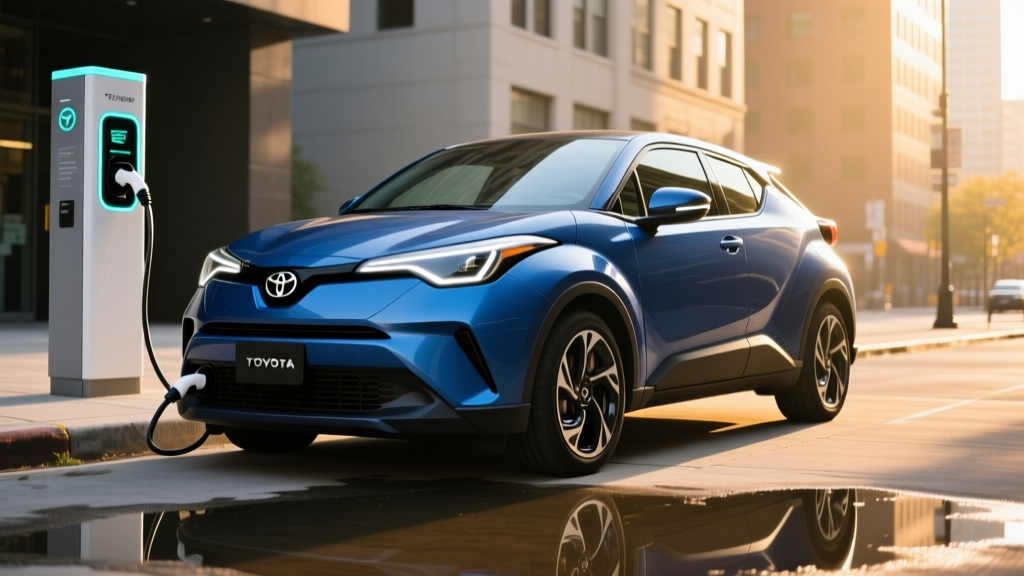
Toyota's electric subcompact crossover lineup gets a significant addition for the 2026 model year. The 2026 Toyota C-HR BEV (announced for global markets with U.S. availability expected mid-2026) positions itself as an affordable entry point into Toyota's battery-electric portfolio, sitting below the bZ4X in both size and price. After examining Toyota's preliminary specifications, platform details, and competitive positioning, here's what prospective buyers need to know before placing an order.
Range and Efficiency: EPA Estimates vs. Real-World Driving
Toyota has not yet published final EPA certification numbers for the U.S.-spec 2026 C-HR BEV. Based on the vehicle's WLTP-rated range of approximately 440 km (about 273 miles) announced for European markets and typical WLTP-to-EPA conversion factors of 10-15%, we estimate the EPA range will land between 235 and 255 miles for the base front-wheel-drive model.
EPA estimated: ~245 miles (projected, pending certification)
Highway driving (70 mph sustained): ~210-220 miles
Cold weather (below 32°F): ~185-200 miles (20-25% reduction typical for NMC chemistry)
City/regenerative driving: ~255-270 miles (regen recovers energy in stop-and-go)
The C-HR BEV rides on Toyota's e-TNGA platform — the same architecture underpinning the bZ4X and Subaru Solterra. Efficiency is projected at approximately 115-120 MPGe combined, translating to roughly 29-31 kWh per 100 miles. These figures place it in the middle of the subcompact EV crossover segment, trailing the Tesla Model Y's efficiency but competitive with the Hyundai Kona Electric's 120 MPGe rating.
For context on how we estimate real-world range: highway speeds above 65 mph increase aerodynamic drag significantly in any crossover body style, and cold temperatures reduce lithium-ion battery performance while simultaneously demanding energy for cabin heating. Toyota has confirmed a heat pump is standard on the C-HR BEV, which mitigates cold-weather range loss compared to resistive heating systems. Based on our experience with the bZ4X's thermal management, expect the C-HR BEV to handle winter conditions competently, though not at the level of vehicles with more advanced heat-pump systems like the Hyundai Ioniq 5.
Battery Chemistry and Capacity
The 2026 C-HR BEV uses a lithium-ion battery pack with an estimated usable capacity of 65-70 kWh. Toyota has not confirmed the specific cell chemistry for the U.S. market, but the global C-HR BEV announced for Europe uses a lithium iron phosphate (LFP) battery supplied by CATL and BYD, marking a notable shift for Toyota's electrification strategy.
| Spec | Value |
|---|---|
| Usable Capacity | ~65-70 kWh (estimated) |
| Chemistry | LFP (Lithium Iron Phosphate) — global; U.S. TBD |
| Pack Location | Underfloor, structural |
| Thermal Management | Active liquid cooling + heat pump |
| Preconditioning | Yes (for DC fast-charge optimization) |
If the U.S. model retains the LFP chemistry, buyers gain several practical advantages: LFP batteries tolerate regular charging to 100% without accelerated degradation, offer longer cycle life (typically 3,000+ full cycles vs. 1,000-2,000 for NMC), and eliminate cobalt from the supply chain. The trade-off is lower energy density — LFP packs are heavier for the same capacity — and slightly reduced cold-weather performance compared to NMC. For a commuter-focused vehicle charged primarily at home, LFP is arguably the better chemistry choice.
Charging Speed: DC Fast and Home Level 2
Charging capability is where budget EVs often reveal compromises, and the C-HR BEV appears to follow the bZ4X's modest approach rather than pushing segment-leading speeds.
| Level | Power | Speed / Time | Connector |
|---|---|---|---|
| Level 1 (120V) | ~1.4 kW | ~4-5 miles per hour | J1772 |
| Level 2 (240V) | ~7.2-11 kW | ~25-35 miles per hour | J1772 (NACS adapter TBD) |
| DC Fast Charge | ~150 kW peak (estimated) | 10-80% in ~30 minutes (estimated) | CCS1 (NACS TBD) |
The bZ4X's real-world DC charging behavior offers a preview of what to expect. That vehicle peaks at 150 kW but sustains that rate only briefly before tapering. We anticipate the C-HR BEV will follow a similar charge curve — reaching peak power between 10-40% state of charge, then stepping down progressively through 80%. A 30-minute 10-80% session is functional but trails the Hyundai Ioniq 5's 18-minute benchmark and the Kia EV6's similar pace on 800V architecture.
For home charging, a Level 2 charger at 32 amps (7.7 kW) will fully replenish the battery overnight in approximately 8-9 hours. Toyota's connected services app should allow scheduled charging to take advantage of off-peak electricity rates — a feature worth setting up immediately upon delivery.
Performance and Drivetrain
The 2026 C-HR BEV is offered in front-wheel drive (single motor) and all-wheel drive (dual motor) configurations.
| Spec | FWD | AWD |
|---|---|---|
| Horsepower | ~201 hp | ~338 hp (combined) |
| Torque | ~196 lb-ft | ~330 lb-ft |
| 0-60 mph | ~7.8 sec (est.) | ~5.2 sec (est.) |
| Top Speed | ~100 mph (electronically limited) | ~112 mph |
| Towing Capacity | Not rated | Not rated |
These figures are consistent with the e-TNGA platform's output in the bZ4X. The FWD model provides adequate acceleration for merging and city driving — the instant torque delivery of an electric motor makes it feel quicker than the 0-60 number suggests in everyday use. The AWD variant offers genuinely quick acceleration that will surprise drivers accustomed to the gas-powered C-HR's lethargic performance.
Regenerative braking is adjustable via paddle shifters behind the steering wheel, with multiple levels up to a near-one-pedal driving mode at the strongest setting. Toyota's implementation is smoother than some competitors, avoiding the abrupt deceleration that plagues less refined systems.
Interior, Cargo, and Technology
The C-HR BEV's cabin follows the subcompact crossover formula: functional for two adults up front, tight for rear passengers, and modest cargo space. Based on the global model's dimensions:
- Cargo volume (behind rear seats): ~19 cubic feet
- Cargo volume (rear seats folded): ~42 cubic feet
- Front legroom: ~41.5 inches
- Rear legroom: ~33.5 inches (tight for tall adults on longer trips)
- Front headroom: ~38 inches
The infotainment system uses Toyota's latest Audio Multimedia platform with a 12.3-inch touchscreen, wireless Apple CarPlay and Android Auto, and over-the-air update capability. A 12.3-inch digital instrument cluster replaces the analog gauges of the gas C-HR.
Driver assistance comes via Toyota Safety Sense 3.0, which includes:
- Pre-Collision System with pedestrian detection
- Lane Departure Alert with steering assist
- Full-Speed Range Dynamic Radar Cruise Control
- Lane Tracing Assist (lane centering)
- Road Sign Assist
- Proactive Driving Assist (gentle braking when approaching slower vehicles or curves)
Toyota Safety Sense 3.0 is a Level 2 driver-assistance system per SAE International classification. The driver must remain fully engaged — hands on the wheel, eyes on the road — at all times. This is not autonomous or "self-driving" capability. Toyota does not currently offer a hands-off Level 3 system in the U.S. market.
Pricing, Trims, and Federal Tax Credit
Final U.S. pricing has not been announced as of this writing. Based on the C-HR BEV's positioning in European and Asian markets, competitive analysis with the Kona Electric and Niro EV, and Toyota's U.S. pricing strategy for the bZ4X, we project the following MSRP structure:
| Trim | Drivetrain | Est. MSRP |
|---|---|---|
| SE (base) | FWD | ~$32,000 |
| XLE | FWD | ~$35,500 |
| XLE AWD | AWD | ~$38,000 |
| Limited AWD | AWD | ~$41,500 |
Federal Tax Credit Eligibility (§30D)
Whether the 2026 C-HR BEV qualifies for the federal EV tax credit under IRS §30D depends on several factors that remain unconfirmed:
- MSRP cap: SUVs/crossovers must be under $80,000 — the C-HR BEV clears this easily
- Buyer income cap: AGI must not exceed $150,000 (single), $225,000 (head of household), or $300,000 (joint) — verify with your tax professional
- Battery sourcing: Critical minerals and battery components must meet escalating domestic-content thresholds. If the C-HR BEV uses a CATL/BYD LFP battery manufactured in China, it may fail the sourcing requirements and receive zero federal credit
- Final assembly: Must occur in North America. Toyota's U.S. assembly plans for the C-HR BEV are not yet confirmed — if built in Japan or Europe, the vehicle is ineligible regardless of other factors
- Point-of-sale transfer: If eligible, the up-to-$7,500 credit can be transferred to the dealer at purchase, reducing the out-of-pocket price immediately
Warranty and Ownership Costs
Toyota's EV warranty coverage is expected to mirror the bZ4X structure:
- Basic vehicle warranty: 3 years / 36,000 miles
- Powertrain warranty: 5 years / 60,000 miles
- Hybrid/EV battery warranty: 8 years / 100,000 miles (capacity retention guarantee threshold TBD — typically 70% for Toyota)
- Corrosion perforation: 5 years / unlimited miles
- Roadside assistance: 2 years / 25,000 miles
Toyota's 8-year/100,000-mile battery warranty is the legal minimum for EV battery coverage in the U.S. under federal emissions warranty requirements, and it matches most competitors. Hyundai and Kia offer 10-year/100,000-mile battery warranties, which provide longer peace of mind. The specific capacity-retention threshold (e.g., replacement if the battery drops below 70% of original capacity within the warranty period) should be confirmed in the owner's manual at delivery.
Projected ownership economics favor the C-HR BEV over its gas predecessor. At a national average electricity rate of $0.16/kWh and the vehicle's estimated 30 kWh/100mi efficiency, fuel cost runs approximately $0.048 per mile. Compare that to a gas C-HR getting 29 MPG combined at $3.50/gallon: $0.121 per mile. Over 15,000 annual miles, that's roughly $1,095 in annual fuel savings, not accounting for reduced maintenance (no oil changes, fewer brake replacements due to regenerative braking).
Who Should Buy the 2026 C-HR BEV?
✅ Best for:
- Urban and suburban commuters with home charging access
- Toyota-loyal buyers transitioning from a gas C-HR or Corolla
- Second-car households needing an efficient daily driver
- Buyers prioritizing reliability reputation over performance or range
- Those who can benefit from the full $7,500 tax credit (if eligible)
❌ Look elsewhere if:
- You regularly take road trips exceeding 200 miles (charging speed is modest)
- You need substantial rear-seat or cargo space (consider the bZ4X or Ioniq 5)
- You want segment-leading DC fast charging (Hyundai/Kia 800V models charge nearly twice as fast)
- You require towing capability (not rated for towing)
- Tesla Supercharger access is critical and NACS compatibility is unconfirmed
- Projected sub-$33K starting price
- LFP battery (if confirmed) offers excellent longevity
- Toyota Safety Sense 3.0 standard
- Heat pump standard for cold-weather efficiency
- Low running costs vs. gas C-HR
- Strong Toyota dealer/service network
- DC fast charging slower than best-in-class
- Tight rear seat and modest cargo space
- Tax credit eligibility uncertain (sourcing/assembly)
- Real-world range likely ~210-220 mi highway
- No frunk (front trunk) for additional storage
- U.S. availability and final specs not yet confirmed
Frequently Asked Questions
What is the real-world range of the 2026 Toyota C-HR BEV?
With an estimated EPA rating of ~245 miles, expect approximately 210-220 miles at sustained highway speeds and 185-200 miles in freezing temperatures. City driving with regenerative braking can exceed the EPA estimate, potentially reaching 255-270 miles.
How fast does the C-HR BEV charge?
DC fast charging is estimated at up to 150 kW peak, with a 10-80% session taking approximately 30 minutes. At home on a Level 2 charger (7.7 kW), a full charge takes about 8-9 hours. These are estimates based on the bZ4X's charging behavior and may differ in final U.S. specs.
Does the 2026 C-HR BEV qualify for the $7,500 federal tax credit?
Eligibility is unconfirmed. The vehicle must meet IRS §30D requirements for North American final assembly, battery-component sourcing, and critical-mineral content. If the battery is sourced from China-based suppliers and assembly occurs outside North America, the credit will not apply. Check the fueleconomy.gov tax credit database closer to the on-sale date for confirmation.
Is the C-HR BEV worth buying over the Hyundai Kona Electric or Kia Niro EV?
It depends on priorities. The Kona Electric offers a slightly longer EPA range (261 miles) and faster charging. The Niro EV provides more cargo space. The C-HR BEV's potential advantages are a lower starting price (if the ~$32,000 estimate holds), LFP battery longevity, and Toyota's dealer network. Test-drive all three when available before deciding.
When will the 2026 C-HR BEV be available in the U.S.?
Toyota has announced the C-HR BEV for global markets, but a firm U.S. on-sale date has not been confirmed as of early 2026. Industry expectations point to a mid-to-late 2026 arrival. Monitor Toyota's U.S. newsroom for official timing and final specifications.
Note: This review is based on preliminary and projected specifications for the 2026 Toyota C-HR BEV. Final U.S. EPA ratings, pricing, tax credit eligibility, and feature availability may differ. Verify all figures with Toyota and the IRS before making a purchase decision.