Tesla Web Browser in the 2026 Model Y: A Full EV Review
If you have ever sat at a Supercharger watching the progress bar crawl past 60%, you have probably wondered what else the massive center touchscreen can do. The Tesla web browser is one of the most under-discussed features in the EV world — a full Chromium-based browser baked into the infotainment system that turns 20 minutes of charging downtime into productive or entertaining screen time. But a browser is only useful if the car it lives in is worth owning. This review covers the 2026 Tesla Model Y Long Range AWD end-to-end — range, charging, pricing, tax credits, and how the in-car browser fits into daily EV ownership.
| Spec | Value |
|---|---|
| EPA Range | 320 miles |
| Battery Capacity | 75 kWh usable (NMC lithium-ion) |
| Drivetrain | Dual-Motor AWD |
| Horsepower | 384 hp combined |
| 0–60 mph | 4.8 seconds |
| Max DC Fast Charge | 250 kW peak |
| 10–80% DC Time | ~27 minutes |
| Level 2 Home Charge | 11.5 kW (~44 mi/hr) |
| MPGe (combined) | 117 MPGe |
| Efficiency | 28 kWh/100 mi |
| Cargo (rear seats up) | 30.2 cu ft |
| Cargo (rear seats folded) | 72.1 cu ft |
| Rear Legroom | 37.0 inches |
| Battery Warranty | 8 years / 120,000 miles |
| Base MSRP | $44,990 |
Real-World Range: What 320 EPA Miles Actually Means
The EPA rates the 2026 Model Y Long Range AWD at 320 miles. That figure is measured on a controlled dynamometer cycle and represents a blended city/highway profile. In real-world driving, your results will diverge based on speed, temperature, and terrain.
EPA Sticker: 320 miles
Real-World Highway (70 mph, 75°F): ~265–285 miles
Real-World City / Suburban: ~295–310 miles
Cold Weather (below 32°F, highway): ~210–245 miles
Source: Owner-reported data aggregated by fueleconomy.gov and independent EV testing.
The Model Y's heat pump — standard since the 2021 refresh — significantly reduces cold-weather cabin energy draw compared to resistive heaters, but battery chemistry itself loses efficiency below freezing. Expect a 20–30% range reduction in sustained sub-32°F highway driving. Preconditioning the battery while plugged in (using the Tesla app's scheduled departure feature) recovers some of that loss by warming the cells before you leave.
For context, a 250-mile real-world highway range still covers most US commutes for a full week without charging, and it makes road trips viable with one or two Supercharger stops per 500-mile leg.
Charging Speed: DC Fast, Level 2, and the Charging Curve Reality
The Model Y Long Range uses a 400-volt architecture and supports a peak DC fast-charge rate of 250 kW at V3 Superchargers. But peak rate is not sustained rate — the charge curve tapers significantly as the battery fills.
| Charging Level | Power (kW) | Speed (miles added/hr) | Notes |
|---|---|---|---|
| Level 1 (120V household) | ~1.4 kW | ~5 mi/hr | Emergency/trickle only |
| Level 2 (240V, 48A Wall Connector) | 11.5 kW | ~44 mi/hr | Full overnight charge in ~7 hrs |
| DC Fast (V3 Supercharger) | 250 kW peak | Up to ~1,000 mi/hr at peak | 10–80% in ~27 min |
| DC Fast (CCS adapter, 3rd-party) | Up to 150–250 kW | Varies by station | Requires Tesla CCS adapter (included) |
The 10–80% window takes roughly 27 minutes at a V3 Supercharger. Above 80%, the charge rate drops sharply to protect cell longevity — going from 80% to 100% can take an additional 20+ minutes. For road trips, the practical strategy is to charge to 80% and move on, which Tesla's navigation system already optimizes by default.
At home, a Tesla Wall Connector on a 60-amp circuit delivers 11.5 kW (48 amps), adding about 44 miles of range per hour. A full charge from 10% to 100% takes roughly 7 hours — easily handled overnight. If your home has a standard NEMA 14-50 outlet on a 50-amp circuit, expect ~30 mi/hr using the Mobile Connector.
Charging-curve insight: The NMC cells in the Long Range tolerate frequent fast charging better than some competitors, but Tesla still recommends daily charging to 80–90% for longevity and reserving 100% for trips. The battery management system handles cell balancing automatically during the final top-off phase.
The Tesla Web Browser: Productivity at the Supercharger
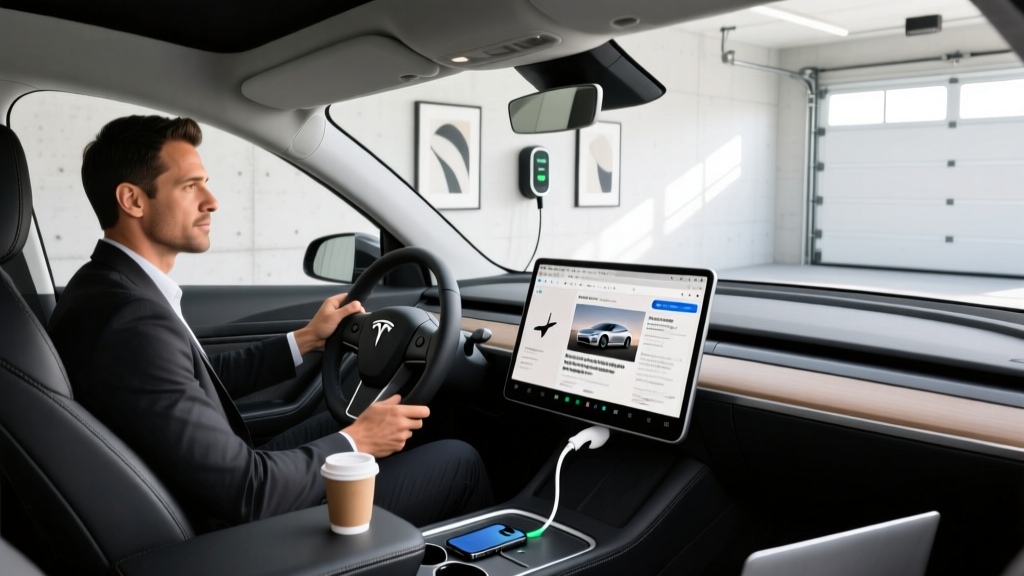
Now to the feature that prompted this deep dive. The Tesla web browser is accessible from the app launcher on the 15.4-inch center touchscreen. It runs a Chromium-based engine, which means it renders most modern websites correctly — news sites, email clients, Google Docs, Reddit, and streaming platforms.
What works well:
- Full desktop-mode rendering of most websites (not stripped mobile versions)
- Pinch-to-zoom on the touchscreen is responsive
- Bookmarks can be saved for frequently visited sites
- Audio from web-based media (podcasts, music streams) plays through the car's speakers
- Usable while the car is parked or charging — and now, with recent software updates, in limited form while in drive (text input is disabled for safety)
Where it falls short:
- No browser extensions or plugins
- Some sites with heavy JavaScript or complex authentication (banking portals, two-factor flows) can be sluggish or fail
- No native file download manager — downloads are limited
- Typing on the on-screen keyboard is tedious for long forms; a Bluetooth keyboard pairs but isn't officially supported for browser input
- Video streaming from YouTube or Netflix works, but only while parked (Tesla blocks video playback above 0 mph)
For the typical use case — reading news, checking email, browsing forums, or catching up on work documents during a 25-minute Supercharger stop — the Tesla web browser is genuinely functional. It is not a laptop replacement, but it transforms dead charging time into productive time in a way no other mainstream EV automaker currently matches. Rivian, Hyundai, and BMW offer app ecosystems, but none expose a full general-purpose browser.
Performance, Efficiency, and Driving Impressions
The dual-motor AWD powertrain produces 384 horsepower and launches the Model Y to 60 mph in 4.8 seconds. That is brisk for a family crossover and confident for highway merging. The instant torque delivery — a hallmark of electric drivetrains — means there is no turbo lag or gear-hunt hesitation.
Efficiency is rated at 117 MPGe combined (28 kWh per 100 miles) by the EPA. This is among the best in the mid-size electric SUV segment. The Hyundai Ioniq 5 AWD achieves 110 MPGe; the Ford Mustang Mach-E Extended Range AWD lands at 101 MPGe. Tesla's efficiency advantage comes from a combination of low drag coefficient (0.23 Cd), aggressive regenerative braking (one-pedal driving is the default and only mode), and a well-managed thermal system.
Ride quality in the 2026 refresh is noticeably improved over pre-2023 models. The updated suspension tuning absorbs road imperfections with less harshness, and cabin noise isolation has been upgraded with acoustic glass. The steering remains quick and precise, if slightly numb in feel — a common Tesla trait.
Pricing, Tax Credits, and Ownership Cost
The 2026 Model Y Long Range AWD starts at $44,990 (including destination). A Performance trim with 303 miles of range and a 3.5-second 0–60 time is available at $48,990. The base RWD model, which uses an LFP battery with 295 miles of range, is priced at $39,990.
| Trim | MSRP | Federal Credit (§30D) | Effective Price |
|---|---|---|---|
| Long Range AWD | $44,990 | Up to $7,500* | As low as $37,490 |
| Performance AWD | $48,990 | Up to $7,500* | As low as $41,490 |
| RWD (LFP battery) | $39,990 | Up to $7,500* | As low as $32,490 |
*Federal tax credit caveats (IRS §30D, 2026 rules): The full $7,500 credit requires the buyer to meet income caps ($150,000 single / $300,000 joint MAGI), the vehicle MSRP must not exceed $80,000 for SUVs (all Model Y trims qualify), and the battery must meet critical-mineral and component-sourcing thresholds that phase in annually. As of 2026, Tesla's US-assembled battery packs and North American-sourced minerals generally satisfy these requirements, but eligibility can shift with supply-chain changes. The credit is available as a point-of-sale transfer to the dealer, effectively reducing the purchase price at signing. Always verify current eligibility on irs.gov and consult a tax professional for your specific situation.
Interior, Cargo, and Tech Features
The Model Y's minimalist interior centers on the 15.4-inch landscape touchscreen, which handles climate, navigation, media, vehicle settings, and — of course — the web browser. There is no instrument cluster behind the steering wheel; all driving information appears on the upper-left quadrant of the center screen.
Cargo capacity is a standout: 30.2 cubic feet behind the rear seats and 72.1 cubic feet with the 60/40 split rear seats folded. The front trunk (frunk) adds 4.1 cubic feet for charging cables or a small bag. Rear legroom measures 37.0 inches — adequate for adults on longer trips, though the relatively flat seat cushion lacks the thigh support of some rivals.
Tech highlights:
- Tesla web browser (Chromium-based, full desktop rendering)
- Netflix, YouTube, Disney+, and Twitch streaming (parked only)
- Over-the-air software updates that add features monthly
- Sentry Mode dashcam recording with USB export
- Dog Mode and Camp Mode for climate control while parked
- 17-speaker premium audio with immersive sound
Driver assistance — Autopilot and FSD (Supervised):
SAE Level 2 — Driver Assistance, NOT Self-Driving
Tesla Autopilot (standard) and Full Self-Driving Supervised ($8,000 option or $99/mo subscription) are SAE Level 2 systems. The driver must remain fully attentive, keep hands on the wheel, and be prepared to take over instantly. FSD Supervised can navigate highway interchanges, stop lights, and some city streets, but it is not autonomous. Only Level 4 services like Waymo operate without a human driver. Do not treat any Tesla system as a substitute for active driving attention.
Warranty, Reliability, and Long-Term Ownership
Tesla covers the Model Y's battery and drive units for 8 years or 120,000 miles (whichever comes first), with a guarantee that the battery will retain at least 70% of its original capacity during that period. The limited vehicle warranty is 4 years / 50,000 miles.
Long-term battery degradation data from owner fleets suggests the NMC pack in the Long Range loses approximately 5–8% capacity over the first 100,000 miles, with the curve flattening significantly afterward. Many Model Y vehicles from 2020–2022 report 90%+ state of health at 80,000 miles. LFP packs (in the RWD trim) show even slower degradation and can be charged to 100% daily without the same longevity concerns — a trade-off for their lower energy density and shorter range.
Insurance costs for the Model Y tend to run 15–25% higher than comparable gas-powered crossovers, driven by repair costs for the aluminum-intensive structure and integrated battery pack. Get quotes before purchasing — this is a real ownership cost that surprises some buyers.
Pros and Cons
Pros
- Class-leading efficiency (117 MPGe, 28 kWh/100 mi)
- Access to the Tesla Supercharger network — 6,000+ US stalls, highest reliability of any DC network
- Functional web browser turns charging downtime into productive time
- Strong cargo capacity (72.1 cu ft folded) with a usable frunk
- Over-the-air updates continuously add features post-purchase
- Excellent real-world fast-charging infrastructure with navigation-based preconditioning
Cons
- Minimalist interior lacks physical controls — everything routes through the touchscreen
- No Apple CarPlay or Android Auto support
- Rear seat comfort is average for the class; seat cushion is relatively flat
- FSD (Supervised) is expensive and still requires full driver attention (Level 2)
- Insurance premiums run higher than segment average
- Web browser has limitations with complex sites and no extension support
Who the 2026 Model Y Suits Best
The Model Y Long Range AWD is the strongest all-around choice for daily commuters who road-trip regularly and value charging infrastructure above all else. The Supercharger network remains the most reliable and geographically complete DC fast-charging system in the US, and the Tesla web browser makes those charging stops more tolerable than in any competing EV.
Families will appreciate the cargo volume and efficiency, though those prioritizing rear-seat luxury or traditional infotainment (CarPlay, physical knobs) should also test the Hyundai Ioniq 5 or Kia EV6. Budget-conscious buyers who charge primarily at home and drive fewer than 200 miles daily may find the RWD trim with its LFP battery and $32,490 effective price (after credit) to be the smarter buy.
Frequently Asked Questions
What is the real-world range of the 2026 Tesla Model Y?
The EPA rates the Long Range AWD at 320 miles. Expect roughly 265–285 miles at sustained highway speeds in mild weather, and 210–245 miles in freezing conditions. City and suburban driving typically returns 295–310 miles thanks to regenerative braking.
How fast does the Model Y charge at home and on the road?
At home on a Level 2 Wall Connector (11.5 kW), the Model Y gains about 44 miles of range per hour, fully charging overnight. On a V3 Supercharger at 250 kW peak, a 10–80% charge takes approximately 27 minutes, with significant taper above 80%.
How much does the Model Y cost after the federal tax credit?
The Long Range AWD starts at $44,990 and can drop to $37,490 with the full $7,500 §30D credit applied at point of sale. Eligibility depends on buyer income, battery sourcing, and MSRP caps — verify on irs.gov before purchasing.
Is the Tesla web browser actually useful?
For reading news, checking email, and browsing during Supercharger stops, yes. It renders most desktop sites well. It is not a laptop replacement — complex web apps, banking portals, and heavy JavaScript sites can struggle, and there is no extension support.
Is the Model Y worth buying vs. the Hyundai Ioniq 5 or Ford Mach-E?
The Model Y wins on efficiency (117 vs. 110 MPGe for the Ioniq 5 AWD), Supercharger network access, and software features including the web browser. The Ioniq 5 offers faster 10–80% charging on 350 kW chargers (~18 min), 800V architecture, Apple CarPlay, and a more comfortable rear seat. The Mach-E competes on driving dynamics but trails on efficiency and charging infrastructure. Test all three before deciding.
Does the 2026 Model Y qualify for the $7,500 federal EV tax credit?
As of 2026, all Model Y trims are assembled in the US and generally meet §30D battery-sourcing requirements. The MSRP is well under the $80,000 SUV cap. Buyer income must not exceed $150,000 (single) or $300,000 (joint). The credit can be transferred at point of sale. Rules can change — check IRS §30D guidance and consult a tax professional.
What are the biggest drawbacks of the Model Y?
The lack of Apple CarPlay/Android Auto, the touchscreen-only interface (no physical climate or volume controls), average rear-seat comfort, and higher-than-average insurance costs are the most common owner complaints. The FSD option at $8,000 remains a Level 2 system requiring constant supervision.
Sources: EPA fueleconomy.gov, IRS §30D Clean Vehicle Credit, Tesla Model Y specifications. All pricing and specifications reflect 2026 model year at time of publication and are subject to change.