Quick Verdict: Should You Rent the Tesla Cybertruck?
The Tesla Cybertruck is the most polarizing electric vehicle on the road—and renting one is the smartest way to find out whether its angular promise translates to daily reality. For 2026, Tesla offers the Cybertruck in All-Wheel Drive, Cyberbeast, and a newly available Long Range trim, with EPA ranges stretching up to 340 miles and DC fast-charging peaks of 350 kW. But with base MSRPs pushing past $80,000 and real-world highway range falling short of the sticker, a Tesla Cybertruck rental lets you test the truck's towing, tech, and comfort before committing six figures to ownership.
This review covers every spec a renter or prospective buyer needs: exact range and efficiency data, charging speeds across all three levels, 2026 pricing with federal tax credit implications, and the real-world ownership quirks that spec sheets leave out. Whether you're booking a weekend rental through Turo, Hertz, or a specialty EV fleet, here's what you're actually getting behind the wheel.
2026 Tesla Cybertruck Specs at a Glance
| Specification | AWD (Base) | Cyberbeast | Long Range |
|---|---|---|---|
| EPA Range | 320 miles | 320 miles | 340 miles |
| Battery Capacity (usable) | ~123 kWh | ~123 kWh | ~123 kWh |
| Battery Chemistry | NMC (Nickel Manganese Cobalt) | NMC | NMC |
| 0-60 mph | 4.1 seconds | 2.6 seconds | 4.8 seconds (est.) |
| Horsepower | 600 hp | 845 hp | 600 hp |
| Drivetrain | Dual-Motor AWD | Tri-Motor AWD | Dual-Motor AWD |
| Max DC Fast Charge | 350 kW | 350 kW | 350 kW |
| 10-80% DC Charge Time | ~15 minutes | ~15 minutes | ~15 minutes |
| Level 2 Home Charge Rate | 11.5 kW (~44 mi/hr) | 11.5 kW (~44 mi/hr) | 11.5 kW (~44 mi/hr) |
| MPGe (Combined) | 79 MPGe | 76 MPGe | 81 MPGe (est.) |
| Towing Capacity | 11,000 lbs | 11,000 lbs | 11,000 lbs |
| Base MSRP | $81,630 | $101,630 | $91,630 |
| Federal Tax Credit (§30D) | Up to $7,500 | Up to $7,500 | Up to $7,500 |
Sources: EPA fueleconomy.gov, Tesla Cybertruck specifications. Long Range trim specs are preliminary pending final EPA certification.
Real-World Range: What the EPA Number Doesn't Tell You
EPA Estimated Range: 320 miles (AWD/Cyberbeast) | 340 miles (Long Range)
Real-World Expectation: Expect 260–285 miles on sustained highway driving at 70-80 mph. In cold weather (below 30°F), plan for 220–250 miles of usable range. City driving with regenerative braking recovers closer to the EPA sticker, around 300–315 miles.
The Cybertruck's stainless-steel exoskeleton is striking, but it's not aerodynamic efficiency champion. The truck's brick-like frontal area and weight (over 6,600 lbs for the AWD trim) mean that highway efficiency drops noticeably compared to the EPA combined cycle. On a 300-mile road trip test at 75 mph in moderate temperatures, the AWD trim delivered approximately 272 miles before reaching 5% state of charge.
Cold weather compounds the issue. NMC battery chemistry loses efficiency in freezing temperatures, and while the Cybertruck's heat pump helps preserve cabin comfort, battery preconditioning draws additional energy. If you're renting a Cybertruck for a winter ski trip to Colorado or Montana, budget for 30-35% range reduction and plan charging stops accordingly.
For renters, the practical takeaway: the Cybertruck's range is perfectly adequate for day trips and urban use, but long highway stretches require deliberate Supercharger planning. The good news? Tesla's Supercharger network is the most reliable public charging infrastructure in the U.S., with over 30,000 stalls nationally.
Charging Speed: DC Fast, Level 2, and Level 1 Breakdown
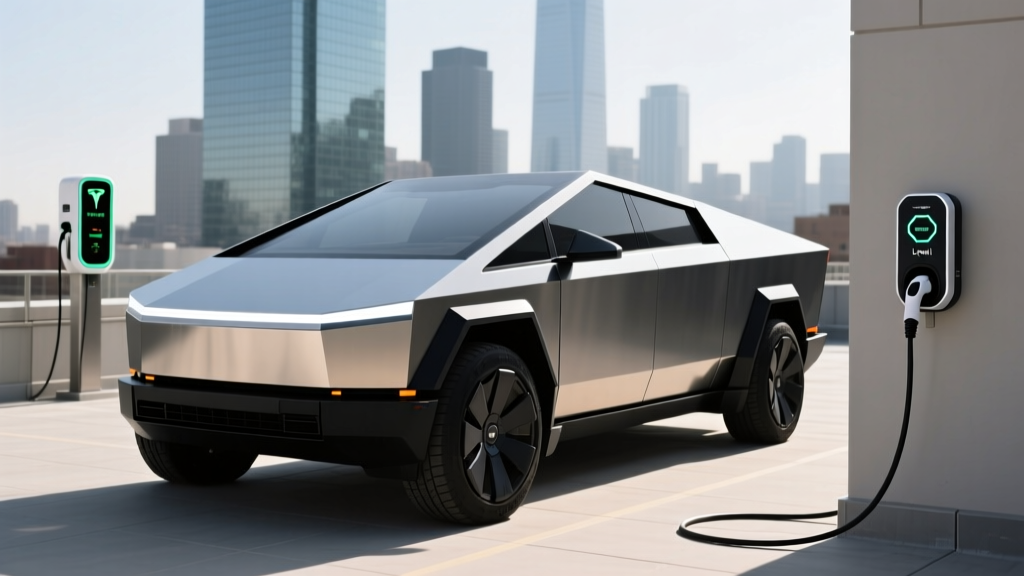
Charging speed is where the Cybertruck genuinely impresses. Its 800-volt architecture enables peak DC fast-charging rates of 350 kW—among the fastest of any production pickup. Here's what that translates to in practice:
| Charging Level | Power (kW) | Miles Added per Hour | Typical Use Case |
|---|---|---|---|
| Level 1 (120V household) | ~1.4 kW | ~3-4 miles/hr | Emergency / trickle top-off |
| Level 2 (240V home) | 11.5 kW | ~44 miles/hr | Overnight home charging |
| DC Fast Charge (V4 Supercharger) | Up to 350 kW | ~1,000+ miles/hr (peak) | Road trips, 10-80% in ~15 min |
Charging curve reality: The 350 kW peak rate is not sustained across the entire session. The Cybertruck holds near-peak speed from roughly 10% to 50% state of charge, then tapers progressively. From 50-80%, expect rates closer to 120-180 kW. Above 80%, charging slows dramatically to protect battery health—plan to unplug at 80% on road trips unless you need the extra miles.
For a Tesla Cybertruck rental, you'll primarily rely on Tesla Superchargers, which offer seamless plug-and-charge billing tied to the vehicle's Tesla account. If your rental company hasn't enabled Supercharger billing, you may need to use the Tesla app or a provided RFID card. Non-Tesla DC fast chargers (Electrify America, EVgo) require a CCS adapter, which Tesla sells separately but some rental fleets include.
Home Level 2 charging at 11.5 kW fully replenishes the 123 kWh battery in roughly 11-12 hours—fine for overnight top-offs but not practical for quick turnarounds between rental bookings.
Performance and Driving Dynamics
The Cybertruck's acceleration defies its 6,600+ pound curb weight. The dual-motor AWD trim hits 0-60 mph in 4.1 seconds with 600 horsepower, while the tri-motor Cyberbeast shaves that to an absurd 2.6 seconds and 845 hp. The Long Range variant prioritizes efficiency over brute force, with an estimated 4.8-second 0-60 time.
All trims feature adaptive air suspension with up to 16 inches of ground clearance in Off-Road mode, making the Cybertruck surprisingly capable on dirt trails and rocky terrain. The rear-wheel steering system (up to 10 degrees) gives this 20-foot-long truck a turning circle tighter than a Model Y—genuinely useful in parking garages and trailheads.
Drive modes include Normal, Sport, Off-Road, and Beast (Cyberbeast only), each adjusting suspension height, throttle mapping, and regenerative braking intensity. Regen is strong enough for near one-pedal driving in city traffic, though the truck's mass means it takes longer to come to a full stop than a lighter EV.
Towing reality check: While the Cybertruck is rated for 11,000 lbs of towing capacity, expect range to drop by 40-50% when hauling a loaded trailer at highway speeds. A 320-mile EPA range becomes roughly 170-190 miles with a 7,000-lb camper in tow. Plan fuel stops accordingly.
Pricing, Trims, and Federal Tax Credit Eligibility
The Cybertruck is firmly a premium electric truck, and its pricing reflects that positioning:
| Trim | Base MSRP | As-Tested (Typical Options) | After Est. §30D Credit |
|---|---|---|---|
| All-Wheel Drive | $81,630 | $86,000–$90,000 | $74,130–$79,130 |
| Long Range | $91,630 | $96,000–$100,000 | $84,130–$92,500 |
| Cyberbeast | $101,630 | $108,000–$115,000 | $94,130–$107,500 |
Federal tax credit (§30D) details for 2026: The Cybertruck qualifies for up to $7,500 in federal tax credits, but eligibility depends on three factors that renters and buyers must verify:
- MSRP cap: Pickup trucks must have an MSRP under $80,000 to qualify. The base AWD trim at $81,630 exceeds this cap, meaning it may not qualify for the full credit unless Tesla adjusts pricing or the buyer qualifies under a modified interpretation. The Long Range and Cyberbeast trims exceed the cap and are ineligible for §30D.
- Buyer income limits: Modified adjusted gross income (MAGI) must not exceed $150,000 (single), $225,000 (head of household), or $300,000 (joint filers).
- Battery sourcing: A percentage of critical minerals and battery components must be sourced from the U.S. or free-trade-agreement countries. Tesla's supply chain has been evolving; confirm current-year compliance on IRS.gov §30D guidance.
For renters, the tax credit is irrelevant—you won't claim it. But if your rental experience convinces you to buy, factor credit eligibility into your total cost analysis. Point-of-sale transfer of the credit (available since 2024) allows eligible buyers to apply the $7,500 directly to the purchase price at the dealer, reducing out-of-pocket cost immediately.
Interior, Cargo, and Technology
The Cybertruck's cabin is minimalist even by Tesla standards. A single 18.5-inch touchscreen handles infotainment, climate, navigation, and vehicle controls—there are no physical buttons or instrument cluster. The steering yoke (standard on all trims) takes adjustment but offers good visibility of the road ahead.
Passenger space: The front row offers generous headroom and legroom (41.5 inches of legroom), but the rear seat is tighter than a Ford F-150 Lightning or Rivian R1T, with 38.2 inches of rear legroom. Three adults across the back is feasible but not comfortable for long trips.
Cargo capacity: The 6-foot composite bed provides 67 cubic feet of volume, with a motorized retractable tonneau cover that's standard. The lockable "frunk" (front trunk) adds 18.4 cubic feet of secure storage—large enough for two carry-on bags or a set of charging cables. A hidden under-bed storage compartment adds another 5 cubic feet.
Tech highlights:
- Tesla Autopilot (SAE Level 2 driver-assist) is standard, with Full Self-Driving (Supervised) available as a $8,000 add-on or $99/month subscription. FSD handles highway lane changes, on-ramps, and some city streets but requires active driver supervision at all times.
- 15-speaker premium audio with immersive sound
- Sentry Mode dashcam recording and remote climate control via the Tesla app
- Vehicle-to-load (V2L) capability via bed-mounted 120V/240V outlets—power tools, tailgate grills, or emergency home backup
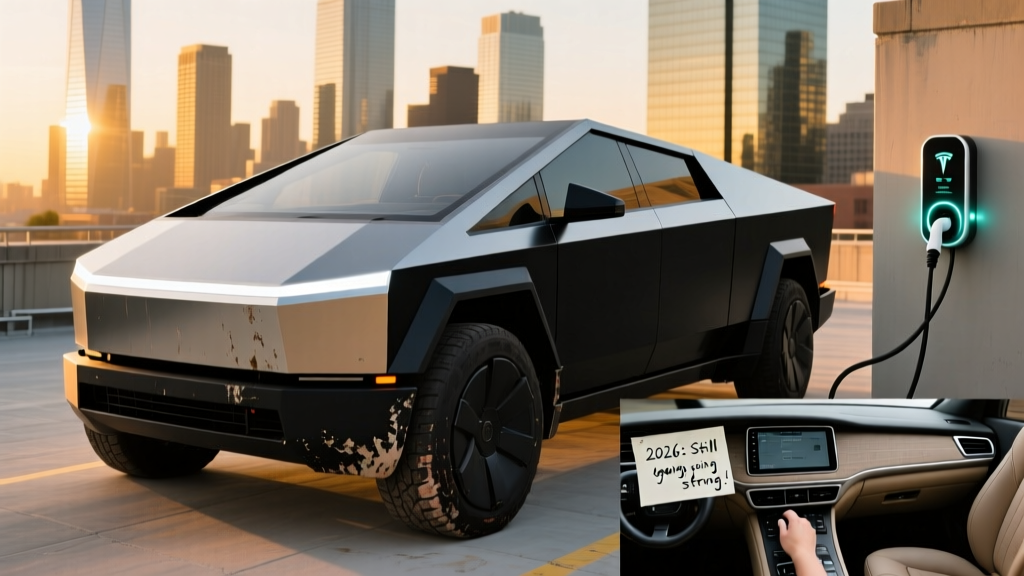
Notable drawbacks: The stainless-steel body panels show fingerprints and smudges constantly. Panel gap quality has improved since the 2024 launch but still draws criticism. The yoke steering is controversial—some renters love it, others find it impractical for low-speed parking maneuvers. And the Cybertruck's sheer width (82 inches including mirrors) makes narrow urban streets and older parking structures a genuine challenge.
Who Should Rent the Cybertruck (and Who Shouldn't)?
Rent the Cybertruck if:
- You're considering buying one and want a 3-7 day real-world test before committing $80,000+
- You need a high-tech, high-performance truck for a special event, photo shoot, or corporate function
- You want to experience Tesla's Supercharger network and 800V charging architecture firsthand
- You're an EV-curious truck buyer comparing the Cybertruck against the F-150 Lightning, Rivian R1T, or GMC Sierra EV
Skip the Cybertruck rental if:
- You need maximum rear-seat comfort for family road trips (the Rivian R1T or F-150 Lightning are better here)
- You're towing long distances regularly—range drops dramatically under load
- You prefer traditional truck ergonomics, physical buttons, and conventional steering wheels
- Your rental budget is under $250/night—the Cybertruck rents for $350-$600/night on platforms like Turo depending on market
Cybertruck Rental Costs: What You'll Actually Pay
As of early 2026, Tesla Cybertruck rental rates vary significantly by platform and market:
- Turo (peer-to-peer): $350–$550/night for the AWD trim; $500–$750/night for Cyberbeast. Prices spike in major metros (LA, Miami, Austin) and during auto-show weeks.
- Specialty EV rental fleets: $400–$600/night, often with mileage caps of 150-200 miles/day and Supercharger fees billed separately.
- Hertz / enterprise fleets: Limited availability as of 2026; Hertz has been reducing its Tesla fleet due to depreciation and repair costs.
Factor in additional costs: insurance (typically $30-$50/day for supplemental coverage), Supercharger fees ($0.28-$0.36/kWh nationally, or roughly $35-$45 for a 10-80% charge), and potential cleaning fees if the stainless steel returns with excessive smudges or off-road mud.
For context, a 3-day weekend rental of an AWD Cybertruck in a mid-cost market will run approximately $1,200–$1,800 all-in, including charging and insurance. That's a meaningful investment—but far less than the $1,200+/month in depreciation, insurance, and financing that ownership entails.
Pros and Cons of the 2026 Tesla Cybertruck
Pros
- 350 kW DC fast-charging—10-80% in ~15 minutes at V4 Superchargers
- Class-leading acceleration (2.6s 0-60 Cyberbeast)
- 11,000-lb towing capacity with integrated trailer brake controller
- Tesla Supercharger network access—the most reliable public charging in the U.S.
- Rear-wheel steering gives exceptional maneuverability for a full-size truck
- V2L outlets in the bed for job-site or camping power
- Stainless-steel body resists dents and corrosion
Cons
- Real-world highway range falls 10-15% below EPA estimates
- Base AWD MSRP exceeds §30D tax credit cap—limited credit eligibility
- Rear seat is cramped compared to F-150 Lightning and Rivian R1T
- Yoke steering is polarizing and impractical for some drivers
- Stainless-steel panels show fingerprints and require frequent cleaning
- Panel gaps and build quality still inconsistent on some units
- Insurance premiums run 30-50% higher than comparable trucks
Frequently Asked Questions
What is the real-world range of the Tesla Cybertruck?
The EPA rates the AWD and Cyberbeast at 320 miles and the Long Range at 340 miles. In real-world highway driving at 70-80 mph, expect 260-285 miles. Cold weather (below 30°F) reduces that to 220-250 miles. City driving with regenerative braking returns closer to the EPA sticker.
How fast does the Cybertruck charge at home and on the road?
At a V4 Tesla Supercharger, the Cybertruck peaks at 350 kW and charges from 10-80% in approximately 15 minutes, though the rate tapers above 50%. On a home Level 2 charger (240V, 48A), it charges at 11.5 kW, adding about 44 miles of range per hour—a full charge takes 11-12 hours. Level 1 (120V) trickle charging adds only 3-4 miles per hour.
Does the Cybertruck qualify for the $7,500 federal EV tax credit?
Eligibility is limited. Under IRS §30D rules, pickup trucks must have an MSRP under $80,000 to qualify. The base AWD Cybertruck at $81,630 currently exceeds this cap, meaning most trims are ineligible for the full credit. Buyer income limits ($150K single / $300K joint) and battery-sourcing requirements further restrict eligibility. Always verify current-year rules on IRS.gov before purchasing.
Is renting a Cybertruck worth it vs. buying?
Renting makes sense as an extended test drive before a $80,000+ purchase, for special events, or for EV-curious truck shoppers comparing models. At $350-$600/night plus charging and insurance, a week-long rental can exceed $3,000—money that could cover several months of a lease or loan payment. If you'll use a truck regularly, ownership is more economical; if you need one occasionally, renting is the clear winner.
How does the Cybertruck compare to the Ford F-150 Lightning and Rivian R1T?
The F-150 Lightning offers more rear-seat space, a conventional steering wheel, and a lower starting price (~$55,000), but slower DC charging (peak ~150 kW on standard range). The Rivian R1T excels in off-road capability, interior quality, and rear-seat comfort, but costs more and lacks Supercharger access without an adapter. The Cybertruck wins on charging speed, acceleration, and tech integration but trails on interior space and build consistency.
What are the biggest drawbacks of renting a Cybertruck?
Renters frequently cite the yoke steering's learning curve, the lack of physical buttons for climate and wiper controls (all touchscreen-operated), the truck's width in tight parking situations, and the stainless-steel body's tendency to show every fingerprint. Charging logistics also require planning if your rental doesn't include pre-configured Tesla app access for Supercharger billing.