Tesla Wall Connector Pricing: Hardware, Installation, and Total Cost
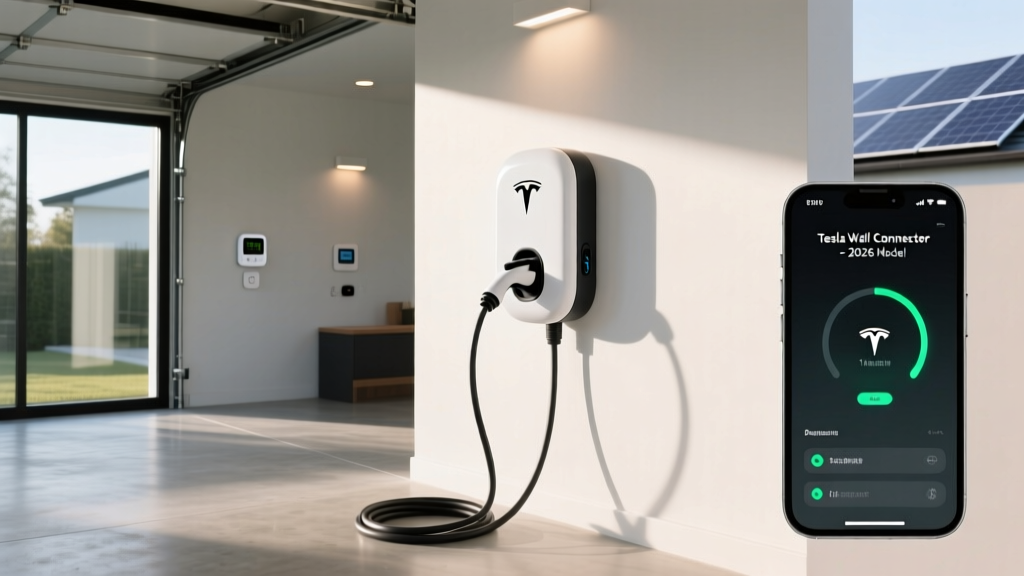
If you own a Tesla—or any EV with a NACS port—the Tesla Wall Connector is typically the fastest, most reliable Level 2 home charger available. But the sticker price of the unit is only part of the equation. The real question buyers search for is the total Tesla wall cost: hardware, electrical work, permits, and any panel upgrades needed to support a 48-amp or 60-amp circuit.
As of 2026, the Tesla Wall Connector (Gen 3) retails for approximately $420 directly from Tesla. However, total installed cost typically ranges from $1,200 to $3,500+ depending on your home's electrical infrastructure. Below, we break down every cost component, charging speed, compatibility, and whether it's worth the investment versus third-party Level 2 alternatives.
| Spec | Value |
|---|---|
| Max Output | 11.5 kW (48 amps on 60A circuit) |
| Connector Type | NACS (Tesla native) |
| Cable Length | 24 feet |
| Wi-Fi | Yes (firmware updates, power sharing) |
| Indoor/Outdoor | Both (NEMA 4 rated) |
| Hardware Price (2026) | ~$420 |
| Warranty | 4 years |
| Voltage | 200–240V AC (single-phase) |
What Determines Your Total Tesla Wall Connector Installation Cost?
The total Tesla wall cost is driven by five factors. Understanding each one before you call an electrician will save you from surprise invoices.
| Component | Low End | High End | Notes |
|---|---|---|---|
| Wall Connector Hardware | $420 | $420 | Fixed retail price from Tesla |
| Electrician Labor | $400 | $1,500 | Depends on run length, conduit, wall type |
| Electrical Materials | $100 | $500 | Wire gauge, conduit, junction boxes, breaker |
| Permit & Inspection | $50 | $300 | Varies by municipality |
| Panel Upgrade (if needed) | $1,500 | $4,000+ | Required if your panel lacks capacity for a 60A circuit |
| Total (no panel upgrade) | $970 | $2,720 | Most homes with 200A service |
| Total (with panel upgrade) | $2,470 | $6,720+ | Homes with 100A or maxed-out 200A panels |
Electrical Panel Capacity: The Make-or-Break Factor
The Wall Connector at full 48-amp output requires a dedicated 60-amp breaker on a 240V circuit. Your home's electrical panel must have both the physical breaker slots and the total amperage headroom to support this. A standard 200-amp residential panel usually handles it fine, but if your panel is already near capacity—running electric HVAC, a dryer, an oven, and a water heater—an electrician may recommend either:
- Downgrading the charge rate: Configuring the Wall Connector via its DIP switches to 40A (requiring a 50A breaker) or 32A (40A breaker), which reduces peak output but avoids a panel upgrade.
- A panel upgrade to 200A or 400A service: This adds $1,500–$4,000+ but is sometimes necessary for older homes with 100A service.
Always have a licensed electrician perform a load calculation (per NEC Article 220) before committing to a circuit size.
Charging Speed: How Fast Does the Tesla Wall Connector Charge?
The Wall Connector at 11.5 kW adds roughly 35 to 44 miles of range per hour of charging, depending on the vehicle's efficiency. Here's how that translates to real Tesla models and popular NACS-equipped EVs in 2026:
| Vehicle | Onboard Charger Limit | Effective kW | Miles/Hour |
|---|---|---|---|
| Tesla Model 3 (2026) | 11.5 kW | 11.5 kW | ~44 mi/hr |
| Tesla Model Y (2026) | 11.5 kW | 11.5 kW | ~40 mi/hr |
| Tesla Model S/X | 11.5 kW | 11.5 kW | ~35 mi/hr |
| Ford F-150 Lightning | 19.2 kW | 11.5 kW* | ~28 mi/hr |
| Rivian R1T/R1S | 11.5 kW | 11.5 kW | ~30 mi/hr |
| Cadillac Lyriq | 19.2 kW | 11.5 kW* | ~33 mi/hr |
*Vehicle onboard charger exceeds Wall Connector output; charging limited to 11.5 kW at this unit.
Understanding kW vs. kWh at Home
The most common confusion among new EV owners is mixing up kW (power—the rate of charging) and kWh (energy—your battery's total capacity). Think of kW as how fast water flows from a hose, and kWh as the size of the bucket. The Wall Connector delivers up to 11.5 kW of power. If your Tesla Model Y has a ~75 kWh usable battery, a full 0–100% charge would take roughly 75 ÷ 11.5 = ~6.5 hours. In practice, most owners plug in at 20–30% and wake up fully charged by morning.
What About DC Fast Charging?
The Wall Connector is a Level 2 AC charger—it's designed for daily home use, not road trips. For fast charging on the go, Tesla's Supercharger network delivers 150–350 kW DC depending on the station. A Model 3 Long Range can charge from 10–80% in roughly 15–20 minutes at a V3/V4 Supercharger. But for daily driving, Level 2 at home is the sweet spot: gentler on the battery, far cheaper per kWh, and you always start with a full charge.
Which Vehicles Are Compatible With the Tesla Wall Connector?
As of 2026, the Wall Connector ships with a native NACS (North American Charging Standard) plug. This means:
- All Tesla vehicles (Model 3, Y, S, X, Cybertruck) plug in directly.
- NACS-equipped non-Tesla EVs — Ford, GM, Rivian, Hyundai, Kia, BMW, and most other automakers have transitioned to NACS for 2025–2026 model-year vehicles. These plug in natively.
- CCS1-equipped EVs (older models or pre-NACS transition) require a NACS-to-CCS adapter. Tesla sells one for approximately $250, and third-party options exist. Charge speed may be limited by the adapter's rating.
- CHAdeMO vehicles (Nissan Leaf, older Mitsubishi) are not practically compatible with the NACS Wall Connector.
| Connector | Native Support? | Adapter Needed? |
|---|---|---|
| NACS (Tesla + 2025–2026 Ford, GM, Rivian, Hyundai, Kia, BMW, others) | Yes | No |
| CCS1 (2024 and older non-Tesla EVs) | No | Yes — NACS-to-CCS adapter (~$200–$250) |
| CHAdeMO (Nissan Leaf, Mitsubishi Outlander PHEV older gen) | No | Not practical |
| J1772 (legacy Level 2 standard) | No | Yes — NACS-to-J1772 adapter |
Tesla Wall Connector vs. Competitors: Is It Worth the Cost?
The Wall Connector isn't the only Level 2 home charger on the market. Here's how it stacks up against popular alternatives in 2026:
| Feature | Tesla Wall Connector | ChargePoint Home Flex | Emporia Vue | Grizzl-E Smart |
|---|---|---|---|---|
| Max Output | 11.5 kW (48A) | 12.5 kW (50A) | 11.5 kW (48A) | 10 kW (40A) |
| Connector | NACS | J1772 or NACS | J1772 or NACS | J1772 or NACS |
| Cable Length | 24 ft | 23 ft | 24 ft | 24 ft |
| Wi-Fi / Smart Features | Yes | Yes | Yes (energy monitoring) | Yes |
| Power Sharing (multi-unit) | Yes (up to 6 units) | No | No | No |
| Hardware Price | ~$420 | ~$550–$650 | ~$400–$500 | ~$450 |
| Warranty | 4 years | 3 years | 3 years | 3 years |
Key Advantages of the Tesla Wall Connector
- Best-in-class integration with Tesla vehicles: Automatic firmware updates, power sharing for multi-charger garages, and seamless Tesla app integration.
- Competitive price: At $420, it undercuts most smart chargers with comparable output.
- NACS native: As the industry converges on NACS, this is increasingly the universal connector.
- Power sharing: You can install up to six Wall Connectors on a single circuit, splitting available amperage—ideal for multi-EV households.
Key Drawbacks
- No built-in energy monitoring dashboard: Unlike Emporia, Tesla doesn't offer granular per-session kWh tracking outside the vehicle's own data.
- Non-Tesla app experience is limited: If you drive a Ford or GM with NACS, the Tesla app doesn't integrate with your vehicle's battery status.
- 11.5 kW ceiling: Vehicles with 19.2 kW onboard chargers (F-150 Lightning, Cadillac Lyriq) cannot reach their maximum Level 2 speed on this unit.
Cost to Charge at Home vs. Public Charging vs. Gas
One of the strongest arguments for installing a Wall Connector is the per-mile energy cost. Here's a realistic comparison based on 2026 national averages:
| Method | Cost per kWh / Gallon | Cost per Mile* |
|---|---|---|
| Home Level 2 (national avg. electricity) | $0.16/kWh | ~$0.045 |
| Tesla Supercharger (avg.) | $0.30–$0.38/kWh | ~$0.09–$0.11 |
| Electrify America / EVgo DC | $0.35–$0.48/kWh | ~$0.10–$0.14 |
| Gasoline (28 MPG avg., $3.40/gal) | $3.40/gal | ~$0.12 |
*Based on a Tesla Model Y at ~3.5 miles/kWh efficiency (286 Wh/mi).
At $0.045 per mile on home electricity, a 12,000-mile/year driver spends roughly $540/year on fuel—compared to $1,440 for a 28 MPG gas car. That's nearly $900 in annual savings, meaning the Wall Connector installation pays for itself within 1–3 years for most owners.
Federal Tax Credits and Utility Rebates for Home Charger Installation
As of 2026, the federal Alternative Fuel Vehicle Refueling Property Credit (IRS Form 8911) can cover 30% of the cost of home EV charging equipment and installation, up to a $1,000 maximum. However, this credit has significant restrictions:
- Available only for primary residences in eligible census tracts (low-income or non-urban areas as defined by the IRS).
- Covers both the hardware and installation labor/electrical work.
- Non-refundable—reduces your tax liability but won't generate a refund beyond what you owe.
Many utility companies also offer rebates of $200–$500 for installing a smart Level 2 charger, and some provide time-of-use (TOU) rate plans that drop overnight electricity to $0.06–$0.10/kWh. Check with your local utility before installation—some require pre-approval to qualify.
For the latest federal credit rules, consult IRS.gov's refueling property credit page. Eligibility is location-specific and subject to change.
Installation Process: What to Expect Step by Step
- Get a quote from a licensed electrician. Tesla's website lists certified installers in your area, or you can use any licensed electrician. Request a load calculation and itemized quote.
- Determine circuit size. Based on your panel capacity, your electrician will recommend a 60A, 50A, or 40A circuit. The Wall Connector can be configured via DIP switches to match any of these.
- Pull a permit. Most jurisdictions require an electrical permit for a new 240V circuit. Your electrician typically handles this.
- Installation day. A standard install (panel in garage, short wire run) takes 2–4 hours. Longer runs through walls, attics, or underground conduit add time and cost.
- Inspection. A city/county inspector verifies the work meets NEC code before you energize the circuit.
- Setup. Connect the Wall Connector to Wi-Fi via the Tesla app, configure the amperage setting, and you're ready to charge.
Frequently Asked Questions
Can I install the Tesla Wall Connector myself?
Tesla strongly recommends professional installation by a licensed electrician. The Wall Connector requires a hardwired 240V connection (it does not plug into a standard outlet), and improper installation can void the warranty, violate electrical code, or create a fire hazard. DIY electrical work on a 60-amp circuit is not advisable unless you are a qualified electrician.
Does the Tesla Wall Connector work with non-Tesla EVs?
Yes—as long as the vehicle has a NACS charge port. By 2026, most major automakers (Ford, GM, Rivian, Hyundai, Kia, BMW, and others) ship vehicles with NACS. For CCS1-equipped EVs, a NACS-to-CCS adapter is required. The Wall Connector also works with Tesla's built-in NACS-to-CCS adapter for older CCS vehicles accessing Superchargers, though home charging via adapter is less common.
What if my garage only has a 120V outlet?
You can charge on a standard 120V (Level 1) outlet using Tesla's Mobile Connector, but expect only 3–5 miles of range per hour—roughly 36–60 miles overnight. This is viable for low-mileage commuters but inadequate for most drivers. Upgrading to a 240V circuit with the Wall Connector is strongly recommended for daily charging needs.
Is a NEMA 14-50 outlet better than hardwiring the Wall Connector?
The Gen 3 Wall Connector is designed for hardwired installation only—it does not come with a plug. A hardwired connection is more reliable, avoids the common NEMA 14-50 overheating issues documented by electrical inspectors, and allows full 48A output. A NEMA 14-50 outlet is limited to 40A continuous (per NEC 80% rule) and requires the separate Mobile Connector with a 14-50 adapter. For a permanent, high-speed home setup, hardwiring is the superior choice.
How much does it cost to charge a Tesla per month at home?
At the national average electricity rate of ~$0.16/kWh and a Model Y consuming roughly 286 Wh/mile, driving 1,000 miles/month costs about $45–$50/month. On a time-of-use plan with overnight rates around $0.08/kWh, that drops to ~$23/month. Compare this to $120–$150/month in gasoline for a comparable ICE vehicle.
Will installing a Wall Connector increase my home's value?
Multiple real estate analyses suggest that homes with installed Level 2 EV charging infrastructure sell at a modest premium, particularly in markets with high EV adoption (California, Pacific Northwest, Northeast). While exact value varies by market, the installation cost is often partially recouped at resale—especially if the 240V circuit and panel upgrade are already in place for the next owner.
Does the Wall Connector qualify for the $7,500 federal EV tax credit?
No. The §30D New Clean Vehicle Credit applies to the purchase of eligible electric vehicles, not charging equipment. Home chargers are covered under a separate credit (Alternative Fuel Vehicle Refueling Property Credit, Form 8911) with a $1,000 cap and census-tract eligibility requirements.
Bottom Line: Is the Tesla Wall Connector Worth the Total Cost?
For Tesla owners and anyone with a NACS-equipped EV, the Wall Connector at $420 is the best-value smart Level 2 charger on the market. The total Tesla wall cost including installation typically lands between $1,000 and $2,700 for homes with adequate panel capacity—and the convenience, speed, and per-mile savings pay that back within a few years of ownership.
If your home needs a panel upgrade, the total investment can exceed $4,000—but that upgrade benefits your entire home's electrical infrastructure and is often worthwhile for EV-owning households running multiple high-draw appliances. Get at least two quotes from licensed electricians, check your utility for rebates, and verify federal credit eligibility through IRS Form 8911 before committing.
Choose the Tesla Wall Connector if: You own a Tesla or NACS-equipped EV, want the fastest reliable Level 2 charge at a competitive hardware price, and value seamless Tesla ecosystem integration.
Consider alternatives if: You drive a CCS1 vehicle without an adapter, want granular energy monitoring (Emporia), or need a charger with a built-in plug for a NEMA 14-50 outlet (ChargePoint Home Flex or Grizzl-E).