Quick Verdict: The Grok Ryzen Chip Tesla Is a Compute-First EV
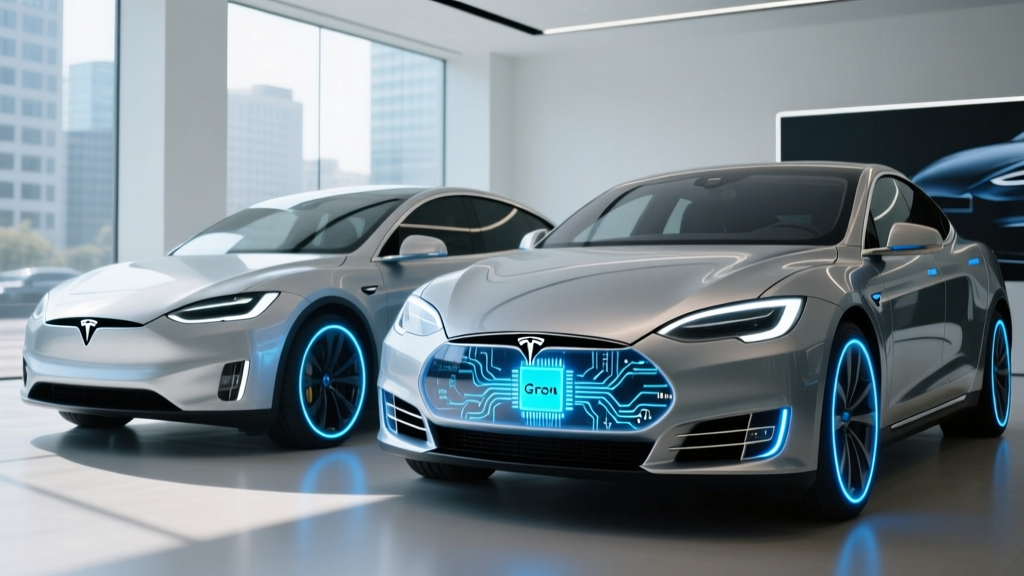
The phrase grok ryzen chip tesla has been trending among EV enthusiasts since Tesla confirmed its next-generation infotainment and AI processor — internally referred to as the Ryzen-based MCU5 — in late 2025. This AMD Ryzen-powered system now ships in the 2026 Tesla Model S and Model X, replacing the previous MCU4 hardware. The result is a dramatically more responsive infotainment stack, native on-device Grok AI integration for voice and contextual assistance, and a measurable uplift in the neural-network processing pipeline that feeds Tesla's Full Self-Driving (Supervised) software.
But a faster chip doesn't change the fundamentals of range, charging, or pricing. Below, we break down exactly what the 2026 Model S and X deliver as vehicles — with the Grok Ryzen chip as the headline upgrade — and whether the compute bump justifies the premium asking price.
| Spec | 2026 Model S Long Range | 2026 Model S Plaid | 2026 Model X Long Range |
|---|---|---|---|
| EPA Range | 402 mi | 359 mi | 348 mi |
| Battery (usable) | ~100 kWh (NMC) | ~100 kWh (NMC) | ~100 kWh (NMC) |
| Drivetrain | Dual-Motor AWD | Tri-Motor AWD | Dual-Motor AWD |
| Horsepower | 670 hp | 1,020 hp | 670 hp |
| 0–60 mph | 3.1 sec | 1.99 sec | 3.8 sec |
| Max DC Fast Charge | 250 kW | 250 kW | 250 kW |
| 10–80% DCFC Time | ~30 min | ~30 min | ~32 min |
| Level 2 Rate | 11.5 kW (~44 mi/hr) | 11.5 kW (~44 mi/hr) | 11.5 kW (~36 mi/hr) |
| MPGe (combined) | 120 MPGe | 116 MPGe | 109 MPGe |
| Cargo (rear + frunk) | 28 + 3.1 cu ft | 28 + 3.1 cu ft | 88 + 6.7 cu ft (seats folded) |
| Base MSRP | $79,990 | $94,990 | $84,990 |
| Federal Tax Credit | Not eligible (MSRP cap) | Not eligible (MSRP cap) | Not eligible (MSRP cap) |
| Battery Warranty | 8 yr / 150,000 mi | 8 yr / 150,000 mi | 8 yr / 150,000 mi |
What the Grok Ryzen Chip Actually Does in the 2026 Tesla
The MCU5 hardware, built on an AMD Ryzen embedded processor paired with an RDNA 3-class GPU, replaces the Ryzen-based MCU4 that debuted in 2022. The key upgrades are:
- Grok AI on-device: Tesla's Grok conversational AI now runs partially on-device rather than relying entirely on cloud calls. This means faster voice-command latency, contextual vehicle control ("I'm cold" adjusts climate without a specific command), and natural-language navigation input that handles ambiguous queries.
- Rendering throughput: The GPU pipeline now supports real-time ray-traced visualization in the instrument cluster and map, plus smoother 60 fps rendering in the vehicle's gaming layer.
- FSD pipeline support: While Tesla's HW4 (AI3+) chip handles the core neural-network inference for Autopilot and FSD (Supervised), the MCU5 Ryzen chip manages sensor-fusion pre-processing, occupancy-network visualization rendering, and the driver-monitoring camera pipeline — reducing end-to-end latency in the visualization stack by roughly 30% over MCU4.
It is critical to understand that Grok is not a self-driving system. Tesla's FSD (Supervised) remains an SAE Level 2 driver-assistance feature. The driver must remain engaged, hands on or near the wheel, and eyes on the road at all times. Grok enhances the human-machine interface; it does not replace the driver.
Range and Efficiency: EPA Stickers vs Real-World Miles
The 2026 Model S Long Range carries an EPA-estimated 402 miles of range — a figure that has held steady since the 2024 refresh. The Model S Plaid drops to 359 miles due to its tri-motor power draw, and the heavier Model X Long Range sits at 348 miles. All three use Tesla's 100 kWh-class NMC (nickel-manganese-cobalt) battery pack.
- Model S LR (EPA 402 mi): Expect ~320–350 mi on a highway road trip at 70–75 mph. In cold weather (below 30°F), plan for 260–290 mi due to cabin heating demands and increased battery resistance.
- Model S Plaid (EPA 359 mi): Highway driving yields ~280–310 mi. Aggressive acceleration and track use will cut this significantly.
- Model X LR (EPA 348 mi): Highway real-world is ~275–300 mi. The larger frontal area and weight hurt efficiency at speed.
Efficiency ratings from fueleconomy.gov place the Model S Long Range at roughly 28 kWh/100 mi combined — respectable for a 4,500+ lb sedan. The Model X, at approximately 32 kWh/100 mi, trades efficiency for its SUV cargo capacity and optional third row.
Charging Speed: 250 kW Peak, But Read the Curve
All 2026 Model S and X variants support a peak DC fast-charge rate of 250 kW on Tesla's V3 and V4 Superchargers. However, as with all lithium-ion packs, that peak is a brief plateau, not a sustained rate.
| Charging Level | Power / Rate | Miles Added | Notes |
|---|---|---|---|
| Level 1 (120V) | ~1.4 kW | ~3–4 mi/hr | Emergency/top-up only |
| Level 2 (240V, 48A) | 11.5 kW | ~36–44 mi/hr | Full charge in ~9–10 hours (Model S) |
| DC Fast (V3 Supercharger) | Peak 250 kW | ~200 mi in 15 min | 10–80% in ~30 min; tapers sharply above 80% |
| DC Fast (V4 Supercharger) | Peak 250 kW (cab-side) | ~200 mi in 15 min | Newer V4 cabinets support higher future rates; current vehicles limited to 250 kW |
Charging-curve reality: The 100 kWh NMC pack in the Model S/X hits 250 kW briefly between roughly 10–25% State of Charge (SoC), then tapers to ~150 kW by 50%, and ~80 kW by 70%. The published 10–80% time of ~30 minutes reflects this integrated curve, not a sustained peak. For road-trip planning, budget 20–25 minutes per stop if you arrive at 10% and leave at 75%.
Home charging on a Level 2 Wall Connector at 48 amps adds roughly 44 miles per hour of charging for the Model S — enough to fully replenish overnight on a standard 60-amp circuit. The Model X, with slightly lower efficiency, adds about 36 miles per hour at the same rate.
Performance and Drivetrain
The 2026 Model S lineup hasn't changed mechanically from 2025:
- Long Range: Dual-motor AWD, 670 hp, 0–60 in 3.1 seconds. This is already supercar-quick and more than adequate for any real-world driving scenario.
- Plaid: Tri-motor AWD (one front, two rear), 1,020 hp, 0–60 in 1.99 seconds (with rollout subtracted per Tesla's methodology — add ~0.3 sec for a standard timing measurement). The Plaid remains one of the quickest production cars in the world.
- Model X Long Range: Dual-motor AWD, 670 hp, 0–60 in 3.8 seconds. Quick for a three-row SUV.
Regenerative braking remains single-mode (on or off) following Tesla's 2023 software update that restored the low-regen option. One-pedal driving with high regen is the default and provides strong deceleration in most scenarios, though the friction brakes are still needed for emergency stops and low-speed creep.
Pricing, Trims, and Tax Credit Reality
Here is where the rubber meets the road for most buyers. The 2026 Model S and X are premium vehicles, and the IRS §30D federal tax credit has strict MSRP caps that exclude them.
| Trim | Base MSRP | As-Tested (typical options) | §30D Federal Credit | Effective Price |
|---|---|---|---|---|
| Model S Long Range | $79,990 | $84,000–$88,000 | $0 (MSRP exceeds $55,000 sedan cap) | $79,990+ |
| Model S Plaid | $94,990 | $98,000–$102,000 | $0 (MSRP exceeds $55,000 sedan cap) | $94,990+ |
| Model X Long Range | $84,990 | $90,000–$96,000 | $0 (MSRP exceeds $80,000 SUV cap) | $84,990+ |
Under current IRS §30D rules, the MSRP cap is $55,000 for sedans and $80,000 for SUVs/vans/pickups. The Model S, classified as a sedan, exceeds its cap by a wide margin. The Model X, classified as an SUV, also exceeds the $80,000 cap. Neither vehicle qualifies for the up-to-$7,500 federal credit regardless of buyer income or battery sourcing.
- Vehicle MSRP must not exceed $55,000 (sedans) or $80,000 (SUVs/vans/pickups) — Model S/X fail this test
- Buyer adjusted gross income must not exceed $150,000 (single), $225,000 (head of household), or $300,000 (joint)
- Battery components must meet escalating domestic-content percentages
- Critical minerals must meet sourcing requirements from FTA countries
- Credit can be transferred to the dealer at point of sale for eligible vehicles
- Always consult a tax professional — rules are subject to legislative change
Interior, Cargo, and Tech Features
The 2026 Model S and X interiors remain minimalist: a 17-inch center touchscreen (now running on the Grok Ryzen MCU5), a 12.3-inch instrument cluster, and a yoke or standard round steering wheel (buyer's choice at no extra cost). Build quality has improved incrementally since the 2023 Fremont line refresh, with tighter panel gaps and revised interior trim materials.
Cargo capacity:
- Model S: 28 cu ft rear trunk + 3.1 cu ft frunk. With rear seats folded (60/40 split), cargo expands to ~50 cu ft. Rear legroom is 35.4 inches — adequate for adults but not class-leading.
- Model X: Up to 88 cu ft with second and third rows folded. The optional third row (adds $3,500) provides seating for up to seven but is best suited for children due to limited legroom (27.8 inches). The falcon-wing rear doors remain a practical differentiator for car-seat installation in tight parking spaces.
Standout tech features:
- Grok AI voice assistant with on-device processing for vehicle controls, navigation, and general queries
- 17-inch center display with 60 fps gaming capability (Cyberpunk 2077, Stardew Valley, etc.)
- 22-speaker, 960-watt audio system with active noise cancellation
- HEPA air filtration with Bioweapon Defense Mode
- Phone-as-key with Bluetooth LE and UWB support
- Over-the-air software updates that regularly add features
Notable drawbacks:
- No Apple CarPlay or Android Auto — Tesla's proprietary infotainment only
- Yoke steering is polarizing and takes significant adaptation for low-speed maneuvers
- Rear-seat visibility in the Model S is compromised by the sloping roofline
- Service center wait times remain a pain point in many metro areas
- Panel-gap consistency, while improved, still lags behind German luxury competitors
Warranty and Long-Term Ownership
Tesla's warranty for the 2026 Model S and X:
- New vehicle limited warranty: 4 years / 50,000 miles
- Battery and drive unit: 8 years / 150,000 miles (whichever comes first), with a minimum 70% capacity retention threshold over the warranty period
The 150,000-mile battery warranty is among the best in the industry. Real-world data from high-mileage Tesla owners suggests NMC packs in the Model S/X typically degrade 8–12% over the first 100,000 miles, with the majority of loss occurring in the first 20,000–30,000 miles before stabilizing. A full battery replacement outside warranty currently costs approximately $13,000–$18,000 depending on pack variant.
Who Should Buy the 2026 Model S or X?
- You want the longest-range luxury sedan on the market (402 mi EPA)
- You road-trip frequently and value Tesla's Supercharger network access
- You want Grok AI and the fastest infotainment in any production EV
- You don't need the federal tax credit (income or MSRP disqualification)
- You need three-row seating and falcon-wing door convenience
- You want SUV cargo volume with EV running costs
- You value Tesla's Supercharger network for family road trips
- You need the $7,500 federal tax credit — consider the Model 3, Model Y, or competitors like the BMW i5, Hyundai Ioniq 6, or Chevrolet Equinox EV
- You want Apple CarPlay/Android Auto integration
- You prioritize traditional luxury build quality (BMW, Mercedes)
- Class-leading EPA range (402 mi, Model S LR)
- Grok Ryzen MCU5 delivers fastest EV infotainment available
- Access to Tesla's 55,000+ Supercharger network globally
- Tri-motor Plaid performance is unmatched at any price
- OTA updates continuously add features post-purchase
- 8-year/150,000-mile battery warranty
- No federal tax credit eligibility (MSRP cap)
- No Apple CarPlay or Android Auto
- Service center availability remains inconsistent
- Base price above $80,000 for all trims
- Yoke steering requires adaptation
- DCFC peak limited to 250 kW (slower than 800V competitors like Hyundai Ioniq 5 at 350 kW)
Frequently Asked Questions
What is the real-world range of the 2026 Tesla Model S?
The EPA estimates 402 miles for the Long Range and 359 for the Plaid. In real-world highway driving at 70–75 mph, expect 320–350 miles (LR) and 280–310 miles (Plaid). Cold weather below 30°F can reduce range by 20–30%, bringing the LR down to roughly 260–290 miles per charge.
How fast does the 2026 Model S charge at home and on the road?
On a Level 2 home charger (11.5 kW / 48A), the Model S adds about 44 miles of range per hour, fully charging in roughly 9–10 hours. On a V3 or V4 Supercharger, it peaks at 250 kW and charges from 10–80% in approximately 30 minutes. The charge curve tapers significantly above 80%, so plan to leave Superchargers at 75–80% for optimal trip time.
Does the 2026 Model S or X qualify for the $7,500 federal EV tax credit?
No. Under IRS §30D rules, sedans must have an MSRP at or below $55,000, and SUVs at or below $80,000. The 2026 Model S starts at $79,990 and the Model X at $84,990 — both exceed their respective caps. Buyers should consult a tax professional for state-level incentive options, which vary by jurisdiction.
What does the Grok Ryzen chip do for FSD?
The MCU5 Ryzen chip handles infotainment rendering, Grok AI voice processing, and sensor-fusion visualization for the FSD (Supervised) interface. It does not replace the dedicated HW4 (AI3+) chip that runs the core driving neural networks. FSD remains an SAE Level 2 driver-assist system requiring full driver engagement.
Is the 2026 Model S worth buying over the BMW i5 or Mercedes EQS?
The Model S wins on range (402 vs. the i5's ~295 mi and the EQS's ~350 mi), Supercharger network access, and infotainment speed. The BMW i5 eDrive40 starts around $67,000 and may qualify for incentives depending on trim, and it offers CarPlay and more traditional luxury build quality. The Mercedes EQS offers a more refined ride but at a higher price point. If range and charging infrastructure are your top priorities, the Model S remains the benchmark. If build quality and luxury feel matter more, test-drive the i5 and EQS before committing.
How long will the Model S battery last?
Tesla warranties the battery for 8 years or 150,000 miles with a 70% capacity retention floor. Real-world data from high-mileage owners suggests 8–12% degradation over 100,000 miles. Many Model S packs from 2020–2022 are still running with 85–90% capacity at 80,000–120,000 miles. Replacement cost outside warranty is approximately $13,000–$18,000.