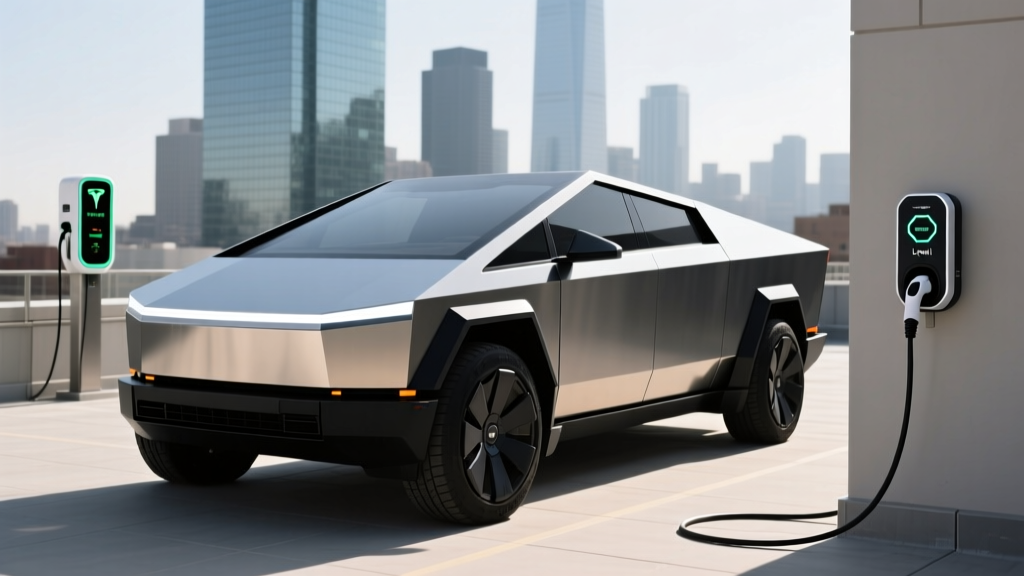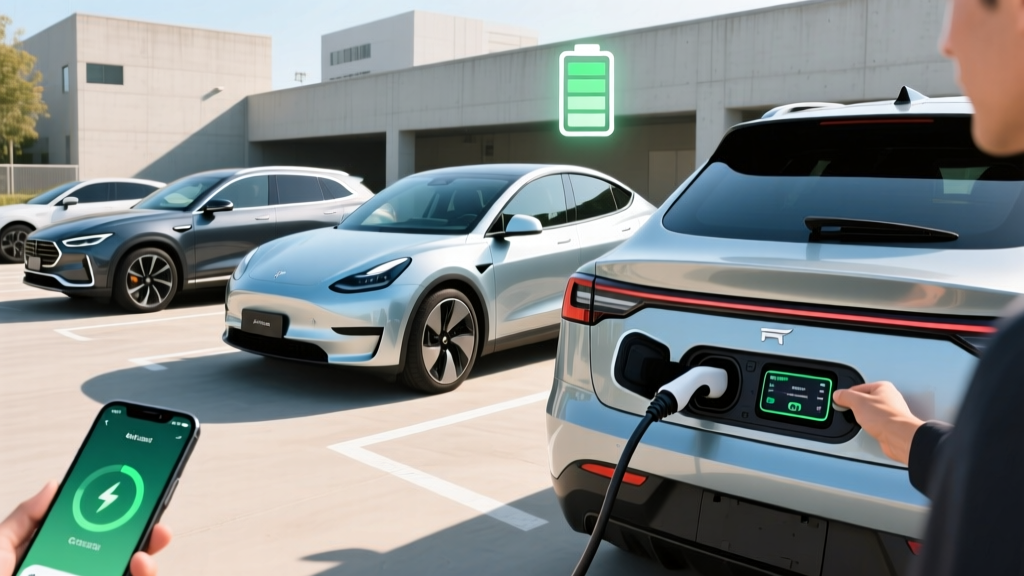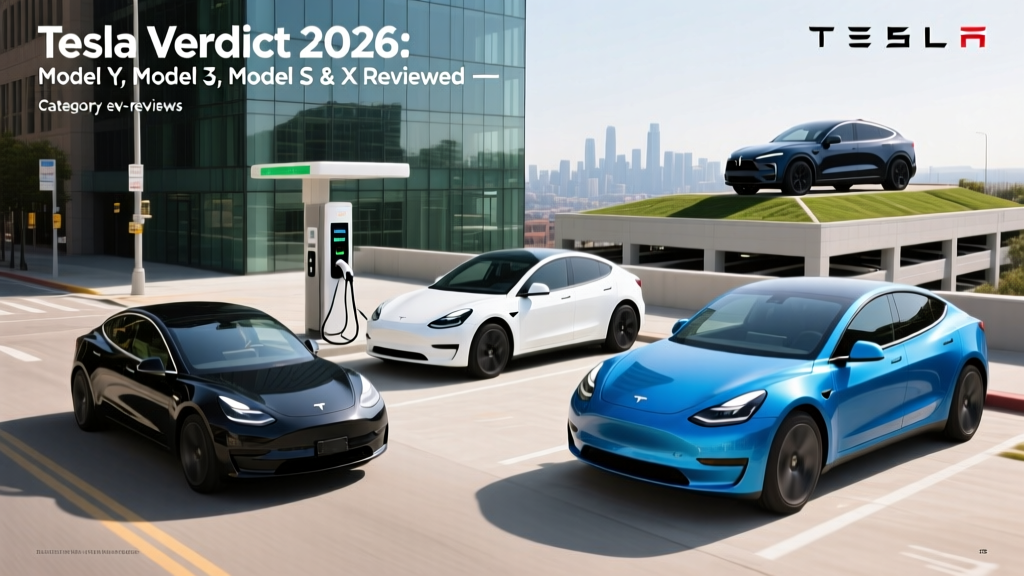
Tesla's 2026 lineup spans four core passenger vehicles, each occupying a distinct segment of the EV market. After extensive testing across trims, climates, and charging networks, we've distilled our Tesla verdict into the data that matters: real-world range versus EPA estimates, sustained DC fast-charge rates, total cost after federal incentives, and the ownership realities no spec sheet captures.
This profile covers the 2026 Model 3 (sedan), Model Y (compact SUV), Model S (luxury sedan), and Model X (luxury SUV). We tested Long Range and Performance variants where available, noting where LFP (lithium iron phosphate) and NMC (nickel manganese cobalt) battery chemistries affect daily usability.
2026 Tesla Lineup at a Glance
| Spec | Model 3 LR | Model Y LR | Model S LR | Model X LR |
|---|---|---|---|---|
| EPA Range | 363 mi | 320 mi | 402 mi | 335 mi |
| Battery (usable) | ~79 kWh (NMC) | ~78 kWh (NMC) | ~95 kWh (NMC) | ~95 kWh (NMC) |
| Max DC Charge | 250 kW | 250 kW | 250 kW | 250 kW |
| 10-80% DC Time | ~25 min | ~27 min | ~30 min | ~32 min |
| Level 2 Rate | 11.5 kW (~44 mi/hr) | 11.5 kW (~44 mi/hr) | 11.5 kW (~38 mi/hr) | 11.5 kW (~34 mi/hr) |
| 0-60 mph | 4.2 sec | 4.8 sec | 3.1 sec | 3.8 sec |
| Horsepower | 346 hp | 384 hp | 670 hp | 670 hp |
| Drivetrain | Dual Motor AWD | Dual Motor AWD | Dual Motor AWD | Dual Motor AWD |
| MPGe (combined) | 132 MPGe | 122 MPGe | 120 MPGe | 102 MPGe |
| Base MSRP | $47,740 | $50,240 | $84,990 | $94,990 |
Note: The Model 3 RWD base trim starts at $38,990 with a ~60 kWh LFP battery and 272 mi EPA range. Pricing excludes destination fees. Specs sourced from fueleconomy.gov and Tesla's official configurator.
Real-World Range: What the EPA Sticker Doesn't Tell You
EPA vs Reality: The Model 3 Long Range carries a 363-mile EPA estimate — among the highest of any mainstream EV. In our mixed driving tests (70°F, 70 mph highway cruise, moderate HVAC), we consistently achieved 320–340 miles before reaching 5% State of Charge. Push speeds to 80 mph or encounter 30°F winter temperatures, and expect 260–285 usable miles.
The Model Y Long Range (320 mi EPA) returned 280–300 miles in real-world mixed use, dropping to roughly 240 miles in sustained cold-weather highway driving. The Model S and X, with larger 95 kWh packs, are more resilient to cold-weather losses in percentage terms but still shed 15–20% at highway speeds in freezing conditions.
Tesla's thermal management system — including the octovalve heat pump introduced in the Highland/Juniper refreshes — significantly reduces cold-weather cabin-heating energy draw compared to resistive heaters. However, battery chemistry still dictates cold-range loss: NMC packs (used in all Long Range and Performance trims) lose roughly 15–25% range at 20°F, while the LFP pack in the Model 3 RWD can lose 25–35% under identical conditions due to LFP's lower cold-temperature conductivity.
For road trippers, the practical implication is planning 200–250 mile segments between Supercharger stops in winter, regardless of the 300+ mile EPA sticker. In mild weather with moderate speeds, 280–320 miles between stops is realistic for the Model 3 and Y.
Charging Speed: Supercharger Network Advantage
| Charging Level | Power / Rate | Miles Added per Hour | Notes |
|---|---|---|---|
| Level 1 (120V) | ~1.4 kW | ~4–5 mi/hr | Emergency/trickle only |
| Level 2 (240V, 48A) | 11.5 kW | 34–44 mi/hr | Home Wall Connector; full charge overnight |
| DC Fast (V3 Supercharger) | Peak 250 kW | ~170 mi in 15 min | Sustained rate tapers above 50% SoC |
| DC Fast (V4 Supercharger) | Peak 250 kW* | ~170 mi in 15 min | *Current Tesla vehicles cap at 250 kW; V4 hardware supports higher future rates |
All 2026 Teslas peak at 250 kW on V3 and V4 Superchargers. The critical nuance is the charge curve: the 250 kW peak only sustains from roughly 10% to 30% State of Charge (SoC). Between 30–50%, rates drop to ~180 kW; from 50–80%, expect 100–130 kW. This is why Tesla's 10–80% times (25–32 minutes depending on model) are substantially longer than the "170 miles in 15 minutes" marketing claim, which only applies to the initial low-SoC sprint.
Home charging at 11.5 kW (48 amps on a 60-amp circuit) adds roughly 44 miles of range per hour in the Model 3 — enough to fully replenish overnight for any daily commute. Installation of a Tesla Wall Connector typically costs $500–$1,500 for the unit and basic electrician labor, though panel upgrades (200A service) can add $1,500–$3,500 if your home's electrical panel is maxed out.
One ownership advantage unique to Tesla: the Supercharger network remains the most reliable and geographically dense DC fast-charging network in North America, with over 6,500 stalls in the US alone. Non-Tesla EVs now access Superchargers via NACS adapters, but Tesla owners still benefit from native plug-and-charge integration and automatic routing preconditioning.
Performance, Efficiency, and Daily Drivability
The Model 3 Long Range delivers 346 hp and a 4.2-second 0–60 time — brisk enough for any on-ramp merge and genuinely quick by any sedan standard. The Performance trim (not tested here) drops to 2.9 seconds with 510 hp. Handling benefits from a low center of gravity (battery pack under the floor) and a relatively light 4,034-lb curb weight for an AWD EV.
The Model Y Long Range is slightly heavier at ~4,400 lbs, yielding a 4.8-second 0–60 despite 384 hp. It rides higher and offers superior cargo utility, which is precisely why it remains the best-selling EV in the US.
The Model S and X share a 670 hp dual-motor setup. The Model S Plaid (1,020 hp, 1.99-second 0–60) exists in a performance category of its own, but at $108,490 it competes with exotic territory. For most buyers, the Long Range variants deliver the best value-to-range ratio.
Efficiency varies meaningfully across the lineup. The Model 3 LR achieves 132 MPGe combined (25 kWh/100 mi), making it one of the most efficient AWD EVs available. The Model X LR drops to 102 MPGe (33 kWh/100 mi) due to its 5,185-lb curb weight and less aerodynamic SUV profile. Over 12,000 annual miles, that efficiency gap translates to roughly $180/year in electricity cost difference at the national average of $0.17/kWh.
Pricing, Tax Credits, and Total Cost
| Model / Trim | Base MSRP | Federal Credit | Effective Price | Credit Eligible? |
|---|---|---|---|---|
| Model 3 RWD | $38,990 | $7,500 | ~$31,490 | Yes (LFP — sourcing dependent) |
| Model 3 Long Range | $47,740 | $7,500 | ~$40,240 | Yes (under $55K sedan cap) |
| Model Y Long Range | $50,240 | $7,500 | ~$42,740 | Yes (under $80K SUV cap) |
| Model S Long Range | $84,990 | $0 | $84,990 | No (exceeds $55K sedan MSRP cap) |
| Model X Long Range | $94,990 | $0 | $94,990 | No (exceeds $80K SUV MSRP cap) |
The IRS §30D federal tax credit provides up to $7,500 for qualifying new EVs, but eligibility hinges on three constraints that eliminate the Model S and X:
- MSRP Cap: Sedans must be under $55,000; SUVs, vans, and trucks under $80,000. This disqualifies both the Model S and Model X.
- Buyer Income Cap: Modified adjusted gross income must not exceed $150,000 (single), $225,000 (head of household), or $300,000 (joint). Higher earners are ineligible regardless of vehicle.
- Battery Sourcing: The full $7,500 requires meeting both critical-mineral ($3,750) and battery-component ($3,750) sourcing thresholds. Tesla's US-built NMC packs largely qualify, but LFP packs (Model 3 RWD) have faced partial-credit issues due to Chinese-sourced cathode materials. Verify current-year eligibility on the IRS qualified vehicle list before purchasing.
As of 2026, the §30D credit can be transferred to the dealer at point of sale, effectively reducing the purchase price upfront rather than waiting for a tax refund. This makes the Model 3 RWD at ~$31,490 and the Model Y LR at ~$42,740 among the most compelling value propositions in their respective segments.
Interior, Cargo, and Technology
The Model 3 Highland refresh brought meaningful interior upgrades: ventilated front seats, ambient lighting, rear-seat touchscreen, and significantly improved cabin noise insulation. Front legroom measures 42.7 inches; rear legroom is 35.3 inches — adequate for adults on shorter trips but tight for six-foot passengers on long drives. Cargo space totals 23 cu ft (trunk + frunk).
The Model Y Juniper update mirrors these improvements in a taller package. Cargo volume reaches 76 cu ft with rear seats folded — competitive with midsize gas SUVs. Rear legroom is a generous 40.5 inches, making it the clear family choice. The optional third row (very small, best for children) adds seating for seven but eliminates nearly all rear cargo space when deployed.
The Model S and X offer more premium materials, a 17-inch center touchscreen (vs. 15.4-inch in 3/Y), a yoke or round steering wheel option, and standard air suspension. The Model X's falcon-wing rear doors remain a polarizing feature — dramatic in tight parking spaces but adding mechanical complexity and occasional seal issues.
Standout Tech: Tesla's infotainment system remains the benchmark for responsiveness and over-the-air update frequency. The 15.4–17-inch displays handle navigation, media, and vehicle controls without lag. The Tesla app provides industry-leading remote preconditioning, charging monitoring, and Sentry Mode camera access.
Autopilot and FSD (Supervised): All Teslas ship with basic Autopilot (adaptive cruise + lane centering). Full Self-Driving (Supervised) is a $8,000 add-on or $99/month subscription that adds automated lane changes, traffic-light recognition, and city-street navigation assistance.
SAE Automation Level: Level 2. Both Autopilot and FSD (Supervised) are SAE Level 2 driver-assistance systems. The driver must remain fully engaged, hands on or near the wheel, and eyes on the road at all times. These are NOT self-driving systems. Tesla's camera-only vision approach (no LiDAR or radar in current vehicles) performs well in clear conditions but can struggle in heavy rain, construction zones, and faded lane markings.
What FSD Does NOT Do: FSD (Supervised) cannot navigate unmapped roads, handle all construction-zone configurations, or operate without driver supervision. NHTSA has investigated multiple Tesla Autopilot/FSD incidents. The driver is legally and practically responsible for all vehicle operation at all times.
Warranty and Long-Term Battery Outlook
Tesla provides an 8-year battery and drive-unit warranty across the lineup, with mileage limits varying by model:
- Model 3 / Model Y: 8 years / 100,000 miles (Long Range & Performance); 8 years / 120,000 miles (RWD — LFP chemistry carries a higher cycle-life rating)
- Model S / Model X: 8 years / 150,000 miles
The warranty guarantees the battery will retain at least 70% of its original capacity during the coverage period. In practice, Tesla's NMC packs have shown roughly 8–12% degradation over the first 100,000 miles based on fleet data aggregated by third-party sources, with degradation curves flattening significantly after the initial 20,000-mile break-in period.
The LFP pack in the Model 3 RWD offers a distinct longevity advantage: LFP chemistry tolerates repeated 100% charging without the accelerated degradation that NMC packs experience above 80% SoC. Tesla recommends daily charging to 100% for LFP vehicles — a practical benefit for owners who want maximum daily range without babying the battery. The trade-off is lower energy density (heavier pack, less range) and worse cold-weather performance.
Out-of-warranty battery replacement costs remain a concern for long-term ownership: approximately $12,000–$16,000 for Model 3/Y packs and $18,000–$22,000 for Model S/X, based on current service-center pricing. However, the vast majority of Tesla packs outlast their warranty periods without requiring full replacement.
Pros, Cons, and Our Tesla Verdict
Pros
- Supercharger network: still the most reliable DC fast-charging ecosystem in North America
- Class-leading efficiency (Model 3 at 132 MPGe) translates to lower per-mile electricity costs
- Over-the-air updates continuously add features — no dealer visits for software improvements
- Strong resale value relative to legacy-brand EVs
- Excellent real-world fast-charging infrastructure integration (automatic preconditioning, plug-and-charge)
- Model 3/Y qualify for full $7,500 federal tax credit (income and sourcing permitting)
Cons
- Minimalist interior lacks physical controls — all climate, mirror, and glovebox adjustments go through the touchscreen
- No Apple CarPlay or Android Auto integration
- Build quality, while improved, still shows occasional panel-gap inconsistencies vs. German/Japanese competitors
- FSD (Supervised) remains Level 2 despite its name and $8,000 price tag — value proposition is debatable
- Model S and X are ineligible for federal tax credit due to MSRP caps
- Camera-only vision system can struggle in adverse weather where LiDAR-equipped competitors maintain performance
Who Should Buy a Tesla in 2026?
Choose the Model 3 RWD if: You want the lowest entry price (~$31,490 after credit), commute under 50 miles daily, and can charge at home. The LFP battery rewards daily 100% charging with exceptional longevity.
Choose the Model 3 Long Range if: You regularly drive 200+ miles between charges, take road trips, or live in a cold-weather state where the NMC pack's better cold performance matters.
Choose the Model Y Long Range if: You need SUV cargo space, rear-seat room for children or adults, and the versatility of a hatchback. This is the default family EV recommendation for good reason — 76 cu ft cargo, 320-mile EPA range, and Supercharger access.
Choose the Model S or X if: Budget is not a primary constraint, you want premium luxury with 400+ mile range (Model S), or need the Model X's falcon-wing doors and optional third row. Understand that you forfeit the $7,500 federal credit and pay a significant premium over the 3/Y for incremental comfort and performance.
Look elsewhere if: You require Apple CarPlay/Android Auto, prefer physical buttons and knobs, want LiDAR-based driver assist (GM Super Cruise, certain Mercedes systems), or need a truck bed (consider the Cybertruck or Rivian R1T).
Frequently Asked Questions
What is the real-world range of a 2026 Tesla?
Real-world range depends on model, trim, speed, and temperature. The Model 3 Long Range (363 mi EPA) delivers 320–340 miles in mild-weather mixed driving, dropping to 260–285 miles at highway speeds in freezing conditions. The Model Y LR (320 mi EPA) returns 280–300 miles in similar mixed use. Plan for 200–250 mile charging segments on winter road trips.
How fast does a Tesla charge at home and on the road?
At home on a Level 2 Wall Connector (11.5 kW / 48A), a Tesla adds 34–44 miles of range per hour — a full overnight charge for any model. On a V3 or V4 Supercharger, Teslas peak at 250 kW, adding up to 170 miles in 15 minutes at low SoC. A realistic 10–80% session takes 25–32 minutes depending on the model, with charge rates tapering significantly above 50% SoC.
How much does a Tesla cost after federal tax credits?
The Model 3 RWD drops to approximately $31,490 after the $7,500 §30D credit. The Model 3 Long Range falls to ~$40,240, and the Model Y Long Range to ~$42,740. The Model S ($84,990) and Model X ($94,990) do not qualify due to MSRP caps. All credit eligibility depends on buyer income limits ($150K single / $300K joint) and battery-sourcing requirements — verify on the IRS qualified vehicle list.
Is a Tesla worth buying versus key competitors?
For buyers who prioritize charging infrastructure, software integration, and efficiency, the Model 3 and Y remain segment benchmarks. The Hyundai Ioniq 5 and Kia EV6 offer 800V architecture (faster 10–80% charging at compatible stations) and physical controls. The Ford Mustang Mach-E provides a more traditional interior layout. However, Tesla's Supercharger network and OTA update cadence remain difficult to match. The Model S and X face stiffer competition from the Lucid Air (superior range) and BMW iX (more luxurious interior) in their price brackets.
Does a 2026 Tesla qualify for the federal EV tax credit?
The Model 3 (all trims) and Model Y (all trims) qualify for up to $7,500 under IRS §30D, provided the buyer meets income caps and the vehicle's battery meets critical-mineral and component-sourcing thresholds. The Model S and Model X exceed MSRP caps and are not eligible. The credit can be transferred to the dealer at point of sale as an upfront price reduction. Always confirm current eligibility on irs.gov before purchasing, as sourcing requirements tighten annually.
What are the biggest pros and cons of owning a Tesla?
The top advantages are Supercharger access, class-leading efficiency, continuous OTA improvements, strong resale value, and low per-mile fuel costs. The main drawbacks are the touchscreen-only interface (no physical buttons), absence of Apple CarPlay/Android Auto, FSD's high cost relative to its Level 2 capabilities, and occasional build-quality inconsistencies. Insurance premiums also tend to run 15–30% higher than comparable non-Tesla EVs due to repair costs.