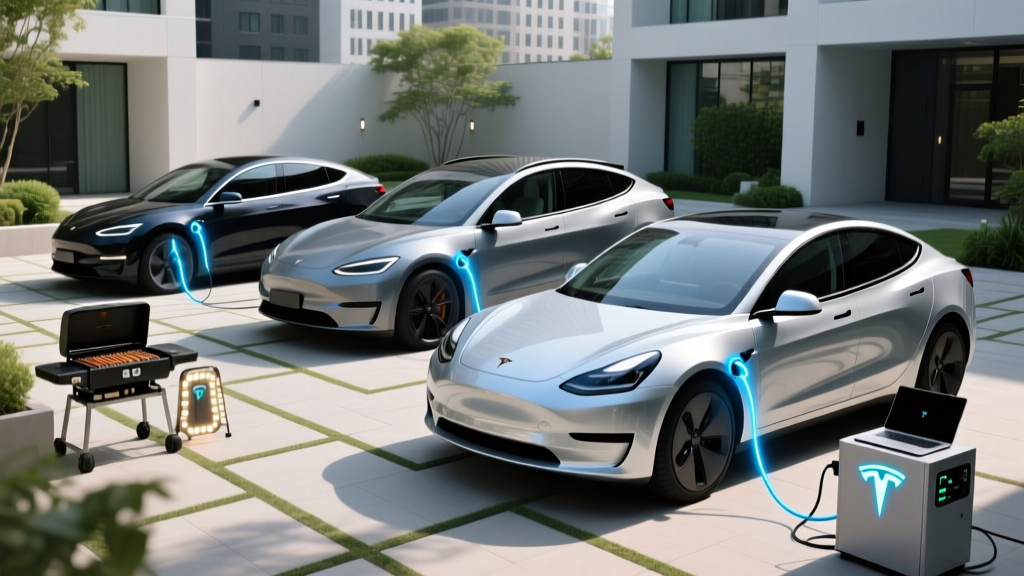
Search forums, Reddit threads, or EV Facebook groups for "tesla vehicle to load" and you will find a recurring question: Can I plug appliances, power tools, or my house into a Tesla? The short answer is yes — but only on specific models, with specific hardware, and with major caveats compared to the V2L (Vehicle-to-Load) systems offered by Hyundai, Kia, Ford, and Rivian.
This guide breaks down exactly which 2026 Tesla models support bidirectional power, what you can realistically run, how Tesla's approach differs from the rest of the industry, and whether it should influence your next EV purchase.
What Is Vehicle-to-Load (V2L) and Why Tesla Was Late
Vehicle-to-Load (V2L) allows an EV's high-voltage traction battery to supply AC power through standard outlets, effectively turning the car into a mobile generator. Competitors like the Hyundai Ioniq 5, Kia EV6, Ford F-150 Lightning, and Rivian R1T have offered built-in 120V/240V outlets for years. The Hyundai Ioniq 5, for example, provides up to 3.6 kW through its internal V2L outlet and external adapter.
Tesla resisted adding V2L for a straightforward engineering reason: bidirectional power flow requires additional onboard inverter hardware, added weight, and thermal management that Tesla's early vehicle architectures (Model S, Model 3, Model X, Model Y) were not designed to accommodate. Tesla's strategy instead centered on stationary storage — the Powerwall — paired with solar, keeping the vehicle's role strictly transportation.
That changed with the Cybertruck.
Cybertruck PowerShare: Tesla's True V2L System
The Tesla Cybertruck, which began deliveries in late 2023 and continues into the 2026 model year, is the first and currently only Tesla vehicle with a genuine V2L system. Tesla calls it PowerShare.
PowerShare Specifications
| Feature | Specification |
|---|---|
| Bed Outlets (120V) | Up to 9.6 kW total across multiple outlets |
| Cabin Outlets (120V) | Up to 2.4 kW (standard 15A/120V household outlet) |
| Vehicle-to-Home (V2H) | Up to 11.5 kW continuous with PowerShare Home adapter |
| Battery Capacity | ~123 kWh usable (est., NMC chemistry) |
| Max Continuous Draw | 11.5 kW (V2H); 9.6 kW (bed outlets combined) |
At 9.6 kW from the bed outlets, the Cybertruck can simultaneously run a miter saw (15A / ~1,800W), a portable air compressor (~1,500W), multiple LED work lights, and a laptop charger without tripping the system. At 11.5 kW in V2H mode, it can sustain essential home circuits — refrigerator, furnace fan, lights, Wi-Fi, and a well pump — for multiple days during an outage.
PowerShare Home Adapter
To enable V2H (Vehicle-to-Home) functionality, Tesla sells the PowerShare Home adapter (approximately $3,000 installed, pricing varies by electrical complexity). This unit connects to your home's main electrical panel through a transfer switch or a dedicated subpanel, allowing the Cybertruck to backfeed your house during grid outages. This requires installation by a licensed electrician and may require a panel upgrade depending on your home's existing service.
Which Tesla Models Do NOT Support V2L
As of the 2026 model year, the following Tesla vehicles do not support vehicle-to-load power output:
- Model 3 (all trims including Highland refresh) — No bidirectional capability
- Model Y (all trims including Juniper refresh) — No bidirectional capability
- Model S (Plaid and Long Range) — No bidirectional capability
- Model X (Plaid and Long Range) — No bidirectional capability
These vehicles can charge from the grid and from solar via a Wall Connector, but they cannot export power to devices or your home. The 12V auxiliary system and USB ports power small electronics, but there is no pathway from the high-voltage traction battery to an external AC outlet.
If V2L is a non-negotiable feature for your use case — job-site power, tailgating, or home backup — and you want to stay in the Tesla ecosystem, the Cybertruck is currently your only option.
Cybertruck Full Spec Overview
Since the Cybertruck is the sole Tesla with V2L, here is the complete spec profile for the 2026 model year.
| Specification | AWD | Cyberbeast |
|---|---|---|
| EPA Range | 340 miles | 320 miles |
| Battery (Usable) | ~123 kWh (NMC) | ~123 kWh (NMC) |
| Max DC Fast Charge | ~250 kW (Supercharger V3/V4) | ~250 kW (Supercharger V3/V4) |
| 10-80% DC Charge Time | ~30 minutes | ~30 minutes |
| Level 2 Home Charging | ~11.5 kW / ~37 mi/hr | ~11.5 kW / ~37 mi/hr |
| 0-60 mph | 4.1 seconds | 2.6 seconds |
| Horsepower | 600 hp | 845 hp |
| Drivetrain | Dual-Motor AWD | Tri-Motor AWD |
| MPGe (Combined) | ~70 MPGe (est.) | ~65 MPGe (est.) |
| Towing Capacity | 11,000 lbs | 11,000 lbs |
| Cargo (Bed) | ~67 cu ft (vault) | ~67 cu ft (vault) |
| Base MSRP | $79,990 | $99,990 |
Pricing, Tax Credits, and Total Cost
| Cost Factor | AWD | Cyberbeast |
|---|---|---|
| Base MSRP | $79,990 | $99,990 |
| Destination Fee | $1,995 | $1,995 |
| Federal §30D Tax Credit | $0 (exceeds MSRP cap) | $0 (exceeds MSRP cap) |
| Estimated Out-the-Door | ~$82,000+ | ~$102,000+ |
PowerShare Home Installation Cost
If you plan to use the Cybertruck for home backup, budget for the PowerShare Home adapter and electrical work:
| Item | Estimated Cost |
|---|---|
| PowerShare Home Adapter Unit | $2,000 - $2,500 |
| Electrician (Transfer Switch / Subpanel) | $1,500 - $4,000 |
| Electrical Panel Upgrade (if needed, 200A) | $2,000 - $5,000 |
| Permits & Inspection | $200 - $600 |
| Total Estimated Install | $3,700 - $12,100 |
Warranty Coverage
Tesla provides the following warranty coverage for the 2026 Cybertruck:
- Basic Vehicle Limited Warranty: 4 years / 50,000 miles
- Battery & Drive Unit Warranty: 8 years / 120,000 miles (whichever comes first), with minimum 70% capacity retention guaranteed over the warranty period
- PowerShare Components: Covered under the basic vehicle warranty; confirm with Tesla whether PowerShare Home adapter is covered separately
The 8-year/120,000-mile battery warranty is competitive with the industry standard. However, note that using PowerShare for frequent deep discharges (e.g., daily home backup cycling) may accelerate degradation. Tesla's warranty guarantees 70% capacity retention, but frequent bidirectional cycling adds charge-discharge cycles beyond normal driving use. Tesla has not published specific guidance on how PowerShare usage affects warranty claims — ask your service advisor before relying on it as a daily backup solution.
Tesla vs. Competitors: V2L Compared
| Vehicle | V2L Outlet Power | V2H Support | Starting MSRP | Federal Credit |
|---|---|---|---|---|
| Tesla Cybertruck | 9.6 kW (bed) / 11.5 kW (V2H) | Yes (with adapter) | $79,990 | No (MSRP cap) |
| Ford F-150 Lightning | 9.6 kW (Pro Power Onboard) | Yes (with Home Integration System) | ~$55,000 | Yes (if eligible) |
| Rivian R1T | ~6.6 kW (bed outlets) | No (as of 2026) | ~$75,000 | Partial (varies by trim) |
| Hyundai Ioniq 5 | 3.6 kW (V2L adapter/outlet) | No | ~$42,000 | No (not N. American assembled) |
| Kia EV6 | 3.6 kW (V2L adapter) | No | ~$43,000 | No (not N. American assembled) |
The Ford F-150 Lightning remains the strongest competitor for buyers who need V2L/V2H at a lower price point and with federal tax credit eligibility. The Lightning's Pro Power Onboard system offers comparable 9.6 kW output, and with the Charge Station Pro and Home Integration System (~$3,800 installed), it can backfeed your home similarly to the Cybertruck — at roughly $25,000 less in starting MSRP.
Where the Cybertruck wins: raw battery capacity (~123 kWh vs. the Lightning's ~131 kWh Extended Range, which is comparable) and the Tesla Supercharger network advantage for road trips. Where it loses: price, tax credit eligibility, and the fact that you must buy a $80,000+ truck to get a feature that Ford offers on a $55,000 work truck.
Who Should Buy the Cybertruck for V2L
The Cybertruck PowerShare is ideal if you:
- Need job-site power for construction, contracting, or film production and want to eliminate a gas generator
- Live in an area with frequent multi-day power outages and want home backup without buying a separate Powerwall
- Are already committed to the Tesla ecosystem (Superchargers, app, solar/Powerwall) and want V2L integrated
- Want a high-performance electric truck (2.6s 0-60 Cyberbeast) that also serves as a mobile power station
Look elsewhere if you:
- Want V2L at the lowest possible price — the F-150 Lightning or even a used Ioniq 5 with a V2L adapter costs far less
- Need the federal §30D tax credit — the Cybertruck's MSRP disqualifies it
- Primarily need V2L for camping or tailgating — the 3.6 kW V2L on an Ioniq 5 or EV6 is sufficient for portable fridges, lights, and a grill, at half the vehicle price
- Want a conventional truck bed — the Cybertruck's vault design and tonneau cover limit some traditional truck use cases
Pros and Cons
Pros
- Class-leading 9.6 kW bed output; 11.5 kW V2H with adapter
- Massive ~123 kWh battery provides extended backup runtime
- Integrated Tesla app monitoring of power export
- 11,000-lb towing capacity with electric torque
- Supercharger network access for road trips
- Stainless steel exoskeleton — no paint to chip on job sites
Cons
- $80,000+ starting price — most expensive V2L vehicle available
- No federal tax credit eligibility (MSRP cap exceeded)
- Real-world range ~260-290 mi highway, well below EPA 340 mi
- PowerShare Home adapter adds $3,700-$12,100 to total cost
- Only Tesla model with V2L — no sedan/SUV option
- Polarizing design limits resale appeal for some buyers
- No NACS adapter needed (native), but Supercharger-only limits some rural DC routes
Frequently Asked Questions
Can a Tesla Model 3 or Model Y power my home during an outage?
No. The Model 3 and Model Y do not have bidirectional charging capability. They cannot export power from the traction battery to external devices or your home. Only the Cybertruck supports this through PowerShare.
Can I use a third-party inverter to get V2L from my Tesla Model Y?
Not safely or without voiding your warranty. Connecting an aftermarket inverter to the high-voltage battery bypasses Tesla's BMS protections and creates serious fire, shock, and warranty-voidance risks. Some owners have jury-rigged 12V inverters for very low-power applications (~150W), but this is not true V2L and is not recommended.
How does Tesla PowerShare compare to Ford's Pro Power Onboard?
Both systems deliver up to 9.6 kW through bed outlets and support home backup at up to ~11.5 kW with their respective home integration hardware. The key difference is price: the F-150 Lightning starts around $55,000 and qualifies for the federal tax credit, while the Cybertruck starts at $79,990 and does not. For pure V2L utility per dollar, the Lightning is the more practical choice.
Will Tesla add V2L to the Model Y or a future SUV?
Tesla has not announced V2L for any vehicle beyond the Cybertruck as of early 2026. The next-generation platform (sometimes referred to as the "Model 2" or "Redwood") may include bidirectional capability, but this is unconfirmed. If V2L is a priority, do not wait — buy a Cybertruck or look at competitors now.
Does using PowerShare degrade my Cybertruck battery faster?
Every charge-discharge cycle contributes to battery wear. If you use PowerShare for daily home backup (deep cycling the battery regularly), you will accumulate cycles faster than driving alone. However, occasional use during outages or on job sites is unlikely to meaningfully impact long-term battery health within the 8-year/120,000-mile warranty window. Tesla has not published specific cycle-life data for PowerShare usage.
Does the Cybertruck qualify for any state or utility incentives?
While it does not qualify for the federal §30D credit, some states and utilities offer separate EV purchase rebates or time-of-use rate discounts for V2H-capable vehicles. These vary significantly by jurisdiction. Check your state's energy office and local utility for current programs — and consult a tax professional for eligibility.